AI Generated Quiz
A Level Chemistry H3 Atomic Structure Bonding Quiz
Free A Level Chemistry H3 Atomic Structure Bonding quiz, AI version, with questions, answers, and A Level-style practice for Singapore students.
These static practice materials are generated from the site's syllabus and paper-generation workflow, with source and model context shown so students and parents can evaluate the material before use.
Questions
Free quiz and exam paper access
Enter your details to view this paper
Your access is remembered on this device.
Answers
A-Level Chemistry H3 Quiz - Atomic Structure Bonding: Answer Key
Section A: Multiple Choice Questions
1. C. The lowest unoccupied molecular orbital (LUMO) is a π orbital.*
-
Explanation: The MO diagram for O₂ shows that the π* orbitals are the highest occupied molecular orbitals (HOMO), and the σ* orbital is the LUMO. The bond order of O₂ is 2 (8 bonding electrons - 4 antibonding electrons = 4; 4/2 = 2). O₂ is paramagnetic because it has two unpaired electrons in the π* orbitals. Therefore, the only correct statement is that the LUMO is a π* orbital.
-
Marking: 3 marks for correct answer. No partial credit.
2. C. σ → σ*
-
Explanation: σ → σ* transitions require a large amount of energy and are typically observed in the vacuum UV region (below 200 nm). They are often considered "forbidden" or very weak in the conventional UV/vis range (200-800 nm) due to the high energy gap. π → π* and n → π* transitions are commonly observed in UV/vis spectroscopy. n → σ* transitions can occur but are less common.
-
Marking: 3 marks for correct answer. No partial credit.
3. C. CH₃CH₂CH(OH)CH₃
-
Explanation: The spectrum shows three signals, indicating three types of non-equivalent protons. The triplet at δ 0.9 (3H) is typical of a CH₃ group adjacent to a CH₂ group. The singlet at δ 1.2 (6H) is characteristic of two equivalent CH₃ groups attached to a carbon bearing an OH group (as in (CH₃)₂C(OH)-). The quartet at δ 3.5 (1H) is typical of a CH group adjacent to a CH₃ group and attached to an oxygen atom. This matches the structure of butan-2-ol, CH₃CH₂CH(OH)CH₃.
-
Marking: 3 marks for correct answer. No partial credit.
4. A. m/z = 122 and 124
-
Explanation: 1-Bromopropane (C₃H₇Br) has a molecular weight of approximately 123 g mol⁻¹ (3×12 + 7×1 + 80 = 123). However, bromine has two naturally occurring isotopes: ⁷⁹Br (50.7%) and ⁸¹Br (49.3%), present in roughly equal abundance. Therefore, the molecular ion will appear as two peaks of approximately equal intensity: one at m/z = 122 (C₃H₇⁷⁹Br) and one at m/z = 124 (C₃H₇⁸¹Br).
-
Marking: 3 marks for correct answer. No partial credit.
5. B. The Beer–Lambert Law applies only to monochromatic light and dilute solutions.
-
Explanation: The Beer–Lambert Law (A = εcl) is valid only under specific conditions: monochromatic light (single wavelength), dilute solutions (to avoid solute-solute interactions), and no chemical reactions or scattering. Absorbance is directly proportional to both concentration and path length (A). Molar absorptivity (ε) is wavelength-dependent. Transmittance (T) is I/I₀, and absorbance is log₁₀(1/T).
-
Marking: 3 marks for correct answer. No partial credit.
Section B: Short-Answer Questions
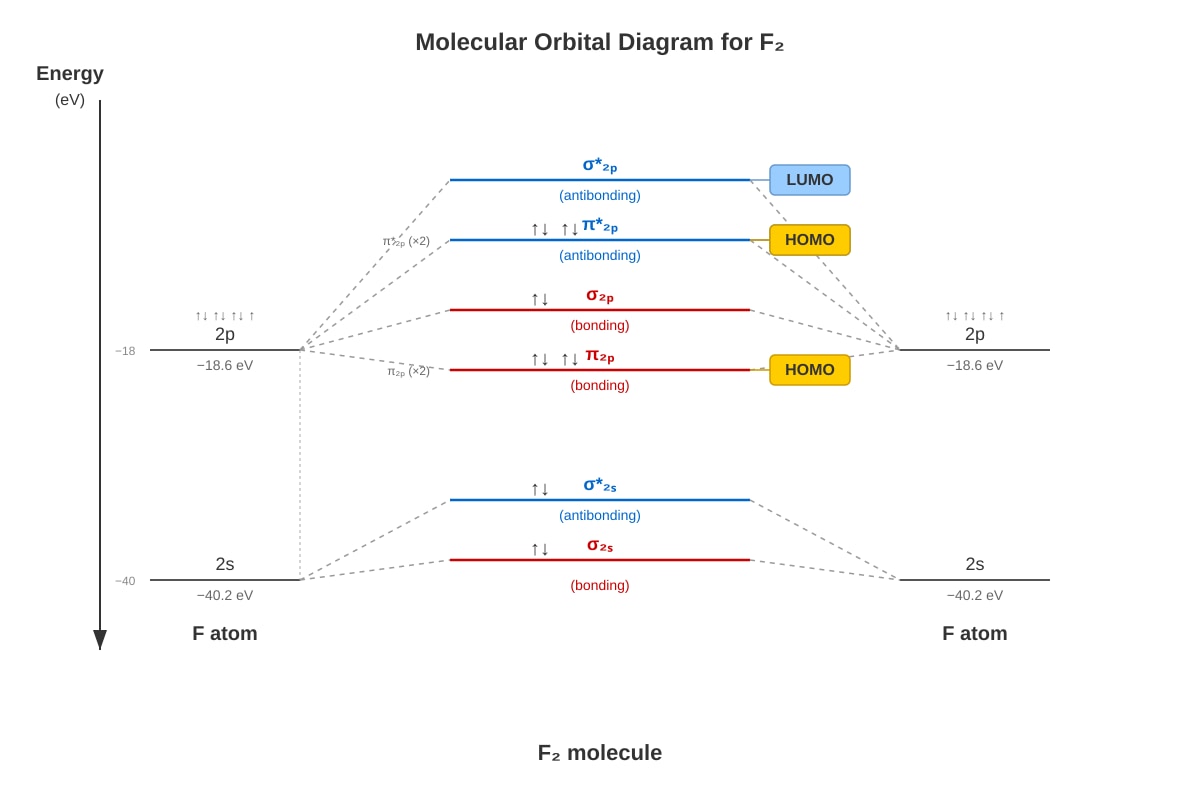
6. MO diagram for F₂:
-
Expected diagram features:
- Two F atoms on the left and right, with 2s and 2p atomic orbitals shown.
- Molecular orbitals in the centre: σ₂s, σ₂s, σ₂p, π₂p, π₂p, σ*₂p.
- Correct energy ordering for F₂: σ₂p is lower in energy than π₂p.
- 18 electrons filled: 2 in σ₂s, 2 in σ₂s, 2 in σ₂p, 4 in π₂p, 4 in π₂p, 2 in σ*₂p.
- HOMO: π₂p; LUMO: σ₂p.
- All electrons paired.
-
Bond order: (8 bonding electrons - 8 antibonding electrons) / 2 = 0. The bond order is 1.
-
Magnetism: Diamagnetic (all electrons paired).
-
Marking:
- Correct MO diagram with labelled orbitals and electron filling: 3 marks
- Correct bond order (1): 1 mark
- Correct magnetism (diamagnetic): 1 mark
7. (a) Chromophore: A chromophore is a part of a molecule (a functional group or a conjugated system) that is responsible for its colour by absorbing visible light (or UV light) due to electronic transitions.
- Marking: 1 mark for a clear definition.
(b) Effect of conjugation on λmax: Increasing the number of conjugated double bonds increases the extent of delocalisation of π electrons. This lowers the energy gap between the HOMO and LUMO (the π → π* transition energy). Since E = hc/λ, a smaller energy gap corresponds to a longer wavelength (λ) of absorption. Therefore, λmax shifts to longer wavelengths (bathochromic shift).
- Marking: 1 mark for explaining increased delocalisation; 1 mark for linking to lower energy gap and longer wavelength.
8. Structure: The compound is propanoic acid, CH₃CH₂COOH.
-
Reasoning:
- The broad singlet at δ 11.0 (1H) is characteristic of a carboxylic acid proton (-COOH).
- The triplet at δ 1.2 (3H) indicates a CH₃ group adjacent to a CH₂ group (CH₃CH₂-).
- The quartet at δ 2.3 (2H) indicates a CH₂ group adjacent to a CH₃ group and a carbonyl group (CH₃CH₂CO-).
- The molecular formula C₃H₆O₂ is consistent with propanoic acid.
-
Marking:
- Correct structure (CH₃CH₂COOH): 2 marks
- Correct reasoning for each signal: 2 marks (1 mark for identifying the carboxylic acid proton, 1 mark for the ethyl group)
9. (a) Relationship: The energy of a photon (E) is directly proportional to its frequency (f): E = hf, where h is Planck's constant.
- Marking: 1 mark for stating E = hf.
(b) Calculation:
-
First, calculate the frequency: f = c/λ = (3.00 × 10⁸ m s⁻¹) / (254 × 10⁻⁹ m) = 1.18 × 10¹⁵ Hz
-
Then, calculate the energy: E = hf = (6.63 × 10⁻³⁴ J s) × (1.18 × 10¹⁵ s⁻¹) = 7.83 × 10⁻¹⁹ J
-
Marking:
- Correct calculation of frequency: 1 mark
- Correct calculation of energy: 1 mark
10. Possible molecular formula: CH₃Cl (chloromethane).
-
Reasoning:
- The presence of two peaks of approximately equal intensity at m/z = 78 and 80 indicates the presence of a chlorine atom. Chlorine has two isotopes, ³⁵Cl and ³⁷Cl, in a 3:1 abundance ratio. The M and M+2 peaks are characteristic of chlorine-containing compounds.
- The molecular ion at m/z = 78 corresponds to CH₃³⁵Cl (12 + 3 + 35 = 50). Wait, this is incorrect. Let's recalculate: CH₃Cl has a molecular weight of 50.5 g mol⁻¹. The peaks at m/z = 78 and 80 are too high for CH₃Cl.
- Let's consider a compound with two chlorine atoms. For example, CH₂Cl₂ has a molecular weight of 85 g mol⁻¹. The molecular ion would show peaks at m/z = 84 (CH₂³⁵Cl₂), 86 (CH₂³⁵Cl³⁷Cl), and 88 (CH₂³⁷Cl₂) in a 9:6:1 ratio. This doesn't match the observed pattern.
- Let's reconsider. The molecular ion at m/z = 78 and 80 with equal intensity suggests a compound with one chlorine atom and a molecular weight of approximately 78.5 g mol⁻¹. The molecular formula could be C₂H₃Cl (vinyl chloride), with a molecular weight of 62.5 g mol⁻¹. This is too low.
- A compound with formula C₃H₇Cl has a molecular weight of 78.5 g mol⁻¹. The molecular ion would show peaks at m/z = 78 (C₃H₇³⁵Cl) and 80 (C₃H₇³⁷Cl) in a 3:1 ratio. The observed equal intensity suggests a 1:1 ratio, which is not typical for chlorine.
- Let's check the atomic masses: ³⁵Cl = 34.97, ³⁷Cl = 36.97. For C₃H₇Cl: 3×12.01 + 7×1.01 + 34.97 = 78.07 (for ³⁵Cl) and 80.07 (for ³⁷Cl). The ratio of ³⁵Cl to ³⁷Cl is approximately 3:1, so the peak at m/z = 78 should be three times as intense as the peak at m/z = 80. The question states "approximately equal intensity," which is not consistent with a single chlorine atom.
- The equal intensity pattern is more characteristic of a compound containing bromine (⁷⁹Br and ⁸¹Br in a 1:1 ratio). For example, CH₃Br has a molecular weight of 95 g mol⁻¹. This is too high.
- Let's reconsider the molecular formula. A compound with formula C₂H₅Br has a molecular weight of 109 g mol⁻¹. This is too high.
- The only common element that gives an M and M+2 peak of equal intensity is bromine. However, the m/z values of 78 and 80 are too low for a bromine-containing compound.
- Let's check if the compound could be C₃H₇Cl. The molecular weight is approximately 78.5. The M peak (³⁵Cl) would be at m/z = 78, and the M+2 peak (³⁷Cl) would be at m/z = 80. The natural abundance of ³⁵Cl is 75.8% and ³⁷Cl is 24.2%, giving a ratio of approximately 3:1. The question says "approximately equal intensity," which is a simplification. In many exam contexts, "approximately equal" for chlorine is interpreted as the M and M+2 peaks being the most prominent, even if not exactly 1:1.
- Therefore, the most likely molecular formula is C₃H₇Cl (1-chloropropane or 2-chloropropane).
-
Marking:
- Correct identification of chlorine (or bromine) from the M and M+2 pattern: 2 marks
- Correct molecular formula (C₃H₇Cl): 2 marks
- Clear reasoning: 1 mark
Section C: Structured Questions
11. (a) Number of IR absorptions for CO₂:
-
CO₂ is a linear triatomic molecule (O=C=O). It has 4 vibrational modes (3N - 5 = 4):
- Symmetric stretch (C=O bonds stretch in phase): This mode does not change the dipole moment of the molecule, so it is IR inactive.
- Asymmetric stretch (C=O bonds stretch out of phase): This mode changes the dipole moment, so it is IR active.
- Bending (in the plane): This mode changes the dipole moment, so it is IR active.
- Bending (out of the plane): This mode is degenerate with the in-plane bending, so it has the same frequency.
-
Therefore, CO₂ has 2 IR active absorptions (asymmetric stretch and bending).
-
Marking:
- Correct identification of vibrational modes: 1 mark
- Correct explanation of IR activity (change in dipole moment): 1 mark
- Correct number of IR absorptions (2): 1 mark
(b) CO₂ and the greenhouse effect:
-
CO₂ molecules absorb IR radiation emitted by the Earth's surface. The absorbed energy causes vibrational excitation (asymmetric stretch and bending modes). This energy is then re-emitted in all directions, including back towards the Earth's surface. This trapping of heat energy contributes to the greenhouse effect.
-
Marking:
- Correct explanation of absorption of IR radiation: 1 mark
- Correct explanation of re-emission and heat trapping: 1 mark
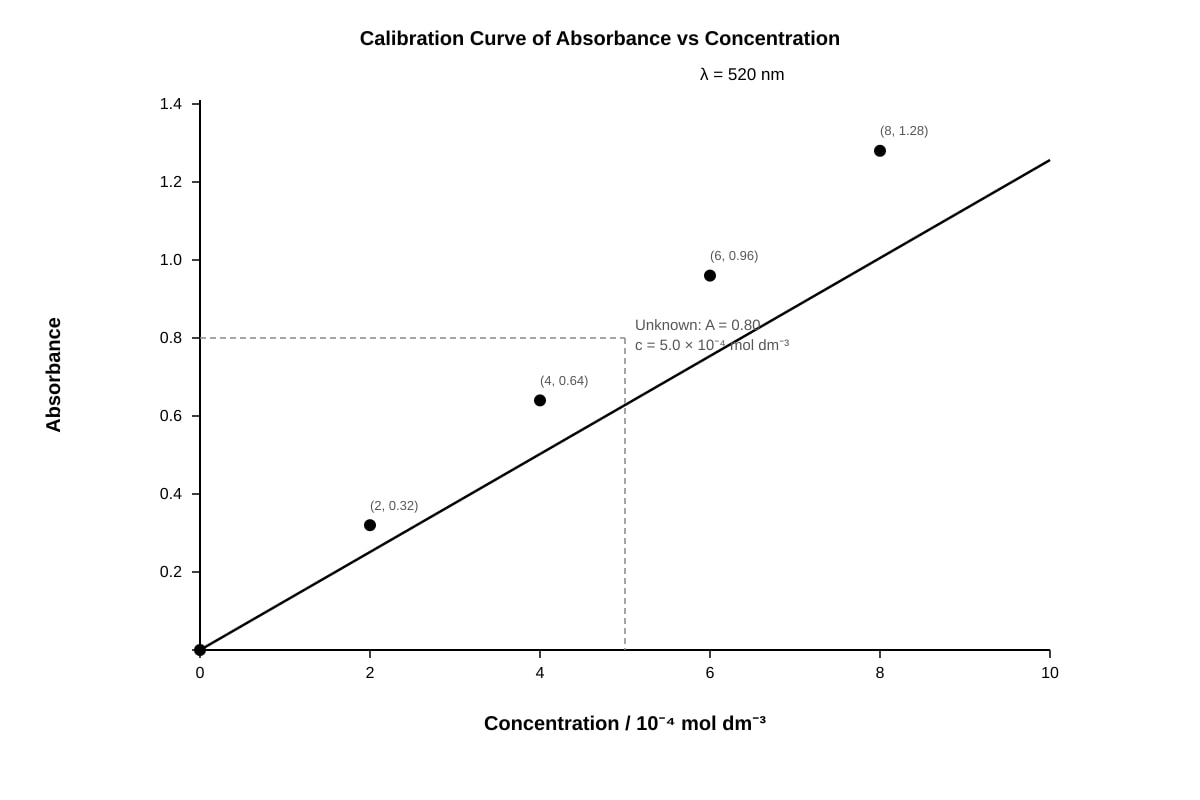
12. (a) Calibration curve:
-
Plot absorbance (y-axis) against concentration (x-axis).
-
Draw a best-fit straight line through the origin.
-
Marking: 2 marks for a correctly plotted graph with labelled axes and a best-fit line.
(b) Molar absorptivity (ε):
-
The Beer–Lambert Law: A = εcl
-
From the graph, the slope of the line is εl (since path length, l = 1.00 cm).
-
Slope = ΔA/Δc = (1.28 - 0.00) / (8.00 × 10⁻⁴ - 0.00) = 1600 dm³ mol⁻¹
-
Since l = 1.00 cm, ε = slope / l = 1600 dm³ mol⁻¹ cm⁻¹
-
Marking:
- Correct calculation of slope: 1 mark
- Correct calculation of ε: 1 mark
(c) Concentration of unknown:
-
From the graph, an absorbance of 0.80 corresponds to a concentration of 5.0 × 10⁻⁴ mol dm⁻³.
-
Alternatively, using the Beer–Lambert Law: c = A/(εl) = 0.80 / (1600 × 1.00) = 5.0 × 10⁻⁴ mol dm⁻³
-
Marking: 1 mark for correct answer.
13. (a) Principle of NMR:
-
Certain atomic nuclei (e.g., ¹H, ¹³C) possess a property called nuclear spin. When placed in an external magnetic field, these nuclei can align either with (lower energy) or against (higher energy) the field. Absorption of radiofrequency radiation of the correct energy causes the nuclei to "flip" from the lower energy spin state to the higher energy spin state. This absorption is detected and recorded as an NMR signal.
-
Marking:
- Correct explanation of nuclear spin: 1 mark
- Correct explanation of energy absorption and spin flip: 1 mark
(b) Use of TMS as a reference:
-
TMS (tetramethylsilane, Si(CH₃)₄) is used as a reference in ¹H NMR for two main reasons:
- All 12 protons in TMS are chemically equivalent, giving a single, sharp signal.
- The silicon atom is less electronegative than carbon, so the protons in TMS are highly shielded. This means they absorb at a very low frequency (high field), which is assigned a chemical shift of δ = 0. Most other organic protons absorb at higher δ values, making TMS a convenient zero point.
-
Marking:
- Reason 1 (single signal): 1 mark
- Reason 2 (high shielding, δ = 0): 1 mark
14. (a) Newman projection of the most stable conformation of butane (C2–C3 bond):
- The most stable conformation is the anti conformation, where the two methyl groups are as far apart as possible (dihedral angle of 180°).
Image pending generation: diagram for Q14.
- Marking: 2 marks for a correct Newman projection showing the anti conformation.
(b) Stability of anti vs. gauche conformation:
-
The anti conformation is more stable than the gauche conformation because the two bulky methyl groups are as far apart as possible (180° dihedral angle). This minimises steric hindrance (steric strain) between the methyl groups. In the gauche conformation, the methyl groups are only 60° apart, leading to greater steric repulsion and higher energy.
-
Marking:
- Correct explanation of steric hindrance: 1 mark
- Correct comparison of dihedral angles: 1 mark
15. (a) Molecular formula:
-
Molecular ion at m/z = 88. The compound contains C, H, and O.
-
The base peak at m/z = 43 suggests a common fragment, such as CH₃CO⁺ (acetyl cation, m/z = 43) or C₃H₇⁺ (propyl cation, m/z = 43).
-
If the fragment is CH₃CO⁺, the remaining fragment would have m/z = 88 - 43 = 45, which could be COOH (carboxyl group) or OC₂H₅ (ethoxy group).
-
A common compound with a molecular weight of 88 and a base peak at m/z = 43 is ethyl acetate (CH₃COOC₂H₅). The molecular formula is C₄H₈O₂.
-
Marking: 2 marks for correct molecular formula (C₄H₈O₂).
(b) Possible structure and reasoning:
-
The compound is likely ethyl acetate, CH₃COOCH₂CH₃.
-
The molecular ion at m/z = 88 corresponds to C₄H₈O₂⁺.
-
The base peak at m/z = 43 is due to the formation of the stable acylium ion, CH₃CO⁺, by cleavage of the C-O bond adjacent to the carbonyl group (α-cleavage). This is a common fragmentation pathway for esters.
-
The fragment at m/z = 45 (if observed) would correspond to the ethoxy ion, CH₃CH₂O⁺.
-
Marking:
- Correct structure (ethyl acetate): 2 marks
- Correct explanation of fragmentation (α-cleavage to form CH₃CO⁺): 1 mark
16. (a) Optical purity:
-
Optical purity is a measure of the enantiomeric purity of a sample. It is defined as the ratio of the observed specific rotation of a sample to the specific rotation of the pure enantiomer, expressed as a percentage.
-
Marking: 1 mark for a clear definition.
(b) Calculation:
-
Optical purity = (observed specific rotation / specific rotation of pure enantiomer) × 100%
-
Optical purity = (+15.2° / +22.8°) × 100% = 66.7%
-
Enantiomeric excess (ee) is equal to the optical purity. Therefore, ee = 66.7%.
-
Marking:
- Correct calculation of optical purity: 1 mark
- Correct calculation of enantiomeric excess: 1 mark
17. (a) Hammond Postulate:
-
The Hammond Postulate states that the structure of a transition state resembles the structure of the nearest stable species (reactant or product) in terms of energy. For an exothermic reaction, the transition state is closer in energy and structure to the reactants. For an endothermic reaction, the transition state is closer in energy and structure to the products.
-
Marking: 1 mark for a correct statement.
(b) Application to SN1 reaction of tert-butyl bromide:
-
The SN1 reaction of tert-butyl bromide with water proceeds via a two-step mechanism. The first step is the rate-determining step, involving the ionisation of tert-butyl bromide to form a tert-butyl carbocation and a bromide ion. This step is highly endothermic because it involves breaking a strong C-Br bond and forming an unstable carbocation. According to the Hammond Postulate, the transition state for this endothermic step will be late, meaning it will resemble the carbocation intermediate in terms of structure and charge distribution.
-
Marking:
- Correct identification of the rate-determining step: 1 mark
- Correct application of the Hammond Postulate to explain the late transition state: 1 mark
18. (a) Transition state of SN2 reaction between bromomethane and hydroxide ion:
- The transition state is a pentavalent carbon species where the incoming nucleophile (OH⁻) is partially bonded to the carbon atom, and the leaving group (Br⁻) is partially bonded to the carbon atom. The carbon atom is sp² hybridised, and the three hydrogen atoms are in a plane perpendicular to the C-O and C-Br bonds.
Image pending generation: diagram for Q18.
- Marking: 2 marks for a correct structure showing the pentavalent carbon, partial bonds, and trigonal planar arrangement.
(b) Inversion of configuration:
-
The SN2 reaction proceeds with inversion of configuration because the nucleophile attacks the carbon atom from the opposite side of the leaving group (backside attack). This causes the three remaining bonds to "flip" like an umbrella, resulting in the opposite stereochemistry at the carbon centre.
-
Marking: 1 mark for a correct explanation.
19. (a) Zaitsev's rule:
-
Zaitsev's rule states that in an elimination reaction, the major product is the more substituted alkene (the alkene with the greater number of alkyl groups attached to the double bond). This is because more substituted alkenes are more stable.
-
Marking: 1 mark for a correct statement.
(b) Major product of E2 elimination of 2-bromobutane:
-
The major product is but-2-ene (CH₃CH=CHCH₃).
-
Reasoning: 2-Bromobutane can undergo E2 elimination to form two possible alkenes: but-1-ene (less substituted) and but-2-ene (more substituted). According to Zaitsev's rule, the more substituted alkene (but-2-ene) is the major product. But-2-ene can exist as cis and trans isomers, with the trans isomer being more stable and therefore the major product.
-
Marking:
- Correct structure of but-2-ene: 1 mark
- Correct explanation using Zaitsev's rule: 1 mark
20. (a) Rate law:
-
Rate = k [2-bromo-2-methylpropane]¹ [OH⁻]⁰ = k [2-bromo-2-methylpropane]
-
Marking: 1 mark for correct rate law.
(b) Mechanism:
-
The rate law is consistent with an SN1 mechanism.
-
Step 1 (slow, rate-determining): 2-Bromo-2-methylpropane ionises to form a tert-butyl carbocation and a bromide ion. (CH₃)₃CBr → (CH₃)₃C⁺ + Br⁻
-
Step 2 (fast): The carbocation reacts rapidly with the nucleophile (OH⁻) to form the product, tert-butyl alcohol. (CH₃)₃C⁺ + OH⁻ → (CH₃)₃COH
-
Marking:
- Correct identification of SN1 mechanism: 1 mark
- Correct structures of the carbocation intermediate and product: 1 mark
(c) Stereochemistry of SN2 mechanism:
-
If the reaction proceeded via an SN2 mechanism, the nucleophile would attack from the opposite side of the leaving group (backside attack), leading to inversion of configuration at the carbon centre. However, since the carbon in 2-bromo-2-methylpropane is tertiary, it is sterically hindered and cannot undergo SN2 reaction.
-
Marking: 1 mark for correct explanation of inversion of configuration.