AI Generated Quiz
A Level Chemistry H3 Atomic Structure Bonding Quiz
Free A Level Chemistry H3 Atomic Structure Bonding quiz, AI version, with questions, answers, and A Level-style practice for Singapore students.
These static practice materials are generated from the site's syllabus and paper-generation workflow, with source and model context shown so students and parents can evaluate the material before use.
Questions
Free quiz and exam paper access
Enter your details to view this paper
Your access is remembered on this device.
Answers
A-Level Chemistry H3 Quiz - Atomic Structure Bonding: Answer Key
Section A: Multiple Choice and Short Answer (Questions 1–10, 30 marks)
1. Answer: D [2 marks] The HOMO is a π* orbital. Explanation: The MO diagram for O₂ shows that the π₂p orbitals are filled before the σ₂p orbital. The electron configuration is (σ₁s)²(σ₁s)²(σ₂s)²(σ₂s)²(σ₂p)²(π₂p)⁴(π₂p)². The HOMO is the π₂p orbital. O₂ has a bond order of 2 and is paramagnetic due to two unpaired electrons in the π* orbitals. Common mistake: Students often confuse the MO ordering for O₂ with that of N₂. For O₂, the π₂p orbitals are lower in energy than the σ₂p orbital.
2. Answer: 266 kJ mol⁻¹ [3 marks] Step-by-step working:
- Convert wavelength to metres: λ = 450 nm = 450 × 10⁻⁹ m = 4.50 × 10⁻⁷ m
- Calculate frequency: f = c/λ = (3.00 × 10⁸) / (4.50 × 10⁻⁷) = 6.67 × 10¹⁴ s⁻¹
- Calculate energy per photon: E = hf = (6.63 × 10⁻³⁴)(6.67 × 10¹⁴) = 4.42 × 10⁻¹⁹ J
- Calculate energy per mole: E_mol = E × L = (4.42 × 10⁻¹⁹)(6.02 × 10²³) = 2.66 × 10⁵ J mol⁻¹ = 266 kJ mol⁻¹ Marking notes: Award 1 mark for correct frequency, 1 mark for correct energy per photon, 1 mark for correct energy per mole. Accept 266–267 kJ mol⁻¹.
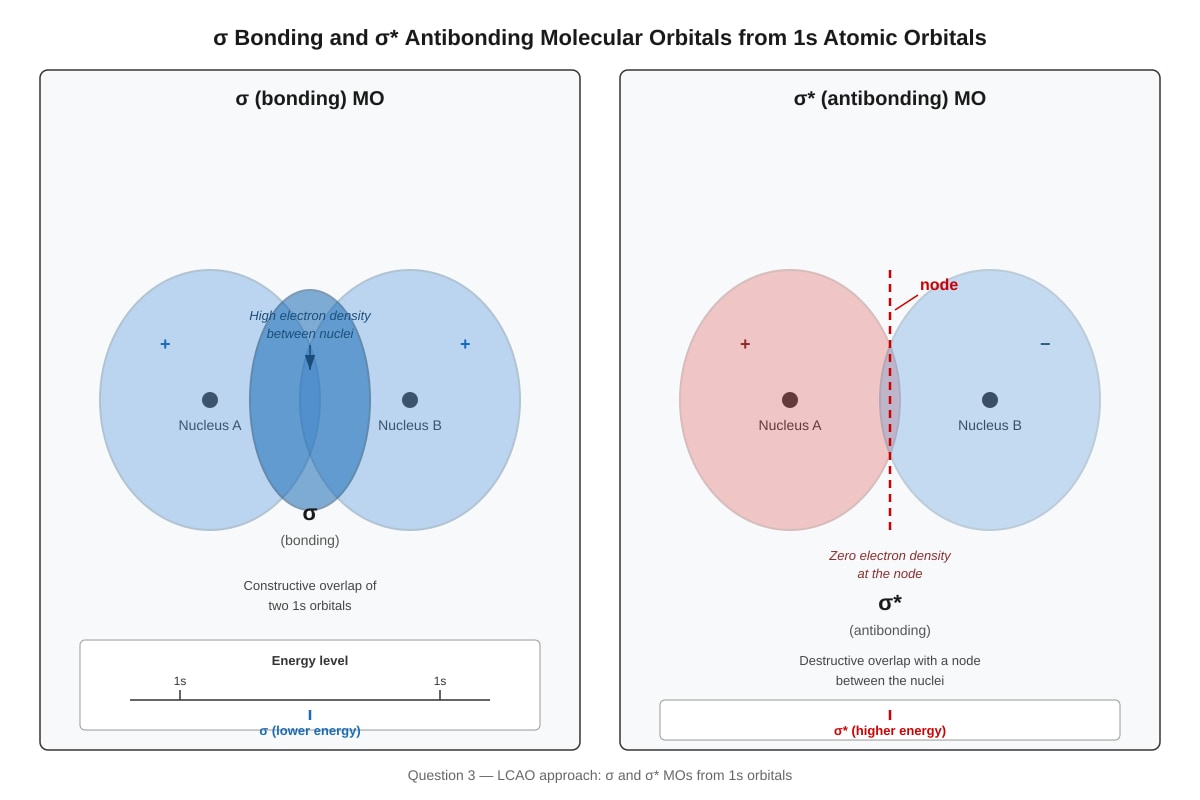
3. Answer: [2 marks] Expected visual features:
- σ bonding MO: Two 1s orbitals overlapping constructively, with electron density concentrated between the two nuclei. No node between nuclei.
- σ* antibonding MO: Two 1s orbitals overlapping destructively, with a node (region of zero electron density) between the two nuclei. Explanation: In LCAO, the bonding MO (σ) is formed by constructive interference (same phase), lowering energy. The antibonding MO (σ*) is formed by destructive interference (opposite phase), raising energy, with a node between nuclei. Marking notes: Award 1 mark for correct σ diagram, 1 mark for correct σ* diagram with node labelled.
4. Answer: D (CH₄) [2 marks] Explanation: CO₂ (linear, 3 atoms) has 4 vibrational modes (3N-5 = 4), but only 2 are IR-active (asymmetric stretch and bending). SO₂ (bent, 3 atoms) has 3 vibrational modes (3N-6 = 3), all IR-active. H₂O (bent, 3 atoms) has 3 vibrational modes, all IR-active. CH₄ (tetrahedral, 5 atoms) has 9 vibrational modes (3N-6 = 9), and several are IR-active. CH₄ has the highest number of IR-active stretching vibrations. Common mistake: Students may think CO₂ has more vibrations because it is linear, but many are IR-inactive due to symmetry.
5. Answer: Butanoic acid (CH₃CH₂CH₂COOH) or a structural isomer with both a carbonyl and O–H group. [3 marks] Explanation:
- IR absorption at 1740 cm⁻¹ indicates a C=O stretch (carbonyl group).
- Broad absorption around 3300 cm⁻¹ indicates an O–H stretch (carboxylic acid or alcohol).
- Molecular formula C₄H₈O₂ with both C=O and O–H suggests a carboxylic acid.
- Possible structure: CH₃CH₂CH₂COOH (butanoic acid) or (CH₃)₂CHCOOH (2-methylpropanoic acid). Marking notes: Award 1 mark for identifying C=O, 1 mark for identifying O–H, 1 mark for correct structure.
6. Answer: [2 marks] TMS is suitable because:
- It has 12 equivalent protons, giving a single sharp signal.
- Its protons are highly shielded (silicon is less electronegative than carbon), so it absorbs at a low chemical shift (δ = 0), which does not interfere with most other signals.
- It is chemically inert and volatile (bp 27°C), making it easy to remove. Marking notes: Award 1 mark for any two valid reasons.
7. Answer: Ethyl acetate (CH₃COOCH₂CH₃) [3 marks] Explanation:
- δ 2.1 (3H, singlet): CH₃ group adjacent to a carbonyl (C=O), with no neighbouring protons.
- δ 2.3 (2H, quartet): CH₂ group adjacent to a CH₃ group (n+1 = 4, so quartet).
- δ 1.2 (3H, triplet): CH₃ group adjacent to a CH₂ group (n+1 = 3, so triplet).
- The splitting pattern (quartet and triplet) indicates an ethyl group (–CH₂CH₃).
- The singlet at δ 2.1 is consistent with a methyl group attached to a carbonyl (CH₃CO–).
- Structure: CH₃COOCH₂CH₃ (ethyl acetate). Marking notes: Award 1 mark for identifying ethyl group, 1 mark for identifying CH₃CO–, 1 mark for correct structure.
8. Answer: [2 marks] Chlorine has two naturally occurring isotopes: ³⁵Cl (75%) and ³⁷Cl (25%). The molecular ion peak at m/z 78 corresponds to the molecule containing ³⁵Cl, and the peak at m/z 80 corresponds to the molecule containing ³⁷Cl. The 3:1 ratio reflects the natural abundance of the two isotopes. Explanation: The M+2 peak is characteristic of chlorine-containing compounds. Marking notes: Award 1 mark for identifying isotopes, 1 mark for explaining the ratio.
9. Answer: Bond order = 1 [3 marks] Step-by-step working:
- F₂ has 18 electrons total (9 from each F atom).
- MO electron configuration for F₂ (order: σ₁s, σ₁s, σ₂s, σ₂s, σ₂p, π₂p, π₂p, σ₂p): (σ₁s)²(σ₁s)²(σ₂s)²(σ₂s)²(σ₂p)²(π₂p)⁴(π*₂p)⁴
- Bond order = (number of bonding electrons – number of antibonding electrons) / 2 Bonding electrons: σ₁s(2) + σ₂s(2) + σ₂p(2) + π₂p(4) = 10 Antibonding electrons: σ₁s(2) + σ₂s(2) + π*₂p(4) = 8 Bond order = (10 – 8) / 2 = 1 Marking notes: Award 1 mark for correct electron configuration, 1 mark for correct calculation, 1 mark for final answer.
10. Answer: C (π → π*) [2 marks] Explanation: In a conjugated π system, the HOMO is a π orbital and the LUMO is a π* orbital. The π → π* transition has the lowest energy gap among the common transitions and is therefore the most likely to occur. σ → σ* transitions require much higher energy (vacuum UV). n → π* transitions are possible but have lower intensity (forbidden transitions). Common mistake: Students may choose n → π* because it occurs in carbonyl compounds, but in conjugated systems, π → π* is the dominant transition.
Section B: Structured Questions (Questions 11–15, 15 marks)
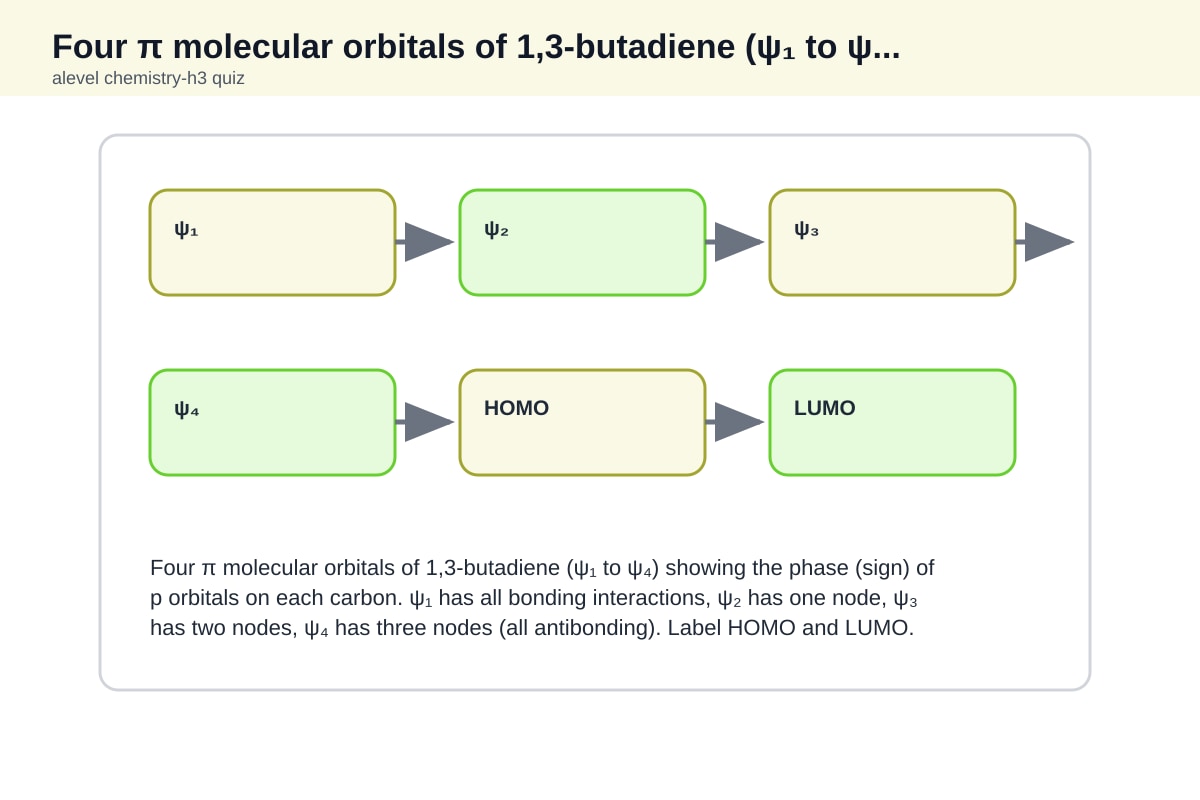
11. (a) Answer: [3 marks] Expected visual features:
- ψ₁ (lowest energy): All bonding interactions between adjacent p orbitals (no nodes between atoms).
- ψ₂: One node between C2 and C3 (one sign change).
- ψ₃: Two nodes (between C1–C2 and C3–C4).
- ψ₄ (highest energy): Three nodes (all antibonding interactions).
- HOMO = ψ₂ (for ground state, 4 π electrons fill ψ₁ and ψ₂).
- LUMO = ψ₃. Marking notes: Award 1 mark for correct ordering, 1 mark for correct HOMO/LUMO, 1 mark for correct node positions.
(b) Answer: [2 marks] As conjugation length increases, the number of π molecular orbitals increases. The HOMO and LUMO become closer in energy because the additional orbitals fill the energy gap between the bonding and antibonding combinations. This is due to greater delocalisation of π electrons, which stabilises the HOMO and destabilises the LUMO less, reducing the energy gap. Marking notes: Award 1 mark for mentioning increased number of MOs, 1 mark for explaining the energy gap reduction.
12. (a) Answer: ε = 1800 dm³ mol⁻¹ cm⁻¹ [2 marks] Step-by-step working: A = εcl ε = A / (cl) = 0.45 / (2.5 × 10⁻⁴ × 1.0) = 1800 dm³ mol⁻¹ cm⁻¹ Marking notes: Award 1 mark for correct rearrangement, 1 mark for correct answer with units.
(b) Answer: c = 5.0 × 10⁻⁴ mol dm⁻³ [1 mark] Step-by-step working: c = A / (εl) = 0.90 / (1800 × 1.0) = 5.0 × 10⁻⁴ mol dm⁻³ Marking notes: Award 1 mark for correct answer.
13. Answer: SO₂ has 3 IR-active stretching vibrations. [3 marks] Explanation:
- SO₂ is a bent triatomic molecule (C₂v symmetry).
- For a non-linear molecule with N atoms, the number of vibrational modes is 3N – 6 = 3(3) – 6 = 3.
- The three modes are: symmetric stretch, asymmetric stretch, and bending.
- All three modes are IR-active because each vibration involves a change in the dipole moment of the molecule.
- In contrast, CO₂ (linear) has 4 vibrational modes (3N – 5 = 4), but only 2 are IR-active because the symmetric stretch does not change the dipole moment. Marking notes: Award 1 mark for identifying 3 modes, 1 mark for explaining 3N – 6, 1 mark for explaining IR activity.
14. Answer: Pentanal (CH₃CH₂CH₂CH₂CHO) [3 marks] Explanation:
- δ 9.8 (1H, singlet): Aldehyde proton (–CHO), characteristic chemical shift around δ 9–10.
- δ 2.4 (2H, triplet): CH₂ group adjacent to a carbonyl (C=O) and next to a CH₂ group (n+1 = 3, so triplet).
- δ 1.6 (2H, sextet): CH₂ group with 5 neighbouring protons (n+1 = 6, so sextet).
- δ 0.9 (3H, triplet): Terminal CH₃ group adjacent to a CH₂ group (n+1 = 3, so triplet).
- The splitting pattern indicates a straight-chain aldehyde: CH₃–CH₂–CH₂–CH₂–CHO. Marking notes: Award 1 mark for identifying aldehyde, 1 mark for interpreting splitting patterns, 1 mark for correct structure.
15. Answer: [2 marks] Bromine has two naturally occurring isotopes: ⁷⁹Br (50%) and ⁸¹Br (50%). The molecular ion peak at m/z 122 corresponds to the molecule containing ⁷⁹Br, and the peak at m/z 124 corresponds to the molecule containing ⁸¹Br. The approximately equal intensity (1:1 ratio) reflects the natural abundance of the two isotopes. A possible molecular formula: C₂H₅Br (Mr = 108 + 79 = 122 for ⁷⁹Br, 108 + 81 = 124 for ⁸¹Br). Explanation: The M+2 peak is characteristic of bromine-containing compounds. The 1:1 ratio is a key identifier. Marking notes: Award 1 mark for explaining isotopes and ratio, 1 mark for suggesting a plausible formula.
Section C: Extended Response (Questions 16–20, 15 marks)
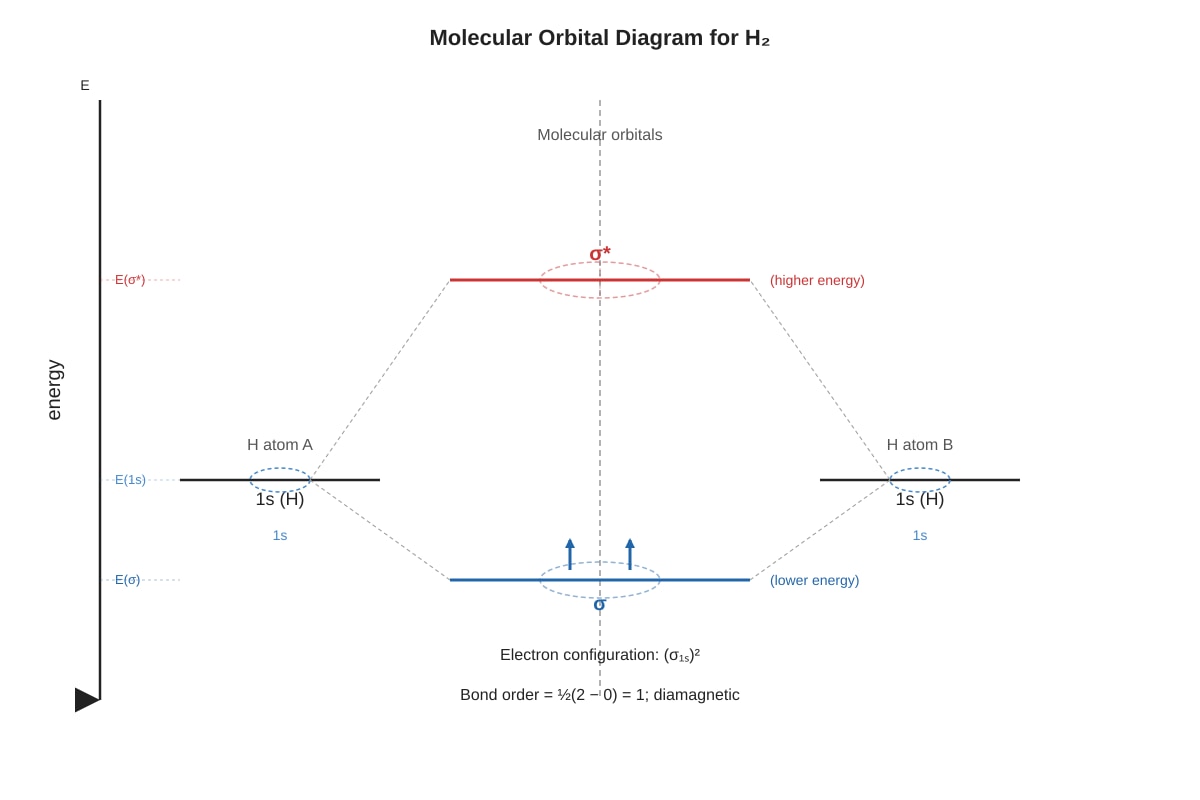
16. Answer: [3 marks] Expected visual features:
- Two H atoms each contribute one 1s atomic orbital.
- The 1s orbitals combine to form two molecular orbitals: σ (bonding, lower energy) and σ* (antibonding, higher energy).
- The σ MO has no node between nuclei; the σ* MO has a node between nuclei.
- Two electrons (one from each H atom) fill the σ bonding MO (spin-paired).
- Electron configuration: (σ)²
- Bond order = (2 – 0) / 2 = 1
- H₂ is diamagnetic (no unpaired electrons). Marking notes: Award 1 mark for correct MO diagram, 1 mark for correct bond order, 1 mark for correct magnetic properties.
17. (a) Answer: ε = 1.22 × 10⁴ dm³ mol⁻¹ cm⁻¹ [2 marks] Step-by-step working:
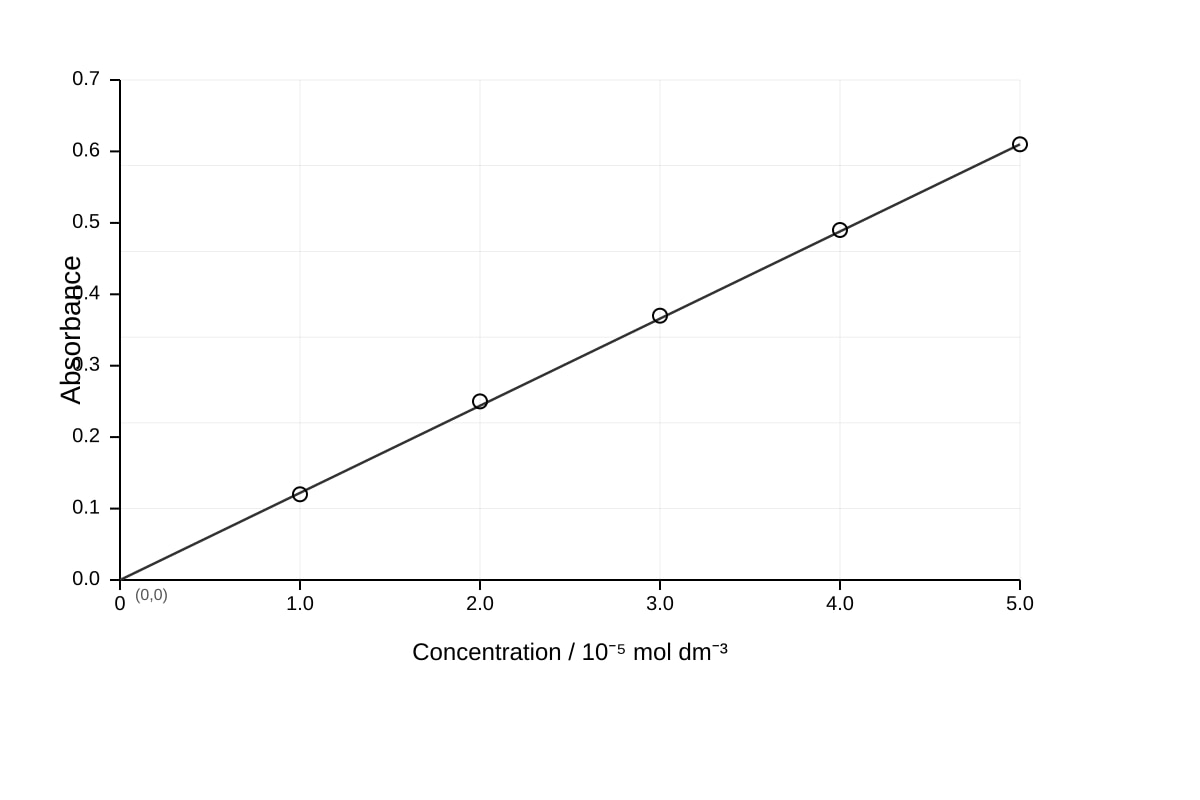
- Plot absorbance (y-axis) vs concentration (x-axis).
- The slope of the best-fit line = εl (since A = εcl, and l = 1.0 cm).
- From the data, slope ≈ (0.61 – 0) / (5.0 × 10⁻⁵ – 0) = 1.22 × 10⁴ dm³ mol⁻¹ cm⁻¹
- Since l = 1.0 cm, ε = 1.22 × 10⁴ dm³ mol⁻¹ cm⁻¹ Marking notes: Award 1 mark for correct slope calculation, 1 mark for correct ε with units.
(b) Answer: c = 2.7 × 10⁻⁵ mol dm⁻³ [1 mark] Step-by-step working: From the graph or calculation: c = A / (εl) = 0.33 / (1.22 × 10⁴ × 1.0) = 2.70 × 10⁻⁵ mol dm⁻³ Marking notes: Award 1 mark for correct answer (accept 2.6–2.8 × 10⁻⁵).
18. Answer: [3 marks] Explanation:
- Spin–spin splitting (coupling) arises from the interaction between the magnetic fields of neighbouring non-equivalent protons.
- The splitting pattern follows the n+1 rule: a proton with n equivalent neighbouring protons will be split into n+1 peaks.
- For an ethyl group (–CH₂CH₃):
- The CH₂ protons have 3 neighbouring protons (from CH₃), so they are split into a quartet (n+1 = 4).
- The CH₃ protons have 2 neighbouring protons (from CH₂), so they are split into a triplet (n+1 = 3).
- The coupling constant (J value) is the same for both signals, confirming they are coupled to each other. Marking notes: Award 1 mark for explaining the origin of splitting, 1 mark for applying n+1 rule, 1 mark for correct ethyl group example.
19. Answer: [3 marks] Explanation:
- Greenhouse gases absorb infrared (IR) radiation, which causes molecular vibrations.
- For a molecule to absorb IR radiation, its vibration must cause a change in the dipole moment of the molecule.
- CO₂ is a linear triatomic molecule. Its asymmetric stretch and bending vibrations cause a change in dipole moment, making it IR-active and able to absorb IR radiation.
- N₂ and O₂ are homonuclear diatomic molecules. Their only vibration (stretching) does not change the dipole moment because the bond is non-polar. Therefore, they are IR-inactive and do not absorb IR radiation.
- CH₄ and H₂O are also IR-active because their vibrations change the dipole moment. Marking notes: Award 1 mark for explaining requirement of dipole moment change, 1 mark for applying to CO₂, 1 mark for applying to N₂/O₂.
20. Answer: The compound is 1-bromobutane (CH₃CH₂CH₂CH₂Br) or 2-bromobutane (CH₃CH₂CHBrCH₃). [3 marks] Explanation:
- Molecular formula C₄H₉Br.
- M⁺ at m/z 136 and M+2 at m/z 138 with approximately equal intensity: indicates the presence of bromine (⁷⁹Br and ⁸¹Br in ~1:1 ratio).
- Base peak at m/z 57: loss of bromine atom (M – Br = 136 – 79 = 57 for ⁷⁹Br, or 138 – 81 = 57 for ⁸¹Br).
- The fragment at m/z 57 corresponds to [C₄H₉]⁺ (butyl cation).
- The formation of the base peak: The molecular ion undergoes cleavage of the C–Br bond, producing a stable butyl cation (C₄H₉⁺) and a bromine radical. The butyl cation is stabilised by hyperconjugation and inductive effects.
- Possible structures: 1-bromobutane (CH₃CH₂CH₂CH₂Br) or 2-bromobutane (CH₃CH₂CHBrCH₃). Both would give a base peak at m/z 57. Marking notes: Award 1 mark for identifying bromine from isotope pattern, 1 mark for identifying m/z 57 as [C₄H₉]⁺, 1 mark for suggesting a plausible structure.
END OF ANSWER KEY