AI Generated Quiz
A Level Chemistry H3 Acids Bases Salts Quiz
Free A Level Chemistry H3 Acids Bases Salts quiz, HY3 AI version, with questions, answers, and A Level-style practice for Singapore students.
These static practice materials are generated from the site's syllabus and paper-generation workflow, with source and model context shown so students and parents can evaluate the material before use.
Questions
A-Level Chemistry H3 Quiz - Acids Bases Salts
Name:
Class:
Date:
Score:
Duration: 60 minutes
Total Marks: 40
Topic: Acids Bases Salts (H3 Chemistry, syllabus-first practice; no past-year paper evidence available)
Instructions:
- Answer all 20 questions.
- Section A: short structured items (1–8). Section B: calculations and explanations (9–14). Section C: extended application (15–20).
- Show all working where calculation is involved. Use appropriate chemical notation.
- This quiz is generated from syllabus context only and is not derived from past exam papers.
Section A: Foundations (Questions 1–8)
1. Define a Brønsted–Lowry acid and a Brønsted–Lowry base. [2]
2. Write the conjugate base of HCO3−. [1]
3. State the colour change of methyl orange in going from pH 2 to pH 10. [1]
4. Give the formula of a salt formed by neutralisation of nitric acid with potassium hydroxide. [1]
5. Explain, in one sentence, why a strong acid has a higher electrical conductivity than a weak acid of the same concentration. [1]
6. Write the equilibrium expression for the dissociation of ethanoic acid, CH3COOH, in water. [1]
7. Identify whether NH3 acts as an acid or base in liquid NH3 autoionisation. [1]
8. State the pH range in which phenolphthalein changes colour. [1]
Section B: Calculations and Explanations (Questions 9–14)
9. A solution of hydrochloric acid has concentration 0.050 mol dm−3. Calculate its pH. [2]
10. The Ka of methanoic acid, HCOOH, is 1.8×10⁻⁴ mol dm−3 at 298 K. Calculate the pH of a 0.10 mol dm−3 solution of methanoic acid. [3]
11. 25.0 cm3 of 0.100 mol dm−3 NaOH is titrated with 0.100 mol dm−3 HCl. (a) Calculate the volume of HCl required for neutralisation. [2] (b) State the pH at the equivalence point. [1]
12. Explain, using Le Chatelier’s principle, how the pH of a buffer containing CH3COOH and CH3COO− changes when a small amount of H+ is added. [3]
13. A student prepares a salt by reacting excess zinc carbonate with sulfuric acid. Write the balanced equation and state the method to obtain pure dry zinc sulfate crystals. [3]
14. Compare the enthalpy of neutralisation of a strong acid–strong base system with that of a weak acid–strong base system. Explain the difference. [3]
Section C: Extended Application (Questions 15–20)
15. A diprotic acid H2A has Ka1=1.0×10⁻³ and Ka2=1.0×10⁻⁷. (a) Write the two dissociation steps. [2] (b) Calculate the pH of a 0.020 mol dm−3 solution of H2A, stating any assumption made. [4]
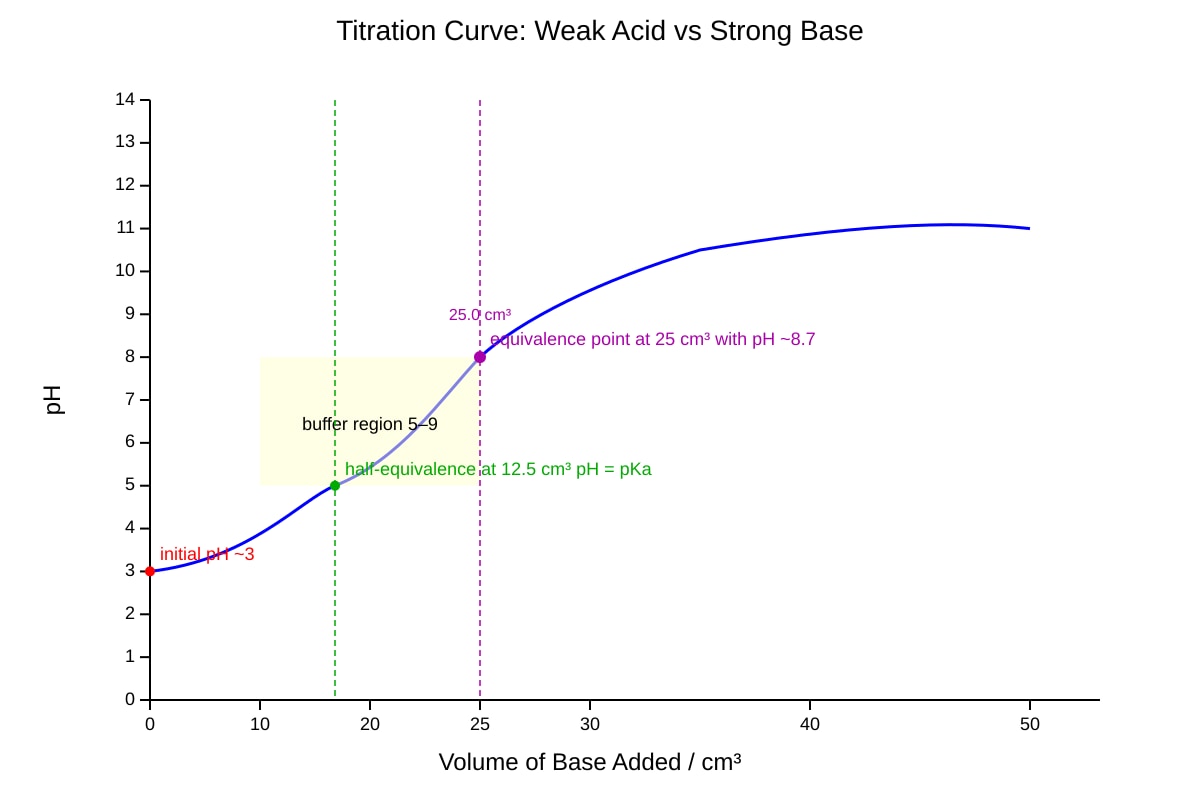
16. The following titration curve was recorded for a weak monoprotic acid titrated with strong base.
Image pending generation: graph for Q16.
Using the graph, determine the pKa of the acid and explain how the curve shows it is weak. [3]
17. Describe how you would prepare a pH=4.75 buffer using ethanoic acid (pKa=4.75) and sodium ethanoate. Include the ratio of concentrations required. [3]
18. A salt X2CO3 is soluble. Describe two tests to confirm the presence of carbonate ion and state the observations. [3]
19. Explain the role of an indicator in a strong acid–strong base titration and why methyl orange is suitable but not suitable for weak acid–strong base titration. [3]
20. A sample of impure calcium carbonate reacts with excess HCl. 2.50 g of sample produces 448 cm3 of CO2 at room temperature and pressure (molar gas volume 24.0 dm3 mol−1). (a) Calculate the percentage purity of the sample. [4] (b) State one source of error in using volume of gas to determine purity. [1]
Answers
A-Level Chemistry H3 Quiz - Acids Bases Salts (Answer Key)
Total Marks: 40
Topic: Acids Bases Salts (syllabus-first; not exam-derived)
Section A Answers (1–8)
1. [2 marks]
- Brønsted–Lowry acid: proton (H+) donor. [1]
- Brønsted–Lowry base: proton (H+) acceptor. [1]
Teaching note: This definition extends beyond aqueous systems; e.g. NH3+HCl→NH4++Cl−, where HCl donates H+.
2. [1 mark]
CO32−
Remove one H+ from HCO3−.
3. [1 mark]
Red to yellow (methyl orange: red below pH 3.1, yellow above pH 4.4).
4. [1 mark]
KNO3
Neutralisation: HNO3+KOH→KNO3+H2O.
5. [1 mark]
Strong acid fully dissociates giving more free ions per unit volume, increasing conductivity.
6. [1 mark]
Ka=[CH3COOH][CH3COO−][H+]
7. [1 mark]
Base (autoionisation: 2NH3⇌NH4++NH2−; NH3 accepts H+ to form NH4+).
8. [1 mark]
pH 8.2–10.0 (colourless to pink).
Section B Answers (9–14)
9. [2 marks]
HCl is strong: [H+]=0.050 mol dm−3
pH=−log(0.050)=1.30 [2 for correct value, or 1 if only formula]
10. [3 marks]
HCOOH⇌H++HCOO−
Ka=0.10−xx2≈0.10x2 (x small)
x=1.8×10−4×0.10=1.8×10−5=4.24×10⁻³
pH=−log(4.24×10⁻³)=2.37 [1 method, 1 calc, 1 pH]
11. [3 marks]
(a) nNaOH=0.0250×0.100=2.50×10⁻³ mol
VHCl=n/c=2.50×10−3/0.100=0.0250 dm3=25.0 cm3 [2]
(b) pH = 7.0 [1] (strong–strong)
12. [3 marks]
Added H+ reacts with CH3COO−: CH3COO−+H+→CH3COOH [1]
Equilibrium shifts left, free H+ consumed [1]
pH changes only slightly due to reservoir of base form [1]
13. [3 marks]
ZnCO3+H2SO4→ZnSO4+CO2+H2O [1]
Filter excess ZnCO3 [1]
Evaporate filtrate and crystallise; dry crystals [1]
14. [3 marks]
Strong–strong: ~ −57.3 kJ mol−1 [1]
Weak–strong: less exothermic [1] because energy used to ionise weak acid [1]
Section C Answers (15–20)
15. [6 marks]
(a) H2A⇌H++HA− [1]; HA−⇌H++A2− [1]
(b) First dissociation dominates: Ka1=x2/(0.020−x)≈x2/0.020
x=1.0×10−3×0.020=2.0×10−5=4.47×10⁻³
pH=−log(4.47×10⁻³)=2.35 [2 calc, 1 assumption: x≪0.020 and Ka2 negligible, 1 final]
16. [3 marks]
pKa = pH at half-equivalence = 4.75 (from graph at 12.5 cm³) [1]
Weak acid: initial pH ~3 not ~1, equivalence pH >7 [2]
17. [3 marks]
Use Henderson–Hasselbalch: pH=pKa+log([A−]/[HA])
For pH = pKa, ratio = 1 [1]
Mix equal concentrations/volumes of CH3COOH and CH3COONa [2]
18. [3 marks]
Add dilute acid: effervescence of CO2 [1,1]
Pass gas into limewater: turns milky [1]
19. [3 marks]
Indicator shows pH jump via colour change [1]
Methyl orange suitable for strong–strong (jump includes 3.1–4.4) [1]
Not suitable for weak–strong (equivalence ~8–9, outside range) [1]
20. [5 marks]
(a) nCO2=0.448/24.0=0.01867 mol [1]
MCaCO3=100.1 g mol−1; mass pure = 0.01867×100.1=1.87 g [1]
% purity = 1.87/2.50×100=74.8% [2]
(b) Gas leakage / not STP [1]
Common mistake: forgetting to convert cm3 to dm3.
Free quiz and exam paper access
Enter your details to view this paper
Your access is remembered on this device.