AI Generated Quiz
A Level Chemistry H3 Acids Bases Salts Quiz
Free A Level Chemistry H3 Acids Bases Salts quiz, AI version, with questions, answers, and A Level-style practice for Singapore students.
These static practice materials are generated from the site's syllabus and paper-generation workflow, with source and model context shown so students and parents can evaluate the material before use.
Questions
Free quiz and exam paper access
Enter your details to view this paper
Your access is remembered on this device.
Answers
Answer Key: A-Level Chemistry H3 Quiz - Acids Bases Salts
Total Marks: 50
Section A: Short-Answer Questions (20 marks)
1. [2 marks]
Answer: As the pH increases from 2.0 to 7.0, the concentration of the conjugate base A⁻ increases due to deprotonation of HA. Since A⁻ is the absorbing species, the absorbance (at the wavelength where A⁻ absorbs) will increase. The UV-Vis spectrum will show an increase in absorbance of the peak corresponding to A⁻.
Explanation: The UV-Vis spectrum is based on electronic transitions. Only A⁻ absorbs in the given wavelength range. HA does not absorb. Raising the pH (making the solution less acidic) causes more HA to dissociate into H⁺ and A⁻. With more A⁻ present, more photons are absorbed, leading to a higher absorbance signal. This is a direct application of the Beer-Lambert Law (A = εcl), where c is the concentration of the absorbing species A⁻.
Marking:
- [1] for identifying that [A⁻] increases.
- [1] for stating that the absorbance of the A⁻ peak increases.
Common Mistake: Saying that the absorbance decreases.
2. [3 marks]
Answer: Assumption: The concentration of HX is much larger than the concentration of H⁺ from self-ionisation of water, so only the dissociation of HX contributes to [H⁺].
[H⁺] = 10⁻³·⁵⁰ = 3.16 × 10⁻⁴ mol dm⁻³
[H⁺] = [X⁻] = 3.16 × 10⁻⁴ mol dm⁻³
[HX] at equilibrium = initial [HX] - [H⁺] ≈ 0.10 - 3.16 × 10⁻⁴ ≈ 0.10 mol dm⁻³ (since the dissociation is small).
Explanation: The pH gives you the concentration of H⁺ ions. For a monoprotic weak acid, [H⁺] = [A⁻] at equilibrium. The equilibrium concentration of HA is the initial concentration minus [H⁺]. Since HA is weak, the approximation that [HA] ≈ initial concentration is valid. Substituting into the Ka expression gives the answer.
Marking:
- [1] for calculating [H⁺] correctly.
- [1] for the assumption (or for using [HX] ≈ 0.10).
- [1] for correct final value of Ka.
Common Mistake: Forgetting to use the initial concentration of the acid minus the dissociated amount.
3. [3 marks]
Answer: The broad band at ~3300 cm⁻¹ is due to the O–H stretching vibration of the carboxylic acid group (-COOH) that is hydrogen-bonded. The sharp band at ~1710 cm⁻¹ is due to the C=O stretching vibration of the carboxylic acid.
When NaOH is added, ethanoic acid is fully deprotonated to form sodium ethanoate (CH₃COONa). The -COOH group no longer exists, so the O–H band disappears. The C=O band at 1710 cm⁻¹ also disappears because the carboxylic acid is converted into a carboxylate ion (COO⁻).
The new band at 1560 cm⁻¹ corresponds to the asymmetric stretching vibration of the carboxylate ion (COO⁻). This is a characteristic absorption for the carboxylate anion.
Explanation: IR spectroscopy identifies functional groups by their characteristic absorption frequencies. Carboxylic acids have a distinct O–H stretch (broad due to hydrogen bonding) and a C=O stretch. Upon deprotonation, the acidic O–H is lost, and the C=O becomes part of a resonance-stabilised carboxylate ion. This ion has a lower frequency C–O stretch due to resonance, which is ~1560-1650 cm⁻¹.
Marking:
- [1] for identifying the 3300 cm⁻¹ band (O–H stretch) and 1710 cm⁻¹ band (C=O stretch).
- [1] for explaining that deprotonation eliminates the C=O group.
- [1] for identifying the new band as the COO⁻ stretch.
Common Mistake: Identifying the 1710 cm⁻¹ band as C=O but not explaining its disappearance.
4. [3 marks]
Answer: The pKa values decrease (acidity increases) as the number of fluorine atoms on the α-carbon increases. CH₃COOH has pKa 4.76 (weakest), CF₃COOH has pKa 0.23 (strongest).
This trend is due to the inductive effect of fluorine. Fluorine is highly electronegative, so it withdraws electron density through the sigma bonds (inductive effect). As more F atoms are added, the electron-withdrawing effect on the O–H bond increases. This weakens the O–H bond and stabilises the conjugate base (the carboxylate ion) by delocalising the negative charge.
Explanation: The pKa measures the strength of an acid: a lower pKa means a stronger acid. The inductive effect is a through-bond effect. Electron-withdrawing groups (like F) stabilise the negative charge on the conjugate base (the carboxylate ion) by pulling electron density away, making the acid more willing to donate a proton. The effect is cumulative: more F atoms = greater stabilisation = stronger acid = lower pKa.
Marking:
- [1] for correctly noting the trend (decreasing pKa with more F).
- [1] for explaining the inductive effect of fluorine.
- [1] for linking the inductive effect to stabilisation of the conjugate base.
Common Mistake: Saying that fluorine’s lone pairs donate electron density (wrong, it's an inductive withdrawer here).
5. [2 marks]
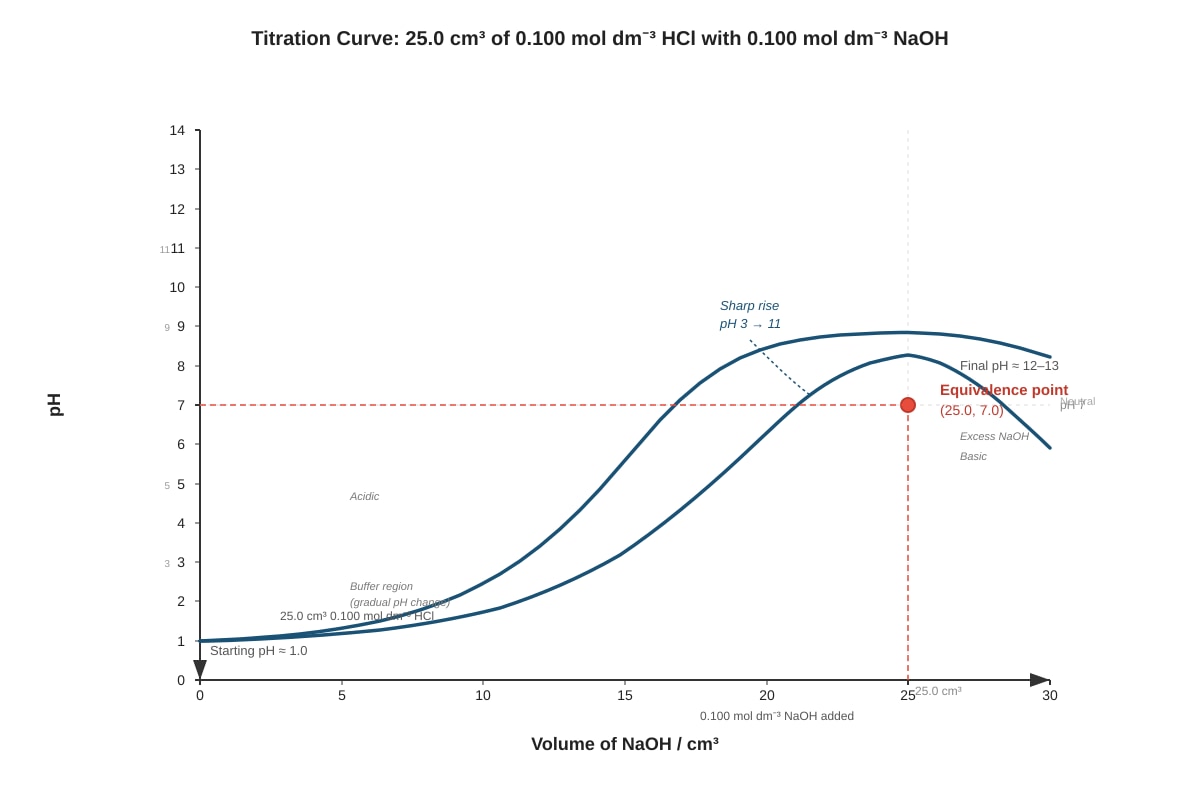
Answer: The graph should show a steep (near-vertical) section around the equivalence point at 25.0 cm³ of NaOH, with pH rising from approximately pH 3 to pH 11. The initial pH should be about 1.0 (for 0.100 M HCl), and the final pH should be about 12-13. The equivalence point should be at pH 7.0.
Explanation: The titration of a strong acid with a strong base results in a sharp pH change near the equivalence point. The initial pH is low because of the high [H⁺] from the strong acid. As NaOH is added, the pH rises gradually, then jumps sharply around the equivalence point (where moles of acid = moles of base), and then levels off at a high pH. The equivalence point is at pH 7 because the salt formed (NaCl) does not undergo hydrolysis.
Marking:
- [1] for correct shape (sigmoidal, steep rise at 25.0 cm³).
- [1] for correctly labelling the equivalence point at pH 7.0 and 25.0 cm³.
6. [2 marks]
Answer: Pair 1: NH₃ (base) and NH₄⁺ (conjugate acid) Pair 2: H₂O (acid) and OH⁻ (conjugate base)
Explanation: A Brønsted–Lowry acid donates a proton (H⁺). A Brønsted–Lowry base accepts a proton. In the forward reaction:
- NH₃ accepts a proton from H₂O to become NH₄⁺. So NH₃ is the base and NH₄⁺ is its conjugate acid.
- H₂O donates a proton to NH₃ to become OH⁻. So H₂O is the acid and OH⁻ is its conjugate base.
Marking:
- [1] for each correct pair (NH₃/NH₄⁺, H₂O/OH⁻).
Common Mistake: Confusing which is the acid and which is the base.
7. [4 marks]
Answer: Moles of CH₃COOH = (50.0/1000) dm³ × 0.200 mol dm⁻³ = 0.0100 mol Moles of CH₃COONa = (25.0/1000) dm³ × 0.200 mol dm⁻³ = 0.00500 mol
Total volume = 50.0 + 25.0 = 75.0 cm³ = 0.0750 dm³
[CH₃COOH] = 0.0100 mol / 0.0750 dm³ = 0.133 mol dm⁻³ [CH₃COO⁻] = 0.00500 mol / 0.0750 dm³ = 0.0667 mol dm⁻³
Using the Henderson-Hasselbalch equation:
Explanation: This problem involves a buffer solution. A buffer is a mixture of a weak acid and its conjugate base. The Henderson-Hasselbalch equation is the most direct method to calculate the pH. First, calculate the moles of each component, then divide by the total volume to get the concentrations. Then plug into the equation.
Marking:
- [1] for correct calculation of moles of CH₃COOH.
- [1] for correct calculation of moles of CH₃COONa.
- [1] for using the correct concentration ratio in the Henderson-Hasselbalch equation.
- [1] for correct final pH (4.46).
Common Mistake: Forgetting to account for the dilution (total volume change) when mixing solutions.
8. [3 marks]
Answer: The CH₂ group signal is split into a quartet (4 peaks) by the neighbouring CH₃ group (which has 3 equivalent protons). This follows the n+1 rule: the CH₂ carbon is adjacent to the CH₃ carbon with n = 3 protons, so the signal for CH₂ is split into 3+1 = 4 peaks.
The chemical shift of the CH₂ group is around δ 2.0-2.5 ppm. This is deshielding because the CH₂ group is attached to a carbonyl carbon (C=O), which is electron-withdrawing, pulling electron density away from the CH₂ protons.
Explanation: In ¹H NMR, signals are split by neighbouring non-equivalent protons. The n+1 rule states that if a signal is adjacent to n equivalent protons, it will appear as n+1 peaks. The CH₂ group in propanoic acid is adjacent to the CH₃ group (3 H's) and next to a COOH group. The splitting comes only from the CH₃ group (3 H's) so it's a quartet. The chemical shift is shifted downfield by the electron-withdrawing effect of the carbonyl group.
Marking:
- [1] for quartet splitting and correct n+1 reasoning.
- [1] for correct chemical shift range (δ ~2.0-2.5).
- [1] for explaining the deshielding effect of the carbonyl group.
Common Mistake: Saying the CH₂ signal is split by the COOH proton (the OH proton is labile and does not cause splitting).
9. [1 mark]
Answer: pH = 12.0
Explanation: NaOH is a strong base, so it dissociates completely: [OH⁻] = [NaOH] = 0.0100 mol dm⁻³.
pOH = -log[OH⁻] = -log(0.0100) = 2.00
At 298K, pH + pOH = 14.0
pH = 14.0 - pOH = 14.0 - 2.00 = 12.0
Marking:
- [1] for correct pH value (12.0).
10. [2 marks]
Answer: Acidic. NH₄Cl dissociates in water to give NH₄⁺ and Cl⁻. The Cl⁻ ion is the conjugate base of a strong acid (HCl) and does not undergo hydrolysis. However, the NH₄⁺ ion is the conjugate acid of a weak base (NH₃) and donates a proton to water:
This increases the [H₃O⁺] concentration, making the solution acidic.
Explanation: The hydrolysis of the cation from a weak base produces H₃O⁺ ions. The anion from a strong acid (Cl⁻) does not react with water. So the solution is acidic.
Marking:
- [1] for stating the solution is acidic.
- [1] for a correct equation showing hydrolysis of NH₄⁺.
Common Mistake: Confusing NH₄⁺ as a base; it is the conjugate acid of NH₃.
Section B: Structured Questions (30 marks)
11. [6 marks]
(a) [3 marks]
Answer: [OH⁻] = √(Kb × [B]) = √(4.00 × 10⁻⁶ × 0.0500) = √(2.00 × 10⁻⁷) = 4.47 × 10⁻⁴ mol dm⁻³
pOH = -log(4.47 × 10⁻⁴) = 3.35
pH = 14.0 - pOH = 14.0 - 3.35 = 10.65
Explanation: For a weak base, [OH⁻] = √(Kb × C₀) assuming the base is weak and the approximation is valid. The pOH is calculated, then pH from the relation pH + pOH = 14 at 298K.
(b) [3 marks]
Answer: After adding 0.0100 mol of HCl to 1.00 dm³: Initial moles B = 0.0500 mol Moles HCl added = 0.0100 mol Reaction
<stage5_quiz_answers_md>
Answer Key: A-Level Chemistry H3 Quiz - Acids Bases Salts
Total Marks: 50
Section A: Short-Answer Questions (20 marks)
1. [2 marks]
Answer: As the pH increases from 2.0 to 7.0, the concentration of the conjugate base A⁻ increases due to deprotonation of HA. Since A⁻ is the absorbing species, the absorbance (at the wavelength where A⁻ absorbs) will increase. The UV-Vis spectrum will show an increase in absorbance of the peak corresponding to A⁻.
Explanation: The UV-Vis spectrum is based on electronic transitions. Only A⁻ absorbs in the given wavelength range. HA does not absorb. Raising the pH (making the solution less acidic) causes more HA to dissociate into H⁺ and A⁻. With more A⁻ present, more photons are absorbed, leading to a higher absorbance signal. This is a direct application of the Beer-Lambert Law (A = εcl), where c is the concentration of the absorbing species A⁻.
Marking:
- [1] for identifying that [A⁻] increases.
- [1] for stating that the absorbance of the A⁻ peak increases.
Common Mistake: Saying that the absorbance decreases.
2. [3 marks]
Answer: Assumption: The concentration of HX is much larger than the concentration of H⁺ from self-ionisation of water, so only the dissociation of HX contributes to [H⁺].
[H⁺] = 10⁻³·⁵⁰ = 3.16 × 10⁻⁴ mol dm⁻³
[H⁺] = [X⁻] = 3.16 × 10⁻⁴ mol dm⁻³
[HX] at equilibrium = initial [HX] - [H⁺] ≈ 0.10 - 3.16 × 10⁻⁴ ≈ 0.10 mol dm⁻³ (since the dissociation is small).
Explanation: The pH gives you the concentration of H⁺. For a weak acid, the concentration of H⁺ is equal to the concentration of the conjugate base (from the dissociation). The equilibrium concentration of the acid is approximately the initial concentration because the dissociation is small. Substitute these values into the expression for Ka.
Marking:
- [1] for stating the assumption (e.g., [HX] ≈ initial [HX]).
- [1] for correct calculation of [H⁺] from pH.
- [1] for correct final Ka value.
Common Mistake: Forgetting to state the assumption or using the initial concentration of HX without subtracting the dissociated amount.
3. [3 marks]
Answer:
- The broad band around 3300 cm⁻¹ is due to O–H stretching of the carboxylic acid group (hydrogen-bonded).
- The strong sharp band at 1710 cm⁻¹ is due to C=O stretching of the carboxylic acid.
- When excess NaOH is added, the acid is completely neutralised to form the sodium salt (ethanoate ion). The O–H band disappears because the acidic proton is removed. The C=O band disappears because the carboxylate ion (COO⁻) has two equivalent C–O bonds with partial double bond character, which absorb at a lower wavenumber (around 1560 cm⁻¹, due to asymmetric stretching of the carboxylate group).
Explanation: IR spectroscopy identifies functional groups by their characteristic absorption frequencies. The O–H stretch of a carboxylic acid is broad due to hydrogen bonding. The C=O stretch is strong and sharp. Upon deprotonation, the carboxylic acid is converted to a carboxylate ion, which has two equivalent C–O bonds. The asymmetric stretch of the carboxylate group appears at a lower wavenumber (around 1550-1610 cm⁻¹) than the C=O stretch of the acid.
Marking:
- [1] for identifying the 3300 cm⁻¹ band as O–H stretch and 1710 cm⁻¹ as C=O stretch.
- [1] for explaining the disappearance of these bands due to neutralisation.
- [1] for explaining the new band at 1560 cm⁻¹ as the carboxylate ion stretch.
Common Mistake: Not mentioning the formation of the carboxylate ion or attributing the new band to a different group.
4. [3 marks]
Answer: The pKa values decrease (acidity increases) as the number of fluorine atoms increases. This is due to the inductive effect of the electronegative fluorine atoms. Fluorine is highly electronegative and withdraws electron density through the sigma bonds (inductive effect). This stabilises the conjugate base (the carboxylate anion) by dispersing the negative charge, making it easier for the acid to lose a proton. The effect is cumulative: more fluorine atoms lead to a stronger electron-withdrawing effect, greater stabilisation of the conjugate base, and thus a lower pKa (stronger acid).
Explanation: The trend shows that CF₃COOH is the strongest acid (lowest pKa) and CH₃COOH is the weakest (highest pKa). The inductive effect is a through-bond effect. The electronegative fluorine atoms pull electron density away from the O–H bond, making it more polar and easier to break. More importantly, they stabilise the negative charge on the conjugate base after deprotonation.
Marking:
- [1] for identifying the trend (pKa decreases with more F atoms).
- [1] for explaining the inductive effect of fluorine.
- [1] for relating the inductive effect to stabilisation of the conjugate base.
Common Mistake: Confusing inductive effect with resonance or mesomeric effect.
5. [2 marks]
Answer: The graph should show a sigmoidal titration curve. The initial pH is approximately 1.0 (since 0.100 M HCl gives pH = 1.0). The pH rises slowly at first, then very sharply around the equivalence point (25.0 cm³ of NaOH added). The equivalence point is at pH 7.0. After the equivalence point, the pH levels off at around 12-13.
Explanation: This is a strong acid-strong base titration. The pH is determined by the excess strong acid or strong base. Before the equivalence point, the solution contains excess HCl. At the equivalence point, the solution is neutral (pH 7) because the salt (NaCl) does not hydrolyse. After the equivalence point, the solution contains excess NaOH.
Marking:
- [1] for correct shape (sigmoidal curve with sharp rise near 25.0 cm³).
- [1] for correctly labelling the equivalence point at (25.0, 7.0) and showing appropriate initial and final pH values.
Common Mistake: Drawing a curve that is not steep enough around the equivalence point, or mislabelling the equivalence point pH.
6. [2 marks]
Answer:
- Conjugate acid-base pair 1: NH₃ (base) and NH₄⁺ (conjugate acid).
- Conjugate acid-base pair 2: H₂O (acid) and OH⁻ (conjugate base).
Explanation: According to Brønsted–Lowry theory, an acid donates a proton and a base accepts a proton. In the forward reaction, NH₃ accepts a proton from H₂O, so NH₃ is the base and H₂O is the acid. The products are NH₄⁺ (conjugate acid of NH₃) and OH⁻ (conjugate base of H₂O).
Marking:
- [1] for each correct conjugate acid-base pair.
Common Mistake: Identifying H₂O as a base or NH₃ as an acid.
7. [4 marks]
Answer: Moles of ethanoic acid = (50.0/1000) × 0.200 = 0.0100 mol Moles of sodium ethanoate = (25.0/1000) × 0.200 = 0.00500 mol Total volume = 50.0 + 25.0 = 75.0 cm³ = 0.0750 dm³
[CH₃COOH] = 0.0100 / 0.0750 = 0.133 mol dm⁻³ [CH₃COO⁻] = 0.00500 / 0.0750 = 0.0667 mol dm⁻³
Using the Henderson-Hasselbalch equation:
Explanation: A buffer solution resists changes in pH. The pH of a buffer can be calculated using the Henderson-Hasselbalch equation, which relates pH to the pKa of the weak acid and the ratio of the concentrations of the conjugate base and the weak acid. First, calculate the moles of each component, then the concentrations in the mixed solution, then apply the equation.
Marking:
- [1] for correct calculation of moles of acid and salt.
- [1] for correct calculation of concentrations in the mixture.
- [1] for correct calculation of pKa.
- [1] for correct final pH.
Common Mistake: Forgetting to account for the change in volume when mixing.
8. [3 marks]
Answer: The CH₂ group is adjacent to a CH₃ group (3 equivalent H atoms) and a COOH group (which has one H atom, but this H is on the O and is exchangeable, so it does not cause splitting in typical ¹H NMR). Therefore, the CH₂ group is split by the three equivalent H atoms of the CH₃ group. According to the n+1 rule, the CH₂ signal will be split into a quartet (n=3, so n+1=4). The chemical shift of the CH₂ group is around δ 2.2-2.6 ppm, which is characteristic of a CH₂ group adjacent to a carbonyl group (deshielding effect).
Explanation: The splitting pattern is determined by the number of equivalent neighbouring protons (n+1 rule). The CH₂ group has three neighbouring protons on the CH₃ group, so it appears as a quartet. The chemical shift is influenced by the electron-withdrawing effect of the adjacent carbonyl group, which deshields the CH₂ protons, moving the signal downfield.
Marking:
- [1] for identifying the splitting as a quartet.
- [1] for explaining the splitting using the n+1 rule.
- [1] for stating the chemical shift range and explaining the deshielding effect.
Common Mistake: Forgetting that the O–H proton is exchangeable and does not cause splitting.
9. [1 mark]
Answer: [OH⁻] = 0.0100 mol dm⁻³ pOH = -log(0.0100) = 2.00 pH = 14.00 - 2.00 = 12.00
Explanation: NaOH is a strong base and dissociates completely. The concentration of OH⁻ is equal to the concentration of NaOH. Calculate pOH and then pH using pH + pOH = 14.00 at 298 K.
Marking:
- [1] for correct pH value.
Common Mistake: Forgetting to convert from pOH to pH.
10. [2 marks]
Answer: The solution is acidic.
Explanation: Ammonium chloride is a salt formed from a weak base (NH₃) and a strong acid (HCl). The ammonium ion (NH₄⁺) undergoes hydrolysis in water:
The production of H₃O⁺ ions makes the solution acidic.
Marking:
- [1] for stating the solution is acidic.
- [1] for the correct hydrolysis equation.
Common Mistake: Saying the solution is neutral because it is a salt.
Section B: Structured Questions (30 marks)
11. [6 marks]
(a) [3 marks]
Answer: [OH⁻] = √(Kb × [B]) = √(4.00 × 10⁻⁶ × 0.0500) = √(2.00 × 10⁻⁷) = 4.47 × 10⁻⁴ mol dm⁻³
pOH = -log(4.47 × 10⁻⁴) = 3.35
pH = 14.00 - 3.35 = 10.65
Explanation: For a weak base, the concentration of OH⁻ is calculated using the approximation [OH⁻] = √(Kb × [B]), assuming the dissociation is small. Then calculate pOH and pH.
Marking:
- [1] for correct formula.
- [1] for correct calculation of [OH⁻].
- [1] for correct pH.
(b) [3 marks]
Answer: Initial moles of B = 0.0500 mol (in 1.00 dm³) Moles of HCl added = 0.0100 mol
The HCl reacts with B to form BH⁺:
After reaction: Moles of B = 0.0500 - 0.0100 = 0.0400 mol Moles of BH⁺ = 0.0100 mol
This is a buffer solution. Using the Henderson-Hasselbalch equation for a base and its conjugate acid:
Explanation: The added HCl reacts completely with the weak base B to form its conjugate acid BH⁺. The resulting solution contains both B and BH⁺, forming a buffer. The pH is calculated using the Henderson-Hasselbalch equation, using the pKa of the conjugate acid.
Marking:
- [1] for correct calculation of moles after reaction.
- [1] for recognising the buffer system.
- [1] for correct pH calculation.
Common Mistake: Using the wrong pKa value (using pKb instead of pKa of BH⁺).
12. [5 marks]
(a) [2 marks]
Answer: Structure of salicylic acid (2-hydroxybenzoic acid):
       COOH
       |
       C
      / \
     C   C
    /     \
   C       C
    \     /
     C   C
      \ /
       C
       |
       OH
The acidic protons are:
- The proton on the COOH group (pKa = 2.97)
- The proton on the OH group (pKa = 13.7)
Explanation: The structure is a benzene ring with a carboxylic acid group (COOH) and a hydroxyl group (OH) in the ortho position. Both groups have acidic protons, but the COOH group is much more acidic.
Marking:
- [1] for correct structure.
- [1] for correctly labelling both acidic protons.
(b) [3 marks]
Answer: The COOH group is significantly more acidic than the OH group because the conjugate base of the COOH group (the carboxylate anion, COO⁻) is stabilised by resonance. The negative charge is delocalised over two oxygen atoms, making it more stable. In contrast, the conjugate base of the OH group (the phenoxide ion, O⁻) has its negative charge localised on one oxygen atom (though it can be delocalised into the benzene ring to some extent, this is less effective than the resonance in the carboxylate group). The inductive effect of the adjacent carbonyl group also contributes to the acidity of the COOH group.
Explanation: The key factor is the resonance stabilisation of the conjugate base. The carboxylate ion has two equivalent resonance structures, distributing the negative charge over two oxygen atoms. The phenoxide ion has less effective resonance stabilisation.
Marking:
- [1] for identifying resonance stabilisation of the carboxylate ion.
- [1] for explaining the delocalisation of negative charge.
- [1] for comparing with the phenoxide ion.
Common Mistake: Not mentioning resonance or only mentioning the inductive effect.
13. [3 marks]
(a) [1 mark]
Answer: pH range 6.0 to 8.0 (approximately pKa ± 1).
Explanation: The colour change interval for an indicator is approximately pKa ± 1.
Marking:
- [1] for correct range.
(b) [2 marks]
Answer: Bromothymol blue is not a suitable indicator for this titration. The equivalence point of a weak acid-strong base titration is above pH 7 (typically pH 8-10). Bromothymol blue changes colour in the pH range 6.0-8.0, which is below the equivalence point pH. The colour change would occur before the equivalence point, leading to an inaccurate endpoint.
Explanation: A suitable indicator should have its colour change interval that encompasses the pH at the equivalence point. For a weak acid-strong base titration, the equivalence point is basic, so an indicator like phenolphthalein (pH 8.2-10.0) would be more suitable.
Marking:
- [1] for stating it is not suitable.
- [1] for explaining that the equivalence point pH is above the indicator's range.
Common Mistake: Saying it is suitable because the pKa is 7.
14. [3 marks]
Answer: The carboxylic acid X with a molecular ion peak at m/z = 60 is ethanoic acid (CH₃COOH).
Structure:
H3C - C - OH
     ||
     O
The mass spectrum can be used to distinguish X from ethyl methanoate because:
- Ethanoic acid (Mr = 60) has a molecular ion peak at m/z = 60.
- Ethyl methanoate (Mr = 74) has a molecular ion peak at m/z = 74.
- Additionally, the fragmentation patterns will differ. Ethanoic acid may show a peak at m/z = 45 (loss of CH₃) or m/z = 43 (loss of OH), while ethyl methanoate may show a peak at m/z = 29 (ethyl group) or m/z = 31 (CH₃O⁺).
Explanation: The molecular ion peak gives the molecular mass of the compound. The different molecular masses (60 vs 74) immediately distinguish them. The fragmentation pattern provides further confirmation.
Marking:
- [1] for correct structure of ethanoic acid.
- [1] for identifying the different molecular ion peaks.
- [1] for mentioning different fragmentation patterns.
Common Mistake: Confusing the molecular masses or not mentioning fragmentation.
15. [2 marks]
Answer: An aqueous solution of Na₂CO₃ is alkaline because the carbonate ion (CO₃²⁻) undergoes hydrolysis with water:
The carbonate ion is the conjugate base of the weak acid HCO₃⁻ (hydrogen carbonate). It accepts a proton from water, producing OH⁻ ions, making the solution alkaline.
Explanation: Salts formed from a weak acid and a strong base undergo hydrolysis. The anion of the weak acid reacts with water to produce OH⁻ ions.
Marking:
- [1] for correct hydrolysis equation.
- [1] for explaining that CO₃²⁻ is the conjugate base of a weak acid.
Common Mistake: Writing the wrong equation (e.g., Na⁺ hydrolysis).
16. [3 marks]
(a) [1 mark]
Answer:
Or more simply:
Explanation: KHP is a monoprotic acid. It reacts with NaOH in a 1:1 mole ratio to form the salt and water.
Marking:
- [1] for correct balanced equation.
(b) [2 marks]
Answer: Moles of KHP = mass / Mr = 1.12 g / 204.22 g mol⁻¹ = 0.00548 mol
Moles of NaOH = moles of KHP = 0.00548 mol (from the 1:1 stoichiometry)
Volume of NaOH = 25.5 cm³ = 0.0255 dm³
Concentration of NaOH = moles / volume = 0.00548 mol / 0.0255 dm³ = 0.215 mol dm⁻³
Explanation: The moles of KHP are calculated from its mass and molar mass. From the balanced equation, the moles of NaOH are equal to the moles of KHP. The concentration is then calculated by dividing moles by volume.
Marking:
- [1] for correct calculation of moles of KHP.
- [1] for correct calculation of concentration of NaOH.
Common Mistake: Using the wrong molar mass or forgetting to convert cm³ to dm³.
17. [3 marks]
Answer: A strong acid (e.g., hydrochloric acid, HCl) dissociates completely in water, meaning all HCl molecules ionise to form H⁺ and Cl⁻ ions. A weak acid (e.g., ethanoic acid, CH₃COOH) only partially dissociates, establishing an equilibrium between the undissociated acid and its ions.
For equimolar solutions (e.g., 0.1 mol dm⁻³):
- HCl has a pH of 1.0 (since [H⁺] = 0.1 mol dm⁻³).
- CH₃COOH has a higher pH (around 2.9) because the concentration of H⁺ is much lower due to incomplete dissociation.
Explanation: The degree of dissociation (α) is the fraction of acid molecules that have dissociated. For strong acids, α ≈ 1. For weak acids, α << 1. This directly affects the [H⁺] and thus the pH.
Marking:
- [1] for defining strong and weak acids in terms of dissociation.
- [1] for using HCl and CH₃COOH as examples.
- [1] for comparing the pH of equimolar solutions.
Common Mistake: Saying that strong acids have a lower pH without explaining the reason.
18. [3 marks]
Answer: According to Lewis theory, a Lewis acid is an electron-pair acceptor, and a Lewis base is an electron-pair donor.
- BF₃ is a Lewis acid because the boron atom has an incomplete octet (only 6 electrons in its valence shell). It can accept a lone pair of electrons from a Lewis base to form a dative covalent bond.
- NH₃ is a Lewis base because the nitrogen atom has a lone pair of electrons that it can donate to form a dative covalent bond.
When BF₃ and NH₃ react, the lone pair on NH₃ is donated to the empty orbital on BF₃, forming a dative covalent bond:
Explanation: The key is the electron configuration. BF₃ is electron-deficient, while NH₃ has a lone pair to donate.
Marking:
- [1] for defining Lewis acid and base.
- [1] for explaining why BF₃ is a Lewis acid (incomplete octet).
- [1] for explaining why NH₃ is a Lewis base (lone pair) and showing the dative bond.
Common Mistake: Confusing Lewis theory with Brønsted–Lowry theory.
19. [2 marks]
Answer: The hydrolysis reaction is:
This occurs because the ethanoate ion (CH₃COO⁻) is the conjugate base of a weak acid (ethanoic acid). It has a tendency to accept a proton from water, producing OH⁻ ions and making the solution alkaline.
Explanation: The ethanoate ion is a relatively strong base (compared to OH⁻). It reacts with water to reform the weak acid and hydroxide ions.
Marking:
- [1] for correct hydrolysis equation.
- [1] for explaining that CH₃COO⁻ is the conjugate base of a weak acid.
Common Mistake: Writing the equation with Na⁺ or writing the reverse reaction.
20. [3 marks]
Answer: Chloroethanoic acid is the stronger acid.
Explanation: The Ka value for chloroethanoic acid (1.4 × 10⁻³) is larger than that for benzoic acid (6.3 × 10⁻⁵). A larger Ka indicates a stronger acid. This is because the electronegative chlorine atom in chloroethanoic acid exerts an electron-withdrawing inductive effect, which stabilises the conjugate base (the chloroethanoate ion) by dispersing the negative charge. This makes it easier for the acid to lose a proton. Benzoic acid does not have this strong electron-withdrawing effect on the carboxylate group.
The pH of 0.10 mol dm⁻³ chloroethanoic acid would be lower (more acidic) than the pH of 0.10 mol dm⁻³ benzoic acid (pH 2.60). For chloroethanoic acid: [H⁺] = √(Ka × [HA]) = √(1.4 × 10⁻³ × 0.10) = √(1.4 × 10⁻⁴) = 0.0118 mol dm⁻³ pH = -log(0.0118) = 1.93
Explanation: The strength of an acid is directly related to its Ka value. The inductive effect of the chlorine atom is the key reason for the difference in acidity.
Marking:
- [1] for identifying chloroethanoic acid as the stronger acid.
- [1] for comparing Ka values.
- [1] for explaining the inductive effect of chlorine.
Common Mistake: Saying benzoic acid is stronger because it has a benzene ring.
End of Answer Key