AI Generated Quiz
A Level Chemistry H3 Acids Bases Salts Quiz
Free A Level Chemistry H3 Acids Bases Salts quiz, AI version, with questions, answers, and A Level-style practice for Singapore students.
These static practice materials are generated from the site's syllabus and paper-generation workflow, with source and model context shown so students and parents can evaluate the material before use.
Questions
Free quiz and exam paper access
Enter your details to view this paper
Your access is remembered on this device.
Answers
A-Level Chemistry H3 Quiz - Acids Bases Salts: Answer Key
Total Marks: 60
Section A: Multiple-Choice Questions (20 marks)
1. D) [1 mark]
- Explanation: The strongest conjugate base is derived from the weakest acid. Water is a weaker acid than HCl, ethanoic acid, and ammonium ion. Therefore, is the strongest conjugate base among the options. The order of acid strength is ; the conjugate base strength is the inverse: .
2. B) [1 mark]
- Explanation: For a weak monoprotic acid, .
- , so mol dm⁻³.
- .
3. B) [1 mark]
- Explanation: Ammonium chloride is a salt of a weak base () and a strong acid (). The ammonium ion, , undergoes hydrolysis: , producing an acidic solution. The other salts are from strong acid/strong base (neutral) or weak acid/strong base (basic).
4. D) The self-ionisation of water is negligible. [1 mark]
- Explanation: The Henderson–Hasselbalch equation is derived from the expression, assuming that the concentrations of the acid and its conjugate base are approximately equal to their initial (stoichiometric) concentrations. This assumption is valid when the acid is weak (minimal dissociation) and the self-ionisation of water is negligible compared to the concentrations of the acid and base.
5. B) 7.0 [1 mark]
- Explanation: Moles of mol. Moles of mol. The acid and base are present in stoichiometrically equal amounts, so they completely neutralise each other, forming a neutral solution of . The pH is 7.0.
6. A) Methyl orange (pH range 3.1–4.4) [1 mark]
- Explanation: The titration of a weak base with a strong acid has an equivalence point at a pH less than 7 (acidic), typically around pH 4-6. Methyl orange has a colour change range that falls within this acidic region, making it suitable. Phenolphthalein changes colour in the basic region and would not be suitable.
7. B) 6.98 [1 mark]
- Explanation: In a very dilute solution of a strong acid, the contribution of from the self-ionisation of water cannot be neglected.
- , where is from water.
- .
- Solving the quadratic: .
- mol dm⁻³.
- mol dm⁻³.
- .
8. A) [1 mark]
- Explanation: Water is amphiprotic. It can act as an acid (donating a proton to form ) and as a base (accepting a proton to form ). is an acid only, is a base only, and is an acid only.
9. B) mol dm⁻³ [1 mark]
- Explanation: .
- mol dm⁻³.
10. A) A salt of a strong acid and a strong base produces a neutral solution. [1 mark]
- Explanation: Salts of strong acids and strong bases (e.g., ) do not undergo hydrolysis and produce neutral solutions. Salts of weak acids and weak bases can be acidic, basic, or neutral depending on the relative and values. Salts of strong acids and weak bases are acidic, and salts of weak acids and strong bases are basic.
Section B: Short-Answer Questions (20 marks)
11. (a) pH is defined as the negative logarithm (base 10) of the hydrogen ion concentration. [1 mark]
(b) Step 1: is a strong acid, so it dissociates completely: mol dm⁻³. [1 mark] Step 2: . [1 mark]
- Final Answer: pH = 1.60
12. (a) A Brønsted–Lowry base is a proton () acceptor. [1 mark]
(b) Equation: [1 mark]
- Conjugate acid-base pairs: / (base/conjugate acid) and / (acid/conjugate base). [2 marks]
13. (a) mol dm⁻³. [1 mark]
(b) Step 1: For a weak monoprotic acid, . [1 mark] Step 2: . [1 mark]
- Final Answer:
14. (a) A buffer solution is a solution that resists changes in pH when small amounts of acid or base are added. [1 mark] It typically consists of a weak acid and its conjugate base (or a weak base and its conjugate acid) in approximately equal concentrations. [1 mark]
(b) Step 1: Calculate the concentrations after mixing:
- mol dm⁻³
- mol dm⁻³ [1 mark] Step 2: Use the Henderson–Hasselbalch equation: [1 mark]
- [1 mark]
- Final Answer: pH = 4.44
15. (a) A Lewis acid is an electron pair acceptor. [1 mark]
(b) The Lewis definition is more general because it includes species that do not contain hydrogen. [1 mark] For example, is a Lewis acid because it can accept an electron pair from a Lewis base like to form , but is not a Brønsted–Lowry acid as it has no proton to donate. [2 marks]
Section C: Extended-Response Questions (20 marks)
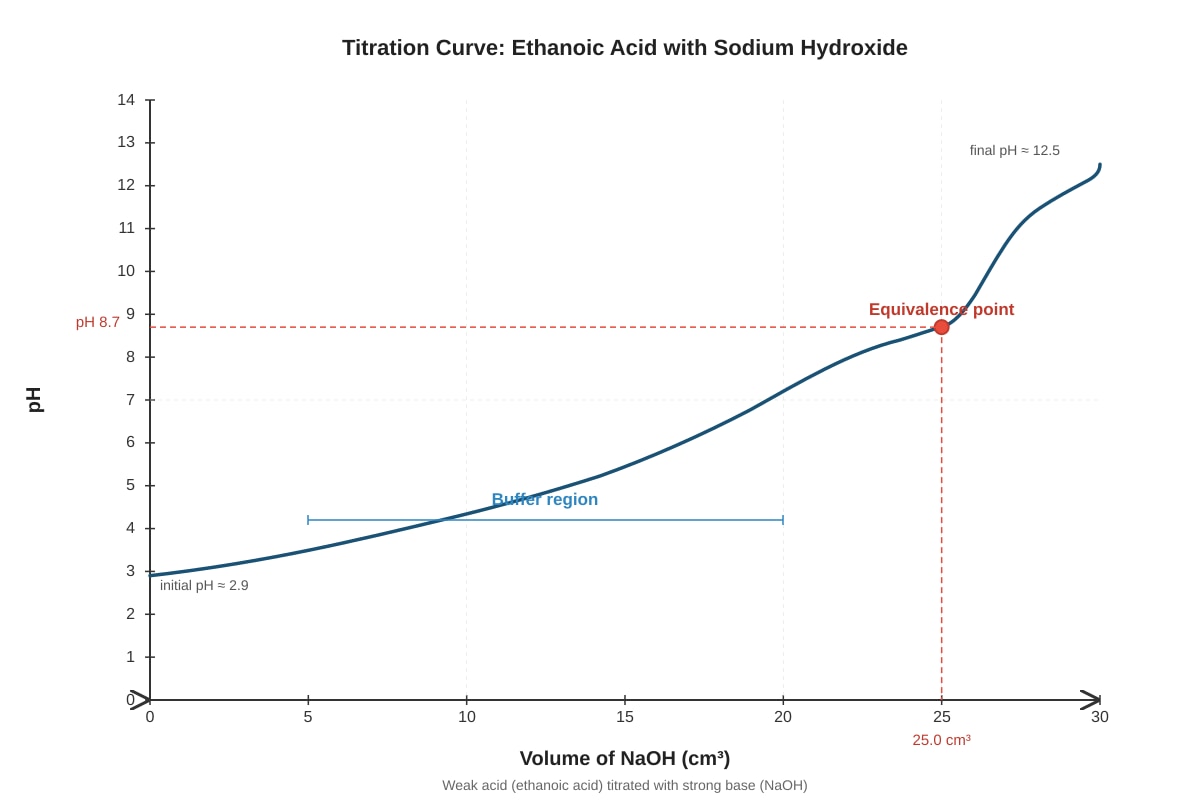
16. (a) Sketch: [4 marks]
- Axes labelled correctly: y-axis: pH (0-14), x-axis: Volume of NaOH (cm³) [1 mark]
- Initial pH: Approximately 2.9 (weak acid) [1 mark]
- Buffer region: Gradual increase in pH between 5-20 cm³ of NaOH [1 mark]
- Equivalence point: At 25.0 cm³ of NaOH, pH approximately 8.7 (basic) [1 mark]
(b) The pH at the equivalence point is not 7 because the salt formed, sodium ethanoate, undergoes hydrolysis. [1 mark] The ethanoate ion () is the conjugate base of a weak acid and reacts with water: . [1 mark] This produces hydroxide ions, making the solution basic (pH > 7). [1 mark]
(c) Phenolphthalein (pH range 8.3–10.0) is suitable. [1 mark] The equivalence point occurs at pH ~8.7, which lies within the colour change range of phenolphthalein, ensuring a sharp colour change at the endpoint. [1 mark]
17. (a) Step 1: Calculate moles:
- Moles of mol
- Moles of mol [1 mark] Step 2: Determine the reaction:
- After reaction: Moles of remaining = mol
- Moles of formed = mol [1 mark] Step 3: Calculate concentrations after mixing (total volume = 75.0 cm³):
- mol dm⁻³
- mol dm⁻³ [1 mark] Step 4: Use the Henderson–Hasselbalch equation: [1 mark]
- [1 mark]
- Final Answer: pH = 4.74
(b) The solution is a buffer because it contains a weak acid () and its conjugate base (). [1 mark] When a small amount of strong acid is added, the ethanoate ions react with the added ions: , minimising the change in pH. [1 mark]
18. (a) Ammonium chloride dissociates completely in water: . [1 mark] The ammonium ion () is the conjugate acid of the weak base ammonia and undergoes hydrolysis: . [1 mark] This produces hydronium ions, making the solution acidic. [1 mark]
(b) Step 1: for [1 mark] Step 2: mol dm⁻³ [2 marks] Step 3: [1 mark]
- Final Answer: pH = 4.98
19. (a) Step 1: for [1 mark] Step 2: mol dm⁻³ [2 marks] Step 3: [0.5 marks] Step 4: [0.5 marks]
- Final Answer: pH = 8.87
(b) The pH is greater than 7 because the ethanoate ion () is the conjugate base of a weak acid and undergoes hydrolysis: [1 mark] , producing hydroxide ions and making the solution basic. [1 mark]
20. (a) For a conjugate acid-base pair, . [1 mark]
(b) [2 marks]
(c) Sodium fluoride dissociates completely in water: . [1 mark] The fluoride ion () is the conjugate base of the weak acid HF and undergoes hydrolysis: , producing hydroxide ions and making the solution basic. [1 mark]