AI Generated Exam Paper
A Level Chemistry H3 Practice Paper 5
Free A Level Chemistry H3 Practice Paper 5, HY3 AI version, with questions, answers, and A Level-style practice for Singapore students.
These static practice materials are generated from the site's syllabus and paper-generation workflow, with source and model context shown so students and parents can evaluate the material before use.
Questions
TuitionGoWhere Practice Paper - Chemistry H3 A-Level
TuitionGoWhere Practice Paper (AI)
Subject: Chemistry H3
Level: A-Level
Paper: Practice Paper (Version 5)
Duration: 2 hours 30 minutes
Total Marks: 100
Name:
Class:
Date:
Instructions:
- This is a syllabus-first practice paper for H3 Chemistry (Syllabus 9813). No past-year exam evidence exists for this subject; questions are generated from syllabus context only.
- Section A is compulsory. Answer all questions.
- Section B: answer any 2 of 3 questions.
- Use the Data Booklet where relevant.
- Show all working for calculation questions.
Section A (60 marks)
1. Define a Brønsted–Lowry acid and base. [2]
2. Write the balanced equation for the reaction of aqueous ammonia with hydrochloric acid. [2]
3. A solution has pH = 3.20. Calculate its hydrogen ion concentration, [H+]. [2]
4. State the colour change of methyl orange in going from pH 3 to pH 5. [1]
5. Explain why a strong acid conducts electricity better than a weak acid of the same concentration. [2]
6. Calculate the pH of 0.050 mol dm−3 HCl. [2]
7. 0.10 mol dm−3 ethanoic acid (Ka=1.8×10⁻⁵) is partially neutralised. Calculate [H+] assuming no salt present. [3]
8. Describe how to prepare a pure sample of lead(II) sulfate from lead(II) nitrate and sodium sulfate. [3]
9. State the ionic equation for the reaction of carbonate ions with acids. [2]
10. A buffer contains 0.20 mol dm−3 CH₃COOH and 0.10 mol dm−3 CH₃COO⁻. Given Ka=1.8×10⁻⁵, find pH. [3]
11. Using the Beer–Lambert Law, calculate concentration c if A=0.45, ε=120 dm3mol−1cm−1, l=1.0 cm. [3]
12. Explain the greenhouse effect with reference to IR absorption by CO₂. [3]
13. Predict the number of IR active stretching absorptions for SO₂. [2]
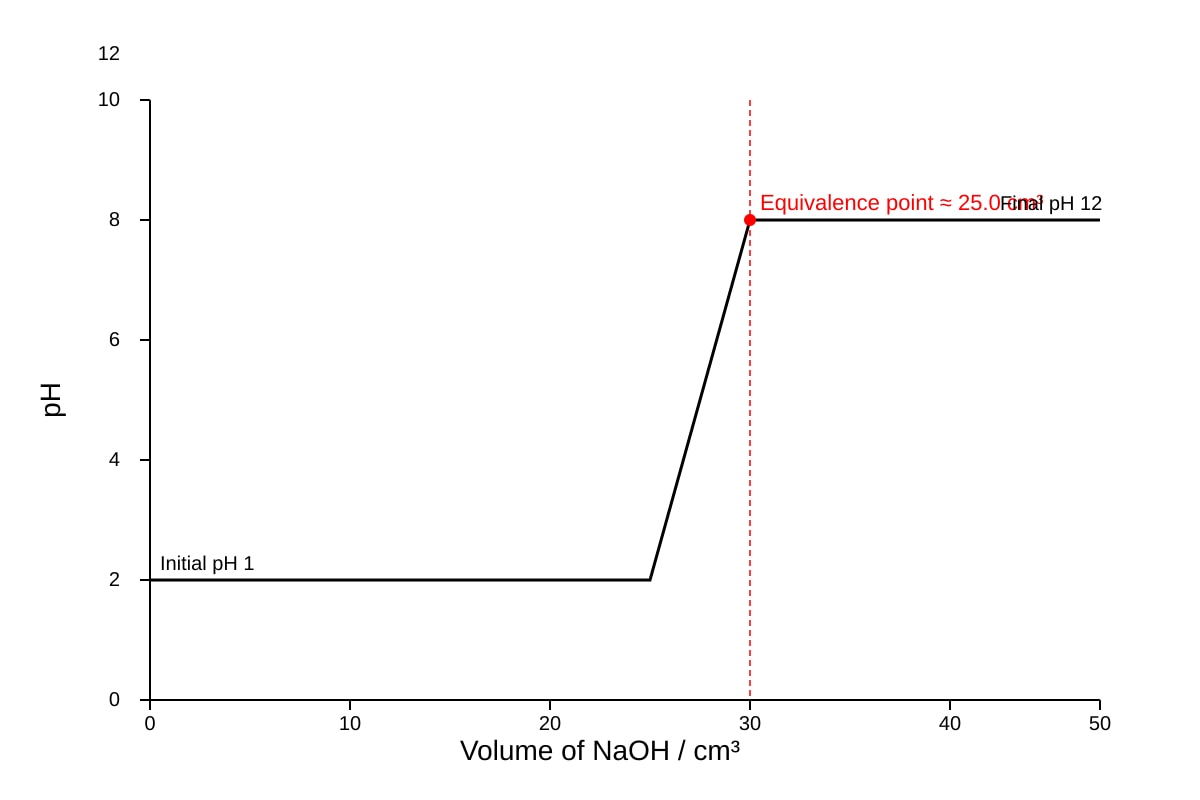
14. A titration curve is shown below. Identify the equivalence point volume.
Image pending generation: graph for 14.
[2]
15. Calculate the volume of 0.100 mol dm−3 NaOH needed to neutralise 25.0 cm³ of 0.080 mol dm−3 H₂SO₄. [3]
16. State and explain the trend in acid strength of HCl, HBr, HI. [3]
17. Write the equation for the hydrolysis of Al³⁺ in water and explain why the solution is acidic. [3]
18. A salt X is formed from weak acid and strong base. Predict whether its aqueous solution is acidic, basic, or neutral. [2]
19. Describe a test to distinguish CaCO₃ from CaSO₄ using dilute HCl. [3]
20. The following is a ¹H NMR context: a compound C₄H₈O₂ shows signals at δ 1.2 (triplet), δ 2.0 (singlet), δ 4.1 (quartet). Suggest a structure consistent with acid/base derived groups. [4]
Section B (40 marks – answer 2 of 3)
21. (a) Derive the Henderson–Hasselbalch equation. (b) Use it to calculate pH when [A−]/[HA]=2 and pKa=4.76. [10]
22. A student prepares a salt by reacting excess CuO with H₂SO₄. (a) Write equation. (b) Describe purification. (c) Calculate mass of CuSO₄·5H₂O from 8.0 g CuO. [10]
23. (a) Explain how increasing conjugation lowers UV absorption energy. (b) A diene shows λmax at 280 nm, a triene at 310 nm; relate to HOMO–LUMO gap. [10]
Answers
TuitionGoWhere Practice Paper - Chemistry H3 A-Level (Answers)
Version 5 Answer Key
Section A
1. [2] Brønsted–Lowry acid: proton donor. Base: proton acceptor. (1 each)
2. [2] NH₃(aq) + HCl(aq) → NH₄Cl(aq) or NH₃ + H⁺ → NH₄⁺.
3. [2] [H+]=10−pH=10−3.20=6.31×10⁻⁴ mol dm−3.
4. [1] Red to yellow/orange (methyl orange red < 3.1, yellow > 4.4).
5. [2] Strong acid fully dissociates → more ions → higher conductivity than weak acid (partial dissociation).
6. [2] HCl strong: [H+]=0.050; pH = −lg0.050=1.30.
7. [3] Ka=[H+][A−]/[HA]≈[H+]2/0.10; [H+]=1.8×10−6=1.34×10⁻³ mol dm−3.
8. [3] Mix solutions, filter precipitate, wash with distilled water, dry. (1 each)
9. [2] CO₃²⁻ + 2H⁺ → CO₂ + H₂O.
10. [3] pH = pK_a + lg([A⁻]/[HA]) = 4.74 + lg(0.10/0.20) = 4.74 – 0.30 = 4.44.
11. [3] c=A/(εl)=0.45/(120×1.0)=3.75×10−3 mol dm−3.
12. [3] IR from Earth absorbed by CO₂ vibrational modes, re-emitted, traps heat. (1 mechanism, 2 link)
13. [2] SO₂ bent, 2 distinct stretches (sym + asym) → 2 IR active.
14. [2] Equivalence at 25.0 cm³ from inflection.
15. [3] mol H₂SO₄ = 0.025 × 0.080 = 2.0×10⁻³; mol H⁺ = 4.0×10⁻³; V NaOH = 4.0×10⁻³ / 0.100 = 0.040 dm³ = 40.0 cm³.
16. [3] Acid strength increases HI > HBr > HCl due to weaker H–X bond down group.
17. [3] Al³⁺ + H₂O ⇌ AlOH²⁺ + H⁺; release H⁺ makes acidic.
18. [2] Basic (anion hydrolyses to OH⁻).
19. [3] Add HCl: CaCO₃ effervesces (CO₂), CaSO₄ no/no visible gas.
20. [4] CH₃COOCH₂CH₃? Actually C₄H₈O₂ with singlet at 2.0 suggests CH₃COO–; quartet+triplet = ethyl; structure ethyl ethanoate CH₃COOCH₂CH₃ (consistent with ester from acid/alcohol).
Section B (answer any 2)
21. [10] (a) Ka=[H+][A−]/[HA] → [H+]=Ka[HA]/[A−]; take -lg: pH = pK_a + lg([A⁻]/[HA]). (5) (b) pH = 4.76 + lg 2 = 5.06. (5)
22. [10] (a) CuO + H₂SO₄ → CuSO₄ + H₂O. (2) (b) Evaporate, crystallise, filter, dry. (3) (c) n CuO = 8.0/79.5 = 0.100 mol; n CuSO₄·5H₂O = 0.100; mass = 0.100 × 249.7 = 25.0 g. (5)
23. [10] (a) Conjugation lowers π→π* gap → longer λ. (5) (b) Triene smaller gap than diene → 310 > 280 nm consistent. (5)
Free quiz and exam paper access
Enter your details to view this paper
Your access is remembered on this device.