TuitionGoWhere Practice Paper - Chemistry H3 A-Level
TuitionGoWhere Practice Paper (AI) — Version 4
Subject: Chemistry H3
Level: A-Level
Paper: Practice Paper (Topic: Acids Bases Salts)
Duration: 1 hour 15 minutes
Total Marks: 40
Name: ______________________
Class: ______________________
Date: ______________________
Instructions:
- This practice paper is generated from syllabus-first inference. It is NOT derived from past-year A-Level H3 papers (none exist for syllabus 9813 yet).
- Answer all 20 questions.
- Useful data: Kw=1.0×10⁻¹⁴ mol2 dm−6 at 298 K; R=8.314 J K−1 mol−1.
- Show all working where calculation is involved.
Section A: Short Structured Questions (1–10) [20 marks]
Each question carries 2 marks unless stated.
1. Define a Brønsted–Lowry acid and give one example of a conjugate base formed from a weak acid. [2]
2. Write the equilibrium expression for the dissociation of ethanoic acid, CH3COOH, in water. [2]
3. Calculate the pH of a 1.0×10⁻³ mol dm−3 solution of hydrochloric acid at 298 K. [2]
4. State the colour change of methyl orange in going from pH 3 to pH 5. [2]
5. A solution has [OH−]=2.0×10⁻⁴ mol dm−3 at 298 K. Calculate its pOH and pH. [2]
6. Explain, using an equation, how NH3 acts as a base in water. [2]
7. Name the salt formed from the neutralisation of HNO3 and KOH. [2]
8. Give the formula of the precipitate formed when BaCl2 reacts with Na2SO4. [2]
9. State whether NH4Cl solution is acidic, basic, or neutral, and give one reason. [2]
10. Write the ionic equation for the reaction of Mg with dilute H2SO4. [2]
Section B: Applied and Multi-step (11–15) [10 marks]
11. A 0.050 mol dm−3 solution of a weak monoprotic acid HA has pH = 3.00. Calculate Ka and hence pKa. [3]
12. Describe how you would prepare a pure sample of zinc sulfate crystals from zinc oxide and dilute sulfuric acid. [3]
13. The titration curve below shows the addition of 0.100 mol dm−3 NaOH to 25.0 cm3 of 0.100 mol dm−3 HCl.
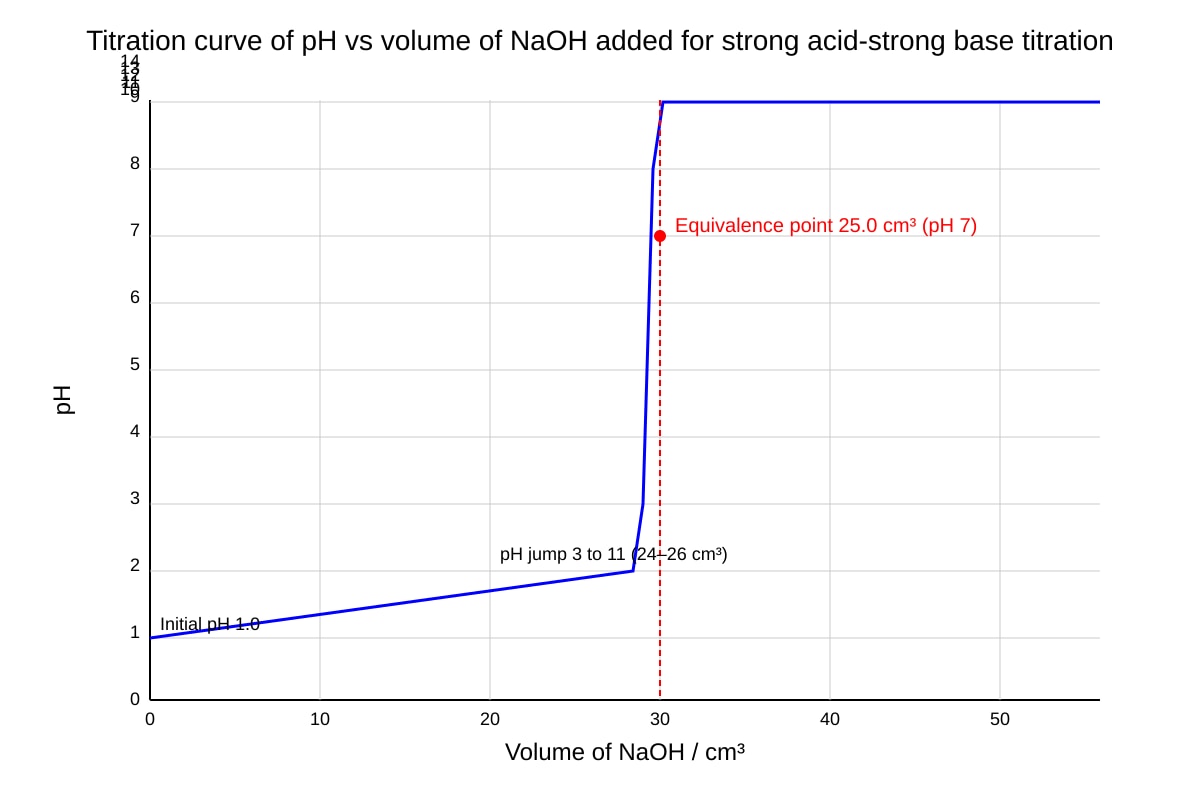
Generated graph for Q13.
State the pH at the equivalence point and give the reason for the shape of the curve. [2]
14. Calculate the volume of 0.200 mol dm−3 HCl required to neutralise 50.0 cm3 of 0.100 mol dm−3 Ba(OH)2. [2]
15. Explain the difference between a strong acid and a concentrated acid. [2]
Section C: Synthesis and Evaluation (16–20) [10 marks]
16. A student adds excess CaCO3 to 2.00 mol dm−3 HCl. Write the equation and calculate the maximum volume of CO2 (at 298 K, 1 atm) from 25.0 cm3 acid. (1 mol gas ≈ 24.5 dm3.) [3]
17. Compare the hydrolysis of CH3COO− and Cl− in water; include equations and state which produces alkaline conditions. [2]
18. A buffer contains 0.10 mol dm−3 CH3COOH (Ka=1.8×10⁻⁵) and 0.20 mol dm−3 CH3COO−. Calculate the pH. [2]
19. State two precautions in an acid–base titration using a burette and explain why each is needed. [2]
20. Given that H2S is a weak diprotic acid (Ka1=9.1×10⁻⁸), explain why the second dissociation contributes negligibly to [H+]. [1]