TuitionGoWhere Practice Paper - Chemistry H3 A-Level
TuitionGoWhere Practice Paper (AI) — Version 3
Subject: Chemistry H3
Level: A-Level
Paper: Practice Paper (Syllabus-First, Version 3 of 5)
Duration: 2 hours 30 minutes
Total Marks: 100
Name: ______________________
Class: ______________________
Date: ______________________
Instructions:
- This paper is a syllabus-aligned practice paper for H3 Chemistry (9813). It is generated from syllabus context only; no past-year exam templates exist because the syllabus is first examined in 2026.
- Section A is compulsory. Answer all questions.
- Section B: answer TWO out of THREE questions.
- Use the Data Booklet where relevant. Show all working for calculation questions.
- Write your answers in the spaces provided.
Section A (60 marks)
Compulsory structured questions. Answer all.
1. [3 marks]
Define a Brønsted–Lowry acid and a Brønsted–Lowry base. Write the conjugate base of HNO3 and the conjugate acid of NH3.
2. [2 marks]
State the expression for the acid dissociation constant, Ka, of a weak monoprotic acid HA in aqueous solution.
3. [4 marks]
Calculate the pH of a 0.025 mol dm−3 solution of ethanoic acid (Ka=1.8×10⁻⁵ mol dm−3 at 298 K). Show your working.
4. [3 marks]
Explain, using an equation, why a solution of Na2CO3 is alkaline in water.
5. [3 marks]
A student prepares a buffer solution by mixing 0.10 mol of CH3COOH with 0.05 mol of NaOH in 1.0 dm3 of water. State the species present that confer buffer action and identify the limiting reagent.
6. [4 marks]
Using the Henderson–Hasselbalch equation, calculate the pH of the buffer in Q5 given Ka(CH3COOH)=1.8×10⁻⁵ mol dm−3.
7. [3 marks]
State and explain the colour change observed when phenolphthalein is used as indicator in the titration of HCl with NH3.
8. [4 marks]
For the diprotic acid H2SO3, write the two stage dissociation equations and state the expression for Ka1 and Ka2.
9. [3 marks]
Explain the term "salt hydrolysis" and give one example of a salt that undergoes hydrolysis to give an acidic solution.
10. [4 marks]
25.0 cm3 of 0.100 mol dm−3 Ba(OH)2 is neutralised by HCl of unknown concentration. 20.0 cm3 of the acid is required. Calculate the concentration of the HCl.
11. [5 marks]
The titration curve below shows the addition of NaOH to a weak acid HA.
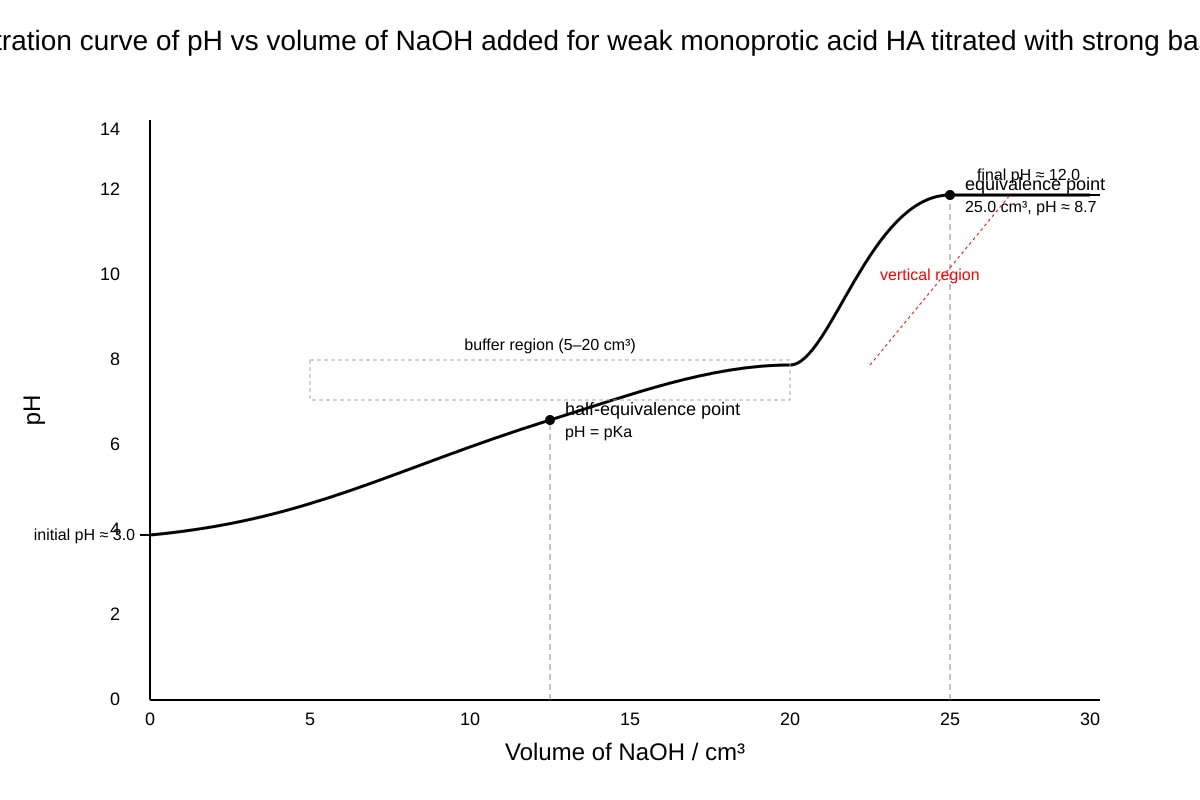
Generated graph for Q11.
(a) State the volume of NaOH at the equivalence point. [1]
(b) Use the curve to estimate the pKa of HA. [2]
(c) Explain why the pH at equivalence is greater than 7. [2]
12. [3 marks]
State two assumptions made when using the approximation [HA]eq≈[HA]initial in weak acid pH calculations.
13. [4 marks]
A salt MX is formed from a weak acid HX (Ka=4.0×10⁻⁶) and a strong base MOH. Calculate the pH of a 0.10 mol dm−3 solution of MX at 298 K.
14. [3 marks]
Give the balanced equation for the reaction of ZnO with H2SO4 and state whether ZnO is acidic, basic, or amphoteric.
15. [4 marks]
Compare the conductivities of 0.10 mol dm−3 HCl and 0.10 mol dm−3 CH3COOH at 298 K. Explain your answer in terms of degree of dissociation.
16. [3 marks]
Write the ionic equation for the precipitation of AgCl from AgNO3 and NaCl. State the observation.
17. [4 marks]
A sample of vinegar is analysed by titrating 10.0 cm3 with 0.0500 mol dm−3 NaOH. 16.5 cm3 is required to reach endpoint. Calculate the concentration of ethanoic acid in the vinegar in mol dm−3 and g dm−3.
18. [3 marks]
State the Lewis definition of an acid and a base, and identify the Lewis acid in the reaction BF3+NH3→F3B←NH3.
19. [3 marks]
Explain why NH4Cl solution has pH < 7 whereas NaCl solution has pH ≈ 7.
20. [5 marks]
A student adds solid Na2CO3 gradually to 50.0 cm3 of 0.100 mol dm−3 HCl.
(a) Write the equation for the first stage reaction. [2]
(b) Calculate the minimum mass of Na2CO3 required to exactly neutralise all acid to CO2 and water. [3]
Section A subtotal: 60 marks
Section B (40 marks)
Answer TWO out of THREE questions. Each carries 20 marks.
21. [20 marks]
(a) Describe how a buffer solution resists changes in pH upon addition of small amounts of strong acid and strong base, using equations. [6]
(b) A buffer is made from 0.20 mol dm−3 NH3 (Kb=1.8×10⁻⁵) and 0.10 mol dm−3 NH4Cl. Calculate its pH. [6]
(c) The buffer is diluted to twice its volume with deionised water. Discuss the effect on its pH and buffer capacity. [8]
22. [20 marks]
(a) Explain the difference between strong and weak acids in terms of Ka and percentage dissociation. [5]
(b) For a 0.050 mol dm−3 solution of a weak acid HA with pH 3.50, calculate Ka and percentage dissociation. [8]
(c) Sketch a labelled diagram showing the distribution of species in solution for a weak acid, and explain the role of the conjugate base. [7]
23. [20 marks]
(a) Define amphoterism with two equations showing Al(OH)3 acting as acid and base. [6]
(b) A mixture contains HCl and CH3COOH. Describe how you would determine the concentration of each by titration with NaOH using phenolphthalein and appropriate calculation logic. [8]
(c) Evaluate the limitation of using pH alone to distinguish the two acids at equal concentration. [6]
Section B subtotal (2 questions attempted): 40 marks
Total Marks: 100