AI Generated Exam Paper
A Level Chemistry H3 Practice Paper 2
Free A Level Chemistry H3 Practice Paper 2, HY3 AI version, with questions, answers, and A Level-style practice for Singapore students.
These static practice materials are generated from the site's syllabus and paper-generation workflow, with source and model context shown so students and parents can evaluate the material before use.
Questions
A-Level Chemistry H3 Quiz - Acids Bases Salts
TuitionGoWhere Practice Quiz (AI) — Version 2 of 5 Subject: Chemistry H3 Level: A-Level Topic: Acids Bases Salts Name: ______________ Class: ______________ Date: ______________ Score: ______________ / 40
Duration: 50 minutes Total Marks: 40
Instructions:
- This quiz contains 20 questions on the topic Acids, Bases and Salts, drawing on H2 foundational knowledge extended to H3 analytical depth.
- Answer all questions in the spaces provided.
- Show all working for calculation questions. Use appropriate units and chemical notation.
- This is syllabus-first generated content; it is not derived from past-year exam papers.
Section A: Foundations (Questions 1–5, 10 marks)
1. Define a Brønsted–Lowry acid and a Brønsted–Lowry base. [2]
Answer: ___________________________________________________________
2. Write the conjugate base of H2PO4−. [1]
Answer: ___________________________________________________________
3. State the colour change of methyl orange in a solution of pH 3. [1]
Answer: ___________________________________________________________
4. Calculate the pH of a 0.010 mol dm−3 solution of HCl at 25 °C. [2]
Answer: ___________________________________________________________
5. Give one example of a salt formed from a strong acid and weak base, and state whether its aqueous solution is acidic, basic or neutral. [2]
Answer: ___________________________________________________________
Section B: Quantitative Acid–Base Chemistry (Questions 6–10, 10 marks)
6. A 25.0 cm3 sample of 0.100 mol dm−3 NaOH is titrated with 0.100 mol dm−3 HCl. Calculate the volume of HCl required for neutralisation. [2]
Answer: ___________________________________________________________
7. The Ka of ethanoic acid is 1.8×10⁻⁵ mol dm−3. Calculate the pH of a 0.050 mol dm−3 solution of ethanoic acid. [3]
Answer: ___________________________________________________________
8. Explain, using an equation, why a solution of CH3COONa is basic. [2]
Answer: ___________________________________________________________
9. 10.0 cm3 of 0.200 mol dm−3 H2SO4 is diluted to 100.0 cm3. Calculate the concentration of H+ in the final solution. [2]
Answer: ___________________________________________________________
10. State two assumptions made when using the approximation [H+]=Kac for a weak acid. [1]
Answer: ___________________________________________________________
Section C: Salt Preparation and Analysis (Questions 11–15, 10 marks)
11. Describe a method to prepare pure, dry crystals of barium sulfate from barium chloride and dilute sulfuric acid. [3]
Answer: ___________________________________________________________
12. A student adds aqueous silver nitrate to a solution suspected to contain chloride ions. State the observation and write the ionic equation. [2]
Answer: ___________________________________________________________
13. Explain why ammonium chloride solution is slightly acidic. [2]
Answer: ___________________________________________________________
14. Calculate the mass of anhydrous sodium carbonate required to prepare 250 cm3 of a 0.100 mol dm−3 solution. (Mr of Na2CO3=106.0) [2]
Answer: ___________________________________________________________
15. State one test to distinguish between a sulfate and a carbonate salt using dilute acid. [1]
Answer: ___________________________________________________________
Section D: Synthesis and Evaluation (Questions 16–20, 10 marks)
16. A buffer solution contains 0.10 mol dm−3 CH3COOH and 0.10 mol dm−3 CH3COO−. Calculate its pH given Ka=1.8×10⁻⁵. [2]
Answer: ___________________________________________________________
17. Explain how the buffer in Q16 resists a small addition of HCl. Include an equation. [2]
Answer: ___________________________________________________________
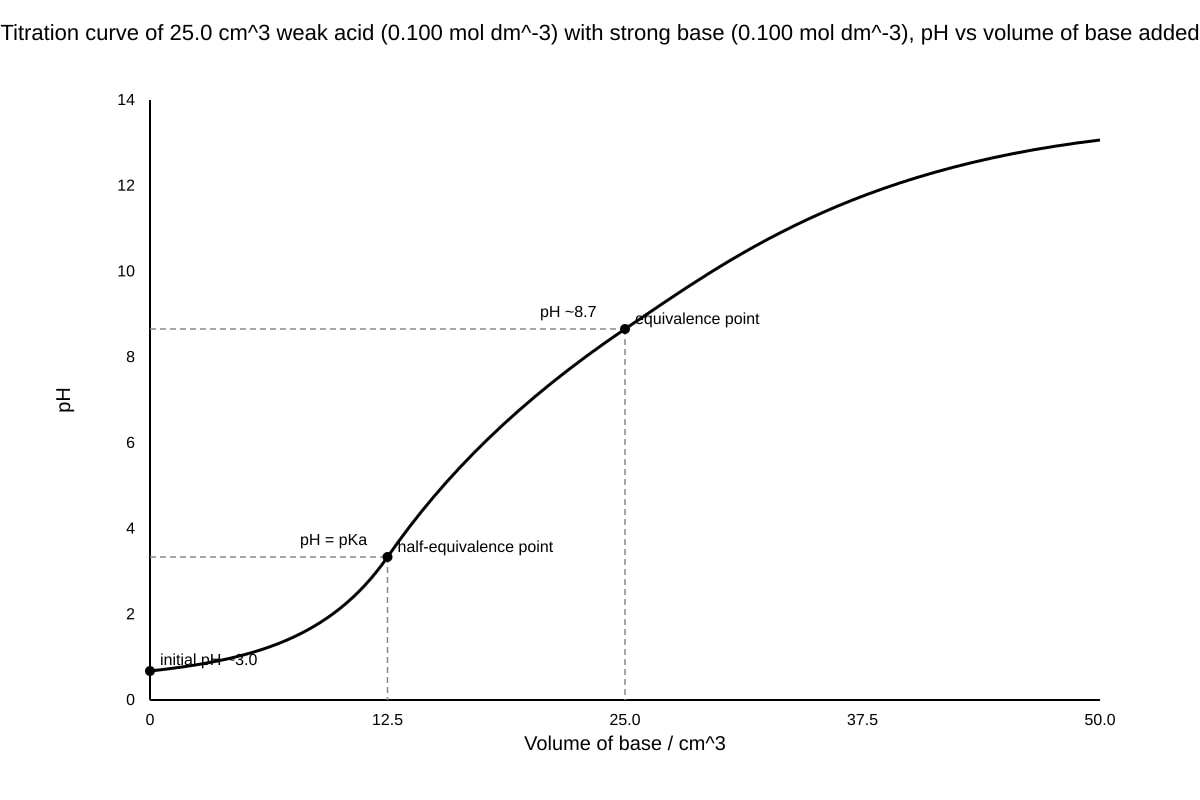
18. The titration curve below shows the neutralisation of a weak acid by a strong base.
Image pending generation: graph for Q18.
State the pH at the half-equivalence point and explain its significance. [2]
Answer: ___________________________________________________________
19. Compare the thermal stability of Group 1 and Group 2 carbonates with reference to cation polarising power. [2]
Answer: ___________________________________________________________
20. A salt X gives a green flame test and forms a white precipitate with aqueous NaOH that is insoluble in excess. Suggest the metal ion in X and one confirmatory test. [2]
Answer: ___________________________________________________________
Answers
A-Level Chemistry H3 Quiz - Acids Bases Salts (Answer Key)
Version 2 of 5 — Syllabus-first generated content (not exam-derived)
Section A: Foundations (Q1–5)
1. [2 marks]
- Brønsted–Lowry acid: proton (H+) donor. [1]
- Brønsted–Lowry base: proton (H+) acceptor. [1] Teaching note: This definition extends beyond aqueous systems and is essential for H3 mechanistic reasoning.
2. [1 mark]
- HPO42− Teaching note: Remove one H+ from H2PO4−; charge decreases by 1.
3. [1 mark]
- Red (methyl orange is red below pH 3.1, orange at 3.1–4.4, yellow above) Teaching note: At pH 3, solution is within red region.
4. [2 marks]
- HCl is strong monoprotic: [H+]=0.010 mol dm−3
- pH=−lg(0.010)=2.00 [2] Common mistake: forgetting strong acid fully dissociates.
5. [2 marks]
- Example: NH4Cl (from HCl + NH3) [1]
- Aqueous solution is acidic [1] Teaching note: NH4+ hydrolyses: NH4++H2O⇌NH3+H3O+.
Section B: Quantitative Acid–Base Chemistry (Q6–10)
6. [2 marks]
- n(NaOH)=0.0250×0.100=2.50×10⁻³ mol
- HCl+NaOH→NaCl+H2O, 1:1
- V(HCl)=n/c=2.50×10−3/0.100=0.0250 dm3=25.0 cm3 [2]
7. [3 marks]
- Ka=[HA][H+][A−]≈0.050x2 [1]
- x2=1.8×10−5×0.050=9.0×10⁻⁷ [1]
- x=9.49×10⁻⁴; pH=−lg(9.49×10⁻⁴)=3.02 [1]
8. [2 marks]
- CH3COO−+H2O⇌CH3COOH+OH− [1]
- Produces OH− so solution basic [1]
9. [2 marks]
- n(H2SO4)=0.0100×0.200=2.00×10⁻³ mol
- Each H2SO4 gives 2 H+: n(H+)=4.00×10⁻³ mol
- [H+]=4.00×10⁻³/0.100=0.0400 mol dm−3 [2]
10. [1 mark]
- Degree of dissociation is small (so [HA]≈c) [0.5]
- [H+]≈[A−] [0.5]
Section C: Salt Preparation and Analysis (Q11–15)
11. [3 marks]
- Mix BaCl2(aq) and H2SO4(aq) to precipitate BaSO4 [1]
- Filter, wash precipitate with distilled water [1]
- Dry in oven / warm dessicator [1] Teaching note: BaSO4 is insoluble; no crystallisation needed.
12. [2 marks]
- White precipitate of AgCl [1]
- Ag++Cl−→AgCl(s) [1]
13. [2 marks]
- NH4++H2O⇌NH3+H3O+ [1]
- Cl− from strong acid HCl is neutral; H3O+ makes solution acidic [1]
14. [2 marks]
- n=0.250×0.100=0.0250 mol
- m=0.0250×106.0=2.65 g [2]
15. [1 mark]
- Add dilute HCl: carbonate gives CO2 gas (effervescence); sulfate gives no gas.
Section D: Synthesis and Evaluation (Q16–20)
16. [2 marks]
- pH=pKa+lg[HA][A−]
- pKa=−lg(1.8×10⁻⁵)=4.74; ratio = 1 → pH = 4.74 [2]
17. [2 marks]
- Added H+ reacts with CH3COO−: CH3COO−+H+→CH3COOH [1]
- Removes free H+, minimising pH change [1]
18. [2 marks]
- pH at half-equivalence = pKa of weak acid (≈4.74 if ethanoic) [1]
- At this point [HA]=[A−], so buffer region midpoint; pH = pKa [1] Image note: Curve must show half-equivalence at 12.5 cm³ with pH labelled.
19. [2 marks]
- Group 2 cations smaller, higher charge density → greater polarising power [1]
- Destabilise large CO32− anion → Group 2 carbonates less thermally stable than Group 1 [1]
20. [2 marks]
- Green flame: Cu2+ (copper(II)) [1]
- Confirmatory: add NH3; blue precipitate insoluble in excess (or K4[Fe(CN)6] gives red-brown ppt) [1]
Free quiz and exam paper access
Enter your details to view this paper
Your access is remembered on this device.