TuitionGoWhere Practice Paper - Chemistry H3 A-Level
TuitionGoWhere Practice Paper (AI) — Version 1
Subject: Chemistry H3
Level: A-Level
Paper: Practice Paper (Syllabus-First, No Past-Paper Evidence)
Duration: 2 hours 30 minutes
Total Marks: 100
Name:
Class:
Date:
Instructions:
- This practice paper is generated from syllabus context only. No past-year A-Level H3 Chemistry papers exist (first exam 2026). It is NOT an official SEAB paper.
- Section A is compulsory (60 marks). Section B requires you to answer 2 of 3 questions (40 marks).
- Use the Data Booklet where relevant. Show all working for calculation questions.
- Write answers in the spaces provided.
Section A (60 marks)
1. Define the Brønsted–Lowry concept of an acid and a base. [2]
2. Write the conjugate base of NH4+ and the conjugate acid of H2O. [2]
3. State the expression for the acid dissociation constant, Ka, of a weak monoprotic acid HA in water. [1]
4. Calculate the pH of a 0.020 mol dm−3 solution of ethanoic acid (Ka=1.8×10⁻⁵ mol dm−3) at 298 K. [3]
5. Explain, using an equation, why a solution of Na2CO3 is alkaline. [3]
6. A student titrates 25.0 cm3 of 0.100 mol dm−3 HCl with 0.100 mol dm−3 NaOH.
(a) Calculate the volume of NaOH required for neutralisation. [2]
(b) State the pH at the equivalence point. [1]
7. The table below shows Ka values for three acids.
| Acid | Ka / mol dm−3 |
|---|
| A | 1.0×10⁻³ |
| B | 4.5×10⁻⁵ |
| C | 2.0×10⁻⁹ |
Arrange A, B, C in order of decreasing acid strength. [1]
8. Describe the change in pH observed when NH3 solution is added gradually to HCl until excess. [2]
9. State two differences between a strong acid and a weak acid of the same concentration. [2]
10. Write the ionic equation for the reaction of MgO with HNO3. [2]
11. A buffer solution contains 0.10 mol dm−3 CH3COOH and 0.15 mol dm−3 CH3COO− (Ka=1.8×10⁻⁵).
(a) Calculate the pH of the buffer. [3]
(b) Explain how the buffer resists pH change on addition of small amount of HCl. [2]
12.
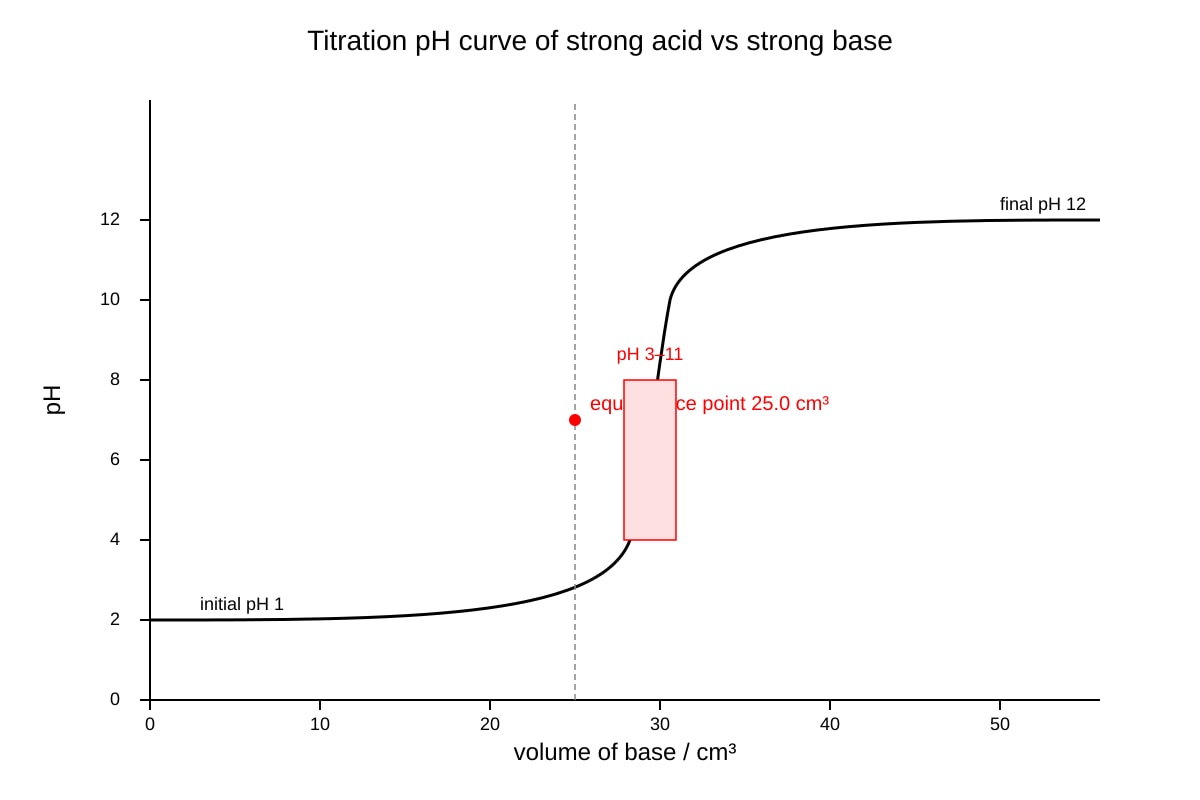
Generated graph for Q12.
Using the graph, state the volume at equivalence and the approximate pH range of the indicator transition suitable for this titration. [2]
13. Explain the term "amphiprotic" and give one example with equation. [3]
14. Calculate [H+] in a solution of pH 4.20. [2]
15. A salt MX is formed from weak acid HX and strong base MOH. Predict whether its aqueous solution is acidic, alkaline, or neutral, and explain. [3]
16. Write the balanced equation for the preparation of PbSO4 from Pb(NO3)2 and Na2SO4. [2]
17. State the colour change of methyl orange in acid and in alkali. [2]
18. A sample of CaCO3 reacts with excess HCl:
CaCO3(s)+2HCl(aq)→CaCl2(aq)+CO2(g)+H2O(l)
If 0.0500 mol CaCO3 is used, calculate the volume of CO2 at room temperature and pressure (24.0 dm3 mol−1). [2]
19. Explain why AlCl3 solution is acidic. [2]
20. The following data are from a pH meter reading during titration of HA (weak acid) with NaOH:
| Vol NaOH / cm³ | pH |
|---|
| 0 | 2.90 |
| 10 | 4.20 |
| 20 | 4.95 |
| 25 | 8.70 |
(a) Estimate the pKa of HA. [1]
(b) Explain your reasoning. [2]
Section B (Answer 2 of 3; 40 marks)
21. (a) Derive the Henderson–Hasselbalch equation from Ka definition. [4]
(b) A buffer has pH 5.00, [CH3COO−]=0.20 M, pKa=4.74. Find [CH3COOH]. [3]
(c) State one limitation of the buffer equation at extreme pH. [1]
22. (a) Explain how Kw varies with temperature and its effect on neutral pH. [4]
(b) At 310 K, Kw=2.9×10⁻¹⁴. Calculate pH of neutral water. [3]
(c) Suggest why Kw increases with T. [1]
23. (a) Compare the hydrolysis of CH3COO− and NH4+ in water. [4]
(b) A solution contains both at equal concentration. Predict pH and explain. [3]
(c) Name one salt that forms an acidic solution from strong acid + weak base. [1]
End of Paper