AI Generated Exam Paper

A Level Chemistry H3 Practice Paper 1

Free A Level Chemistry H3 Practice Paper 1, AI version, with questions, answers, and A Level-style practice for Singapore students.

These static practice materials are generated from the site's syllabus and paper-generation workflow, with source and model context shown so students and parents can evaluate the material before use.

A Level Chemistry H3 AI Generated Generated by DeepSeek V4 Flash Sample 03 Updated 2026-08-17

Questions

Free quiz and exam paper access

Enter your details to view this paper

Your access is remembered on this device.

Answers

TuitionGoWhere Practice Paper - Chemistry H3 A-Level: Answer Key and Marking Scheme

Subject: Chemistry H3 Level: A-Level (H3, Syllabus 9813) Paper: Practice Paper (Version 1 of 5) Total Marks: 100


Section A (60 Marks)

Question 1 (Total: 9 marks)

(a) Brønsted–Lowry acid: A species that donates a proton (H+H^+). [1] Brønsted–Lowry base: A species that accepts a proton (H+H^+). [1]

(b) (i) Ka=[CH3COO][H+][CH3COOH]K_a = \frac{[CH_3COO^-][H^+]}{[CH_3COOH]} [1]

(ii) Step 1: Set up ICE table (or use approximation). CH3COOHCH3COO+H+CH_3COOH \rightleftharpoons CH_3COO^- + H^+ Initial: 0.250, 0, 0 Change: -x, +x, +x Equilibrium: 0.250 - x, x, x

Step 2: Substitute into KaK_a expression. 1.74×105=x20.250x1.74 \times 10^{-5} = \frac{x^2}{0.250 - x}

Step 3: Assume x is negligible compared to 0.250 (since KaK_a is small). 1.74×105x20.2501.74 \times 10^{-5} \approx \frac{x^2}{0.250} x2=4.35×10⁶x^2 = 4.35 \times 10^{-6} x=2.09×10³ mol dm3x = 2.09 \times 10^{-3} \text{ mol dm}^{-3}

Step 4: Calculate pH. pH=log[H+]=log(2.09×10³)=2.68pH = -\log[H^+] = -\log(2.09 \times 10^{-3}) = 2.68 [2]

Assumption: The extent of dissociation of ethanoic acid is negligible, so [CH3COOH]equilibrium0.250 mol dm3[CH_3COOH]_{equilibrium} \approx 0.250 \text{ mol dm}^{-3}. [1]

(c) (i) Step 1: Calculate moles of acid and salt. Moles of CH3COOH=50.01000×0.500=0.0250 molCH_3COOH = \frac{50.0}{1000} \times 0.500 = 0.0250 \text{ mol} Moles of CH3COONa=25.01000×0.500=0.0125 molCH_3COONa = \frac{25.0}{1000} \times 0.500 = 0.0125 \text{ mol}

Step 2: Calculate concentrations in the mixture. Total volume = 75.0 cm³ = 0.0750 dm³. [CH3COOH]=0.02500.0750=0.333 mol dm3[CH_3COOH] = \frac{0.0250}{0.0750} = 0.333 \text{ mol dm}^{-3} [CH3COO]=0.01250.0750=0.167 mol dm3[CH_3COO^-] = \frac{0.0125}{0.0750} = 0.167 \text{ mol dm}^{-3}

Step 3: Use the Henderson–Hasselbalch equation. pH=pKa+log[CH3COO][CH3COOH]pH = pK_a + \log\frac{[CH_3COO^-]}{[CH_3COOH]} pH=log(1.74×10⁵)+log0.1670.333pH = -\log(1.74 \times 10^{-5}) + \log\frac{0.167}{0.333} pH=4.76+log(0.500)=4.760.301=4.46pH = 4.76 + \log(0.500) = 4.76 - 0.301 = 4.46 [2]

(ii) The added H+H^+ ions react with the ethanoate ions, CH3COOCH_3COO^-, to form undissociated ethanoic acid, CH3COOHCH_3COOH. This removes most of the added H+H^+ ions, so the pH change is small. [1]


Question 2 (Total: 10 marks)

(a) (i) B+H2OBH++OHB + H_2O \rightleftharpoons BH^+ + OH^- [1]

(ii) Step 1: Calculate [OH][OH^-] from pH. pOH=14pH=1411.13=2.87pOH = 14 - pH = 14 - 11.13 = 2.87 [OH]=102.87=1.35×10³ mol dm3[OH^-] = 10^{-2.87} = 1.35 \times 10^{-3} \text{ mol dm}^{-3}

Step 2: Set up ICE table. B+H2OBH++OHB + H_2O \rightleftharpoons BH^+ + OH^- Initial: 0.100, 0, 0 Change: -x, +x, +x Equilibrium: 0.100 - x, x, x where x=[OH]=1.35×10³ mol dm3x = [OH^-] = 1.35 \times 10^{-3} \text{ mol dm}^{-3}

Step 3: Substitute into KbK_b expression. Kb=[BH+][OH][B]=x20.100x=(1.35×10³)20.1001.35×103K_b = \frac{[BH^+][OH^-]}{[B]} = \frac{x^2}{0.100 - x} = \frac{(1.35 \times 10^{-3})^2}{0.100 - 1.35 \times 10^{-3}} Kb=1.82×1060.09865=1.85×10⁵ mol dm3K_b = \frac{1.82 \times 10^{-6}}{0.09865} = 1.85 \times 10^{-5} \text{ mol dm}^{-3} [3]

(b) (i) The ionic product of water, KwK_w, is the product of the concentrations of hydrogen ions and hydroxide ions in water, Kw=[H+][OH]K_w = [H^+][OH^-]. At 298 K, Kw=1.00×10¹⁴ mol2 dm6K_w = 1.00 \times 10^{-14} \text{ mol}^2 \text{ dm}^{-6}. [1]

(ii) Step 1: Calculate [OH][OH^-]. Ba(OH)2Ba2++2OHBa(OH)_2 \rightarrow Ba^{2+} + 2OH^- [OH]=2×0.0100=0.0200 mol dm3[OH^-] = 2 \times 0.0100 = 0.0200 \text{ mol dm}^{-3}

Step 2: Calculate [H+][H^+]. [H+]=Kw[OH]=1.00×10140.0200=5.00×10¹³ mol dm3[H^+] = \frac{K_w}{[OH^-]} = \frac{1.00 \times 10^{-14}}{0.0200} = 5.00 \times 10^{-13} \text{ mol dm}^{-3}

Step 3: Calculate pH. pH=log(5.00×10¹³)=12.30pH = -\log(5.00 \times 10^{-13}) = 12.30 [2]

(c) (i) Step 1: Calculate [H+][H^+] of the original solution. [H+]=101.30=0.0501 mol dm3[H^+] = 10^{-1.30} = 0.0501 \text{ mol dm}^{-3}

Step 2: Calculate [H+][H^+] after dilution. Dilution factor = 100, so [H+]diluted=0.0501100=5.01×10⁴ mol dm3[H^+]_{diluted} = \frac{0.0501}{100} = 5.01 \times 10^{-4} \text{ mol dm}^{-3}

Step 3: Calculate pH. pH=log(5.01×10⁴)=3.30pH = -\log(5.01 \times 10^{-4}) = 3.30 [2]

(ii) At very low concentrations, the auto-ionisation of water ([H+]=1.00×10⁷ mol dm3[H^+] = 1.00 \times 10^{-7} \text{ mol dm}^{-3}) becomes significant and cannot be neglected. The pH will approach 7, not continue to increase indefinitely. [1]


Question 3 (Total: 11 marks)

(a) (i) Na2CO3+2HCl2NaCl+H2O+CO2Na_2CO_3 + 2HCl \rightarrow 2NaCl + H_2O + CO_2 [1]

(ii) Step 1: Calculate moles of Na2CO3Na_2CO_3. Molar mass of Na2CO3=(2×23.0)+12.0+(3×16.0)=106.0 g mol1Na_2CO_3 = (2 \times 23.0) + 12.0 + (3 \times 16.0) = 106.0 \text{ g mol}^{-1} Moles of Na2CO3=2.65106.0=0.0250 molNa_2CO_3 = \frac{2.65}{106.0} = 0.0250 \text{ mol}

Step 2: Calculate concentration. Concentration =0.02500.250=0.100 mol dm3= \frac{0.0250}{0.250} = 0.100 \text{ mol dm}^{-3} [2]

(b) (i) Step 1: Calculate moles of Na2CO3Na_2CO_3 in the titre. Moles of Na2CO3=25.01000×0.100=2.50×10³ molNa_2CO_3 = \frac{25.0}{1000} \times 0.100 = 2.50 \times 10^{-3} \text{ mol}

Step 2: Calculate moles of HCl. From the equation, mole ratio Na2CO3:HCl=1:2Na_2CO_3 : HCl = 1:2. Moles of HCl =2×2.50×103=5.00×10³ mol= 2 \times 2.50 \times 10^{-3} = 5.00 \times 10^{-3} \text{ mol}

Step 3: Calculate concentration of HCl. Concentration =5.00×10323.50/1000=0.213 mol dm3= \frac{5.00 \times 10^{-3}}{23.50/1000} = 0.213 \text{ mol dm}^{-3} [2]

(ii) Indicator: Methyl orange. [1] Reason: The titration is between a strong acid (HCl) and a weak base (Na2CO3Na_2CO_3). The pH at the equivalence point is acidic (pH < 7) because CO2CO_2 is formed and dissolved in the solution. Methyl orange changes colour in the pH range 3.1–4.4, which is within the sharp pH change at the equivalence point for this titration. [1]

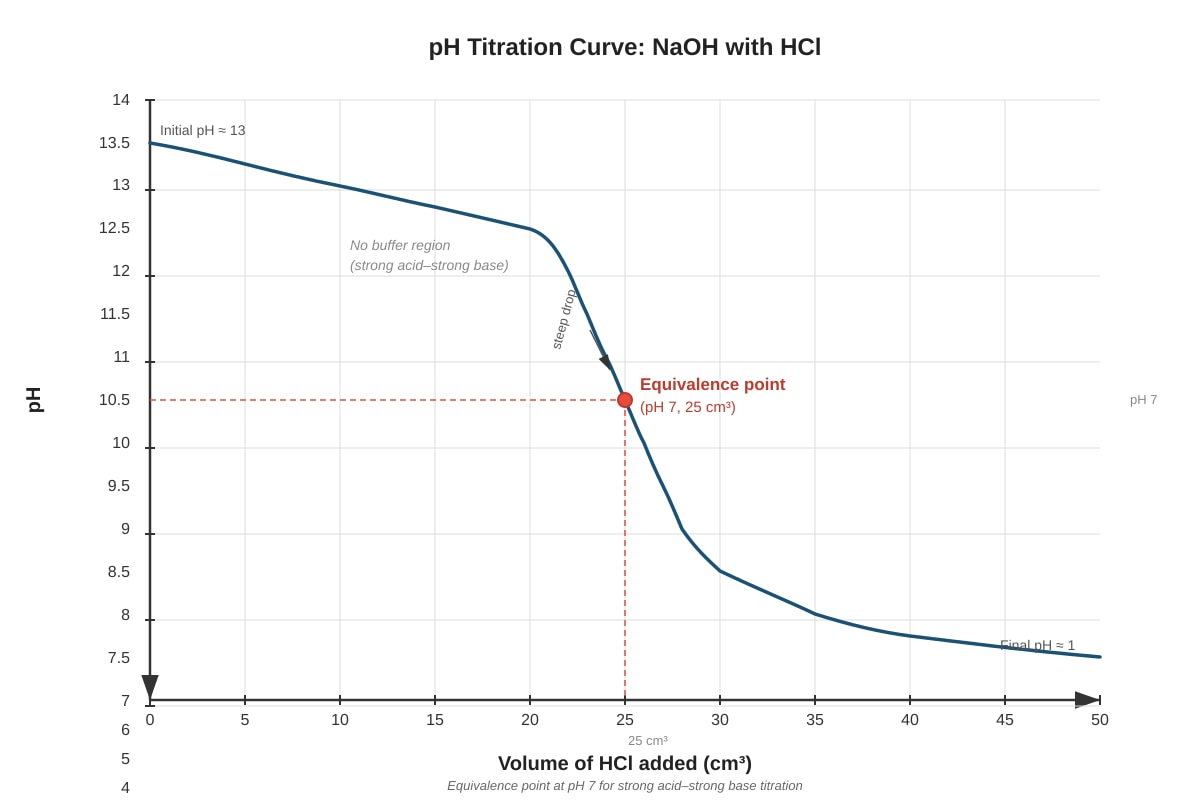
(c) (i) Sketch: The graph should show:

  • A curve starting at pH ~13 (strong base).
  • A gradual decrease in pH as HCl is added.
  • A sharp, vertical drop in pH around the equivalence point (at 25 cm³ of HCl added).
  • The equivalence point at pH 7.
  • The curve levelling off at pH ~1 after the equivalence point.
  • The buffer region is before the equivalence point, where the pH changes gradually. [3]

(ii) At the equivalence point, the solution contains only NaCl, which is a salt of a strong acid and a strong base. Neither Na+Na^+ nor ClCl^- hydrolyses significantly in water, so the solution is neutral, and pH = 7. [1]


Question 4 (Total: 10 marks)

(a) (i) Ksp=[Ag+][Cl]K_{sp} = [Ag^+][Cl^-] [1]

(ii) Step 1: Let solubility = s mol dm⁻³. AgCl(s)Ag+(aq)+Cl(aq)AgCl(s) \rightleftharpoons Ag^+(aq) + Cl^-(aq) [Ag+]=s[Ag^+] = s, [Cl]=s[Cl^-] = s

Step 2: Substitute into KspK_{sp} expression. Ksp=s×s=s2=1.77×10¹⁰K_{sp} = s \times s = s^2 = 1.77 \times 10^{-10}

Step 3: Calculate s. s=1.77×1010=1.33×10⁵ mol dm3s = \sqrt{1.77 \times 10^{-10}} = 1.33 \times 10^{-5} \text{ mol dm}^{-3} [2]

(b) Step 1: Consider the common ion effect. In a 0.100 mol dm30.100 \text{ mol dm}^{-3} NaCl solution, [Cl]=0.100 mol dm3[Cl^-] = 0.100 \text{ mol dm}^{-3}.

Step 2: Let solubility in NaCl solution = s' mol dm⁻³. [Ag+]=s[Ag^+] = s', [Cl]=0.100+s0.100[Cl^-] = 0.100 + s' \approx 0.100 (since s' is very small).

Step 3: Substitute into KspK_{sp} expression. Ksp=s×0.100=1.77×10¹⁰K_{sp} = s' \times 0.100 = 1.77 \times 10^{-10}

Step 4: Calculate s'. s=1.77×10100.100=1.77×10⁹ mol dm3s' = \frac{1.77 \times 10^{-10}}{0.100} = 1.77 \times 10^{-9} \text{ mol dm}^{-3} [3]

(c) (i) Ksp=[Ag+]2[CrO42]K_{sp} = [Ag^+]^2[CrO_4^{2-}] [1]

(ii) Step 1: Let solubility = s mol dm⁻³. Ag2CrO4(s)2Ag+(aq)+CrO42(aq)Ag_2CrO_4(s) \rightleftharpoons 2Ag^+(aq) + CrO_4^{2-}(aq) [Ag+]=2s[Ag^+] = 2s, [CrO42]=s[CrO_4^{2-}] = s

Step 2: Substitute into KspK_{sp} expression. Ksp=(2s)2×s=4s3=1.12×10¹²K_{sp} = (2s)^2 \times s = 4s^3 = 1.12 \times 10^{-12}

Step 3: Calculate s. s3=1.12×10124=2.80×10¹³s^3 = \frac{1.12 \times 10^{-12}}{4} = 2.80 \times 10^{-13} s=2.80×10133=6.54×10⁵ mol dm3s = \sqrt[3]{2.80 \times 10^{-13}} = 6.54 \times 10^{-5} \text{ mol dm}^{-3} [3]


Question 5 (Total: 10 marks)

(a) (i) Ksp=[Mg2+][OH]2K_{sp} = [Mg^{2+}][OH^-]^2 [1]

(ii) Step 1: Calculate pOHpOH and [OH][OH^-]. pOH=1410.45=3.55pOH = 14 - 10.45 = 3.55 [OH]=103.55=2.82×10⁴ mol dm3[OH^-] = 10^{-3.55} = 2.82 \times 10^{-4} \text{ mol dm}^{-3}

Step 2: Calculate [Mg2+][Mg^{2+}]. From the equation Mg(OH)2(s)Mg2+(aq)+2OH(aq)Mg(OH)_2(s) \rightleftharpoons Mg^{2+}(aq) + 2OH^-(aq), [Mg2+]=12[OH]=1.41×10⁴ mol dm3[Mg^{2+}] = \frac{1}{2}[OH^-] = 1.41 \times 10^{-4} \text{ mol dm}^{-3}

Step 3: Substitute into KspK_{sp} expression. Ksp=(1.41×104)×(2.82×104)2K_{sp} = (1.41 \times 10^{-4}) \times (2.82 \times 10^{-4})^2 Ksp=1.41×104×7.95×108=1.12×10¹¹ mol3 dm9K_{sp} = 1.41 \times 10^{-4} \times 7.95 \times 10^{-8} = 1.12 \times 10^{-11} \text{ mol}^3 \text{ dm}^{-9} [3]

(b) (i) Colourless. [1]

(ii) The solution is basic (pH 10.45 > 8.2), so phenolphthalein turns pink. [1]

(c) (i) The pink colour fades and the solution becomes colourless. [1] This is because the added H+H^+ ions neutralise the OHOH^- ions, shifting the equilibrium Mg(OH)2(s)Mg2+(aq)+2OH(aq)Mg(OH)_2(s) \rightleftharpoons Mg^{2+}(aq) + 2OH^-(aq) to the right. As [OH][OH^-] decreases, the pH drops below 8.2, and phenolphthalein becomes colourless. [1]

(ii) H+(aq)+OH(aq)H2O(l)H^+(aq) + OH^-(aq) \rightarrow H_2O(l) [1]

(d) Magnesium hydroxide is sparingly soluble, so it dissolves slowly and provides a gradual, prolonged neutralisation of stomach acid without causing a sudden, drastic change in pH. This makes it a mild, safe antacid. [1]


Question 6 (Total: 10 marks)

(a) (i) [4]

SaltpH (acidic/basic/neutral)Reason
NaClNeutralSalt of a strong acid (HCl) and a strong base (NaOH). Neither Na+Na^+ nor ClCl^- hydrolyses significantly.
NH4ClNH_4ClAcidicSalt of a strong acid (HCl) and a weak base (NH3NH_3). The NH4+NH_4^+ ion hydrolyses to produce H+H^+ ions.
CH3COONaCH_3COONaBasicSalt of a weak acid (CH3COOHCH_3COOH) and a strong base (NaOH). The CH3COOCH_3COO^- ion hydrolyses to produce OHOH^- ions.
AlCl3AlCl_3AcidicThe small, highly charged Al3+Al^{3+} ion hydrolyses water, producing H+H^+ ions.

(ii) NH4+(aq)+H2O(l)NH3(aq)+H3O+(aq)NH_4^+(aq) + H_2O(l) \rightleftharpoons NH_3(aq) + H_3O^+(aq) [1]

(b) (i) Step 1: Set up ICE table. NH4++H2ONH3+H3O+NH_4^+ + H_2O \rightleftharpoons NH_3 + H_3O^+ Initial: 0.200, 0, 0 Change: -x, +x, +x Equilibrium: 0.200 - x, x, x

Step 2: Substitute into KaK_a expression. Ka=[NH3][H3O+][NH4+]=x20.200x=5.62×10¹⁰K_a = \frac{[NH_3][H_3O^+]}{[NH_4^+]} = \frac{x^2}{0.200 - x} = 5.62 \times 10^{-10}

Step 3: Assume x is negligible. x2=5.62×1010×0.200=1.124×10¹⁰x^2 = 5.62 \times 10^{-10} \times 0.200 = 1.124 \times 10^{-10} x=1.06×10⁵ mol dm3x = 1.06 \times 10^{-5} \text{ mol dm}^{-3}

Step 4: Calculate pH. pH=log(1.06×10⁵)=4.97pH = -\log(1.06 \times 10^{-5}) = 4.97 [3]

(c) (i) CH3COO(aq)+H2O(l)CH3COOH(aq)+OH(aq)CH_3COO^-(aq) + H_2O(l) \rightleftharpoons CH_3COOH(aq) + OH^-(aq) [1]

(ii) Step 1: Calculate pOHpOH and [OH][OH^-]. pOH=148.88=5.12pOH = 14 - 8.88 = 5.12 [OH]=105.12=7.59×10⁶ mol dm3[OH^-] = 10^{-5.12} = 7.59 \times 10^{-6} \text{ mol dm}^{-3}

Step 2: Substitute into KbK_b expression. Kb=[CH3COOH][OH][CH3COO]=(7.59×10⁶)20.1007.59×106K_b = \frac{[CH_3COOH][OH^-]}{[CH_3COO^-]} = \frac{(7.59 \times 10^{-6})^2}{0.100 - 7.59 \times 10^{-6}} Kb5.76×10110.100=5.76×10¹⁰ mol dm3K_b \approx \frac{5.76 \times 10^{-11}}{0.100} = 5.76 \times 10^{-10} \text{ mol dm}^{-3} [1]


Section B (40 Marks)

Question 7 (Total: 20 marks)

(a) (i) HCOOH(aq)HCOO(aq)+H+(aq)HCOOH(aq) \rightleftharpoons HCOO^-(aq) + H^+(aq) [1]

(ii) Step 1: Calculate [H+][H^+]. [H+]=102.38=4.17×10³ mol dm3[H^+] = 10^{-2.38} = 4.17 \times 10^{-3} \text{ mol dm}^{-3}

Step 2: Set up ICE table. HCOOHHCOO+H+HCOOH \rightleftharpoons HCOO^- + H^+ Initial: 0.100, 0, 0 Change: -x, +x, +x Equilibrium: 0.100 - x, x, x where x=4.17×10³ mol dm3x = 4.17 \times 10^{-3} \text{ mol dm}^{-3}

Step 3: Substitute into KaK_a expression. Ka=[HCOO][H+][HCOOH]=x20.100x=(4.17×10³)20.1004.17×103K_a = \frac{[HCOO^-][H^+]}{[HCOOH]} = \frac{x^2}{0.100 - x} = \frac{(4.17 \times 10^{-3})^2}{0.100 - 4.17 \times 10^{-3}} Ka=1.74×1050.09583=1.82×10⁴ mol dm3K_a = \frac{1.74 \times 10^{-5}}{0.09583} = 1.82 \times 10^{-4} \text{ mol dm}^{-3} [3]

(b) (i) The chlorine atom is more electronegative than the hydrogen atom. It exerts a negative inductive effect (-I effect), withdrawing electron density from the O–H bond through the sigma bond framework. This weakens the O–H bond, making it easier for the proton to be released. Therefore, chloroethanoic acid is a stronger acid than methanoic acid. [3]

(c) (i) Step 1: Calculate moles of acid and salt. Moles of HCOOH =25.01000×0.200=5.00×10³ mol= \frac{25.0}{1000} \times 0.200 = 5.00 \times 10^{-3} \text{ mol} Moles of HCOONa =20.01000×0.150=3.00×10³ mol= \frac{20.0}{1000} \times 0.150 = 3.00 \times 10^{-3} \text{ mol}

Step 2: Calculate concentrations in the mixture. Total volume = 45.0 cm³ = 0.0450 dm³. [HCOOH]=5.00×1030.0450=0.111 mol dm3[HCOOH] = \frac{5.00 \times 10^{-3}}{0.0450} = 0.111 \text{ mol dm}^{-3} [HCOO]=3.00×1030.0450=0.0667 mol dm3[HCOO^-] = \frac{3.00 \times 10^{-3}}{0.0450} = 0.0667 \text{ mol dm}^{-3}

Step 3: Use the Henderson–Hasselbalch equation. pH=pKa+log[HCOO][HCOOH]pH = pK_a + \log\frac{[HCOO^-]}{[HCOOH]} pH=log(1.82×10⁴)+log0.06670.111pH = -\log(1.82 \times 10^{-4}) + \log\frac{0.0667}{0.111} pH=3.74+log(0.600)=3.740.222=3.52pH = 3.74 + \log(0.600) = 3.74 - 0.222 = 3.52 [4]

(d) (i) Step 1: Calculate moles of HCl added. Moles of HCl =1.01000×1.00=1.00×10³ mol= \frac{1.0}{1000} \times 1.00 = 1.00 \times 10^{-3} \text{ mol}

Step 2: Calculate new moles of acid and salt after reaction. The added H+H^+ reacts with HCOOHCOO^-: HCOO+H+HCOOHHCOO^- + H^+ \rightarrow HCOOH. Moles of HCOOH $= 5.00 \times 10^{-3} + 1.00 \times 10^{-3} = 6.00 \times

<stage5_exam_answers_md>