AI Generated Exam Paper
A Level Chemistry H3 Practice Paper 1
Free A Level Chemistry H3 Practice Paper 1, AI version, with questions, answers, and A Level-style practice for Singapore students.
These static practice materials are generated from the site's syllabus and paper-generation workflow, with source and model context shown so students and parents can evaluate the material before use.
Questions
Free quiz and exam paper access
Enter your details to view this paper
Your access is remembered on this device.
Answers
A-Level Chemistry H3 Exam - Acids Bases Salts - Answer Key
Total Marks: 50
Section A: Multiple-Choice Questions (10 marks)
-
B. PO₄³⁻
- Explanation: The conjugate base is formed by removing a proton (H⁺) from the acid. HPO₄²⁻ - H⁺ = PO₄³⁻.
- Marking: 1 mark for correct answer.
-
B. 2.0 × 10⁻⁵
- Explanation:
- [H⁺] = 10⁻²·⁸⁵ = 1.41 × 10⁻³ mol dm⁻³
- For a weak acid, [H⁺] = √(Ka × [HA]), so Ka = [H⁺]² / [HA]
- Ka = (1.41 × 10⁻³)² / 0.10 = 1.99 × 10⁻⁶ / 0.10 = 1.99 × 10⁻⁵ ≈ 2.0 × 10⁻⁵ mol dm⁻³
- Marking: 1 mark for correct answer.
- Explanation:
-
C. NH₄Cl
- Explanation: NH₄Cl is the salt of a weak base (NH₃) and a strong acid (HCl). The ammonium ion (NH₄⁺) hydrolyses in water to produce H⁺ ions, making the solution acidic.
- Marking: 1 mark for correct answer.
-
A. 0.050 mol dm⁻³
- Explanation: For a strong base, [OH⁻] = concentration of base = 0.050 mol dm⁻³. The pH of 12.70 confirms this, as pOH = 14.00 - 12.70 = 1.30, and [OH⁻] = 10⁻¹·³⁰ = 0.050 mol dm⁻³.
- Marking: 1 mark for correct answer.
-
C. The pH of a buffer solution is independent of the ratio of the concentrations of the weak acid and its conjugate base.
- Explanation: The pH of a buffer does depend on the ratio of [conjugate base] to [weak acid], as shown by the Henderson-Hasselbalch equation: pH = pKa + log([A⁻]/[HA]).
- Marking: 1 mark for correct answer.
-
B. 7.0
- Explanation: Equal volumes and concentrations of a strong acid (HCl) and a strong base (NaOH) will neutralise each other completely, forming a neutral salt (NaCl) and water. The pH of a neutral solution at 25°C is 7.0.
- Marking: 1 mark for correct answer.
-
A. 2.87
- Explanation:
- [H⁺] = √(Ka × [HA]) = √(1.8 × 10⁻⁵ × 0.10) = √(1.8 × 10⁻⁶) = 1.34 × 10⁻³ mol dm⁻³
- pH = -log(1.34 × 10⁻³) = 2.87
- Marking: 1 mark for correct answer.
- Explanation:
-
A. Kw = [H⁺][OH⁻]
- Explanation: The ionic product of water is the equilibrium constant for the self-ionisation of water: 2H₂O(l) ⇌ H₃O⁺(aq) + OH⁻(aq). The expression is Kw = [H⁺][OH⁻].
- Marking: 1 mark for correct answer.
-
B. 2.0 × 10⁻⁵
- Explanation:
- pOH = 14.00 - 11.30 = 2.70
- [OH⁻] = 10⁻²·⁷⁰ = 2.00 × 10⁻³ mol dm⁻³
- For a weak base, [OH⁻] = √(Kb × [B]), so Kb = [OH⁻]² / [B]
- Kb = (2.00 × 10⁻³)² / 0.20 = 4.0 × 10⁻⁶ / 0.20 = 2.0 × 10⁻⁵ mol dm⁻³
- Marking: 1 mark for correct answer.
- Explanation:
-
C. KCl
- Explanation: KCl is the salt of a strong acid (HCl) and a strong base (KOH). Neither the K⁺ nor the Cl⁻ ion hydrolyses appreciably in water, so the solution remains neutral.
- Marking: 1 mark for correct answer.
Section B: Short-Answer Questions (20 marks)
11. (a) A Bronsted-Lowry acid is a proton (H⁺) donor. [1 mark]
(b) The conjugate acid-base pairs are: [2 marks] - NH₃ (base) and NH₄⁺ (conjugate acid) - H₂O (acid) and OH⁻ (conjugate base)
Marking: 1 mark for each correctly identified pair.
12. [3 marks] 1. [H⁺] = 10⁻²·⁹⁵ = 1.12 × 10⁻³ mol dm⁻³ 2. For a weak acid, HA ⇌ H⁺ + A⁻, so [H⁺] = [A⁻] = 1.12 × 10⁻³ mol dm⁻³ 3. Ka = [H⁺][A⁻] / [HA] = (1.12 × 10⁻³)² / (0.15 - 1.12 × 10⁻³) 4. Assuming [HA] ≈ 0.15 (since dissociation is small): Ka ≈ (1.25 × 10⁻⁶) / 0.15 = 8.3 × 10⁻⁶ mol dm⁻³
Marking: 1 mark for calculating [H⁺], 1 mark for correct Ka expression, 1 mark for final answer.
13. (a) pH = pKa + log([A⁻]/[HA]) [1 mark]
(b) [4 marks] 1. Moles of ethanoic acid = (50.0/1000) × 0.20 = 0.010 mol 2. Moles of sodium ethanoate = (30.0/1000) × 0.10 = 0.0030 mol 3. Total volume = 50.0 + 30.0 = 80.0 cm³ = 0.080 dm³ 4. [HA] = 0.010 / 0.080 = 0.125 mol dm⁻³ 5. [A⁻] = 0.0030 / 0.080 = 0.0375 mol dm⁻³ 6. pKa = -log(1.8 × 10⁻⁵) = 4.74 7. pH = 4.74 + log(0.0375 / 0.125) = 4.74 + log(0.30) = 4.74 + (-0.52) = 4.22
Marking: 1 mark for calculating moles, 1 mark for calculating concentrations, 1 mark for pKa, 1 mark for final pH.
14. [3 marks] - Ammonium chloride (NH₄Cl) is a salt formed from a weak base (NH₃) and a strong acid (HCl). - In water, the ammonium ion (NH₄⁺) acts as a weak acid and donates a proton to water: NH₄⁺(aq) + H₂O(l) ⇌ NH₃(aq) + H₃O⁺(aq). - The chloride ion (Cl⁻) is the conjugate base of a strong acid and does not hydrolyse. - The production of H₃O⁺ ions results in an acidic solution (pH < 7).
Marking: 1 mark for identifying the salt type, 1 mark for the hydrolysis equation, 1 mark for explaining the production of H⁺.
15. [2 marks] 1. [OH⁻] = 0.010 mol / 1.0 dm³ = 0.010 mol dm⁻³ 2. pOH = -log(0.010) = 2.00 3. pH = 14.00 - 2.00 = 12.00
Marking: 1 mark for calculating [OH⁻], 1 mark for final pH.
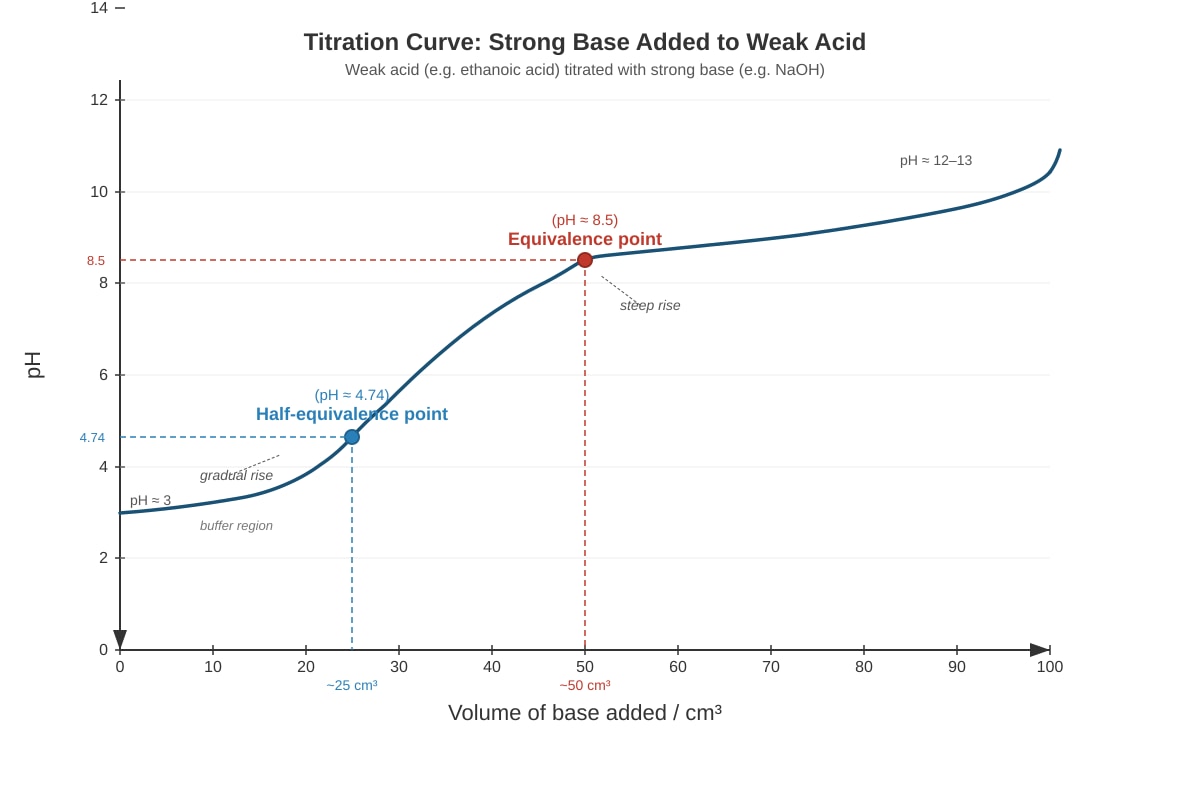
16. (a) The equivalence point should be labelled at the centre of the steep vertical section of the curve, at approximately pH 8.5. [1 mark]
(b) [2 marks] - The salt formed at the equivalence point is the conjugate base of the weak acid (e.g., CH₃COONa). - This salt hydrolyses in water to produce OH⁻ ions: CH₃COO⁻(aq) + H₂O(l) ⇌ CH₃COOH(aq) + OH⁻(aq). - The presence of OH⁻ ions makes the solution basic (pH > 7).
Marking: 1 mark for identifying the salt hydrolysis, 1 mark for explaining the production of OH⁻.
(c) At the half-equivalence point, [HA] = [A⁻], so pH = pKa. Therefore, the Ka of the weak acid can be determined by reading the pH at the half-equivalence point. [1 mark]
Section C: Structured Questions (20 marks)
17. (a) [3 marks] - Measure the pH of each solution using a pH meter. - The solution with pH 1.0 is HCl (strong acid). - The solution with pH around 2.9 is CH₃COOH (weak acid). - The solution with pH 13.0 is NaOH (strong base).
Marking: 1 mark for measuring pH, 1 mark for identifying the strong acid, 1 mark for identifying the weak acid and strong base.
(b) [3 marks] - HCl is a strong acid, fully dissociated, so [H⁺] = 0.10 mol dm⁻³, pH = 1.0. - CH₃COOH is a weak acid, partially dissociated, so [H⁺] < 0.10 mol dm⁻³, pH ≈ 2.9. - NaOH is a strong base, fully dissociated, so [OH⁻] = 0.10 mol dm⁻³, pOH = 1.0, pH = 13.0.
Marking: 1 mark for each correct explanation.
18. (a) [3 marks] 1. [HA] = 0.25 mol / 1.0 dm³ = 0.25 mol dm⁻³ 2. [A⁻] = 0.15 mol / 1.0 dm³ = 0.15 mol dm⁻³ 3. pKa = -log(1.3 × 10⁻⁵) = 4.89 4. pH = 4.89 + log(0.15 / 0.25) = 4.89 + log(0.60) = 4.89 + (-0.22) = 4.67
Marking: 1 mark for calculating concentrations, 1 mark for pKa, 1 mark for final pH.
(b) [4 marks] 1. Initial moles of HA = 0.25 mol, initial moles of A⁻ = 0.15 mol. 2. Added HCl (0.020 mol) reacts with A⁻: A⁻ + H⁺ → HA. 3. Moles of HA after addition = 0.25 + 0.020 = 0.27 mol. 4. Moles of A⁻ after addition = 0.15 - 0.020 = 0.13 mol. 5. Volume remains 1.0 dm³, so [HA] = 0.27 mol dm⁻³, [A⁻] = 0.13 mol dm⁻³. 6. pH = 4.89 + log(0.13 / 0.27) = 4.89 + log(0.481) = 4.89 + (-0.32) = 4.57
Marking: 1 mark for calculating new moles, 1 mark for calculating new concentrations, 1 mark for correct pH calculation, 1 mark for final answer.
19. (a) [3 marks] 1. [H⁺] = √(Ka × [HA]) = √(4.5 × 10⁻⁶ × 0.20) = √(9.0 × 10⁻⁷) = 9.49 × 10⁻⁴ mol dm⁻³ 2. pH = -log(9.49 × 10⁻⁴) = 3.02
Marking: 1 mark for correct formula, 1 mark for calculating [H⁺], 1 mark for final pH.
(b) [4 marks] 1. [H⁺] = 10⁻³·⁵⁰ = 3.16 × 10⁻⁴ mol dm⁻³ 2. For a weak acid, [H⁺] = √(Ka × [HA]), so [HA] = [H⁺]² / Ka 3. [HA] = (3.16 × 10⁻⁴)² / (4.5 × 10⁻⁶) = (1.0 × 10⁻⁷) / (4.5 × 10⁻⁶) = 0.022 mol dm⁻³
Marking: 1 mark for calculating [H⁺], 1 mark for correct formula, 1 mark for calculating [HA], 1 mark for final answer.
20. (a) Kw = [H⁺][OH⁻] [1 mark]
(b) [2 marks] - The self-ionisation of water is an endothermic process: 2H₂O(l) ⇌ H₃O⁺(aq) + OH⁻(aq) ΔH > 0. - According to Le Chatelier's principle, increasing the temperature favours the endothermic reaction, shifting the equilibrium to the right. - This increases the concentrations of H⁺ and OH⁻ ions, thus increasing the value of Kw.
Marking: 1 mark for identifying the reaction as endothermic, 1 mark for explaining the shift in equilibrium.
(c) [3 marks] 1. In pure water, [H⁺] = [OH⁻]. 2. Kw = [H⁺]², so [H⁺] = √Kw = √(5.5 × 10⁻¹⁴) = 2.35 × 10⁻⁷ mol dm⁻³ 3. pH = -log(2.35 × 10⁻⁷) = 6.63
Marking: 1 mark for recognising [H⁺] = [OH⁻], 1 mark for calculating [H⁺], 1 mark for final pH.
END OF ANSWER KEY