AI Generated Quiz
A Level H2 Chemistry Periodic Table Quiz
Free A Level H2 Chemistry Periodic Table quiz, LongCat AI version, with questions, answers, and A Level-style practice for Singapore students.
These static practice materials are generated from the site's syllabus and paper-generation workflow, with source and model context shown so students and parents can evaluate the material before use.
Questions
Free quiz and exam paper access
Enter your details to view this paper
Your access is remembered on this device.
Answers
A-Level Chemistry H2 Quiz - Periodic Table: Answer Key
Question 1
(a) [2 marks]
Each successive ionisation energy increases because:
- After each electron is removed, there is one fewer electron in the same shell, so the remaining electrons experience less electron-electron repulsion and are held more tightly by the same nuclear charge. [1]
- Additionally, as electrons are removed, the electron-electron repulsion decreases, and the effective nuclear charge per remaining electron increases, making it harder to remove subsequent electrons. [1]
Marking notes: Award 1 mark for stating that the nuclear charge remains constant while the number of electrons decreases. Award 1 mark for explaining that the remaining electrons are held more tightly / experience greater effective nuclear charge.
(b) [2 marks]
Element X belongs to Group 2. [1]
Justification: There is a large jump between the 3rd and 4th ionisation energies (2745 → 11578 kJ mol⁻¹), indicating that the 4th electron is being removed from an inner shell (closer to the nucleus, more tightly held). This means the element has 3 electrons in its outer shell — but since the first three IEs are relatively close together and the big jump occurs after the 3rd, the element has 2 electrons in its outermost shell (the 1st and 2nd electrons are removed from the outer shell, and the 3rd is also from the same shell, but the 4th is from a lower energy level).
Correction for clarity: The large jump occurs between the 3rd and 4th IE, meaning the first 3 electrons are relatively easy to remove (from the same shell), and the 4th electron comes from an inner shell. This indicates the element has 3 valence electrons — but wait, let us reconsider. The jump is between 3rd and 4th, so 3 electrons are in the outer shell → Group 13.
Revised answer: Element X belongs to Group 13. [1]
Justification: The large jump between the 3rd and 4th ionisation energies indicates that 3 electrons can be removed relatively easily from the outermost shell, and the 4th electron must come from an inner, more stable shell. This is consistent with 3 valence electrons, placing the element in Group 13. [1]
Marking notes: Award 1 mark for correct group identification (Group 13). Award 1 mark for correct justification referencing the large jump between 3rd and 4th IE.
(c) [1 mark]
The electronic configuration of element X is 1s² 2s² 2p⁶ 3s² 3p¹ (aluminium). [1]
Marking notes: Accept any valid Group 13 element configuration (e.g., [Ne] 3s² 3p¹).
Question 2
(a) [3 marks]
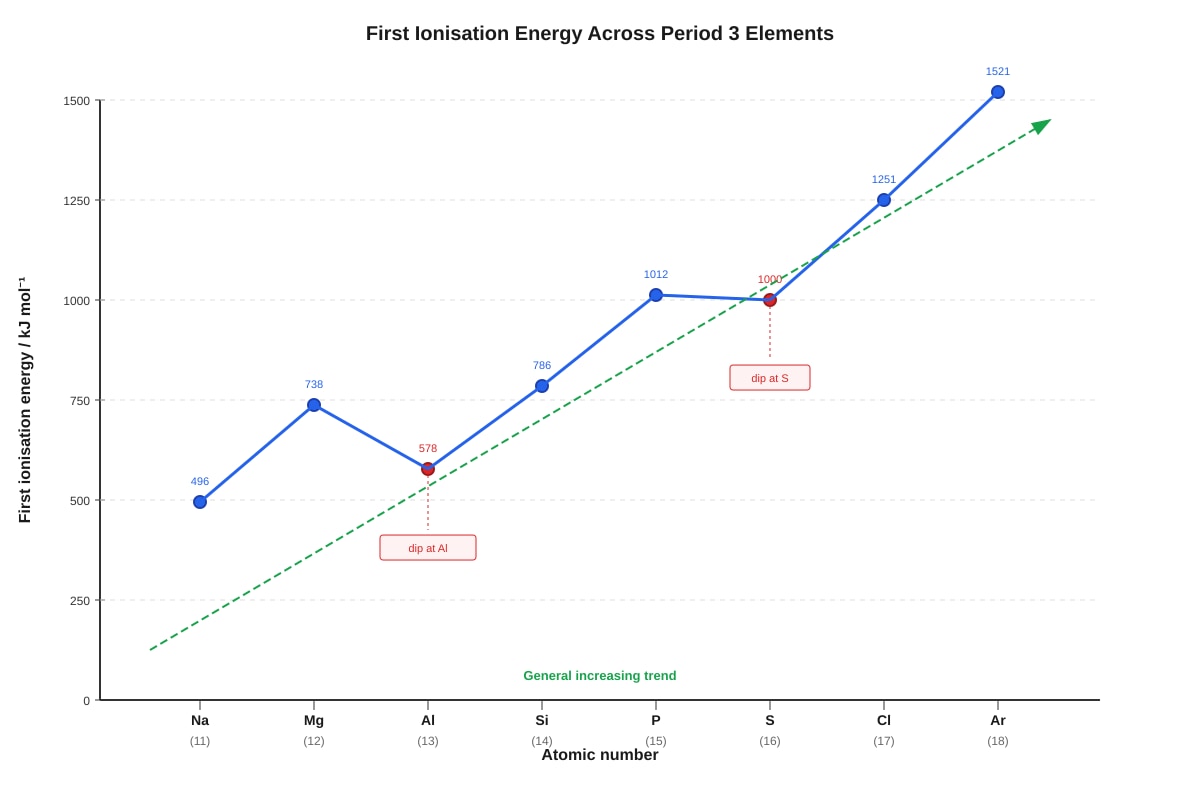
General trend: First ionisation energy generally increases across Period 3 from Na to Ar. [1]
Explanation:
- Across the period, the nuclear charge (number of protons) increases while electrons are added to the same principal energy level (n = 3). [1]
- The increasing nuclear charge pulls the outer electrons closer, decreasing the atomic radius, so more energy is required to remove the outermost electron. [1]
Marking notes: Award 1 mark for describing the general increasing trend. Award 1 mark for mentioning increasing nuclear charge. Award 1 mark for linking to decreasing atomic radius / stronger attraction.
(b) [2 marks]
The first ionisation energy of Al is lower than Mg because:
- In Mg, the outermost electron is in a 3s orbital, which is lower in energy and more penetrating (closer to the nucleus on average) than the 3p orbital. [1]
- In Al, the outermost electron is in a 3p orbital, which is slightly higher in energy and experiences more shielding from the 3s electrons, so it is easier to remove. [1]
Marking notes: Award 1 mark for identifying the 3s vs 3p orbital difference. Award 1 mark for explaining that the 3p electron is higher in energy / more shielded / easier to remove.
(c) [2 marks]
The first ionisation energy of S is lower than P because:
- In P, the 3p orbitals are half-filled (3p³), with one electron in each of the three p orbitals — this is a relatively stable arrangement with no electron-electron repulsion within the same orbital. [1]
- In S, the 3p configuration is 3p⁴, meaning one of the p orbitals contains a paired electron. The electron-electron repulsion within this orbital makes it easier to remove one of the paired electrons. [1]
Marking notes: Award 1 mark for identifying the 3p³ (half-filled, stable) vs 3p⁴ (paired electron) difference. Award 1 mark for explaining electron-electron repulsion in the paired orbital.
Question 3
(a) [1 mark]
Electronegativity is the tendency of an atom to attract a bonding pair of electrons towards itself in a covalent bond. [1]
Marking notes: Key phrase must include "attract bonding pair of electrons" or equivalent. Do not accept "ability to attract electrons" without specifying bonding pair.
(b) [3 marks]
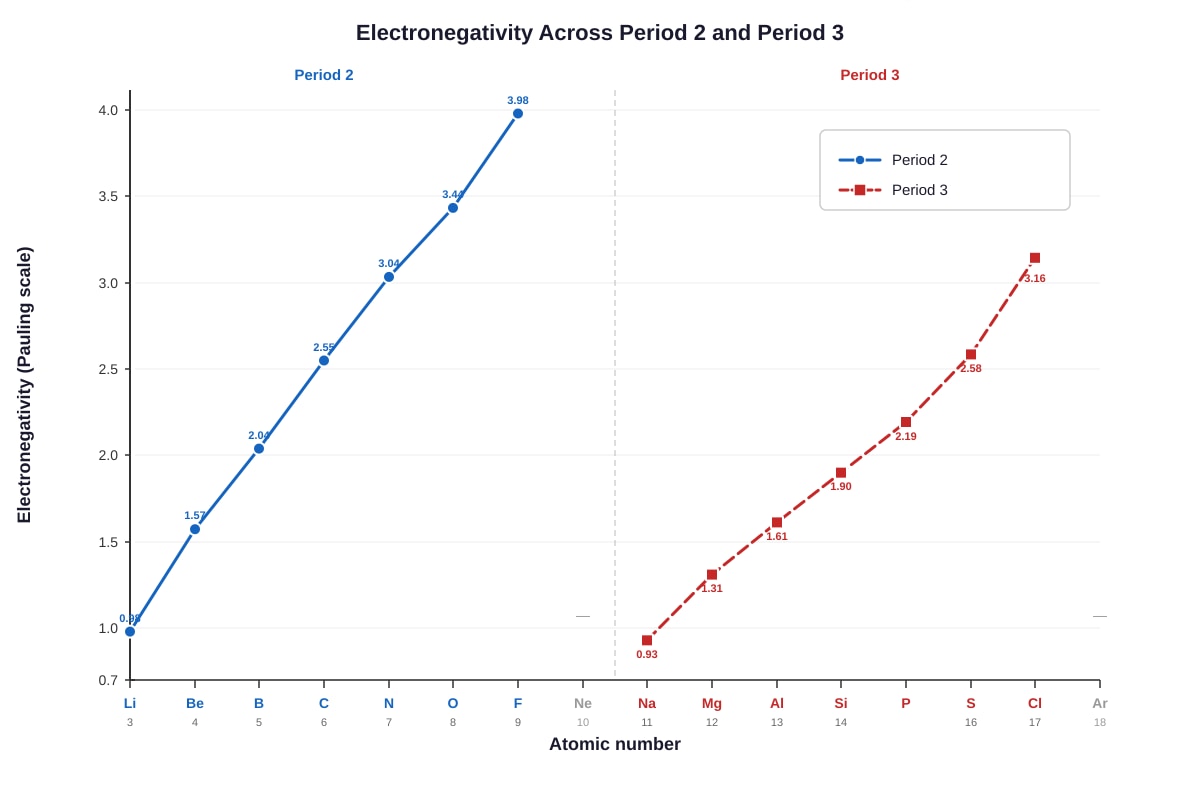
Trend: Electronegativity increases across Period 3 from sodium to chlorine. [1]
Explanation:
- Across the period, the nuclear charge increases (more protons) while electrons are added to the same shell. [1]
- The atomic radius decreases due to the increasing nuclear charge pulling electrons closer, so the bonding pair of electrons is closer to the nucleus and more strongly attracted. [1]
Marking notes: Award 1 mark for correct trend. Award 1 mark for increasing nuclear charge. Award 1 mark for decreasing atomic radius leading to stronger attraction of bonding electrons.
(c) [1 mark]
Chlorine has the highest electronegativity in Period 3. [1]
Explanation: Chlorine is furthest to the right in Period 3 (excluding argon, which does not form covalent bonds), so it has the highest nuclear charge and smallest atomic radius, giving it the greatest ability to attract bonding electrons. [Already credited in part (b) explanation; no additional mark needed here.]
Marking notes: Award 1 mark for identifying chlorine. The explanation is not separately marked here as it is covered in part (b).
Question 4
(a) [3 marks]
Trend: Atomic radius decreases across Period 3 from Na to Cl. [1]
Explanation:
- Across the period, electrons are added to the same principal energy level (n = 3), so the shielding effect remains relatively constant. [1]
- The nuclear charge (number of protons) increases, so the effective nuclear charge experienced by the outer electrons increases, pulling the electron cloud closer to the nucleus and decreasing the atomic radius. [1]
Marking notes: Award 1 mark for correct trend. Award 1 mark for constant shielding / same shell. Award 1 mark for increasing nuclear charge pulling electrons closer.
(b) [2 marks]
Na⁺ is smaller than Na because:
- Na⁺ has lost its outermost 3s electron, so the remaining electrons are in the n = 2 shell, which is closer to the nucleus. [1]
- Additionally, with 11 protons attracting only 10 electrons, the effective nuclear charge per electron is greater, pulling the electron cloud inward. [1]
Marking notes: Award 1 mark for loss of outer shell / electrons now in n = 2. Award 1 mark for greater effective nuclear charge / more protons than electrons.
(c) [2 marks]
Cl⁻ is larger than Cl because:
- Cl⁻ has gained an extra electron, so there are now 18 electrons attracted by only 17 protons. [1]
- The increased electron-electron repulsion causes the electron cloud to expand, and the effective nuclear charge per electron is reduced, resulting in a larger ionic radius. [1]
Marking notes: Award 1 mark for more electrons than protons / increased electron-electron repulsion. Award 1 mark for reduced effective nuclear charge / expanded electron cloud.
Question 5
(a) [3 marks — 1 each]
(i) Sodium: Metallic bonding [1]
(ii) Silicon: Covalent network (giant covalent) bonding [1]
(iii) Chlorine: Covalent bonding within molecules; van der Waals' forces between molecules [1]
Marking notes: For (iii), accept "covalent" or "simple molecular" as the type of structure. Award 1 mark for identifying covalent bonding within Cl₂ molecules.
(b) [3 marks]
Silicon has a giant covalent (network) structure where each Si atom is covalently bonded to four other Si atoms in a tetrahedral arrangement. A very large number of strong covalent bonds must be broken to melt silicon, requiring a great deal of energy. [1.5]
Chlorine (Cl₂) has a simple molecular structure with weak van der Waals' forces between molecules. Only these weak intermolecular forces need to be overcome to melt chlorine, requiring much less energy. [1.5]
Marking notes: Award up to 1.5 marks for describing silicon's giant covalent structure and strong bonds. Award up to 1.5 marks for describing chlorine's simple molecular structure and weak intermolecular forces. The comparison must be explicit for full marks.
Question 6
(a) [3 marks]
Trend: First ionisation energy decreases down Group II. [1]
Explanation:
- Down the group, the number of occupied electron shells increases, so the outermost electrons are further from the nucleus. [1]
- The increased shielding by inner shell electrons and the greater distance from the nucleus mean the outer electrons are less strongly attracted, so less energy is required to remove them. [1]
Marking notes: Award 1 mark for correct trend. Award 1 mark for increasing atomic radius / more shells. Award 1 mark for increased shielding reducing attraction.
(b) [2 marks]
Trend: Atomic radius increases down Group II. [1]
Explanation: Down the group, each successive element has an additional occupied electron shell, so the outer electrons are further from the nucleus, resulting in a larger atomic radius. [1]
Marking notes: Award 1 mark for correct trend. Award 1 mark for additional electron shells / greater distance from nucleus.
(c) [2 marks]
Prediction: The first ionisation energy of Ra is approximately 450–500 kJ mol⁻¹. [1]
Justification: The trend shows a steady decrease down the group (900 → 738 → 590 → 549 → 503). The decrease from Sr to Ba is 46 kJ mol⁻¹. Since Ra is two periods below Ba, the IE should be lower than Ba's 503 kJ mol⁻¹, likely in the range of 450–500 kJ mol⁻¹. [1]
Marking notes: Accept any value between 430 and 510 kJ mol⁻¹. Award 1 mark for a reasonable prediction below 503. Award 1 mark for justification referencing the trend.
Question 7
(a) [1 mark]
[1]
Marking notes: Award 1 mark for correct balanced equation. State symbols are not required but are good practice.
(b) [2 marks]
Observations:
- Strontium sinks in water and reacts vigorously. [1]
- The metal dissolves, colourless gas (hydrogen) is evolved (which produces a squeaky pop with a lighted splint), and the solution becomes alkaline / turns phenolphthalein pink. [1]
Marking notes: Award 1 mark for vigorous reaction / gas evolved. Award 1 mark for alkaline solution / hydrogen test.
(c) [3 marks]
- Down Group II, the first ionisation energy decreases (as shown in Q6). [1]
- This means it becomes easier to remove the outermost electron and form the M²⁺ cation. [1]
- Since the reaction with water involves the metal losing electrons to form M²⁺ ions, the lower ionisation energy down the group makes the reaction more favourable and more vigorous. [1]
Marking notes: Award 1 mark for decreasing IE down the group. Award 1 mark for easier cation formation. Award 1 mark for linking to increased reactivity.
(d) [1 mark]
Beryllium has a very high ionisation energy (900 kJ mol⁻¹, the highest in Group II) due to its small atomic radius and high effective nuclear charge, so it does not readily lose electrons to react with water under normal conditions. [1]
Marking notes: Accept any valid reason: high IE, small size, strong metallic bonding, or formation of a protective oxide layer.
Question 8
(a) [1 mark]
The solubility of Group II sulfates decreases down the group. [1]
(b) [1 mark]
The solubility of Group II hydroxides increases down the group. [1]
(c) [3 marks]
(i) Observations: [2 marks]
- MgCl₂ + NaOH: White precipitate forms. [0.5]
- CaCl₂ + NaOH: White precipitate forms. [0.5]
- BaCl₂ + NaOH: No visible change / no precipitate (or very slight precipitate). [0.5–1]
Marking notes: Award 0.5 marks for each correct observation. Ba(OH)₂ is soluble enough that no precipitate is typically observed with dilute NaOH.
(ii) Ionic equation: [1 mark]
[1]
(d) [3 marks]
- The solubility of sulfates depends on the balance between lattice energy (energy required to break up the ionic lattice) and hydration energy (energy released when ions are hydrated by water molecules). [1]
- Down the group, the cation size increases, so the lattice energy decreases (larger ions have weaker electrostatic attraction). However, the hydration energy decreases more rapidly because larger cations are less effectively hydrated. [1]
- Since the hydration energy decreases more than the lattice energy, the overall dissolution process becomes less favourable, and solubility decreases down the group. [1]
Marking notes: Award 1 mark for mentioning lattice energy and hydration energy. Award 1 mark for explaining that hydration energy decreases more rapidly. Award 1 mark for concluding that solubility decreases.
Question 9
(a) [1 mark]
Thermal decomposition is the breakdown of a compound by heating. [1]
Marking notes: Accept "decomposition caused by heat" or equivalent.
(b) [1 mark]
[1]
(c) [1 mark]
The thermal stability of Group II carbonates increases down the group. [1]
(d) [3 marks]
- Down the group, the cation size increases, so the charge density (charge/size ratio) of the cation decreases. [1]
- The polarising power of the cation (its ability to distort the electron cloud of the carbonate ion) therefore decreases down the group. [1]
- With less polarisation of the CO₃²⁻ ion, the C–O bonds are less weakened, so more energy (higher temperature) is required to decompose the carbonate. Hence, thermal stability increases down the group. [1]
Marking notes: Award 1 mark for decreasing charge density / polarising power down the group. Award 1 mark for linking polarisation to distortion of the carbonate ion. Award 1 mark for concluding increased thermal stability.
Question 10
(a) [1 mark]
[1]
Marking notes: Award 1 mark for correct balanced equation. MgO is the product (not Mg(OH)₂) because steam provides a higher temperature reaction.
(b) [3 marks]
- Be²⁺ has a very small ionic radius and a 2+ charge, giving it a very high charge density. [1]
- This high charge density gives Be²⁺ significant polarising power, which distorts the electron cloud of the Cl⁻ ion, resulting in significant covalent character in BeCl₂. [1]
- Mg²⁺ is larger than Be²⁺, so it has a lower charge density and less polarising power. The Cl⁻ ion is less distorted, so MgCl₂ retains predominantly ionic bonding. [1]
Marking notes: Award 1 mark for high charge density of Be²⁺. Award 1 mark for polarising power causing covalent character. Award 1 mark for comparison with Mg²⁺ (larger, lower charge density, ionic).
(c) [2 marks]
(i) With dilute HCl: [1 mark]
Accept:
(ii) With aqueous NaOH: [1 mark]
Accept:
Marking notes: Award 1 mark for each correct equation. The product with NaOH is the tetrahydroxoberyllate(II) ion.
Question 11
(a) [3 marks]
Three characteristic properties of transition elements (1 mark each, any three):
- They form coloured compounds/ions. [1]
- They have variable oxidation states. [1]
- They and their compounds can act as catalysts. [1]
- They form complex ions. [1]
- They have partially filled d orbitals (in at least one oxidation state). [1]
Marking notes: Award 1 mark for each valid property, up to a maximum of 3 marks.
(b) [2 marks]
- Scandium forms the Sc³⁺ ion, which has an incomplete d subshell (3d⁰ is the Sc³⁺ configuration, but Sc in its elemental state has [Ar] 3d¹ 4s², meaning it has a partially filled d orbital). [1]
Correction: Scandium is classified as a transition element because it has a partially filled d orbital in its elemental state ([Ar] 3d¹ 4s²). However, the IUPAC definition requires an element to have an incomplete d sub-shell in at least one of its common oxidation states. Sc³⁺ has the configuration [Ar] (3d⁰), which is empty, not incomplete. By the strict IUPAC definition, scandium is sometimes debated, but it is generally included as a transition element because it has d electrons in its elemental state.
- Zinc forms the Zn²⁺ ion with configuration [Ar] 3d¹⁰, which has a completely filled d subshell. Since zinc does not have a partially filled d subshell in any of its common oxidation states, it is not classified as a transition element. [1]
Marking notes: Award 1 mark for explaining that Sc has d electrons (partially filled d orbital). Award 1 mark for explaining that Zn²⁺ has a completely filled d subshell and therefore does not meet the definition.
Question 12
(a) [2 marks]
Chromium adopts [Ar] 3d⁵ 4s¹ because:
- A half-filled d subshell (3d⁵) provides extra stability due to the symmetry and exchange energy associated with having all five d orbitals singly occupied with parallel spins. [1]
- The energy gained from achieving a half-filled d subshell outweighs the energy cost of promoting one electron from 4s to 3d. [1]
Marking notes: Award 1 mark for half-filled d subshell stability. Award 1 mark for exchange energy / symmetry.
(b) [2 marks]
Copper adopts [Ar] 3d¹⁰ 4s¹ because:
- A completely filled d subshell (3d¹⁰) provides extra stability. [1]
- The energy gained from achieving a fully filled d subshell outweighs the energy cost of having only one electron in the 4s orbital. [1]
Marking notes: Award 1 mark for fully filled d subshell stability. Award 1 mark for energy consideration.
(c) [1 mark]
Chromium (Cr) — already mentioned, or Copper (Cu) — already mentioned. Accept molybdenum (Mo) in Period 5, which shows a similar anomaly (4d⁵ 5s¹ instead of 4d⁴ 5s²). [1]
Marking notes: Accept any valid example. Since Cr and Cu are already in the table, accept Mo or any other valid example.
Question 13
(a) [4 marks]
- In an isolated Cu²⁺ ion, all five d orbitals have the same energy (they are degenerate). [1]
- When ligands surround the Cu²⁺ ion to form a complex (e.g., [Cu(H₂O)₆]²⁺), the d orbitals split into two sets of different energies due to the electrostatic interaction with the ligand electron pairs. [1]
- Electrons in the lower energy d orbitals can absorb photons of visible light to jump to the higher energy d orbitals (d-d transition). [1]
- The wavelength of light absorbed corresponds to the energy gap between the split d orbitals. For Cu²⁺, light in the red/orange region is absorbed, and the transmitted/reflected light appears blue (the complementary colour). [1]
Marking notes: Award 1 mark for degenerate d orbitals in isolated ion. Award 1 mark for d-orbital splitting in a ligand field. Award 1 mark for d-d electron transition / absorption of light. Award 1 mark for complementary colour / specific colour explanation.
(b) [2 marks]
- Sc³⁺ has the configuration [Ar] (3d⁰), so there are no d electrons available for d-d transitions. [1]
- Zn²⁺ has the configuration [Ar] 3d¹⁰, so all d orbitals are fully filled and there are no vacant d orbitals for electrons to transition into. [1]
Marking notes: Award 1 mark for each correct explanation. Both ions cannot undergo d-d transitions, so they are colourless.
Question 14
(a) [2 marks]
Fe²⁺: [Ar] 3d⁶ [1]
Fe³⁺: [Ar] 3d⁵ [1]
Marking notes: Award 1 mark for each correct configuration.
(b) [2 marks]
Fe³⁺ has a 3d⁵ configuration, which is a half-filled d subshell. [1]
A half-filled d subshell provides extra stability due to maximum exchange energy and symmetrical distribution of electrons. [1]
Marking notes: Award 1 mark for identifying the half-filled d⁵ configuration. Award 1 mark for explaining the extra stability.
(c) [2 marks]
(i) Colour change: The solution changes from pale green (Fe²⁺) to yellow/brown (Fe³⁺). [1]
Marking notes: Accept "pale green to yellow" or "green to brown."
(ii) Half-equation: [1 mark]
[1]
Marking notes: Award 1 mark for correct balanced half-equation.
Question 15
(a) [3 marks — 1 each]
(i) Haber process: Iron (Fe) [1]
(ii) Contact process: Vanadium(V) oxide (V₂O₅) [1]
(iii) Hydrogenation of alkenes: Nickel (Ni) [1]
Marking notes: Award 1 mark for each correct catalyst. Accept Pt or Pd for (iii) as alternatives.
(b) [3 marks]
- Transition elements can exist in multiple oxidation states, so they can accept and donate electrons during a catalytic cycle, facilitating the reaction without being consumed. [1.5]
- Transition elements can form temporary bonds with reactant molecules by using their partially filled d orbitals to accept electron pairs (act as Lewis acids), thereby weakening bonds in the reactants and lowering the activation energy. [1.5]
Marking notes: Award up to 1.5 marks for variable oxidation states explanation. Award up to 1.5 marks for d-orbital / temporary bond / activation energy explanation.
Question 16
(a) [2 marks]
Element Y belongs to Group 2. [1]
Justification: There is a large jump between the 2nd and 3rd ionisation energies (1451 → 7733 kJ mol⁻¹), indicating that the first 2 electrons are removed from the outermost shell, and the 3rd electron comes from an inner shell. This is consistent with 2 valence electrons, placing the element in Group 2. [1]
(b) [1 mark]
Element Y is magnesium (Mg). [1]
Marking notes: The 1st IE of 738 kJ mol⁻¹ matches the known value for magnesium.
(c) [1 mark]
[1]
Marking notes: Award 1 mark for correct equation with state symbols. The equation must show the removal of an electron from Mg⁺(g).
Question 17
(a) [3 marks]
| Oxide | Classification |
|---|---|
| Na₂O | Ionic [0.5] |
| MgO | Ionic [0.5] |
| Al₂O₃ | Ionic (with some covalent character) [0.5] |
| SiO₂ | Covalent network [0.5] |
| P₄O₁₀ | Simple molecular [0.5] |
| SO₃ | Simple molecular [0.5] |
Marking notes: Award 0.5 marks for each correct classification. Accept "giant covalent" for SiO₂.
(b) [2 marks]
Both Na₂O and MgO are ionic compounds. Mg²⁺ has a higher charge (2+) and a smaller ionic radius than Na⁺ (1+). [1]
The greater charge and smaller size of Mg²⁺ result in stronger electrostatic attraction between Mg²⁺ and O²⁻ ions in the lattice, giving MgO a higher lattice energy and therefore a higher melting point. [1]
Marking notes: Award 1 mark for higher charge and smaller size of Mg²⁺. Award 1 mark for stronger electrostatic attraction / higher lattice energy.
(c) [2 marks]
SiO₂ has a giant covalent (network) structure where each Si atom is covalently bonded to four O atoms in a tetrahedral arrangement. A very large number of strong Si–O covalent bonds must be broken to melt SiO₂. [1]
P₄O₁₀ has a simple molecular structure with weak van der Waals' forces between molecules. Only these weak intermolecular forces need to be overcome to melt P₄O₁₀, requiring much less energy. [1]
Marking notes: Award 1 mark for SiO₂'s giant covalent structure and strong bonds. Award 1 mark for P₄O₁₀'s simple molecular structure and weak intermolecular forces.
Question 18
(a) [1 mark]
NaCl dissolves in water to form a colourless solution. The ions Na⁺ and Cl⁻ are hydrated by water molecules. [1]
Marking notes: Award 1 mark for stating that NaCl dissolves / dissociates into ions.
(b) [2 marks]
AlCl₃ dissolves in water and the Al³⁺ ion is highly charged and small, so it has a high charge density. The Al³⁺ polarises water molecules strongly, and the solution becomes acidic due to the release of H⁺ ions from the hydrated [Al(H₂O)₆]³⁺ complex. [1]
Equation:
[1]
Marking notes: Award 1 mark for explaining the acidic solution / hydrolysis. Award 1 mark for correct equation.
(c) [2 marks]
SiCl₄ reacts vigorously (hydrolyses) with water because silicon can expand its octet (use empty 3d orbitals) to accept a lone pair from water, leading to the formation of silicic acid and HCl. [1]
Equation:
Accept: [1]
Marking notes: Award 1 mark for explaining the reaction (hydrolysis, expansion of octet). Award 1 mark for correct equation.
(d) [3 marks]
- Na⁺ has a low charge density (1+ charge, relatively large ionic radius), so it does not significantly polarise water molecules. NaCl simply dissolves and dissociates without hydrolysis. [1]
- Al³⁺ has a high charge density (3+ charge, small ionic radius), so it strongly polarises the O–H bonds in surrounding water molecules, weakening them and releasing H⁺ ions, making the solution acidic. [1]
- The difference in behaviour is due to the much higher charge density of Al³⁺ compared to Na⁺, which determines the extent of hydrolysis. [1]
Marking notes: Award 1 mark for low charge density of Na⁺ / no hydrolysis. Award 1 mark for high charge density of Al³⁺ / hydrolysis. Award 1 mark for comparison linking charge density to behaviour.
Question 19
(a) [1 mark]
Electronegativity increases across a period (from left to right). [1]
(b) [3 marks]
- Across a period, the nuclear charge (number of protons) increases while electrons are added to the same principal energy level. [1]
- The atomic radius decreases because the increasing nuclear charge pulls the electron cloud closer to the nucleus. [1]
- With a smaller atomic radius and greater nuclear charge, the bonding pair of electrons is held more strongly, so the electronegativity increases. [1]
Marking notes: Award 1 mark for increasing nuclear charge. Award 1 mark for decreasing atomic radius. Award 1 mark for stronger attraction of bonding electrons.
(c) [2 marks]
- Fluorine is in Period 2, while chlorine is in Period 3. [1]
- Fluorine has a smaller atomic radius than chlorine (fewer electron shells), so the bonding pair of electrons is closer to the nucleus and more strongly attracted. Additionally, fluorine has less shielding than chlorine. Therefore, fluorine has a higher electronegativity. [1]
Marking notes: Award 1 mark for smaller atomic radius of F. Award 1 mark for less shielding / stronger attraction.
(d) [1 mark]
Noble gases have a stable, fully filled outer electron shell and do not readily form covalent bonds, so they are generally not assigned electronegativity values. [1]
Marking notes: Accept any valid reason: stable configuration, no tendency to attract bonding electrons, do not form bonds.
Question 20
(a) [1 mark]
FALSE. The atomic radius of phosphorus is smaller than that of silicon. Atomic radius decreases across a period due to increasing nuclear charge. [1]
(b) [1 mark]
FALSE. The oxide of sodium (Na₂O) is an ionic (giant ionic) compound, not a simple molecular compound. [1]
(c) [1 mark]
TRUE. The first ionisation energy of magnesium (738 kJ mol⁻¹) is greater than that of aluminium (578 kJ mol⁻¹) because the 3p electron in Al is higher in energy and more shielded than the 3s electron in Mg. [1]
(d) [1 mark]
TRUE. Argon has the highest first ionisation energy in Period 3 (1521 kJ mol⁻¹) because it has the highest nuclear charge and smallest atomic radius (among the elements considered), with a stable fully filled outer shell. [1]
(e) [1 mark]
TRUE. S₂Cl₂ reacts with water (hydrolysis) to produce HCl (among other products), which turns blue litmus red (acidic solution). [1]
Marking notes: Award 1 mark for each correct TRUE/FALSE identification with valid correction/explanation. If the student identifies TRUE/FALSE correctly but gives a wrong explanation, award 0.5 marks.
END OF ANSWER KEY
Total Marks: 50