AI Generated Quiz
A Level H2 Chemistry Organic Chemistry Quiz
Free A Level H2 Chemistry Organic Chemistry quiz, HY3 AI version, with questions, answers, and A Level-style practice for Singapore students.
These static practice materials are generated from the site's syllabus and paper-generation workflow, with source and model context shown so students and parents can evaluate the material before use.
Questions
Free quiz and exam paper access
Enter your details to view this paper
Your access is remembered on this device.
Answers
A-Level Chemistry H2 Quiz - Organic Chemistry (Answer Key)
Total Marks: 40
Teaching notes are provided for each item. Marks are shown as [n].
Q1. [2]
- Structural isomerism: compounds with the same molecular formula but different structural arrangements of atoms (different connectivity). [1]
- Shared molecular formula: . [1]
Teaching note: Propan-1-ol (chain alcohol) and methoxyethane (ether) have same atoms, different bonds. Common mistake: writing (that is for aldehydes/ketones).
Q2. [2]
- cis-but-2-ene: groups on the same side of the double bond.
Structure:
with both upward (or both downward). [2 for correct drawing]
Teaching note: cis = same side; trans = opposite. Mark deducted if methyl groups shown opposite.
Q3. [1]
- Butan-2-ol. [1]
Teaching note: OH on C2 of 4-carbon chain. IUPAC priority gives lowest locant to OH.
Q4. [2]
- 2-bromobutane has a chiral centre at C2 (attached to Br, H, , ) → rotates plane-polarised light. [1]
- A racemic mixture of butan-2-ol contains equal (+) and (–) enantiomers, net rotation = 0, so no observable optical activity. [1]
Teaching note: Chirality needs 4 different groups. Racemate cancels rotation.
Q5. [2]
- Empirical mass = 14; → molecular formula . [1]
- Homologous series: alkenes (or cycloalkanes). [1]
Teaching note: fits alkene series.
Q6. [3]
- Equation: . [1]
- Mechanism: nucleophilic substitution (). [1]
- With ethanolic KOH (no water), elimination occurs → ethene + KBr (not substitution). [1]
Teaching note: Solvent controls pathway: aqueous = substitution, alcoholic = elimination.
Q7. [4]
Mechanism ():
- (slow, carbocation). [1]
- Curly arrow from lone pair to carbocation C. [1]
- Product: (propan-2-ol). [1]
- Correct curly arrows from C–Br bond to Br, and from OH to C shown. [1]
Teaching note: Secondary halide can do ; carbocation is planar intermediate.
Q8. [3]
- Major product: 2-bromopropane. [1]
- Markovnikov: H adds to C with more H; Br to more substituted C. [1]
- Intermediate: more stable secondary carbocation forms. [1]
Teaching note: No peroxides → ionic addition, Markovnikov orientation.
Q9. [3]
- (propanal). [1]
- (propanoic acid). [1]
- Conditions: heat under reflux with acidified . [1]
Teaching note: Primary alcohol → aldehyde → carboxylic acid.
Q10. [2]
- Reagents: (sodium borohydride) in methanol/water. [1]
- Conditions: room temperature, then acid workup. [1]
Teaching note: Aldehyde + hydride reducing agent gives secondary alcohol.
Q11. [4]
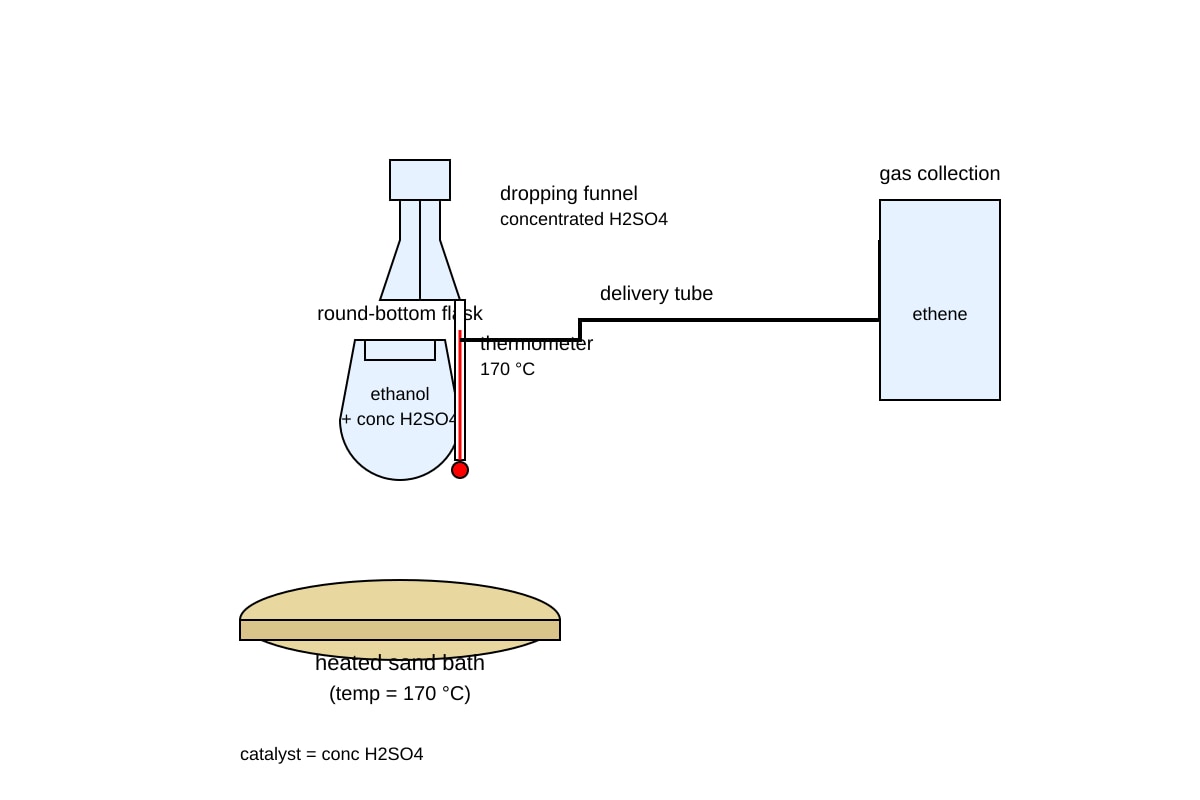
- Diagram shows flask with ethanol + conc , thermometer at 170 °C, delivery to gas jar. [2]
- Role of acid: catalyst and dehydrating agent (removes water). [1]
- Product: . [1]
Teaching note: Image must show temp 170 not 140 (140 gives ether).
Q12. [3]
- Order of hydrolysis rate: 1-iodobutane > 1-bromobutane > 1-chlorobutane. [1]
- C–I bond weakest (lowest bond enthalpy), C–Cl strongest. [1]
- Rate-determining step is C–X bond breaking; weaker bond = faster. [1]
Teaching note: Bond enthalpies: C–Cl ~340, C–Br ~280, C–I ~240 kJ/mol.
Q13. [3]
- Product: N-methylethanamide (). [1]
- Equation: . [1]
- Functional group: amide. [1]
Teaching note: Acyl chloride + amine → amide (nucleophilic acyl substitution).
Q14. [2]
- Step 1: (ethanenitrile). [1]
- Step 2: (propanoic acid). [1]
Teaching note: CN lengthens chain by 1 C; hydrolysis gives acid.
Q15. [3]
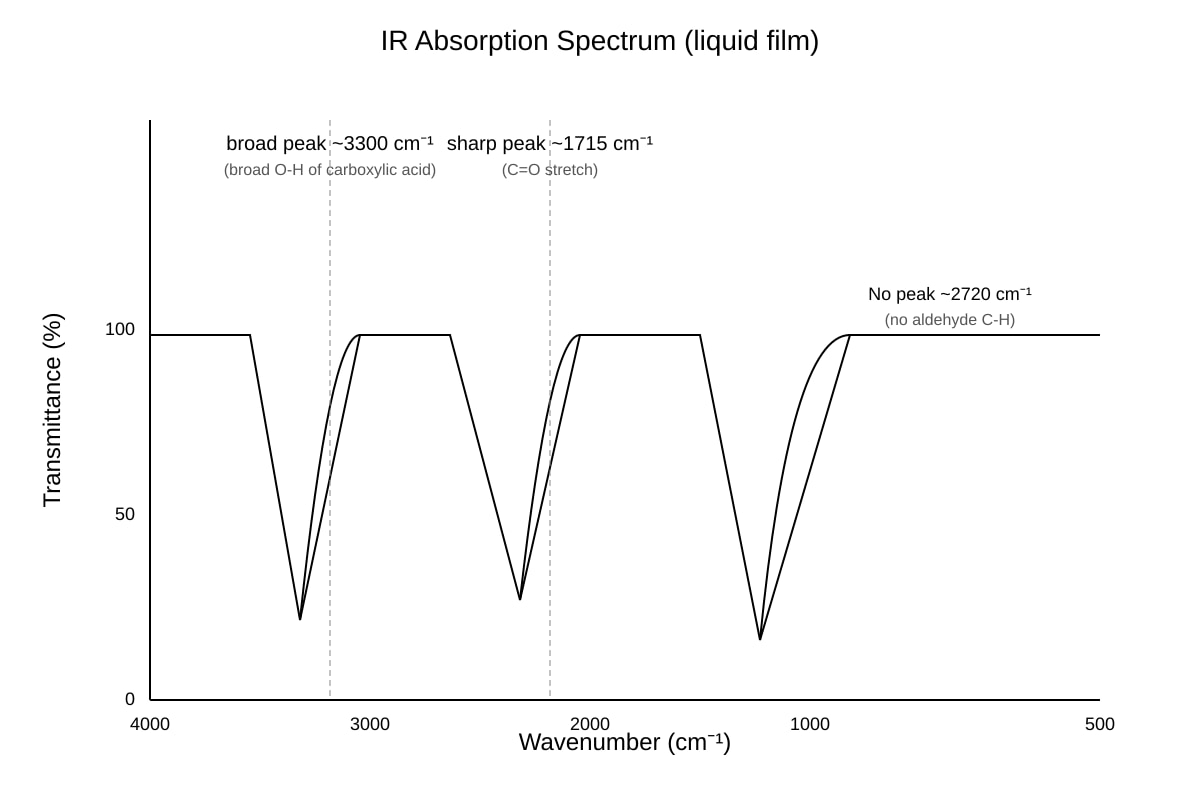
- Functional group: carboxylic acid (broad O–H + C=O). [1]
- Compound: ethanoic acid (not propanal) because broad 3300 = O–H of COOH. [1]
- Propanal would lack broad O–H and show aldehyde C–H ~2720. [1]
Teaching note: Image shows broad 3300 + 1715 → acid, not aldehyde.
Q16. [3]
- Type: addition polymerisation. [1]
- Segment: , draw two repeats with on alternate C. [2]
Teaching note: Double bond opens; side group stays on every other carbon.
Q17. [2]
- Repeat unit from : .
- . [2]
Teaching note: Sum atoms in repeat unit, not monomer gas mass only.
Q18. [3]
- Reagents: conc + conc . [1]
- Conditions: < 55 °C (avoid dinitration). [1]
- Electrophile: ; equation: . [1]
Teaching note: generates nitronium ion.
Q19. [3]
- Glycine: ; Alanine: .
- Dipeptide: . [2]
- Linkage: peptide (amide) bond. [1]
Teaching note: Condensation releases between carboxyl and amino.
Q20. [3]
- → (alkane : ). [1]
- Two isomers: n-pentane; 2-methylbutane (or 2,2-dimethylpropane). [2]
Teaching note: Draw chain and branched versions; all .