AI Generated Quiz
A Level H2 Chemistry Kinetics Equilibrium Quiz
Free A Level H2 Chemistry Kinetics Equilibrium quiz, LongCat AI version, with questions, answers, and A Level-style practice for Singapore students.
These static practice materials are generated from the site's syllabus and paper-generation workflow, with source and model context shown so students and parents can evaluate the material before use.
Questions
Free quiz and exam paper access
Enter your details to view this paper
Your access is remembered on this device.
Answers
A-Level Chemistry H2 Quiz - Kinetics Equilibrium
Answer Key and Marking Scheme
Question 1 [2 marks]
Answer: The rate of reaction is defined as the change in concentration of a reactant (or product) per unit time.
Marking:
- 1 mark for "change in concentration" (or equivalent wording such as "change in amount")
- 1 mark for "per unit time" (or "with respect to time")
Teaching notes: Rate measures how fast a reaction proceeds. It can be expressed as or . The negative sign for reactants ensures the rate is positive since reactant concentration decreases over time. Common units are mol dm⁻³ s⁻¹.
Question 2 [7 marks total]
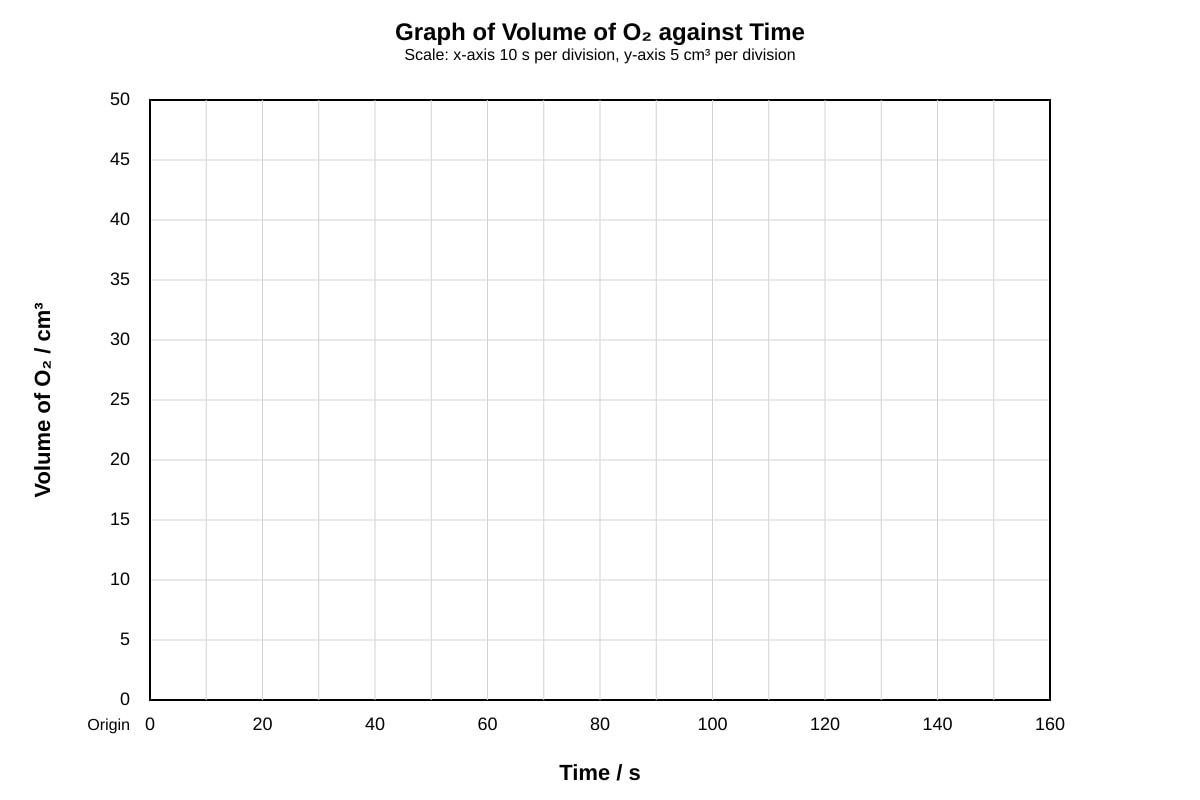
(a) [3 marks]
Marking:
- 1 mark for correct scale choice (using at least half the grid in both directions)
- 1 mark for all points correctly plotted (allow ±½ small square)
- 1 mark for smooth curve of best fit drawn through the points
Expected graph: The curve starts at the origin, rises steeply initially, then gradually levels off, reaching a plateau at 48 cm³ at approximately 120–140 s. The curve should be smooth and asymptotic to the plateau.
(b) [2 marks]
Answer: The reaction reaches completion at approximately 120 s. This is determined from the graph as the time at which the volume of O₂ stops increasing (the curve becomes horizontal/plateau). Beyond this point, no more O₂ is produced, indicating all H₂O₂ has decomposed.
Marking:
- 1 mark for correct time (110–130 s accepted)
- 1 mark for correct explanation (volume stops increasing / curve becomes horizontal / plateau reached)
(c) [2 marks]
Answer: As the reaction progresses, the concentration of H₂O₂ decreases. According to collision theory, for a reaction to occur, reactant particles must collide with sufficient energy (≥ activation energy) and the correct orientation. A lower concentration of H₂O₂ means fewer H₂O₂ particles per unit volume, resulting in fewer effective collisions per unit time. Therefore, the rate of reaction decreases.
Marking:
- 1 mark for stating that concentration of H₂O₂ decreases
- 1 mark for linking this to fewer effective collisions per unit time (collision theory)
Question 3 [10 marks total]
(a) [2 marks]
Answer: Order with respect to Na₂S₂O₃ = 1 (first order).
When [Na₂S₂O₃] is doubled from 0.10 to 0.20 mol dm⁻³ (with [HCl] constant), the time taken decreases from 45 s to 23 s. The rate is inversely proportional to time (rate ∝ 1/t). The rate approximately doubles (45/23 ≈ 2.0), so doubling the concentration doubles the rate. This indicates first order with respect to Na₂S₂O₃.
Marking:
- 1 mark for correct order (1)
- 1 mark for correct reasoning linking concentration change to rate change
(b) [2 marks]
Answer: Order with respect to HCl = 1 (first order).
When [HCl] is doubled from 0.50 to 1.00 mol dm⁻³ (with [Na₂S₂O₃] constant), the time decreases from 45 s to 22 s. The rate approximately doubles (45/22 ≈ 2.0), so doubling the concentration doubles the rate. This indicates first order with respect to HCl.
Marking:
- 1 mark for correct order (1)
- 1 mark for correct reasoning
(c) [1 mark]
Answer:
Marking:
- 1 mark for correct rate equation with both orders = 1
(d) [3 marks]
Answer: From Experiment 1:
(Using rate ∝ 1/time as a relative measure)
Marking:
- 1 mark for calculating rate from time (1/45)
- 1 mark for correct substitution into rate equation
- 1 mark for correct answer with units (dm³ mol⁻¹ s⁻¹)
Note: Accept answers in range 0.40–0.49 dm³ mol⁻¹ s⁻¹ depending on rounding.
Question 4 [5 marks total]
(a) [1 mark]
Answer: Overall order = 2 + 1 = 3 (third order)
(b) [2 marks]
Answer: For a third-order reaction:
Marking:
- 1 mark for showing the working (dividing rate units by concentration raised to appropriate power)
- 1 mark for correct units
(c) [2 marks]
Answer:
The rate increases by a factor of 12.
Marking:
- 1 mark for correct substitution
- 1 mark for correct answer (12)
Question 5 [4 marks]
Answer: Using the two-point form of the Arrhenius equation:
Marking:
- 1 mark for correct substitution into the two-point Arrhenius equation
- 1 mark for correct calculation of ln(5.6) = 1.723
- 1 mark for correct calculation of the temperature term (1/300 – 1/350)
- 1 mark for correct final answer (30.1 kJ mol⁻¹, accept 29–31 kJ mol⁻¹)
Common mistakes:
- Forgetting to convert kJ to J (or vice versa) when using R = 8.31 J K⁻¹ mol⁻¹
- Swapping T₁ and T₂ which gives a negative E_a
Question 6 [5 marks total]
(a) [2 marks]
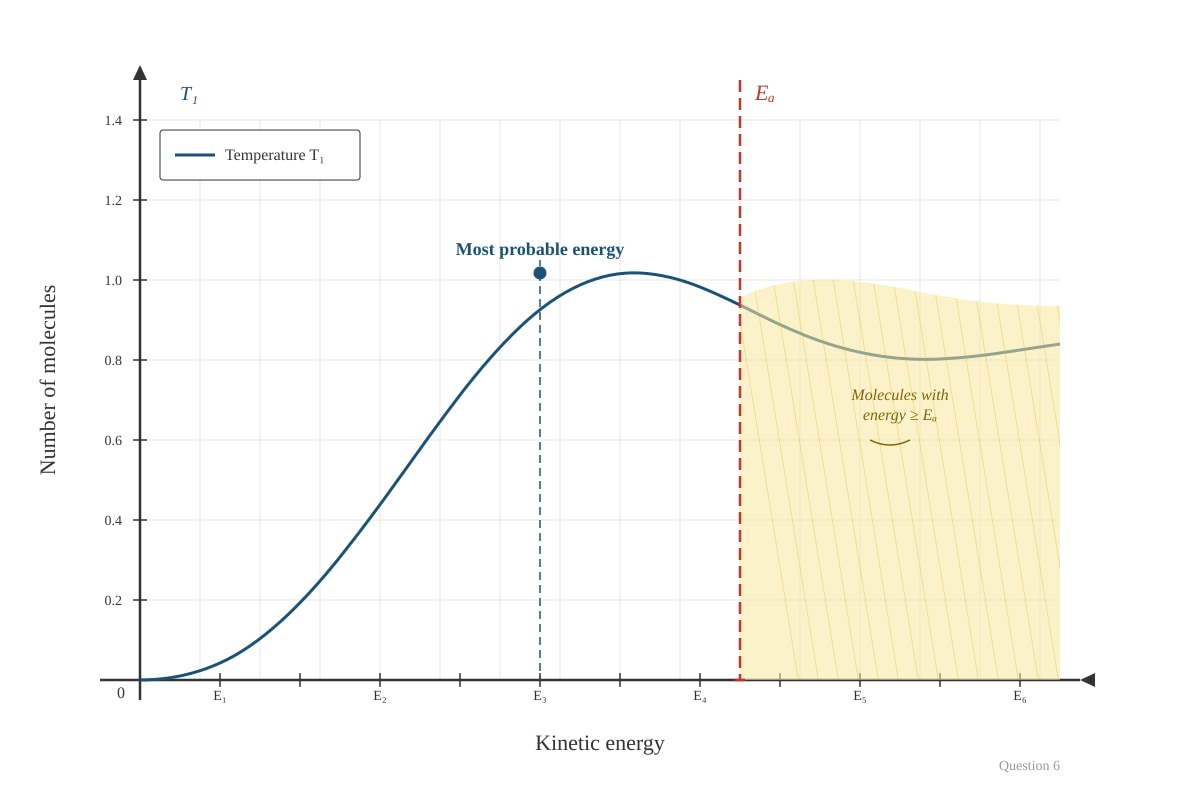
Answer: The curve at T₂ should be:
- Shifted to the right (higher most probable kinetic energy)
- Lower peak height (more spread out)
- Flatter/broader shape
- Starts from the origin
Marking:
- 1 mark for curve shifted right with lower peak
- 1 mark for curve being broader/flatter (not narrower)
(b) [1 mark]
Answer: The area under the T₂ curve to the right of the Eₐ line should be shaded. This shaded area is larger than the corresponding area for T₁.
Marking:
- 1 mark for correct shading beyond Eₐ on the T₂ curve
(c) [2 marks]
Answer: At a higher temperature, the Maxwell-Boltzmann distribution curve shifts to the right and becomes broader. This means a greater proportion of molecules have kinetic energy equal to or greater than the activation energy (Eₐ). Since only molecules with energy ≥ Eₐ can undergo successful (effective) collisions, a larger proportion of molecules can react. Therefore, there are more effective collisions per unit time, and the rate of reaction increases.
Marking:
- 1 mark for stating that more molecules have energy ≥ Eₐ at higher temperature
- 1 mark for linking this to more effective collisions and hence faster rate
Question 7 [6 marks total]
(a) [1 mark]
Answer: Any one of:
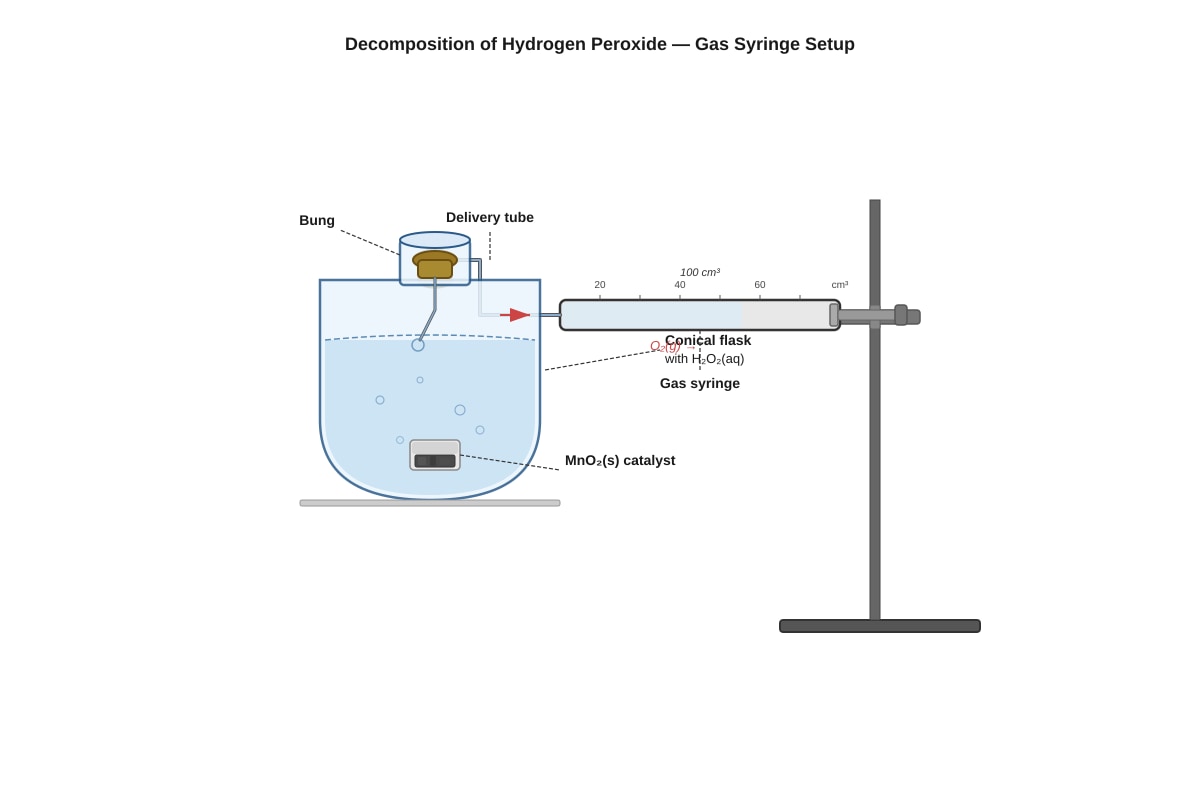
- Ensure the apparatus is gas-tight / no leaks
- Use the same volume and concentration of H₂O₂ solution
- Ensure the catalyst is added quickly and the bung is replaced immediately
- Maintain constant temperature
(b) [3 marks]
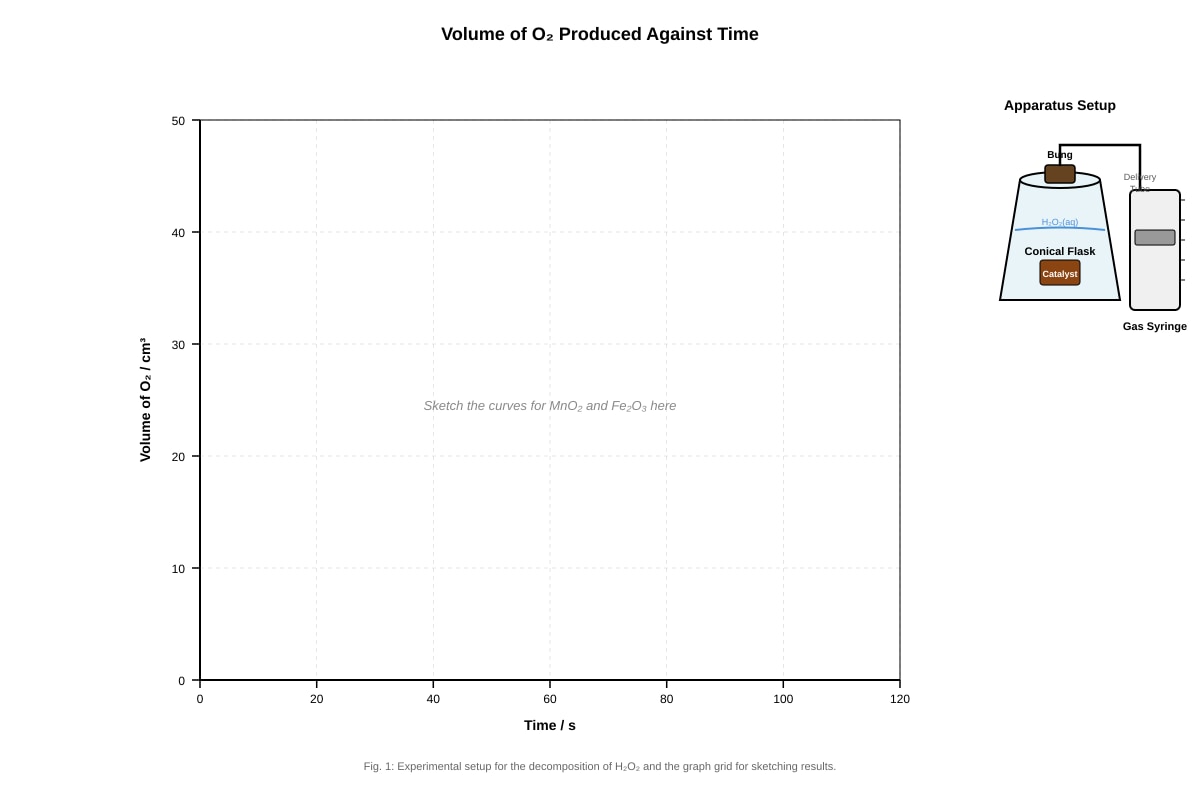
Answer: Both curves should reach the same final volume of O₂ (since the same amount of H₂O₂ is used, the same amount of O₂ is produced). The curve with MnO₂ should be steeper initially (faster rate) than the curve with Fe₂O₃, assuming MnO₂ is a more effective catalyst for this reaction. Both curves should plateau at the same final volume.
Marking:
- 1 mark for both curves reaching the same final volume (plateau at same level)
- 1 mark for MnO₂ curve being steeper initially (faster rate)
- 1 mark for both curves being smooth and asymptotic to the plateau
(c) [2 marks]
Answer: A catalyst provides an alternative reaction pathway with a lower activation energy. This means that the Eₐ line on the Maxwell-Boltzmann distribution curve effectively shifts to the left (lower energy value). Consequently, a greater proportion of molecules now have energy ≥ Eₐ, resulting in more effective collisions per unit time and hence a faster rate of reaction.
Marking:
- 1 mark for stating that a catalyst lowers the activation energy
- 1 mark for explaining that more molecules have energy ≥ Eₐ (or the Eₐ line shifts left on the distribution curve)
Question 8 [7 marks total]
(a) [2 marks]
Answer: Comparing Experiments 2 and 3: [H₂] is constant (0.040 mol dm⁻³), [NO] doubles from 0.010 to 0.020 mol dm⁻³.
Rate changes from to mol dm⁻³ s⁻¹.
When [NO] doubles, the rate increases by a factor of 4 = 2². Therefore, the order with respect to NO is 2 (second order).
Marking:
- 1 mark for correct comparison and calculation
- 1 mark for correct order (2)
(b) [2 marks]
Answer: Comparing Experiments 1 and 2: [NO] is constant (0.010 mol dm⁻³), [H₂] doubles from 0.020 to 0.040 mol dm⁻³.
Rate changes from to mol dm⁻³ s⁻¹.
When [H₂] doubles, the rate doubles. Therefore, the order with respect to H₂ is 1 (first order).
Marking:
- 1 mark for correct comparison and calculation
- 1 mark for correct order (1)
(c) [3 marks]
Answer: Rate equation:
Using data from Experiment 1:
Marking:
- 1 mark for correct rate equation
- 1 mark for correct substitution
- 1 mark for correct answer with units (dm⁶ mol⁻² s⁻¹)
Question 9 [5 marks total]
(a) [3 marks]
Answer: The Maxwell-Boltzmann distribution shows that at any temperature, molecules have a wide range of kinetic energies. Only molecules with energy ≥ Eₐ can react (effective collisions). The proportion of molecules with energy ≥ Eₐ is represented by the area under the curve beyond Eₐ. When temperature increases by only 10 °C, the curve shifts slightly to the right and broadens. Although the shift in average kinetic energy is small (~4%), the area under the curve beyond Eₐ increases significantly because the high-energy tail of the distribution extends much further. This disproportionate increase in the number of molecules exceeding Eₐ leads to approximately double the number of effective collisions, hence approximately doubling the rate.
Marking:
- 1 mark for reference to the Maxwell-Boltzmann distribution and the range of molecular energies
- 1 mark for explaining that only molecules with E ≥ Eₐ react (area under curve beyond Eₐ)
- 1 mark for explaining that a small temperature increase causes a disproportionate increase in the proportion of molecules with E ≥ Eₐ
(b) [2 marks]
Answer: Increasing the pressure of a gaseous reaction decreases the volume, which increases the concentration of the gaseous reactants. According to collision theory, higher concentration means more molecules per unit volume, leading to more frequent collisions and hence a higher rate of reaction. However, the Maxwell-Boltzmann distribution depends only on temperature, not pressure. Since the temperature is unchanged, the distribution of molecular kinetic energies remains the same — the shape of the curve does not change.
Marking:
- 1 mark for explaining that pressure increases concentration, leading to more frequent collisions
- 1 mark for stating that the Maxwell-Boltzmann distribution depends only on temperature
Question 10 [6 marks total]
(a) [2 marks]
Answer:
Marking:
- 1 mark for correct substitution
- 1 mark for correct answer (4.86 × 10⁻⁴ mol dm⁻³ s⁻¹)
(b) [4 marks]
Answer: Using the two-point Arrhenius equation:
Marking:
- 1 mark for correct substitution (note E_a must be in J mol⁻¹ = 52000)
- 1 mark for correct calculation of the temperature term
- 1 mark for correct calculation of ln(k₂/k₁)
- 1 mark for correct final answer (0.135 dm⁶ mol⁻² s⁻¹, accept 0.13–0.14)
Question 11 [2 marks]
Answer: Dynamic equilibrium is a state in which the forward and reverse reactions are occurring at the same rate, so that the concentrations of reactants and products remain constant (but not necessarily equal). The equilibrium is "dynamic" because the reactions have not stopped — both forward and reverse reactions continue to occur.
Marking:
- 1 mark for stating forward and reverse rates are equal
- 1 mark for stating concentrations remain constant (and that reactions continue / it is dynamic)
Question 12 [4 marks total]
(a) [1 mark]
Answer:
(b) [3 marks]
Answer:
Marking:
- 1 mark for correct substitution
- 1 mark for correct calculation
- 1 mark for correct units (dm³ mol⁻¹)
Question 13 [5 marks total]
(a) [2 marks]
Answer: Increasing the temperature shifts the equilibrium to the left (towards the reactants), so the yield of NH₃ decreases. Since the forward reaction is exothermic (ΔH = –92 kJ mol⁻¹), heat can be considered a "product". By Le Chatelier's principle, increasing temperature favours the endothermic direction (the reverse reaction) to absorb the added heat.
Marking:
- 1 mark for stating yield decreases / equilibrium shifts left
- 1 mark for correct explanation using Le Chatelier's principle and the exothermic nature
(b) [2 marks]
Answer: Increasing the pressure shifts the equilibrium to the right (towards the products), so the yield of NH₃ increases. There are 4 moles of gas on the reactant side (1 N₂ + 3 H₂) and 2 moles of gas on the product side (2 NH₃). By Le Chatelier's principle, increasing pressure favours the side with fewer moles of gas to reduce the pressure.
Marking:
- 1 mark for stating yield increases / equilibrium shifts right
- 1 mark for correct explanation comparing moles of gas on each side
(c) [1 mark]
Answer: Adding a catalyst has no effect on the yield of NH₃. A catalyst increases the rate of both the forward and reverse reactions equally, so equilibrium is reached faster but the position of equilibrium (and hence the yield) is unchanged.
Marking:
- 1 mark for stating no effect with brief explanation
Question 14 [6 marks total]
(a) [1 mark]
Answer:
(b) [3 marks]
Answer:
Marking:
- 1 mark for correct substitution into K_p expression
- 1 mark for correct rearrangement
- 1 mark for correct answer (0.50 atm)
(c) [2 marks]
Answer: would be smaller at 800 K. Since the forward reaction is exothermic, increasing the temperature shifts the equilibrium to the left (towards reactants) by Le Chatelier's principle. This means the partial pressures of products decrease and reactants increase, so the value of decreases.
Marking:
- 1 mark for stating K_p is smaller
- 1 mark for correct explanation (exothermic reaction, equilibrium shifts left)
Question 15 [6 marks total]
(a) [2 marks]
Answer: Adding Fe(NO₃)₃ increases the concentration of Fe³⁺ ions. By Le Chatelier's principle, the equilibrium shifts to the right (towards products) to partially reduce the increased concentration of Fe³⁺. This produces more [FeSCN]²⁺, which is blood-red, so the solution becomes darker red.
Marking:
- 1 mark for stating equilibrium shifts right
- 1 mark for linking to increased [Fe³⁺] and more [FeSCN]²⁺ produced
(b) [2 marks]
Answer: NaOH reacts with Fe³⁺ to form Fe(OH)₃ precipitate (brown), removing Fe³⁺ ions from the solution. By Le Chatelier's principle, the equilibrium shifts to the left to partially replace the removed Fe³⁺. This reduces the concentration of [FeSCN]²⁺, so the red colour becomes paler.
Marking:
- 1 mark for stating that Fe³⁺ is removed (precipitated as Fe(OH)₃)
- 1 mark for stating equilibrium shifts left, reducing [FeSCN]²⁺
(c) [2 marks]
Answer: The forward reaction is exothermic. When the solution is heated, the equilibrium shifts to the left (the solution becomes paler, meaning less [FeSCN]²⁺). By Le Chatelier's principle, increasing temperature favours the endothermic direction. Since the reverse reaction is endothermic, the forward reaction must be exothermic.
Marking:
- 1 mark for stating exothermic
- 1 mark for correct reasoning (heating shifts equilibrium left, so reverse is endothermic, forward is exothermic)
Question 16 [6 marks total]
(a) [5 marks]
Answer: Initial concentration of PCl₅ = 0.500 / 2.00 = 0.250 mol dm⁻³
Let x = amount of PCl₅ that dissociates (in mol dm⁻³):
Using the quadratic formula:
Equilibrium concentrations:
- mol dm⁻³
- mol dm⁻³
- mol dm⁻³
Marking:
- 1 mark for correct initial concentration calculation
- 1 mark for correct ICE table setup
- 1 mark for correct K_c expression and substitution
- 1 mark for correct solution of quadratic (or valid approximation method)
- 1 mark for correct equilibrium concentrations (3 values)
(b) [1 mark]
Answer:
Question 17 [6 marks total]
(a) [4 marks]
Answer: Initial concentrations: [H₂] = 1.00 mol dm⁻³, [I₂] = 1.00 mol dm⁻³, [HI] = 0
Let x = amount of H₂ that reacts:
Taking square roots of both sides:
Equilibrium concentrations:
- mol dm⁻³
- mol dm⁻³
- mol dm⁻³
Marking:
- 1 mark for correct ICE table
- 1 mark for correct K_c expression and substitution
- 1 mark for correct algebraic solution (including square root step)
- 1 mark for correct equilibrium concentrations (all 3 values)
(b) [2 marks]
Answer: depends only on temperature. Since the temperature is unchanged, remains the same. Additionally, for this reaction, the total number of moles of gas is the same on both sides of the equation (1 + 1 = 2 moles on each side). Therefore, changing the pressure (by changing volume) does not shift the equilibrium position — the equilibrium concentrations change proportionally such that the ratio in the expression remains constant.
Marking:
- 1 mark for stating K_c depends only on temperature
- 1 mark for noting equal moles of gas on both sides (or that pressure change doesn't shift equilibrium)
Question 18 [6 marks total]
(a) [3 marks]
Answer: Although a lower temperature would give a higher equilibrium yield of NH₃ (since the forward reaction is exothermic), the rate of reaction at low temperature would be too slow to be economically viable. At 450 °C, a compromise is reached: the rate of reaction is fast enough to produce NH₃ at a commercially useful rate, while still maintaining a reasonable yield. The iron catalyst also helps to increase the rate at this temperature.
Marking:
- 1 mark for stating that lower temperature gives higher yield but slower rate
- 1 mark for explaining that 450 °C is a compromise between rate and yield
- 1 mark for mentioning economic/commercial viability
(b) [2 marks]
Answer: A high pressure of 200 atm shifts the equilibrium to the right (towards products), increasing the yield of NH₃. This is because there are fewer moles of gas on the product side (2 moles) compared to the reactant side (4 moles). By Le Chatelier's principle, high pressure favours the side with fewer moles of gas.
Marking:
- 1 mark for stating that high pressure increases yield / shifts equilibrium right
- 1 mark for explaining using moles of gas comparison
(c) [1 mark]
Answer: The iron catalyst increases the rate of reaction by providing an alternative pathway with a lower activation energy. It does not change the yield of NH₃ but allows equilibrium to be reached faster, making the process more efficient.
Marking:
- 1 mark for stating catalyst increases rate / lowers activation energy / reaches equilibrium faster
Question 19 [6 marks total]
(a) [4 marks]
Answer: Let x = moles of CH₃COOH that react:
Since all species are in the same liquid phase and the volume is constant:
Taking square roots:
Equilibrium amounts:
- CH₃COOH: 1.00 – 0.667 = 0.333 mol
- C₂H₅OH: 1.00 – 0.667 = 0.333 mol
- CH₃COOC₂H₅: 0.667 mol
- H₂O: 0.667 mol
Marking:
- 1 mark for correct ICE table
- 1 mark for correct K_c expression and substitution
- 1 mark for correct algebraic solution
- 1 mark for correct equilibrium amounts (all 4 values)
(b) [2 marks]
Answer: Any one of:
- Increase the concentration of one reactant (e.g., add excess ethanol): By Le Chatelier's principle, the equilibrium shifts to the right to produce more ethyl ethanoate.
- Remove a product (e.g., distil off the ethyl ethanoate as it forms): This reduces the concentration of product, shifting the equilibrium to the right.
- Remove water (e.g., using a dehydrating agent): Shifts equilibrium right.
Marking:
- 1 mark for valid method
- 1 mark for correct explanation using Le Chatelier's principle
Question 20 [8 marks total]
(a) [3 marks]
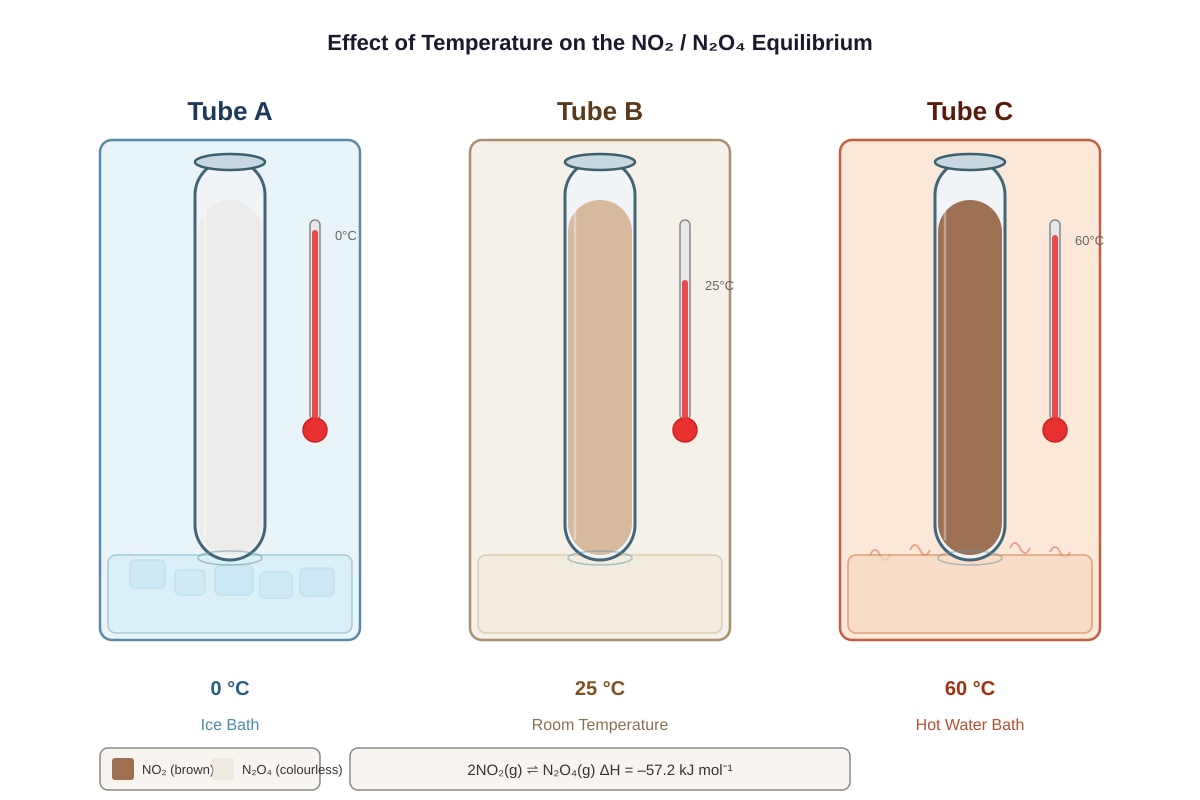
Answer: Tube C is at a higher temperature (60 °C) than Tube B (25 °C). The forward reaction (2NO₂ → N₂O₄) is exothermic, so the reverse reaction (N₂O₄ → 2NO₂) is endothermic. By Le Chatelier's principle, increasing the temperature favours the endothermic direction — the reverse reaction. This produces more NO₂ (brown gas) and less N₂O₄ (colourless), so the colour becomes darker brown.
Marking:
- 1 mark for identifying that higher temperature favours the reverse reaction
- 1 mark for stating the reverse reaction is endothermic
- 1 mark for linking to more NO₂ produced and darker colour
(b) [3 marks]
Answer: At equilibrium:
- atm
- Total pressure = 1.20 atm
- atm
Marking:
- 1 mark for correct calculation of
- 1 mark for correct substitution into expression
- 1 mark for correct answer with units (atm⁻¹)
(c) [2 marks]
Answer: The value of decreases when the temperature is increased. Since the forward reaction (2NO₂ → N₂O₄) is exothermic, increasing the temperature shifts the equilibrium to the left (towards NO₂). This means decreases and increases, so the value of decreases.
Marking:
- 1 mark for stating K_p decreases
- 1 mark for correct explanation (equilibrium shifts left, exothermic forward reaction)
Total: 60 marks