AI Generated Quiz
A Level H2 Chemistry Kinetics Equilibrium Quiz
Free A Level H2 Chemistry Kinetics Equilibrium quiz, HY3 AI version, with questions, answers, and A Level-style practice for Singapore students.
These static practice materials are generated from the site's syllabus and paper-generation workflow, with source and model context shown so students and parents can evaluate the material before use.
Questions
Free quiz and exam paper access
Enter your details to view this paper
Your access is remembered on this device.
Answers
A-Level Chemistry H2 Quiz - Kinetics Equilibrium (Answer Key)
Topic: Kinetics & Equilibrium
Total Marks: 40
Section A: Reaction Kinetics
1. [2 marks]
Order with respect to X = 3 (third order).
Working: Rate ∝ [X]ⁿ. If [X] doubles, rate × 8 ⇒ 2ⁿ = 8 ⇒ n = 3.
Teaching note: The order is the power to which concentration must be raised in the rate equation. A factor of 8 increase from doubling means 2³.
Common mistake: Stating order = 8 or confusing factor with power.
2. [3 marks]
Rate equation: rate = k[NO]²[O₂].
Working:
- From Exp 1→2: [NO] doubles, [O₂] constant, rate ×4 ⇒ order in NO = 2.
- From Exp 1→3: [O₂] doubles, [NO] constant, rate ×2 ⇒ order in O₂ = 1.
- Overall: rate = k[NO]²[O₂].
Mark breakdown: 1 mark for NO order, 1 mark for O₂ order, 1 mark for equation.
Teaching note: Compare experiments where only one concentration changes.
3. [2 marks]
Any two of: increased concentration, increased pressure (for gases), increased temperature, increased surface area, use of catalyst. (Credit only those increasing collision frequency effectively: concentration, pressure, surface area.)
Teaching note: Effective collisions require correct orientation and sufficient energy; frequency is raised by more particles per unit volume.
4. [3 marks]
Rate-determining step = Step 2 (slow).
Rate = k[protonated aspirin][H₂O]. Since protonated aspirin formed fast from aspirin + H⁺, rate ≈ k'[aspirin][H⁺][H₂O].
Mark breakdown: 1 mark RDS, 2 marks rate equation.
Teaching note: The slow step governs rate; intermediates from fast pre-equilibria can be substituted.
5. [2 marks]
Increasing T shifts Maxwell–Boltzmann distribution to higher energies; more molecules exceed Eₐ, so more effective collisions per second ⇒ faster rate.
Teaching note: Only molecules with energy > activation energy react.
6. [3 marks]
First-order: t = (1/k) ln([A]₀/[A]).
t = (1 / 5.0×10⁻⁴) × ln(0.020 / 0.0050) = 2000 × ln(4) = 2000 × 1.386 = 2772 s ≈ 2.77 × 10³ s.
Mark breakdown: 1 mark formula, 1 mark substitution, 1 mark answer.
Common mistake: Using wrong order formula.
7. [2 marks]
Catalyst lowers Eₐ for forward and reverse equally, so forward and reverse rates increase by same factor; equilibrium constant unchanged ⇒ no shift in position.
Teaching note: Equilibrium position depends on ΔG°, not on rate.
Section B: Chemical Equilibria
8. [2 marks]
K_c = [NH₃]² / ([N₂][H₂]³)
Teaching note: Products over reactants, powers = coefficients.
9. [3 marks]
K_c = [NH₃]² / ([N₂][H₂]³) = 0.50
[NH₃]² = 0.50 × 0.20 × (0.60)³ = 0.50 × 0.20 × 0.216 = 0.0216
[NH₃] = √0.0216 = 0.147 mol dm⁻³ ⇒ in 1.0 dm³, moles = 0.147 mol.
Mark breakdown: 1 mark substitution, 1 mark square root, 1 mark unit/moles.
10. [2 marks]
Le Chatelier’s principle: If a system at equilibrium is subjected to a change, the system shifts to oppose that change.
11. [3 marks]
(a) Increase T: equilibrium shifts left (endothermic direction) to absorb heat ⇒ yield SO₃ decreases.
(b) Increase P: shifts to side with fewer gas moles (right, 3→2) ⇒ yield SO₃ increases.
Mark breakdown: 1 mark per prediction, 1 mark explanation.
12. [2 marks]
K_p = P_CO₂ (solids omitted).
13. [3 marks]
Only CO₂ is gaseous, so P_CO₂ = K_p = 1.2 atm. Total pressure given is consistent (2.0 atm includes inert? Actually only CO₂ present ⇒ P_CO₂ = 1.2 atm at equilibrium).
Teaching note: For heterogeneous equilibria, solid activities = 1.
14. [2 marks]
Solids have constant activity (concentration); changing amount does not change their activity, so no effect on K_p or position.
Section C: Integrated and Data-Based
15. [2 marks]
Let x = [HI] at eq. Then [H₂]=[I₂]=(1−x/2). K_c = x²/((1−x/2)²)=50. x/(1−x/2)=√50≈7.07 ⇒ x = 7.07−3.54x ⇒ 4.54x=7.07 ⇒ x≈1.56 (impossible >1). Recheck: initial 1.0 each, x max 2.0? Actually 2HI from 1 H₂+1 I₂, so x ≤2. Solve: x² = 50(1−x/2)² ⇒ x/(1−0.5x)=7.07 ⇒ x = 7.07 − 3.535x ⇒ 4.535x = 7.07 ⇒ x = 1.56 mol dm⁻³.
Teaching note: Use ICE table.
16. [3 marks]
Rate = k[A]¹[B]²; overall order = 3.
Working: Doubling A ⇒ ×2 ⇒ order A=1; doubling B ⇒ ×4 ⇒ order B=2.
17. [3 marks]
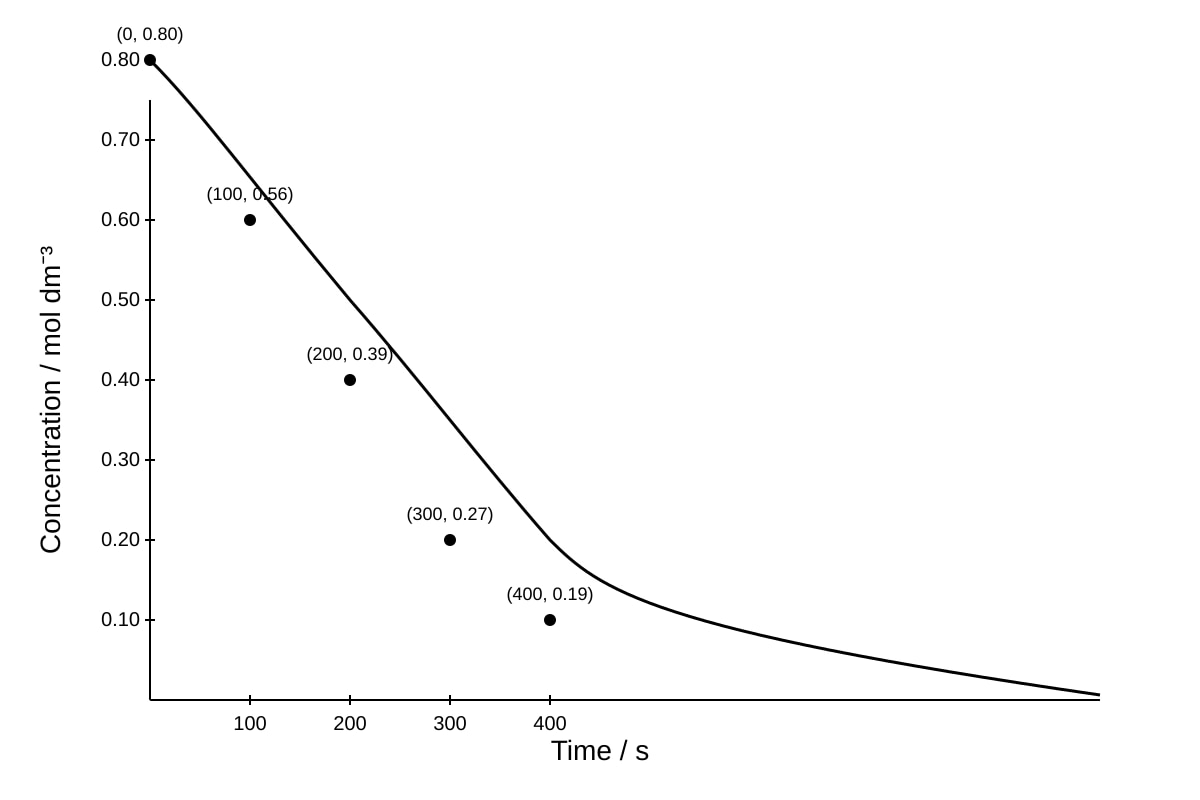
From graph: half-life ≈ time for 0.80→0.40 ≈ 230 s. k = ln2 / t½ = 0.693/230 = 3.0×10⁻³ s⁻¹.
Image requirement: Decay curve must show exponential drop; half-life read from plot.
18. [2 marks]
Catalyst lowers Eₐ; K_c unchanged (thermodynamic constant depends only on T).
19. [3 marks]
Let x = [PCl₃]=[Cl₂] at eq. [PCl₅]=0.25−x (0.50 mol/2 dm³).
K_c = x²/(0.25−x) = 0.040 ⇒ x² = 0.010 − 0.040x ⇒ x²+0.040x−0.010=0.
x = [−0.040 + √(0.0016+0.040)]/2 = [−0.040+0.203]/2 = 0.0815 mol dm⁻³.
[PCl₅]=0.1685, [PCl₃]=[Cl₂]=0.0815 mol dm⁻³.
Mark breakdown: 1 setup, 1 solve, 1 final conc.
20. [2 marks]
K_c = e^(−ΔG°/RT); ΔG° changes with T ⇒ K_c changes. Concentration/pressure changes shift position but not ΔG° ⇒ K_c constant.