AI Generated Quiz
A Level H2 Chemistry Atomic Structure Bonding Quiz
Free A Level H2 Chemistry Atomic Structure Bonding quiz, LongCat AI version, with questions, answers, and A Level-style practice for Singapore students.
These static practice materials are generated from the site's syllabus and paper-generation workflow, with source and model context shown so students and parents can evaluate the material before use.
Questions
Free quiz and exam paper access
Enter your details to view this paper
Your access is remembered on this device.
Answers
A-Level Chemistry H2 Quiz - Atomic Structure Bonding
Answer Key and Teaching Notes
Question 1 [4 marks]
(a) [3]
- Proton: mass = 1, charge = +1
- Neutron: mass = 1, charge = 0
- Electron: mass = 1/1840 (or approximately 0), charge = −1
Teaching notes: These are the standard relative values. The mass of an electron is negligible compared to protons and neutrons. Students should memorise these values as they are fundamental to understanding atomic structure. One mark for each row completed correctly.
(b) [1]
The mass number is the total number of protons and neutrons in the nucleus of an atom.
Teaching notes: Mass number (A) = number of protons (Z) + number of neutrons (N). This is also called the nucleon number. Students sometimes confuse this with relative atomic mass, which is a weighted average of all isotopes.
Question 2 [3 marks]
(a) [2]
The relative atomic mass is 40.08, which is very close to 40. Since both isotopes have the same number of protons, and the mass number of the first isotope = protons + 20, and the second = protons + 22, the weighted average is approximately 40.
Let the number of protons = p.
Mass number of isotope 1 = p + 20
Mass number of isotope 2 = p + 22
Using the weighted average:
0.9694(p + 20) + 0.0306(p + 22) = 40.08
0.9694p + 19.388 + 0.0306p + 0.6732 = 40.08
p + 20.0612 = 40.08
p ≈ 20
The element is calcium (Ca) with 20 protons.
Teaching notes: This requires students to set up a weighted average equation. The key insight is that both isotopes share the same proton number. Award 1 mark for setting up the correct equation and 1 mark for the correct answer.
(b) [1]
Relative abundance of second isotope = 100% − 96.94% = 3.06%
Teaching notes: Straightforward subtraction. The abundances of all isotopes must sum to 100%.
Question 3 [4 marks]
(a) [1]
1s² 2s² 2p⁶ 3s² 3p⁶ 3d² 4s²
Teaching notes: Ti has 22 electrons. Students must fill orbitals in order of increasing energy: 1s → 2s → 2p → 3s → 3p → 4s → 3d. A common error is writing 3d before 4s, but the configuration is written with 3d before 4s in the final answer (by convention, orbitals are listed in order of principal quantum number).
(b) [1]
1s² 2s² 2p⁶ 3s² 3p⁶ 3d²
Teaching notes: When forming positive ions, transition metals lose electrons from the 4s orbital before the 3d orbital, because the 4s orbital is at a higher energy level than 3d once occupied. Ti loses its two 4s electrons to form Ti²⁺.
(c) [2]
Ti²⁺ has partially filled 3d orbitals (3d²). In the presence of ligands (such as water in aqueous solution), the 3d orbitals split into different energy levels. Electrons can absorb visible light to undergo d-d transitions between these split d-orbitals. The wavelengths absorbed correspond to certain colours, and the transmitted/reflected light appears coloured.
Teaching notes: Two key points needed: (1) partially filled d orbitals, and (2) d-d transitions / splitting of d orbitals by ligands. Ions with empty d orbitals (e.g., Sc³⁺) or fully filled d orbitals (e.g., Zn²⁺) are colourless.
Question 4 [4 marks]
(a) [2]
Element Y belongs to Group 2. There is a large jump in ionisation energy between the 2nd and 3rd ionisation energies (2745 → 11577 kJ mol⁻¹). This indicates that the first two electrons are removed from the outermost shell, and the third electron must be removed from an inner shell, which is much closer to the nucleus and more tightly held. Having two electrons in the outermost shell is characteristic of Group 2 elements.
Teaching notes: The key diagnostic feature is the large jump in IE. Students should look for where the IE increases dramatically — this reveals the number of valence electrons. Award 1 mark for identifying Group 2 and 1 mark for the explanation involving the large jump.
(b) [1]
Magnesium (Mg)
Teaching notes: The successive IE values match those of magnesium (Z = 12, Group 2, Period 3). Students can verify using the Data Booklet.
(c) [1]
Mg⁺(g) → Mg²⁺(g) + e⁻
Teaching notes: The third ionisation energy involves removing an electron from Mg²⁺ to form Mg³⁺. Wait — let me correct this. The third ionisation energy means removing the third electron, so it is:
Mg²⁺(g) → Mg³⁺(g) + e⁻
Correction: The nth ionisation energy is the energy required to remove an electron from the (n−1)+ ion. So the 3rd IE is: Mg²⁺(g) → Mg³⁺(g) + e⁻. State symbols (g) are required.
Question 5 [7 marks]
(a) [3]
Across Period 3 from Na to Ar, the first ionisation energy generally increases. This is because the nuclear charge (number of protons) increases across the period, while the electrons are being added to the same principal energy level (n = 3). The increasing nuclear charge pulls the outer electrons closer to the nucleus, resulting in a smaller atomic radius and stronger attraction between the nucleus and the outer electrons. More energy is therefore required to remove an electron.
Teaching notes: Award 1 mark for stating the trend (increases), 1 mark for explaining increasing nuclear charge / proton number, and 1 mark for linking to stronger attraction / smaller atomic radius. Students must mention that electrons are added to the same shell (similar shielding).
(b) [2]
In magnesium, the outermost electron is in a 3s orbital. In aluminium, the outermost electron is in a 3p orbital. The 3p orbital is at a slightly higher energy level than the 3s orbital and is, on average, further from the nucleus. Additionally, the 3p electron experiences slightly more shielding from the 3s electrons. Therefore, the 3p electron in aluminium is easier to remove than the 3s electron in magnesium, resulting in a lower first ionisation energy.
Teaching notes: Key points: (1) the outer electron in Al is in a 3p orbital (higher energy, further from nucleus), and (2) the 3p electron is more shielded. Award 1 mark for each point.
(c) [2]
In phosphorus, the 3p orbitals are half-filled (3p³), with one electron in each of the three 3p orbitals. This is a relatively stable arrangement with no electron-electron repulsion within the same orbital. In sulfur, the 3p configuration is 3p⁴, meaning one of the 3p orbitals contains a pair of electrons. The electron-electron repulsion within this paired orbital makes it easier to remove one of the paired electrons, resulting in a lower first ionisation energy for sulfur compared to phosphorus.
Teaching notes: Key points: (1) P has 3p³ with one electron per orbital (stable, no pairing repulsion), and (2) S has 3p⁴ with a paired orbital, so electron-electron repulsion makes removal easier. Award 1 mark for each point.
Question 6 [5 marks]
(a) [1]
Electronegativity is the tendency of an atom to attract the bonding pair of electrons towards itself in a covalent bond.
Teaching notes: This is the standard definition. Students should be precise — it refers to the bonding pair of electrons, not all electrons.
(b) [2]
Fluorine is more electronegative than chlorine. The electronegativity difference between H and F is greater than that between H and Cl. This means the bonding pair of electrons in HF is pulled much closer to F than the bonding pair in HCl is pulled to Cl. The greater unequal sharing of electrons in HF results in a larger partial charge separation, making the H–F bond more polar.
Teaching notes: Award 1 mark for stating F is more electronegative than Cl, and 1 mark for explaining the greater unequal sharing / larger dipole.
(c) [2]
ΔEN(H–F) = 3.98 − 2.20 = 1.78
ΔEN(H–Cl) = 3.16 − 2.20 = 0.96
The H–F bond has the greater ionic character because it has the larger electronegativity difference.
Teaching notes: Award 1 mark for both correct calculations and 1 mark for the correct conclusion. Note: despite having greater ionic character, HF is still a covalent compound (the bond is polar covalent, not ionic).
Question 7 [7 marks]
(a)(i) NH₃ [2]
A dot-and-cross diagram showing:
- N (centre) with 5 valence electrons (e.g., shown as dots)
- Each H contributes 1 electron (e.g., shown as crosses)
- Three N–H single bonds (each a shared pair: one dot + one cross)
- One lone pair on N (two dots)
Award 1 mark for correct bonding pairs and 1 mark for the lone pair on N.
(a)(ii) CO₂ [2]
A dot-and-cross diagram showing:
- C (centre) with 4 valence electrons (dots)
- Two O atoms, each with 6 valence electrons (crosses)
- Two C=O double bonds (each double bond = 2 shared pairs between C and O)
- Each O has 2 lone pairs
Award 1 mark for correct double bonds and 1 mark for correct lone pairs on both O atoms.
(b) [3]
NH₃ has 4 electron pairs around the central N atom (3 bonding pairs + 1 lone pair). According to VSEPR theory, these 4 electron pairs arrange themselves in a tetrahedral geometry to minimise repulsion. However, the molecular shape is determined by the positions of the atoms only, so NH₃ has a trigonal pyramidal shape. The lone pair exerts greater repulsion than bonding pairs, compressing the bond angle from the ideal tetrahedral angle of 109.5° to approximately 107°.
Teaching notes: Award 1 mark for identifying 4 electron pairs / tetrahedral electron geometry, 1 mark for trigonal pyramidal shape, and 1 mark for the bond angle of ~107° with explanation involving lone pair repulsion.
Question 8 [7 marks]
(a) [4 — 1 mark each]
(i) NaCl: Ionic bonding
(ii) Solid CO₂: Covalent bonding within molecules; van der Waals' (London dispersion) forces between molecules (accept "intermolecular forces" or "van der Waals' forces")
(iii) Cu: Metallic bonding
(iv) Ice (solid H₂O): Covalent bonding within molecules; hydrogen bonding between molecules
(b) [3]
Sodium chloride has a giant ionic structure consisting of Na⁺ and Cl⁻ ions held together by strong electrostatic forces of attraction in all directions. A large amount of energy is required to overcome these strong ionic bonds, resulting in a high melting point (801 °C).
Solid carbon dioxide has a simple molecular structure. The CO₂ molecules are held together by weak van der Waals' (London dispersion) forces between molecules. Only a small amount of energy is needed to overcome these weak intermolecular forces, resulting in a low melting point (−78 °C, it sublimes).
Teaching notes: Award 1 mark for identifying the structure of NaCl (giant ionic), 1 mark for identifying the structure of CO₂ (simple molecular with weak intermolecular forces), and 1 mark for linking the strength of forces to the melting point difference.
Question 9 [6 marks]
(a) [2]
A hydrogen bond is a strong intermolecular force of attraction between a hydrogen atom bonded to a highly electronegative atom (N, O, or F) and a lone pair of electrons on another electronegative atom (N, O, or F) in a neighbouring molecule.
Teaching notes: Award 1 mark for identifying it as an intermolecular force involving H bonded to N/O/F, and 1 mark for mentioning the lone pair on a neighbouring electronegative atom. Students must specify that it is an intermolecular force (not a covalent bond).
(b)(i) [2]
H₂O molecules are held together by hydrogen bonds, which are strong intermolecular forces. H₂S molecules are held together by weaker permanent dipole-dipole forces (and London dispersion forces). Sulfur is not electronegative enough to form hydrogen bonds. Since hydrogen bonds are much stronger than dipole-dipole forces, more energy is required to separate H₂O molecules, giving it a much higher boiling point.
Teaching notes: Award 1 mark for identifying hydrogen bonding in H₂O, and 1 mark for explaining that H₂S has weaker intermolecular forces (no hydrogen bonding because S is not sufficiently electronegative).
(b)(ii) [2]
From H₂S to H₂Te, the molecular mass increases, which means there are more electrons in each molecule. This leads to stronger London dispersion (temporary dipole-induced dipole) forces between molecules. More energy is required to overcome these stronger intermolecular forces, so the boiling point increases.
Teaching notes: Award 1 mark for identifying increasing molecular mass / number of electrons, and 1 mark for linking to stronger London dispersion forces and higher boiling points.
Question 10 [5 marks]
(a) [1]
Dative covalent bond (or coordinate bond)
(b) [3]
In BF₃, boron has only 6 electrons in its valence shell (3 bonding pairs, 0 lone pairs), making it electron-deficient. In NH₃, nitrogen has a lone pair of electrons. The lone pair on the nitrogen atom in NH₃ is donated into the empty orbital of boron in BF₃, forming a dative covalent bond. Both electrons in the B–N bond come from the nitrogen atom.
Teaching notes: Award 1 mark for stating that B in BF₃ is electron-deficient (incomplete octet), 1 mark for stating that N in NH₃ has a lone pair, and 1 mark for explaining that the lone pair from N is donated to B.
(c) [1]
BF₃ is electron-deficient because boron has only 6 electrons in its valence shell (3 bonding pairs), which is fewer than the stable octet of 8 electrons.
Teaching notes: Boron does not have a complete octet in BF₃ — this is why it acts as a Lewis acid and accepts a lone pair.
Question 11 [8 marks — 2 marks each]
(a) CH₄
Shape: Tetrahedral
Bond angle: 109.5°
4 bonding pairs, 0 lone pairs on C. Tetrahedral arrangement.
(b) SF₆
Shape: Octahedral
Bond angle: 90°
6 bonding pairs, 0 lone pairs on S. Octahedral arrangement. (S can expand its octet using d orbitals.)
(c) XeF₄
Shape: Square planar
Bond angle: 90°
4 bonding pairs, 2 lone pairs on Xe. The 6 electron pairs adopt an octahedral arrangement, but the 2 lone pairs occupy opposite positions (to minimise repulsion), giving a square planar molecular shape.
(d) ClF₃
Shape: T-shaped
Bond angle: approximately 87.5° (accept 90° or "less than 90°")
3 bonding pairs, 2 lone pairs on Cl. The 5 electron pairs adopt a trigonal bipyramidal arrangement. The 2 lone pairs occupy equatorial positions, giving a T-shaped molecular shape. Bond angles are slightly less than 90° due to lone pair repulsion.
Teaching notes: For each, award 1 mark for the correct shape and 1 mark for the correct bond angle. Students should use VSEPR theory systematically: count total electron pairs → determine electron geometry → determine molecular shape based on bonding pairs only.
Question 12 [4 marks]
(a) [2]
Both NH₃ and CH₄ have 4 electron pairs around the central atom (tetrahedral electron geometry). However, in CH₄ all 4 electron pairs are bonding pairs, giving an ideal tetrahedral bond angle of 109.5°. In NH₃, one of the 4 electron pairs is a lone pair. Lone pairs are held closer to the nucleus and occupy more space than bonding pairs, exerting greater repulsion. This compresses the H–N–H bond angle from 109.5° to approximately 107°.
Teaching notes: Award 1 mark for identifying the lone pair in NH₃, and 1 mark for explaining that lone pair-bonding pair repulsion is greater than bonding pair-bonding pair repulsion, compressing the angle.
(b) [2]
In NF₃, the highly electronegative fluorine atoms pull the bonding pairs of electrons away from the central nitrogen atom. This reduces the electron density around nitrogen, causing the bonding pairs to be further from N and closer to the F atoms. The bonding pairs are therefore spread out less around N, reducing the bond angle. Additionally, the lone pair on nitrogen in NF₃ occupies more relative space (since bonding pairs are pulled away), increasing lone pair-bonding pair repulsion and further compressing the bond angle to 102.5°.
Alternative acceptable explanation: In NH₃, the bonding pairs are held closer to N (since H is less electronegative), so the bonding pair-bonding pair repulsion is greater, resulting in a larger bond angle. In NF₃, the bonding pairs are pulled towards F, reducing bonding pair repulsion and allowing the lone pair to compress the angle further.
Teaching notes: Award 1 mark for mentioning the effect of electronegativity pulling bonding pairs away from N, and 1 mark for explaining the resulting reduction in bond angle.
Question 13 [7 marks]
(a) [2]
In order of increasing strength:
- London dispersion forces (temporary dipole-induced dipole / van der Waals' forces)
- Permanent dipole-dipole forces
- Hydrogen bonds
Teaching notes: Award 1 mark for all three types named correctly and 1 mark for the correct order. Some exam boards consider hydrogen bonds as a special type of permanent dipole-dipole force, but at A-Level they are typically listed separately.
(b)(i) [3]
CH₃CH₂OH (ethanol) has an –OH group, which can form hydrogen bonds between molecules. CH₃OCH₃ (dimethyl ether) does not have an H bonded to O, N, or F, so it cannot form hydrogen bonds; it has permanent dipole-dipole forces and London dispersion forces. Since hydrogen bonds are stronger than dipole-dipole forces, CH₃CH₂OH has the higher boiling point.
Teaching notes: Award 1 mark for identifying hydrogen bonding in ethanol, 1 mark for identifying dipole-dipole forces in dimethyl ether, and 1 mark for the correct comparison. Both have similar molecular masses, so London dispersion forces are similar — the difference is due to hydrogen bonding.
(b)(ii) [2]
Both I₂ and Br₂ are nonpolar molecules with only London dispersion forces between molecules. I₂ has a larger molecular mass and more electrons than Br₂, so the London dispersion forces in I₂ are stronger. Therefore, I₂ has the higher boiling point.
Teaching notes: Award 1 mark for identifying London dispersion forces in both, and 1 mark for explaining that I₂ has stronger London forces due to more electrons / larger molecular mass.
Question 14 [4 marks]
(a) [2]
Solid sodium has a giant metallic structure consisting of a lattice of Na⁺ ions surrounded by a "sea" of delocalised electrons. These delocalised electrons are free to move throughout the structure and can carry electrical charge, making solid sodium a good electrical conductor.
Solid sodium chloride has a giant ionic structure with Na⁺ and Cl⁻ ions held in fixed positions in the lattice. The ions are not free to move in the solid state, so solid NaCl does not conduct electricity.
Teaching notes: Award 1 mark for explaining metallic bonding and delocalised electrons in Na, and 1 mark for explaining that ions are fixed in position in solid NaCl.
(b) [2]
When sodium chloride is melted, the Na⁺ and Cl⁻ ions are free to move and can carry electrical charge through the molten liquid, so molten NaCl conducts electricity.
When sulfur is melted, it consists of S₈ (or similar) molecules with no ions or delocalised electrons. There are no charged particles free to move, so molten sulfur does not conduct electricity.
Teaching notes: Award 1 mark for explaining that ions are free to move in molten NaCl, and 1 mark for explaining that molten sulfur has no ions or delocalised electrons.
Question 15 [6 marks]
(a) [1]
Giant covalent (macromolecular) structure
(b) [3]
Diamond consists of carbon atoms each covalently bonded to four other carbon atoms in a tetrahedral arrangement, forming a rigid three-dimensional network. All the carbon-carbon bonds are strong covalent bonds. To melt diamond, a very large number of these strong C–C covalent bonds must be broken throughout the entire structure, requiring an extremely large amount of energy. This is why diamond has a melting point above 3500 °C.
Teaching notes: Award 1 mark for identifying the giant covalent structure, 1 mark for describing the tetrahedral bonding arrangement, and 1 mark for explaining that many strong covalent bonds must be broken.
(c) [2]
SiCl₄ has a simple molecular structure. The SiCl₄ molecules are held together by weak London dispersion forces (and possibly weak dipole-dipole forces). Only a small amount of energy is needed to overcome these weak intermolecular forces, so SiCl₄ has a low boiling point.
Teaching notes: Award 1 mark for identifying the simple molecular structure, and 1 mark for identifying weak intermolecular forces (London dispersion forces).
Question 16 [7 marks]
(a) [1]
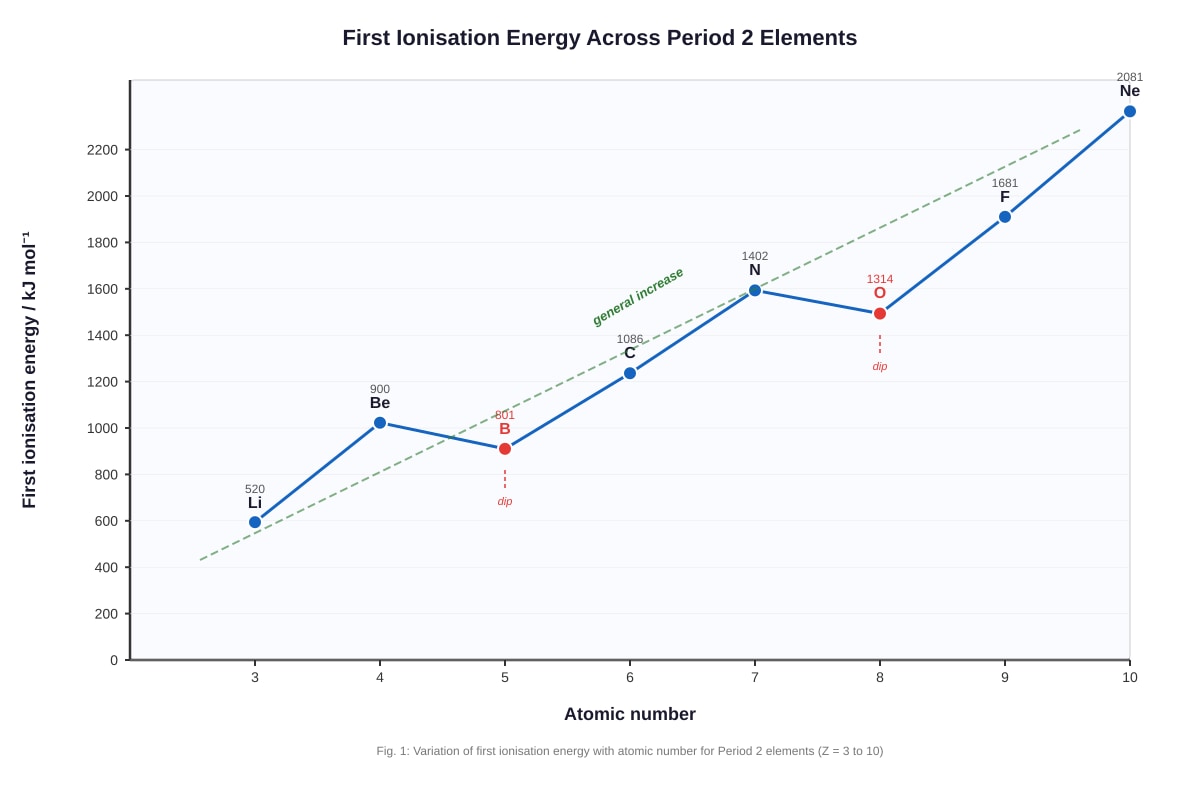
The first ionisation energy generally increases across Period 2 from Li to Ne.
(b) [2]
Across Period 2, the number of protons in the nucleus increases, so the nuclear charge increases. The electrons being added go into the same principal energy level (n = 2), so the shielding effect remains approximately constant. The increasing nuclear charge attracts the outer electrons more strongly, resulting in a smaller atomic radius and making it harder to remove an electron. Hence, the first ionisation energy increases.
Teaching notes: Award 1 mark for mentioning increasing nuclear charge, and 1 mark for mentioning constant shielding / same shell.
(c) [2]
Beryllium has an electron configuration of 1s² 2s², so its outer electron is in the 2s orbital. Boron has an electron configuration of 1s² 2s² 2p¹, so its outer electron is in the 2p orbital. The 2p orbital is at a slightly higher energy level than the 2s orbital and is, on average, further from the nucleus. The 2p electron also experiences slightly more shielding from the 2s electrons. Therefore, the 2p electron in boron is easier to remove than the 2s electron in beryllium, resulting in a lower first ionisation energy.
Teaching notes: Award 1 mark for identifying that B's outer electron is in 2p (higher energy than 2s), and 1 mark for explaining that this makes it easier to remove.
(d) [2]
Nitrogen has an electron configuration of 1s² 2s² 2p³, with one electron in each of the three 2p orbitals (half-filled, relatively stable). Oxygen has an electron configuration of 1s² 2s² 2p⁴, meaning one of the 2p orbitals contains a pair of electrons. The electron-electron repulsion within this paired orbital makes it easier to remove one of the paired electrons. Therefore, oxygen has a lower first ionisation energy than nitrogen.
Teaching notes: Award 1 mark for identifying the paired electrons in O's 2p orbital, and 1 mark for explaining the electron-electron repulsion that makes removal easier.
Question 17 [6 marks]
(a) [1]
A dative covalent bond (coordinate bond) is a covalent bond in which both electrons in the shared pair are provided by the same atom.
Teaching notes: The key point is that both electrons come from one atom. This distinguishes it from a normal covalent bond where each atom contributes one electron.
(b) [3]
A dot-and-cross diagram for NH₄⁺ showing:
- N (centre) with 5 valence electrons (dots)
- Four H atoms, each contributing 1 electron (crosses)
- Three normal N–H covalent bonds (each: one dot from N + one cross from H)
- One dative bond from N to the fourth H (both electrons from N, shown as two dots, with an arrow from N to H to indicate the dative bond)
- The overall charge of +1
Award 1 mark for showing 4 N–H bonds, 1 mark for correctly indicating the dative bond (both electrons from N), and 1 mark for showing the +1 charge.
(c) [2]
NH₄⁺ has 4 bonding pairs of electrons around the central N atom and 0 lone pairs. According to VSEPR theory, 4 bonding pairs arrange themselves as far apart as possible in a tetrahedral geometry with bond angles of 109.5°.
Teaching notes: Award 1 mark for identifying 4 bonding pairs and 0 lone pairs, and 1 mark for the tetrahedral shape.
Question 18 [6 marks]
(a) [3]
SiO₂ has the highest melting point. SiO₂ has a giant covalent (macromolecular) structure in which each silicon atom is covalently bonded to four oxygen atoms and each oxygen atom is bonded to two silicon atoms, forming a rigid three-dimensional network. To melt SiO₂, a very large number of strong Si–O covalent bonds must be broken, requiring an extremely large of energy.
(Note: MgO also has a very high melting point due to its giant ionic structure with strong electrostatic forces. However, SiO₂'s giant covalent structure with very strong Si–O bonds gives it a higher melting point than MgO. If a student argues for MgO with correct reasoning, award full marks.)
Teaching notes: Award 1 mark for identifying SiO₂ (or MgO with valid reasoning), 1 mark for identifying the correct structure type, and 1 mark for explaining that strong bonds throughout the structure must be broken.
(b) [2]
Fe is a good electrical conductor in the solid state. Iron has a giant metallic structure with a lattice of Fe²⁺/Fe³⁺ ions surrounded by delocalised electrons. These delocalised electrons are free to move and carry electrical charge through the solid.
Teaching notes: Award 1 mark for identifying Fe, and 1 mark for explaining delocalised electrons in metallic bonding.
(c) [1]
Ar (argon)
Teaching notes: Argon exists as individual atoms (monatomic) with only weak London dispersion forces between atoms.
Question 19 [8 marks]
(a) [2]
Metallic bonding is the electrostatic attraction between a lattice of positive metal ions and a "sea" of delocalised electrons. The metal atoms release their valence electrons, which become delocalised and free to move throughout the structure, while the remaining positive ions are arranged in a regular lattice.
Teaching notes: Award 1 mark for mentioning positive metal ions in a lattice, and 1 mark for mentioning delocalised electrons.
(b) [3]
Both magnesium and sodium have metallic bonding. Magnesium has 2 valence electrons per atom compared to sodium's 1 valence electron per atom. This means there are more delocalised electrons per atom in magnesium, leading to stronger electrostatic attraction between the Mg²⁺ ions and the electron sea. Additionally, the Mg²⁺ ion has a smaller ionic radius than Na⁺, so the ions are closer to the delocalised electrons, further strengthening the metallic bond. More energy is required to overcome the stronger metallic bonding in magnesium, giving it a higher melting point.
Teaching notes: Award 1 mark for mentioning more delocalised electrons in Mg, 1 mark for mentioning the greater charge on Mg²⁺ (or smaller ionic radius), and 1 mark for linking to stronger metallic bonding and higher melting point.
(c) [3]
In metals, the layers of positive ions can slide over each other when a force is applied because the delocalised electrons are not fixed between specific pairs of ions — they move with the layers and maintain the metallic bond. This allows metals to be shaped (malleable) without breaking.
In ionic solids, the ions are arranged in a regular lattice with alternating positive and negative ions. When a force is applied and layers of ions shift, ions of the same charge are brought next to each other. The resulting electrostatic repulsion between like charges causes the lattice to shatter, making ionic solids brittle.
Teaching notes: Award 1 mark for explaining that metal layers can slide due to non-directional metallic bonding, 1 mark for explaining that shifting ionic layers brings like charges together, and 1 mark for explaining the resulting repulsion causes shattering.
Question 20 [7 marks]
(a) [4 — 1 mark each]
- P: Ionic structure — high melting point (801 °C), conducts electricity when molten, soluble in water. (This is NaCl.)
- Q: Simple molecular structure — very low melting point (−78 °C), does not conduct electricity, slightly soluble in water. (This is CO₂.)
- R: Simple molecular structure — low melting point (113 °C), does not conduct electricity, insoluble in water. (This could be iodine, I₂, or another molecular solid.)
- S: Giant covalent (macromolecular) structure — very high melting point (3550 °C), does not conduct electricity, insoluble in water. (This is diamond or silicon dioxide.)
Teaching notes: Award 1 mark for each correct identification. The key distinguishing features are: ionic compounds conduct when molten; giant covalent compounds have very high melting points but do not conduct; simple molecular compounds have low melting points.
(b) [2]
Solid P (NaCl) does not conduct electricity because the Na⁺ and Cl⁻ ions are held in fixed positions in the ionic lattice and are not free to move. When P is melted, the ions gain enough energy to overcome the electrostatic forces holding them in the lattice and become free to move, allowing them to carry electrical charge.
Teaching notes: Award 1 mark for explaining that ions are fixed in the solid, and 1 mark for explaining that ions are free to move in the molten state.
(c) [1]
Diamond (carbon) or silicon dioxide (SiO₂) or silicon carbide (SiC)
Teaching notes: Any giant covalent solid with a very high melting point and no electrical conductivity is acceptable. Diamond is the most common example.
Total: 60 marks
Mark Distribution Summary:
| Section | Questions | Marks |
|---|---|---|
| A: Atomic Structure & Electron Configuration | 1–5 | 18 |
| B: Chemical Bonding | 6–10 | 23 |
| C: Molecular Geometry & Intermolecular Forces | 11–15 | 25 |
| D: Mixed & Applied Questions | 16–20 | 34 |
| Total | 1–20 | 60 |
(Note: Section marks overlap as some questions draw on multiple subtopics. The total is 60 marks.)