AI Generated Quiz

A Level H2 Chemistry Acids Bases Salts Quiz

Free AI-Generated Owl Alpha A Level H2 Chemistry Acids Bases Salts quiz with questions and answers for Singapore students. This page is rendered as a direct URL so the questions and answers can be discovered without pressing in-page buttons.

These static practice materials are generated from the site's syllabus and paper-generation workflow, with source and model context shown so students and parents can evaluate the material before use.

A Level H2 Chemistry AI Generated Generated by Owl Alpha Updated 2026-06-07

Questions

<!-- TuitionGoWhere generation metadata: stage=5-1; model=openrouter/owl-alpha; model_label=Owl Alpha; generated=2026-06-06; Sources: Stage 4-0 LLM templates, syllabus context, and Stage 2 evidence where available. -->

A-Level Chemistry H2 Quiz - Acids Bases Salts

Name: ____________________ Class: ____________________ Date: ____________________ Score: _____ / 60

Duration: 75 minutes

Instructions:

  • Answer ALL questions.
  • Show all working clearly in the spaces provided.
  • The number of marks for each question is shown in brackets [ ].
  • The total mark for this paper is 60.
  • You may use a calculator.
  • A Data Booklet is provided.
  • Write your answers in the spaces provided.

Section A: Multiple Choice & Short Answer (Questions 1–8)

Questions 1–5 are multiple choice. Each question carries 1 mark.


1. Which of the following is the conjugate base of HSO4HSO_4^-?

A. H2SO4H_2SO_4 B. SO42SO_4^{2-} C. H3O+H_3O^+ D. H2SO3H_2SO_3

[1]


2. A solution has a pH of 3.40. What is the concentration of OHOH^- ions in this solution at 25 °C?

A. 2.51×1042.51 \times 10^{-4} mol dm3^{-3} B. 3.98×1043.98 \times 10^{-4} mol dm3^{-3} C. 2.51×10112.51 \times 10^{-11} mol dm3^{-3} D. 3.98×10113.98 \times 10^{-11} mol dm3^{-3}

[1]


3. Which of the following salts produces an acidic solution when dissolved in water?

A. Na2CO3Na_2CO_3 B. KNO3KNO_3 C. NH4ClNH_4Cl D. CH3COONaCH_3COONa

[1]


4. The KaK_a of a weak acid HAHA is 4.0×1064.0 \times 10^{-6} mol dm3^{-3}. What is the pH of a 0.050 mol dm3^{-3} solution of HAHA?

A. 2.70 B. 3.35 C. 3.85 D. 4.35

[1]


5. In the titration of 25.0 cm3^3 of 0.100 mol dm3^{-3} CH3COOHCH_3COOH with 0.100 mol dm3^{-3} NaOHNaOH, which statement about the equivalence point is correct?

A. The pH at the equivalence point is 7.0. B. The pH at the equivalence point is less than 7.0. C. The pH at the equivalence point is greater than 7.0. D. The moles of NaOHNaOH required are greater than the moles of CH3COOHCH_3COOH.

[1]


6. Define the term buffer solution.


[2]


7. Explain why the pH of a 0.10 mol dm3^{-3} solution of hydrochloric acid is lower than the pH of a 0.10 mol dm3^{-3} solution of ethanoic acid (Ka=1.8×10⁵K_a = 1.8 \times 10^{-5} mol dm3^{-3}).


[2]


8. Write an expression for the solubility product, KspK_{sp}, of lead(II) iodide, PbI2PbI_2, including units.


[2]


Section B: Structured Questions (Questions 9–15)


9. A student carries out a titration to determine the concentration of a solution of sulfuric acid, H2SO4H_2SO_4, using 0.100 mol dm3^{-3} NaOHNaOH.

The student's titration results are shown below:

TitrationRough123
Final burette reading / cm3^324.8024.3035.1024.40
Initial burette reading / cm3^30.000.0010.500.00
Volume of NaOHNaOH used / cm3^324.8024.3024.6024.40

(a) Identify any anomalous result and explain your reasoning.


[1]

(b) Calculate the mean volume of 0.100 mol dm3^{-3} NaOHNaOH used, using only concordant titres.


[1]

(c) Write the balanced equation for the reaction between H2SO4H_2SO_4 and NaOHNaOH.


[1]

(d) 25.0 cm3^3 of H2SO4H_2SO_4 was used in each titration. Calculate the concentration of the sulfuric acid in mol dm3^{-3}.


[3]


10. A buffer solution is prepared by mixing 50.0 cm3^3 of 0.200 mol dm3^{-3} ethanoic acid (CH3COOHCH_3COOH) with 50.0 cm3^3 of 0.300 mol dm3^{-3} sodium ethanoate (CH3COONaCH_3COONa).

KaK_a for CH3COOH=1.8×10⁵CH_3COOH = 1.8 \times 10^{-5} mol dm3^{-3}

(a) Calculate the pH of this buffer solution.


[3]

(b) Explain, with reference to the equilibrium involved, how this buffer solution resists a change in pH when a small amount of dilute hydrochloric acid is added.


[3]

(c) State and explain whether the pH of the buffer would increase, decrease, or remain approximately the same if a small amount of solid NaOHNaOH is added.


[2]


11. The solubility product of magnesium hydroxide, Mg(OH)2Mg(OH)_2, is 1.8×10111.8 \times 10^{-11} mol3^3 dm9^{-9} at 25 °C.

(a) Write an expression for KspK_{sp} of Mg(OH)2Mg(OH)_2.


[1]

(b) Calculate the solubility of Mg(OH)2Mg(OH)_2 in mol dm3^{-3} at 25 °C.


[3]

(c) Calculate the pH of a saturated solution of Mg(OH)2Mg(OH)_2 at 25 °C.


[3]


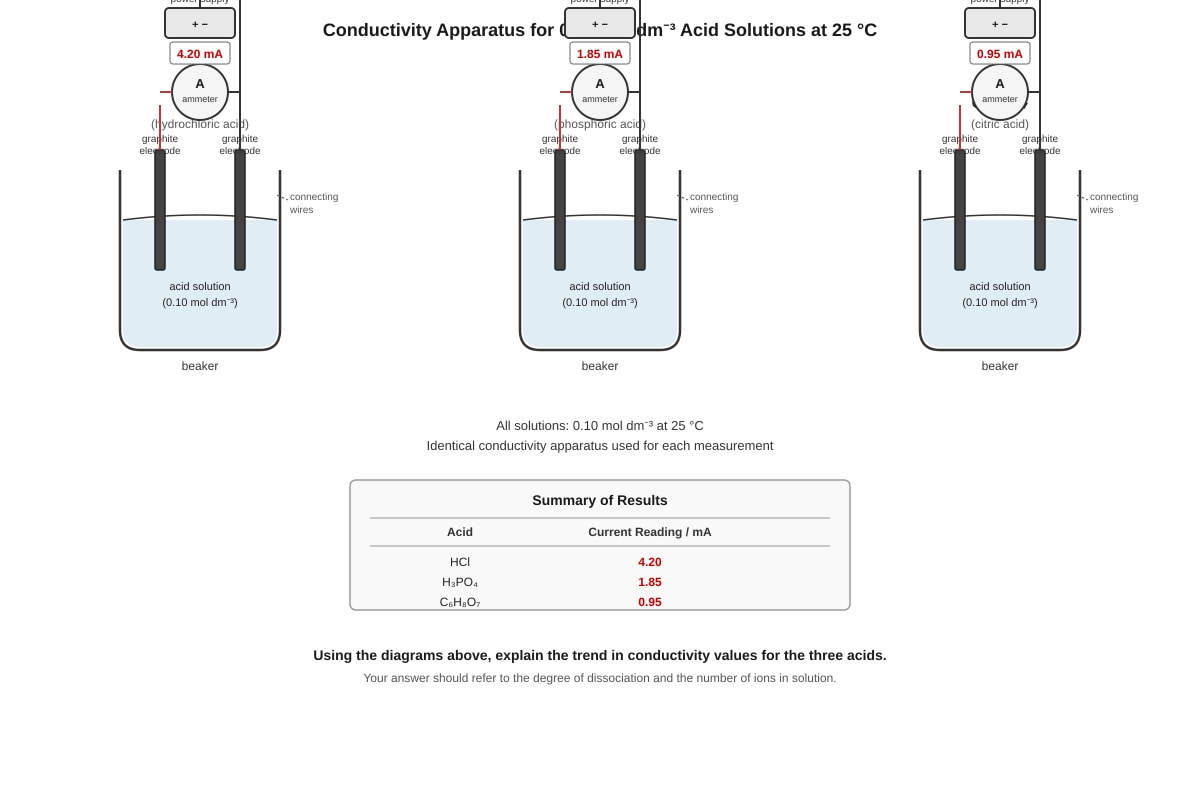
12. A student investigates the relative strengths of three acids: hydrochloric acid (HClHCl), phosphoric acid (H3PO4H_3PO_4), and citric acid (C6H8O7C_6H_8O_7).

The student measures the electrical conductivity of 0.10 mol dm3^{-3} solutions of each acid at 25 °C.

<image_placeholder> id: Q12-fig1 type: experimental_setup linked_question: Q12 description: A diagram showing a simple conductivity apparatus with a beaker containing 0.10 mol dm⁻³ acid solution, two graphite electrodes immersed in the solution connected via wires to a power supply and an ammeter in series. The ammeter shows a current reading. Labels: beaker, acid solution, graphite electrodes, ammeter, power supply, connecting wires. labels: beaker, acid solution (0.10 mol dm⁻³), graphite electrodes, ammeter (showing current reading I), power supply, connecting wires values: Current readings for three acids: HCl: 4.20 mA, H₃PO₄: 1.85 mA, C₆H₈O₇: 0.95 mA must_show: The ammeter reading must be clearly visible for each acid. The setup must be identical for all three acids. The acid identity must be clearly labelled for each measurement.

(a) State and explain which acid gives the highest conductivity reading.


[2]

(b) Explain why the conductivity of the citric acid solution is the lowest.


[2]

(c) Suggest a reason why the conductivity of phosphoric acid is lower than that of hydrochloric acid despite both being acids.


[2]


13. The following question relates to the titration of 25.0 cm3^3 of 0.200 mol dm3^{-3} propanoic acid (C2H5COOHC_2H_5COOH, Ka=1.3×10⁵K_a = 1.3 \times 10^{-5} mol dm3^{-3}) with 0.200 mol dm3^{-3} NaOHNaOH.

(a) Calculate the pH of the propanoic acid solution before any NaOHNaOH is added.


[3]

(b) Calculate the pH at the equivalence point of this titration.


[4]

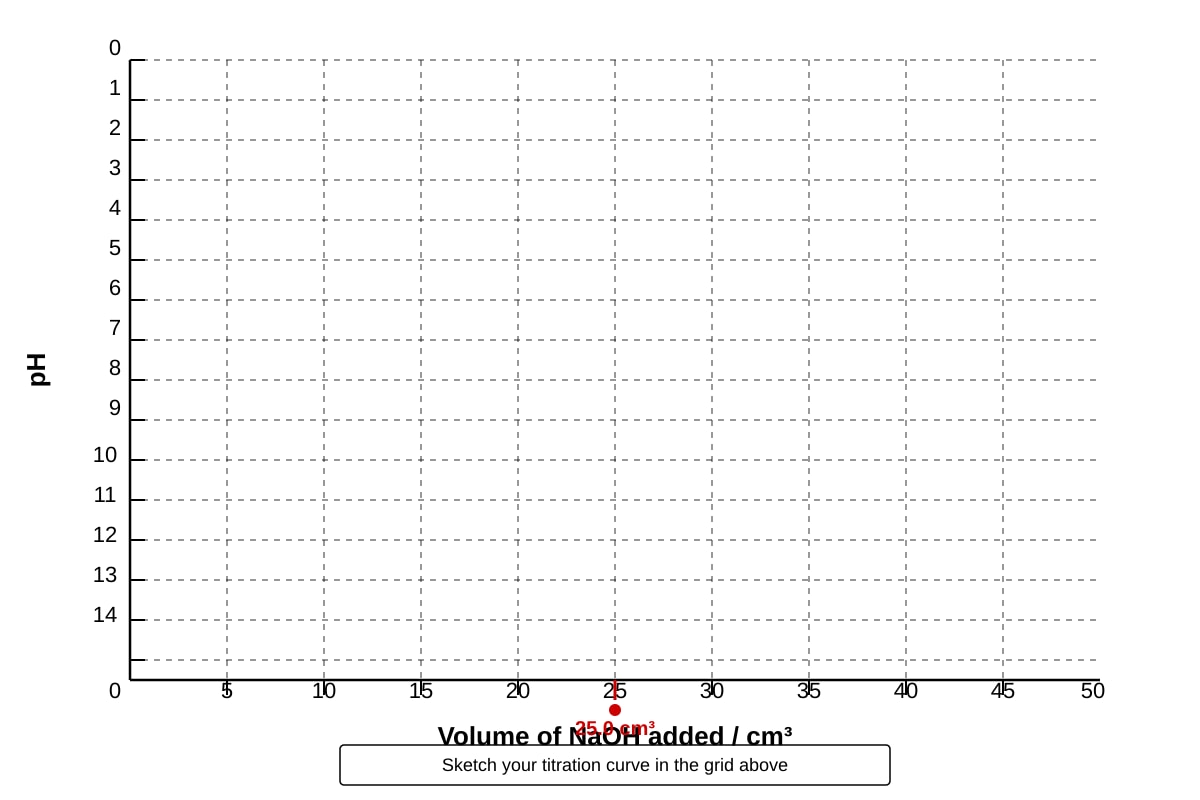
(c) Sketch a titration curve for this experiment on the axes provided. Label the initial pH, the equivalence point, the buffer region, and the pH at the equivalence point.

<image_placeholder> id: Q13-fig1 type: graph linked_question: Q13 description: A blank set of axes for the student to sketch a titration curve. The x-axis is labelled 'Volume of NaOH added / cm³' ranging from 0 to 50 cm³. The y-axis is labelled 'pH' ranging from 0 to 14. The axes are blank with no curve drawn — the student is expected to sketch the curve. labels: x-axis: Volume of NaOH added / cm³ (0 to 50), y-axis: pH (0 to 14) values: Key reference points: initial pH ≈ 2.79 at 0 cm³ NaOH, equivalence point at 25.0 cm³ NaOH with pH ≈ 8.79, buffer region centred around 12.5 cm³ NaOH at pH = pKa ≈ 4.89 must_show: Axes must be clearly labelled with units and ranges. Grid lines should be present to assist sketching. The equivalence point volume (25.0 cm³) should be marked on the x-axis.

[2]


14. A solution contains a mixture of 0.10 mol dm3^{-3} HClHCl and 0.10 mol dm3^{-3} CH3COOHCH_3COOH (Ka=1.8×10⁵K_a = 1.8 \times 10^{-5} mol dm3^{-3}).

(a) Explain why the contribution of CH3COOHCH_3COOH to the H+H^+ concentration in this mixture is negligible compared to that of HClHCl.


[2]

(b) Calculate the pH of this mixture.


[2]

(c) Explain, using Le Chatelier's principle, what happens to the position of equilibrium of the ethanoic acid dissociation when HClHCl is present.


[2]


15. Solid silver chloride, AgClAgCl, is added to three different solutions:

  • Solution X: Pure water
  • Solution Y: 0.10 mol dm3^{-3} NaClNaCl
  • Solution Z: 0.10 mol dm3^{-3} AgNO3AgNO_3

KspK_{sp} of AgCl=1.8×10¹⁰AgCl = 1.8 \times 10^{-10} mol2^2 dm6^{-6}

(a) Write the expression for KspK_{sp} of AgClAgCl.


[1]

(b) Without calculation, arrange the solutions in order of increasing solubility of AgClAgCl. Explain your reasoning.


[3]

(c) Calculate the solubility of AgClAgCl in pure water in g dm3^{-3}. (MrM_r of AgCl=143.4AgCl = 143.4)


[3]


Section C: Data-Based & Application Questions (Questions 16–20)


16. The following information relates to the use of acid-base indicators in titrations.

An acid-base indicator, HInHIn, dissociates in water according to the equilibrium:

HIn(aq)H+(aq)+In(aq)HIn(aq) \rightleftharpoons H^+(aq) + In^-(aq) colour Acolour B\text{colour A} \qquad \qquad \text{colour B}

The indicator changes colour over the pH range pKIn±1pK_{In} \pm 1.

(a) Explain, using Le Chatelier's principle, why the indicator changes colour from colour A to colour B as the pH of the solution increases.


[2]

(b) An indicator has KIn=5.0×10⁷K_{In} = 5.0 \times 10^{-7}. Calculate its pH range for colour change.


[2]

(c) Explain why this indicator would be suitable for the titration of a strong acid with a strong base but not for the titration of a weak acid with a strong base.


[2]


17. Rainwater in an industrial area has a pH of 4.2 due to the presence of sulfuric acid formed from sulfur dioxide emissions.

(a) Calculate the concentration of H+H^+ ions in this rainwater.


[1]

(b) Write a balanced equation for the formation of sulfuric acid from sulfur dioxide in the atmosphere.


[1]

(c) Explain why the pH of this rainwater is not as low as might be expected from the concentration of sulfuric acid alone, given that H2SO4H_2SO_4 is a strong acid.


[2]

(d) Suggest one environmental effect of acid rain and one method to reduce it.


[2]


18. A student wishes to prepare a buffer solution with a pH of 5.00 using ethanoic acid (Ka=1.8×10⁵K_a = 1.8 \times 10^{-5} mol dm3^{-3}) and sodium ethanoate.

(a) Calculate the ratio of [CH3COO][CH_3COO^-] to [CH3COOH][CH_3COOH] required to achieve this pH.


[3]

(b) The student has 100 cm3^3 of 0.500 mol dm3^{-3} CH3COOHCH_3COOH. Calculate the mass of sodium ethanoate (CH3COONaCH_3COONa, Mr=82.0M_r = 82.0) that must be dissolved in this solution to prepare the buffer.


[3]


19. The following data relates to three salts and their 0.10 mol dm3^{-3} solutions at 25 °C:

SaltpH of 0.10 mol dm3^{-3} solution
Na2SO4Na_2SO_47.0
Na2CO3Na_2CO_311.6
AlCl3AlCl_33.0

(a) Explain why the solution of Na2SO4Na_2SO_4 is neutral.


[1]

(b) Explain why the solution of Na2CO3Na_2CO_3 is alkaline. Include an equation in your answer.


[2]

(c) Explain why the solution of AlCl3AlCl_3 is acidic. Include an equation in your answer.


[2]

(d) Predict and explain whether a 0.10 mol dm3^{-3} solution of ammonium ethanoate (CH3COONH4CH_3COONH_4) would be acidic, alkaline, or neutral. (KaK_a of CH3COOH=1.8×10⁵CH_3COOH = 1.8 \times 10^{-5}; KbK_b of NH3=1.8×10⁵NH_3 = 1.8 \times 10^{-5})


[2]


20. A solution is prepared by mixing 30.0 cm3^3 of 0.150 mol dm3^{-3} NaOHNaOH with 20.0 cm3^3 of 0.100 mol dm3^{-3} H2SO4H_2SO_4.

(a) Calculate the number of moles of OHOH^- and H+H^+ ions present before reaction.


[2]

(b) Determine whether the resulting solution is acidic, basic, or neutral. Show your reasoning.


[2]

(c) Calculate the pH of the resulting solution.


[2]

(d) If an additional 10.0 cm3^3 of 0.100 mol dm3^{-3} H2SO4H_2SO_4 is added to the resulting solution, calculate the new pH.


[3]


End of Quiz

Total: 60 marks

Answers

<!-- TuitionGoWhere generation metadata: stage=5-1; model=openrouter/owl-alpha; model_label=Owl Alpha; generated=2026-06-06; Sources: Stage 4-0 LLM templates, syllabus context, and Stage 2 evidence where available. -->

A-Level Chemistry H2 Quiz - Acids Bases Salts: Answer Key


Section A: Multiple Choice & Short Answer (Questions 1–8)


1. Answer: BSO42SO_4^{2-}

Explanation: A conjugate base is formed when an acid donates a proton (H+H^+). HSO4HSO_4^- acts as an acid by losing one H+H^+ to become SO42SO_4^{2-}. Option A (H2SO4H_2SO_4) is the conjugate acid (gaining a proton), not the conjugate base. Option C is the conjugate acid of water. Option D is unrelated.

[1 mark]


2. Answer: C2.51×10112.51 \times 10^{-11} mol dm3^{-3}

Explanation:

  • pH=3.40pH = 3.40, so [H+]=103.40=3.98×10⁴[H^+] = 10^{-3.40} = 3.98 \times 10^{-4} mol dm3^{-3}
  • At 25 °C, Kw=[H+][OH]=1.00×10¹⁴K_w = [H^+][OH^-] = 1.00 \times 10^{-14} mol2^2 dm6^{-6}
  • [OH]=Kw[H+]=1.00×10143.98×104=2.51×10¹¹[OH^-] = \frac{K_w}{[H^+]} = \frac{1.00 \times 10^{-14}}{3.98 \times 10^{-4}} = 2.51 \times 10^{-11} mol dm3^{-3}

Common mistake: Students often select option A, which is the [H+][H^+] value, not [OH][OH^-]. Always check what the question is asking for.

[1 mark]


3. Answer: CNH4ClNH_4Cl

Explanation: NH4ClNH_4Cl is a salt formed from a weak base (NH3NH_3) and a strong acid (HClHCl). The NH4+NH_4^+ ion undergoes hydrolysis:

NH4+(aq)+H2O(l)NH3(aq)+H3O+(aq)NH_4^+(aq) + H_2O(l) \rightleftharpoons NH_3(aq) + H_3O^+(aq)

This produces H3O+H_3O^+ ions, making the solution acidic. Na2CO3Na_2CO_3 and CH3COONaCH_3COONa produce alkaline solutions (salts of strong base + weak acid). KNO3KNO_3 is neutral (strong acid + strong base).

[1 mark]


4. Answer: C — 3.85

Explanation:

  • For a weak acid: Ka=[H+]2[HA]K_a = \frac{[H^+]^2}{[HA]} (assuming [H+]=[A][H^+] = [A^-] and dissociation is small)
  • [H+]=Ka×[HA]=4.0×106×0.050=2.0×107=4.47×10⁴[H^+] = \sqrt{K_a \times [HA]} = \sqrt{4.0 \times 10^{-6} \times 0.050} = \sqrt{2.0 \times 10^{-7}} = 4.47 \times 10^{-4} mol dm3^{-3}
  • pH=log(4.47×10⁴)=3.35pH = -\log(4.47 \times 10^{-4}) = 3.35

Wait — let me recalculate:

  • [H+]=4.0×106×0.050=2.0×107=4.472×10⁴[H^+] = \sqrt{4.0 \times 10^{-6} \times 0.050} = \sqrt{2.0 \times 10^{-7}} = 4.472 \times 10^{-4}
  • pH=log(4.472×10⁴)=3.35pH = -\log(4.472 \times 10^{-4}) = 3.35

Hmm, that gives 3.35 which is option B. Let me recheck: 2.0×107=20×108=4.472×10⁴\sqrt{2.0 \times 10^{-7}} = \sqrt{20 \times 10^{-8}} = 4.472 \times 10^{-4}. log(4.472×10⁴)=4log(4.472)=40.650=3.35-\log(4.472 \times 10^{-4}) = 4 - \log(4.472) = 4 - 0.650 = 3.35.

Corrected Answer: B — 3.35

Explanation:

  • For a weak acid HAHA: Ka=[H+][A][HA][H+]2[HA]0K_a = \frac{[H^+][A^-]}{[HA]} \approx \frac{[H^+]^2}{[HA]_0} (since dissociation is small)
  • [H+]=Ka×[HA]0=4.0×106×0.050=2.0×107=4.47×10⁴[H^+] = \sqrt{K_a \times [HA]_0} = \sqrt{4.0 \times 10^{-6} \times 0.050} = \sqrt{2.0 \times 10^{-7}} = 4.47 \times 10^{-4} mol dm3^{-3}
  • pH=log(4.47×10⁴)=3.35pH = -\log(4.47 \times 10^{-4}) = 3.35

Common mistake: Using [HA]=0.050[HA] = 0.050 directly in Ka=[H+]2/[HA]K_a = [H^+]^2/[HA] without the square root, or confusing KaK_a with pKapK_a.

[1 mark]


5. Answer: C — The pH at the equivalence point is greater than 7.0.

Explanation: CH3COOHCH_3COOH is a weak acid and NaOHNaOH is a strong base. At the equivalence point, all the CH3COOHCH_3COOH has been converted to CH3COOCH_3COO^- (the conjugate base), which hydrolyses in water to produce OHOH^- ions:

CH3COO(aq)+H2O(l)CH3COOH(aq)+OH(aq)CH_3COO^-(aq) + H_2O(l) \rightleftharpoons CH_3COOH(aq) + OH^-(aq)

This makes the solution slightly alkaline, so pH > 7. The moles of NaOHNaOH required equal the moles of CH3COOHCH_3COOH (1:1 stoichiometry), so D is incorrect.

[1 mark]


6. Answer: A buffer solution is a solution that resists changes in pH when small amounts of acid or base are added (or when it is diluted).

Teaching note: A buffer typically consists of a weak acid and its conjugate base (or a weak base and its conjugate acid). The key feature is its ability to maintain a relatively constant pH. Students should mention both the resistance to pH change and the small quantity of acid/base added.

[2 marks] — 1 mark for "resists change in pH", 1 mark for "when small amounts of acid or base are added"


7. Answer: Hydrochloric acid is a strong acid and dissociates completely in water, so a 0.10 mol dm3^{-3} solution gives [H+]=0.10[H^+] = 0.10 mol dm3^{-3} and pH = 1.0. Ethanoic acid is a weak acid and only partially dissociates. For 0.10 mol dm3^{-3} CH3COOHCH_3COOH:

[H+]=Ka×[HA]=1.8×105×0.10=1.34×10³[H^+] = \sqrt{K_a \times [HA]} = \sqrt{1.8 \times 10^{-5} \times 0.10} = 1.34 \times 10^{-3} mol dm3^{-3}

pH=log(1.34×10³)=2.87pH = -\log(1.34 \times 10^{-3}) = 2.87

Since [H+][H^+] is much lower for ethanoic acid, its pH is higher.

Teaching note: The key distinction is complete dissociation (strong acid) vs. partial dissociation (weak acid). At the same concentration, a strong acid always has a lower pH.

[2 marks] — 1 mark for identifying HCl as strong (complete dissociation) and CH₃COOH as weak (partial dissociation), 1 mark for calculation or comparison showing higher [H⁺] for HCl


8. Answer:

Ksp=[Pb2+][I]2K_{sp} = [Pb^{2+}][I^-]^2

Units: mol3^3 dm9^{-9}

Teaching note: PbI2PbI_2 dissociates as PbI2(s)Pb2+(aq)+2I(aq)PbI_2(s) \rightleftharpoons Pb^{2+}(aq) + 2I^-(aq). The KspK_{sp} expression raises each ion concentration to the power of its stoichiometric coefficient. Since the units are (mol dm3^{-3})(mol dm3^{-3})2^2 = mol3^3 dm9^{-9}.

[2 marks] — 1 mark for correct expression, 1 mark for correct units


Section B: Structured Questions (Questions 9–15)


9.

(a) Answer: Titration 3 (35.10 → 10.50 = 24.60 cm3^3) is not anomalous. All three accurate titres (24.30, 24.60, 24.40) are concordant (within 0.20 cm3^3 of each other). There is no anomalous result.

Wait — let me re-examine. Titration 1: 24.30, Titration 2: 24.60, Titration 3: 24.40. The range is 24.60 − 24.30 = 0.30 cm3^3. This is slightly more than 0.20 cm3^3. However, in many exam mark schemes, titres within 0.30 cm3^3 are still considered acceptable. Titration 2 (24.60) could be considered slightly anomalous as it is 0.30 cm3^3 from titration 1.

Revised Answer: Titration 2 (24.60 cm3^3) could be considered anomalous as it differs by 0.30 cm3^3 from the closest titre (24.30 cm3^3), which exceeds the usual 0.20 cm3^3 concordancy criterion.

Actually, let me reconsider the data more carefully:

  • Titration 1: 24.30 cm3^3
  • Titration 2: 24.60 cm3^3 (difference from T1 = 0.30)
  • Titration 3: 24.40 cm3^3 (difference from T1 = 0.10, from T2 = 0.20)

Titration 2 is 0.30 cm3^3 from Titration 1, which is outside the 0.20 cm3^3 concordancy range. So Titration 2 is anomalous.

Answer: Titration 2 (24.60 cm3^3) is anomalous because it differs by more than 0.20 cm3^3 from the closest titre (24.30 cm3^3).

[1 mark]

(b) Answer: Using concordant titres (Titrations 1 and 3):

Mean volume=24.30+24.402=24.35 cm3\text{Mean volume} = \frac{24.30 + 24.40}{2} = 24.35 \text{ cm}^3

[1 mark]

(c) Answer:

H2SO4(aq)+2NaOH(aq)Na2SO4(aq)+2H2O(l)H_2SO_4(aq) + 2NaOH(aq) \rightarrow Na_2SO_4(aq) + 2H_2O(l)

[1 mark]

(d) Answer:

  • Moles of NaOHNaOH used = 0.100×24.351000=2.435×1030.100 \times \frac{24.35}{1000} = 2.435 \times 10^{-3} mol
  • From the equation, mole ratio H2SO4:NaOH=1:2H_2SO_4 : NaOH = 1 : 2
  • Moles of H2SO4=2.435×1032=1.2175×10³H_2SO_4 = \frac{2.435 \times 10^{-3}}{2} = 1.2175 \times 10^{-3} mol
  • Concentration of H2SO4=1.2175×10325.0/1000=1.2175×1030.0250=0.0487H_2SO_4 = \frac{1.2175 \times 10^{-3}}{25.0/1000} = \frac{1.2175 \times 10^{-3}}{0.0250} = 0.0487 mol dm3^{-3}

[3 marks] — 1 mark for moles of NaOH, 1 mark for mole ratio and moles of H₂SO₄, 1 mark for final concentration


10.

(a) Answer:

  • After mixing, total volume = 100.0 cm3^3
  • [CH3COOH]=0.200×50.0100.0=0.100[CH_3COOH] = \frac{0.200 \times 50.0}{100.0} = 0.100 mol dm3^{-3}
  • [CH3COO]=0.300×50.0100.0=0.150[CH_3COO^-] = \frac{0.300 \times 50.0}{100.0} = 0.150 mol dm3^{-3}
  • Using Henderson-Hasselbalch equation:

pH=pKa+log[A][HA]pH = pK_a + \log\frac{[A^-]}{[HA]}

pKa=log(1.8×10⁵)=4.74pK_a = -\log(1.8 \times 10^{-5}) = 4.74

pH=4.74+log0.1500.100=4.74+log(1.50)=4.74+0.18=4.92pH = 4.74 + \log\frac{0.150}{0.100} = 4.74 + \log(1.50) = 4.74 + 0.18 = 4.92

[3 marks] — 1 mark for calculating diluted concentrations, 1 mark for correct pKa, 1 mark for correct pH

(b) Answer: When HClHCl is added, the H+H^+ ions react with the conjugate base CH3COOCH_3COO^- in the buffer:

CH3COO(aq)+H+(aq)CH3COOH(aq)CH_3COO^-(aq) + H^+(aq) \rightarrow CH_3COOH(aq)

By Le Chatelier's principle, the equilibrium CH3COOH(aq)CH3COO(aq)+H+(aq)CH_3COOH(aq) \rightleftharpoons CH_3COO^-(aq) + H^+(aq) shifts to the left to consume the added H+H^+. The CH3COOCH_3COO^- ions act as a "sink" for the added H+H^+, converting them into undissociated CH3COOHCH_3COOH. Since most of the added H+H^+ is consumed, the change in [H+][H^+] and hence pH is very small.

[3 marks] — 1 mark for equation showing H⁺ reacting with CH₃COO⁻, 1 mark for Le Chatelier's principle / equilibrium shift, 1 mark for explaining minimal pH change

(c) Answer: The pH would increase slightly. The OHOH^- ions from NaOHNaOH react with the CH3COOHCH_3COOH component of the buffer:

CH3COOH(aq)+OH(aq)CH3COO(aq)+H2O(l)CH_3COOH(aq) + OH^-(aq) \rightarrow CH_3COO^-(aq) + H_2O(l)

This converts CH3COOHCH_3COOH into CH3COOCH_3COO^-, increasing the ratio [CH3COO]/[CH3COOH][CH_3COO^-]/[CH_3COOH], which increases the pH slightly. However, the buffer minimises the pH change.

[2 marks] — 1 mark for stating pH increases, 1 mark for correct explanation involving reaction with CH₃COOH


11.

(a) Answer:

Ksp=[Mg2+][OH]2K_{sp} = [Mg^{2+}][OH^-]^2

[1 mark]

(b) Answer:

  • Let the solubility of Mg(OH)2=sMg(OH)_2 = s mol dm3^{-3}
  • Mg(OH)2(s)Mg2+(aq)+2OH(aq)Mg(OH)_2(s) \rightleftharpoons Mg^{2+}(aq) + 2OH^-(aq)
  • [Mg2+]=s[Mg^{2+}] = s, [OH]=2s[OH^-] = 2s
  • Ksp=s×(2s)2=4s3K_{sp} = s \times (2s)^2 = 4s^3
  • 4s3=1.8×10114s^3 = 1.8 \times 10^{-11}
  • s3=4.5×10¹²s^3 = 4.5 \times 10^{-12}
  • s=4.5×10123=1.65×10⁴s = \sqrt[3]{4.5 \times 10^{-12}} = 1.65 \times 10^{-4} mol dm3^{-3}

[3 marks] — 1 mark for correct Ksp substitution with 2s, 1 mark for algebraic manipulation, 1 mark for correct answer

(c) Answer:

  • [OH]=2s=2×1.65×104=3.30×10⁴[OH^-] = 2s = 2 \times 1.65 \times 10^{-4} = 3.30 \times 10^{-4} mol dm3^{-3}
  • pOH=log(3.30×10⁴)=3.48pOH = -\log(3.30 \times 10^{-4}) = 3.48
  • pH=14.003.48=10.52pH = 14.00 - 3.48 = 10.52

[3 marks] — 1 mark for [OH⁻] = 2s, 1 mark for pOH calculation, 1 mark for pH


12.

(a) Answer: Hydrochloric acid gives the highest conductivity reading (4.20 mA). HClHCl is a strong acid and dissociates completely in water, producing the highest concentration of ions (H+H^+ and ClCl^-) available to carry current.

[2 marks] — 1 mark for identifying HCl, 1 mark for explanation involving complete dissociation / highest ion concentration

(b) Answer: Citric acid is a weak acid with the smallest KaK_a value among the three acids. It dissociates only partially in water, producing the lowest concentration of ions. Since electrical conductivity depends on the concentration of ions in solution, the citric acid solution has the lowest conductivity.

[2 marks] — 1 mark for identifying citric acid as weakest/least dissociated, 1 mark for linking to lowest ion concentration and conductivity

(c) Answer: Although both are acids, HClHCl is a strong acid that dissociates completely, while H3PO4H_3PO_4 is a weak acid that only partially dissociates. Therefore, the concentration of H+H^+ ions (and hence total ion concentration) is lower in the phosphoric acid solution, resulting in lower conductivity.

[2 marks] — 1 mark for identifying HCl as strong and H₃PO₄ as weak, 1 mark for linking to ion concentration and conductivity


13.

(a) Answer:

  • C2H5COOH(aq)C2H5COO(aq)+H+(aq)C_2H_5COOH(aq) \rightleftharpoons C_2H_5COO^-(aq) + H^+(aq)
  • Ka=[H+]2[HA]0=1.3×10⁵K_a = \frac{[H^+]^2}{[HA]_0} = 1.3 \times 10^{-5}
  • [H+]=1.3×105×0.200=2.6×106=1.61×10³[H^+] = \sqrt{1.3 \times 10^{-5} \times 0.200} = \sqrt{2.6 \times 10^{-6}} = 1.61 \times 10^{-3} mol dm3^{-3}
  • pH=log(1.61×10³)=2.79pH = -\log(1.61 \times 10^{-3}) = 2.79

[3 marks] — 1 mark for Ka expression, 1 mark for [H⁺] calculation, 1 mark for pH

(b) Answer:

  • At equivalence point, all propanoic acid is converted to sodium propanoate (C2H5COONaC_2H_5COONa).
  • Moles of C2H5COOH=0.200×0.0250=5.0×10³C_2H_5COOH = 0.200 \times 0.0250 = 5.0 \times 10^{-3} mol
  • Volume of NaOHNaOH needed = 5.0×1030.200=0.0250\frac{5.0 \times 10^{-3}}{0.200} = 0.0250 dm3^3 = 25.0 cm3^3
  • Total volume = 25.0 + 25.0 = 50.0 cm3^3
  • [C2H5COO]=5.0×1030.0500=0.100[C_2H_5COO^-] = \frac{5.0 \times 10^{-3}}{0.0500} = 0.100 mol dm3^{-3}

The propanoate ion hydrolyses: C2H5COO(aq)+H2O(l)C2H5COOH(aq)+OH(aq)C_2H_5COO^-(aq) + H_2O(l) \rightleftharpoons C_2H_5COOH(aq) + OH^-(aq)

Kb=KwKa=1.0×10141.3×105=7.69×10¹⁰K_b = \frac{K_w}{K_a} = \frac{1.0 \times 10^{-14}}{1.3 \times 10^{-5}} = 7.69 \times 10^{-10}

[OH]=Kb×[C2H5COO]=7.69×1010×0.100=7.69×1011=8.77×10⁶ mol dm3[OH^-] = \sqrt{K_b \times [C_2H_5COO^-]} = \sqrt{7.69 \times 10^{-10} \times 0.100} = \sqrt{7.69 \times 10^{-11}} = 8.77 \times 10^{-6} \text{ mol dm}^{-3}

pOH=log(8.77×10⁶)=5.06pOH = -\log(8.77 \times 10^{-6}) = 5.06

pH=14.005.06=8.94pH = 14.00 - 5.06 = 8.94

[4 marks] — 1 mark for calculating concentration of salt at equivalence point, 1 mark for Kb calculation, 1 mark for [OH⁻] calculation, 1 mark for pH

(c) Answer: The titration curve should show:

  • Starting pH ≈ 2.79 (weak acid)
  • A gradually rising curve with a buffer region (relatively flat section) centred around half-equivalence point (12.5 cm3^3 NaOH) where pH = pKapK_a = 4.89
  • A steep rise near the equivalence point (25.0 cm3^3)
  • Equivalence point at pH ≈ 8.94 (> 7, since salt of weak acid + strong base)
  • Curve levels off at high pH after equivalence point

[2 marks] — 1 mark for correct shape with buffer region and steep rise, 1 mark for correct labelling of key points (initial pH, equivalence point pH > 7, buffer region)


14.

(a) Answer: HClHCl is a strong acid and dissociates completely, giving [H+]=0.10[H^+] = 0.10 mol dm3^{-3}. Ethanoic acid is a weak acid with Ka=1.8×10⁵K_a = 1.8 \times 10^{-5}. In the presence of HClHCl, the high [H+][H^+] from HClHCl suppresses the dissociation of CH3COOHCH_3COOH (common ion effect / Le Chatelier's principle). The contribution of H+H^+ from CH3COOHCH_3COOH is negligible compared to 0.10 mol dm3^{-3} from HClHCl.

[2 marks] — 1 mark for identifying complete dissociation of HCl giving [H⁺] = 0.10, 1 mark for common ion effect suppressing CH₃COOH dissociation

(b) Answer:

  • [H+]0.10[H^+] \approx 0.10 mol dm3^{-3} (from HClHCl only; contribution from CH3COOHCH_3COOH is negligible)
  • pH=log(0.10)=1.00pH = -\log(0.10) = 1.00

[2 marks] — 1 mark for stating [H⁺] ≈ 0.10, 1 mark for pH = 1.00

(c) Answer: The dissociation equilibrium of ethanoic acid is:

CH3COOH(aq)CH3COO(aq)+H+(aq)CH_3COOH(aq) \rightleftharpoons CH_3COO^-(aq) + H^+(aq)

HClHCl dissociates completely, increasing [H+][H^+]. By Le Chatelier's principle, the equilibrium shifts to the left to counteract the increase in [H+][H^+]. This suppresses the dissociation of CH3COOHCH_3COOH, so very little CH3COOCH_3COO^- and additional H+H^+ is produced.

[2 marks] — 1 mark for identifying the equilibrium, 1 mark for stating shift to the left with Le Chatelier's explanation


15.

(a) Answer:

Ksp=[Ag+][Cl]K_{sp} = [Ag^+][Cl^-]

[1 mark]

(b) Answer: Order of increasing solubility: Z < Y < X

Explanation: The solubility of AgClAgCl is reduced in solutions containing a common ion (either Ag+Ag^+ or ClCl^-) due to the common ion effect.

  • Solution Z (0.10 mol dm3^{-3} AgNO3AgNO_3): Contains Ag+Ag^+ ions — common ion suppresses dissolution. Lowest solubility.
  • Solution Y (0.10 mol dm3^{-3} NaClNaCl): Contains ClCl^- ions — common ion suppresses dissolution. Intermediate solubility.
  • Solution X (pure water): No common ions. Highest solubility.

Both Y and Z have the same concentration of common ion (0.10 mol dm3^{-3}), so their solubilities would be similar but not identical (depending on which ion's concentration is held constant in the Ksp expression). However, since Ksp=[Ag+][Cl]K_{sp} = [Ag^+][Cl^-] and both common ion concentrations are equal, the solubilities are the same. The expected answer is Z ≈ Y < X.

Revised: Since both NaCl and AgNO₃ provide the same concentration (0.10 mol dm⁻³) of common ion, the solubility of AgCl in Y and Z would be approximately equal. The order is: Z ≈ Y < X (or Z = Y < X).

[3 marks] — 1 mark for correct order, 1 mark for identifying common ion effect, 1 mark for explaining that pure water has no common ion

(c) Answer:

  • Let solubility of AgCl=sAgCl = s mol dm3^{-3}
  • Ksp=s2=1.8×10¹⁰K_{sp} = s^2 = 1.8 \times 10^{-10}
  • s=1.8×1010=1.34×10⁵s = \sqrt{1.8 \times 10^{-10}} = 1.34 \times 10^{-5} mol dm3^{-3}
  • Solubility in g dm3=1.34×105×143.4=1.92×10³^{-3} = 1.34 \times 10^{-5} \times 143.4 = 1.92 \times 10^{-3} g dm3^{-3}

[3 marks] — 1 mark for s² = Ksp, 1 mark for s value, 1 mark for conversion to g dm⁻³


Section C: Data-Based & Application Questions (Questions 16–20)


16.

(a) Answer: As pH increases, [H+][H^+] decreases. By Le Chatelier's principle, the equilibrium:

HIn(aq)H+(aq)+In(aq)HIn(aq) \rightleftharpoons H^+(aq) + In^-(aq)

shifts to the right to produce more H+H^+ (counteracting the decrease). This increases the concentration of InIn^- (colour B), causing the colour to change from colour A to colour B.

[2 marks] — 1 mark for decrease in [H⁺] shifting equilibrium right, 1 mark for linking to colour change

(b) Answer:

  • pKIn=log(5.0×10⁷)=6.30pK_{In} = -\log(5.0 \times 10^{-7}) = 6.30
  • pH range = 6.30±16.30 \pm 1 = 5.30 to 7.30

[2 marks] — 1 mark for pKIn calculation, 1 mark for correct range

(c) Answer: In a strong acid–strong base titration, the equivalence point is at pH 7.0, and there is a steep pH jump from approximately pH 4 to pH 10. The indicator's range (5.30–7.30) falls within this steep region, so the colour change accurately signals the equivalence point.

In a weak acid–strong base titration, the equivalence point is at pH > 7 (typically pH 8–9). The steep portion of the titration curve occurs at higher pH values. The indicator's range (5.30–7.30) falls before the equivalence point, so the colour change would occur too early, leading to a significant titration error.

[2 marks] — 1 mark for explaining suitability for strong-strong (range within steep region at pH 7), 1 mark for explaining unsuitability for weak-strong (range below equivalence point pH)


17.

(a) Answer:

  • [H+]=104.2=6.31×10⁵[H^+] = 10^{-4.2} = 6.31 \times 10^{-5} mol dm3^{-3}

[1 mark]

(b) Answer:

2SO2(g)+O2(g)+2H2O(l)2H2SO4(aq)2SO_2(g) + O_2(g) + 2H_2O(l) \rightarrow 2H_2SO_4(aq)

(Alternatively: SO2+H2OH2SO3SO_2 + H_2O \rightarrow H_2SO_3, then 2H2SO3+O22H2SO42H_2SO_3 + O_2 \rightarrow 2H_2SO_4)

[1 mark]

(c) Answer: Sulfuric acid is diprotic. The first dissociation is complete (H2SO4H++HSO4H_2SO_4 \rightarrow H^+ + HSO_4^-), but the second dissociation (HSO4H++SO42HSO_4^- \rightleftharpoons H^+ + SO_4^{2-}) is not complete (Ka2=1.2×10²K_{a2} = 1.2 \times 10^{-2}). Therefore, not all H2SO4H_2SO_4 molecules release both protons, so the [H+][H^+] is less than twice the H2SO4H_2SO_4 concentration, resulting in a pH that is higher than expected if both dissociations were complete.

[2 marks] — 1 mark for identifying incomplete second dissociation, 1 mark for explaining effect on [H⁺]

(d) Answer:

  • Environmental effect: Acid rain damages aquatic ecosystems by lowering the pH of lakes and rivers, killing fish and other aquatic organisms. It also corrodes buildings and statues made of limestone/marble, and damages soil by leaching essential nutrients.
  • Method to reduce: Use flue gas desulfurisation (scrubbers) in power plants to remove SO2SO_2 from exhaust gases before release. Alternatively, use catalytic converters, switch to low-sulfur fuels, or use renewable energy sources.

[2 marks] — 1 mark for environmental effect, 1 mark for reduction method


18.

(a) Answer:

  • Using Henderson-Hasselbalch: pH=pKa+log[CH3COO][CH3COOH]pH = pK_a + \log\frac{[CH_3COO^-]}{[CH_3COOH]}
  • 5.00=4.74+log[CH3COO][CH3COOH]5.00 = 4.74 + \log\frac{[CH_3COO^-]}{[CH_3COOH]}
  • log[CH3COO][CH3COOH]=5.004.74=0.26\log\frac{[CH_3COO^-]}{[CH_3COOH]} = 5.00 - 4.74 = 0.26
  • [CH3COO][CH3COOH]=100.26=1.82\frac{[CH_3COO^-]}{[CH_3COOH]} = 10^{0.26} = 1.82

[3 marks] — 1 mark for correct substitution, 1 mark for log calculation, 1 mark for ratio

(b) Answer:

  • Moles of CH3COOH=0.500×0.100=0.0500CH_3COOH = 0.500 \times 0.100 = 0.0500 mol
  • From part (a): [CH3COO][CH3COOH]=1.82\frac{[CH_3COO^-]}{[CH_3COOH]} = 1.82
  • Since both are in the same volume: nCH3COOnCH3COOH=1.82\frac{n_{CH_3COO^-}}{n_{CH_3COOH}} = 1.82
  • nCH3COO=1.82×0.0500=0.0910n_{CH_3COO^-} = 1.82 \times 0.0500 = 0.0910 mol
  • Mass of CH3COONa=0.0910×82.0=7.46CH_3COONa = 0.0910 \times 82.0 = 7.46 g

[3 marks] — 1 mark for moles of CH₃COOH, 1 mark for using ratio to find moles of CH₃COONa, 1 mark for mass calculation


19.

(a) Answer: Na2SO4Na_2SO_4 is formed from a strong base (NaOHNaOH) and a strong acid (H2SO4H_2SO_4). Neither the Na+Na^+ cation nor the SO42SO_4^{2-} anion undergoes hydrolysis in water, so the solution remains neutral (pH = 7.0).

[1 mark]

(b) Answer: Na2CO3Na_2CO_3 is formed from a strong base (NaOHNaOH) and a weak acid (H2CO3H_2CO_3). The CO32CO_3^{2-} ion is the conjugate base of the weak acid HCO3HCO_3^- and undergoes hydrolysis:

CO32(aq)+H2O(l)HCO3(aq)+OH(aq)CO_3^{2-}(aq) + H_2O(l) \rightleftharpoons HCO_3^-(aq) + OH^-(aq)

This produces OHOH^- ions, making the solution alkaline (pH > 7).

[2 marks] — 1 mark for identifying salt of strong base + weak acid, 1 mark for hydrolysis equation producing OH⁻

(c) Answer: AlCl3AlCl_3 is formed from a weak base (Al(OH)3Al(OH)_3) and a strong acid (HClHCl). The Al3+Al^{3+} ion is a small, highly charged cation that acts as a Lewis acid and undergoes hydrolysis:

[Al(H2O)6]3+(aq)+H2O(l)[Al(H2O)5(OH)]2+(aq)+H3O+(aq)[Al(H_2O)_6]^{3+}(aq) + H_2O(l) \rightleftharpoons [Al(H_2O)_5(OH)]^{2+}(aq) + H_3O^+(aq)

The high charge density of Al3+Al^{3+} polarises the O–H bonds in the coordinated water molecules, making it easier for a proton to be released. This produces H3O+H_3O^+ ions, making the solution acidic.

[2 marks] — 1 mark for identifying salt of weak base + strong acid, 1 mark for hydrolysis equation producing H₃O⁺

(d) Answer: The solution would be neutral. Ammonium ethanoate is a salt of a weak acid (CH3COOHCH_3COOH, Ka=1.8×10⁵K_a = 1.8 \times 10^{-5}) and a weak base (NH3NH_3, Kb=1.8×10⁵K_b = 1.8 \times 10^{-5}). Since Ka=KbK_a = K_b, the extent of hydrolysis of CH3COOCH_3COO^- (producing OHOH^-) is equal to the extent of hydrolysis of NH4+NH_4^+ (producing H+H^+). The [H+][H^+] and [OH][OH^-] produced are equal, so the solution is neutral (pH ≈ 7).

[2 marks] — 1 mark for stating neutral, 1 mark for explaining that Ka = Kb so hydrolysis is equal


20.

(a) Answer:

  • Moles of OH=0.150×30.01000=4.50×10³OH^- = 0.150 \times \frac{30.0}{1000} = 4.50 \times 10^{-3} mol
  • Moles of H+=2×0.100×20.01000=4.00×10³H^+ = 2 \times 0.100 \times \frac{20.0}{1000} = 4.00 \times 10^{-3} mol (Note: H2SO4H_2SO_4 provides 2 moles of H+H^+ per mole of acid)

[2 marks] — 1 mark for OH⁻ moles, 1 mark for H⁺ moles (including factor of 2)

(b) Answer: The solution is basic.

H++OHH2OH^+ + OH^- \rightarrow H_2O

Moles of OHOH^- remaining = 4.50×1034.00×103=0.50×1034.50 \times 10^{-3} - 4.00 \times 10^{-3} = 0.50 \times 10^{-3} mol

Since excess OHOH^- remains after neutralisation, the solution is basic.

[2 marks] — 1 mark for identifying excess OH⁻, 1 mark for stating basic

(c) Answer:

  • Total volume = 30.0 + 20.0 = 50.0 cm3^3 = 0.0500 dm3^3
  • [OH]=0.50×1030.0500=0.010[OH^-] = \frac{0.50 \times 10^{-3}}{0.0500} = 0.010 mol dm3^{-3}
  • pOH=log(0.010)=2.00pOH = -\log(0.010) = 2.00
  • pH=14.002.00=12.00pH = 14.00 - 2.00 = 12.00

[2 marks] — 1 mark for [OH⁻] calculation, 1 mark for pH

(d) Answer:

  • Additional moles of H+=2×0.100×10.01000=2.00×10³H^+ = 2 \times 0.100 \times \frac{10.0}{1000} = 2.00 \times 10^{-3} mol
  • Moles of OHOH^- before addition = 0.50×1030.50 \times 10^{-3} mol
  • After reaction: moles of H+H^+ remaining = 2.00×1030.50×103=1.50×1032.00 \times 10^{-3} - 0.50 \times 10^{-3} = 1.50 \times 10^{-3} mol
  • New total volume = 50.0 + 10.0 = 60.0 cm3^3 = 0.0600 dm3^3
  • [H+]=1.50×1030.0600=0.0250[H^+] = \frac{1.50 \times 10^{-3}}{0.0600} = 0.0250 mol dm3^{-3}
  • pH=log(0.0250)=1.60pH = -\log(0.0250) = 1.60

[3 marks] — 1 mark for additional H⁺ moles, 1 mark for excess H⁺ and new volume, 1 mark for pH


End of Answer Key

Total: 60 marks