A-Level Chemistry H2 Quiz - Acids Bases Salts
Name: ___________________________
Class: ___________________________
Date: ___________________________
Score: _______ / 40
Duration: 60 minutes
Total Marks: 40
Instructions: Answer all 20 questions. Show all working where calculations are required. Use the Data Booklet if needed. Section A is short structured questions; Section B is calculations and explanations; Section C is data interpretation and applied reasoning.
Section A: Short Structured Questions (Questions 1–5)
1. [2 marks] State the Brønsted–Lowry definitions of an acid and a base.
Acid: ________________________________________________________
Base: ________________________________________________________
2. [1 mark] Write the conjugate base of HCO3−.
3. [2 marks] A student adds aqueous sodium hydroxide dropwise to a solution containing Al3+(aq). Describe the observation and write the formula of the complex ion formed in excess NaOH.
Observation: __________________________________________________
Complex ion: __________________________________________________
4. [1 mark] Define the term Ka for a weak acid HA.
5. [2 marks] Complete the gas test table below.
| Gas | Test and Result |
|---|
| NH3 | ________________________________________________ |
| CO2 | ________________________________________________ |
Section B: Calculations and Explanations (Questions 6–15)
6. [3 marks] The solubility of AgCl in water at 25 °C is 0.00143 g dm−3. Calculate the solubility product Ksp of AgCl. (Mr of AgCl = 143.5)
Working:
7. [4 marks] A buffer solution contains 0.20 mol dm−3 CH3COOH and 0.30 mol dm−3 CH3COONa. Calculate the pH of the buffer. (Ka for CH3COOH=1.8×10⁻⁵ mol dm−3)
Working:
8. [3 marks] Explain, using equations, how the buffer in Q7 resists a change in pH when a small amount of HCl(aq) is added.
9. [2 marks] Calculate the pH of a 0.010 mol dm−3 solution of HCl (assume complete dissociation).
Working: ________________________________________________________
10. [3 marks] 0.0250 dm3 of 0.100 mol dm−3 NaOH is exactly neutralised by 0.0200 dm3 of H2SO4. Calculate the concentration of the H2SO4 solution.
Working:
11. [2 marks] Write the expression for Ksp of Mg(OH)2 and state its units.
Expression: __________________________________________________
Units: ______________________________________________________
12. [4 marks] 25.0 cm3 of 0.100 mol dm−3 CH3COOH is titrated with 0.100 mol dm−3 NaOH. Calculate the pH at the equivalence point. (Ka for CH3COOH=1.8×10⁻⁵; Kw=1.0×10⁻¹⁴ at 25 °C)
Working:
13. [2 marks] State the Lewis definition of a base and give one example of a Lewis base.
Definition: __________________________________________________
Example: ____________________________________________________
14. [3 marks] A solution has [H+]=3.2×10⁻⁴ mol dm−3. Calculate the pH and state whether the solution is acidic, neutral, or basic.
Working: ____________________________________________________
Classification: ______________________________________________
15. [3 marks] Explain why CH3COOH is a weak acid whereas HCl is a strong acid, in terms of extent of dissociation.
Section C: Data Interpretation and Applied Reasoning (Questions 16–20)
16. [3 marks] The table below shows titration volumes from a practical session.
| Titration | Volume / cm³ |
|---|
| Rough | 24.80 |
| 1 | 24.35 |
| 2 | 24.40 |
| 3 | 24.38 |
Obtain a suitable mean titre for calculations and show your working.
Mean: ______________________________________________________
Working: ____________________________________________________
17. [3 marks] The following titration curve was generated for a weak acid–strong base titration.
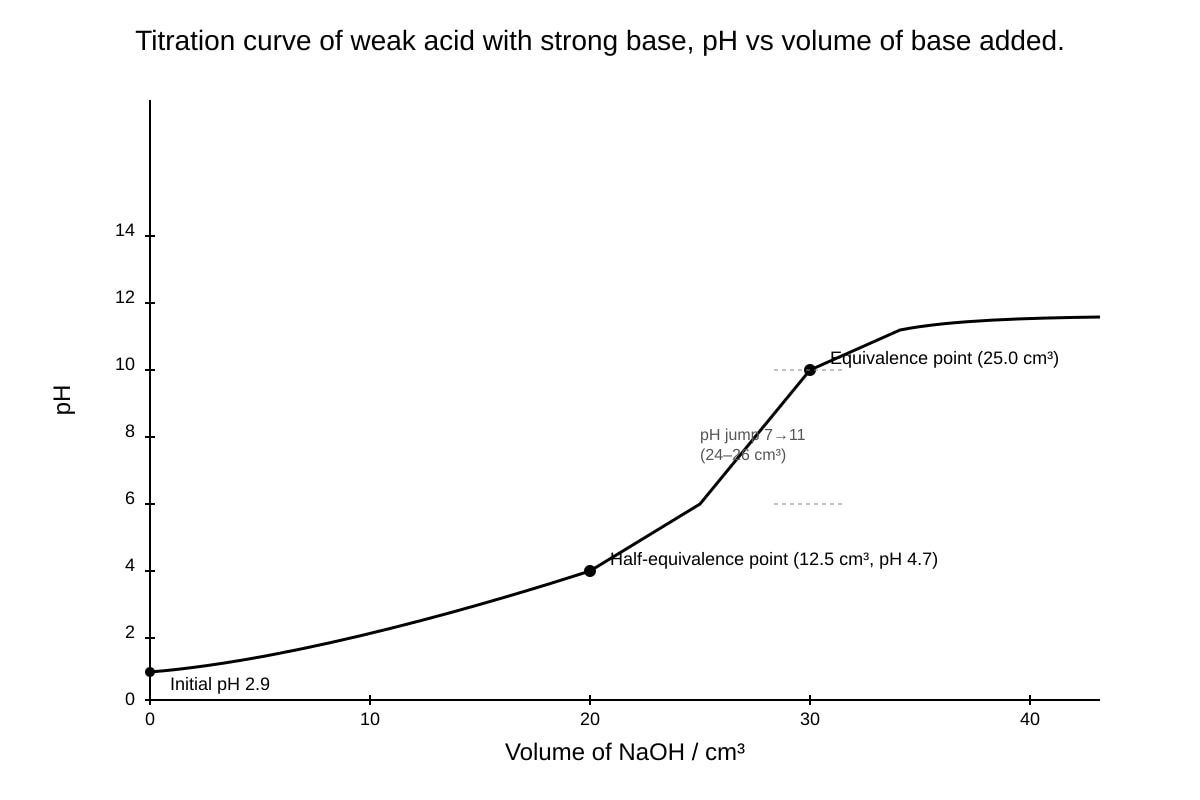
Generated graph for 17.
Using the graph, state the pH at the half-equivalence point and deduce the pKa of the acid.
pH at half-equivalence: ________
pKa: ________
18. [3 marks] A student prepares a buffer by mixing 0.050 mol dm−3 NH3 and 0.030 mol dm−3 NH4Cl. Given Kb for NH3=1.8×10⁻⁵, calculate the pH. (Use Ka=Kw/Kb)
Working:
19. [2 marks] State two assumptions made when using the Henderson–Hasselbalch equation for buffer pH calculations.
-
-
20. [3 marks] A water sample contains Ca2+(aq) at 2.0×10⁻⁴ mol dm−3. If Ksp of CaF2=3.9×10⁻¹¹ mol3 dm−9, calculate the maximum [F−] before precipitation occurs.
Working: