From Real Exams Quiz

A Level H2 Chemistry Periodic Table Quiz

Free Exam-Derived Owl Alpha A Level H2 Chemistry Periodic Table quiz with questions and answers for Singapore students. This page is rendered as a direct URL so the questions and answers can be discovered without pressing in-page buttons.

These static practice materials are generated from the site's syllabus and paper-generation workflow, with source and model context shown so students and parents can evaluate the material before use.

A Level H2 Chemistry From Real Exams Generated by Owl Alpha Updated 2026-06-07

Questions

<!-- TuitionGoWhere generation metadata: stage=3-0; model=openrouter/owl-alpha; model_label=Owl Alpha; generated=2026-06-06; Sources: Stage 2-1 real exam-derived templates and Stage 2-2 exam-enriched syllabus. -->

A-Level Chemistry H2 Quiz - Periodic Table

Name: ___________________________
Class: ___________________________
Date: ___________________________
Score: _________ / 50

Duration: 60 minutes
Total Marks: 50

Instructions:

  • Answer all questions in the spaces provided.
  • Show all working for calculation questions. Marks are awarded for correct method even if the final answer is incorrect.
  • Use the Data Booklet where relevant.
  • Write your answers in ink. You may use a pencil for diagrams and graphs.
  • The mark allocation for each question is shown in brackets [ ].

Section A: Periodicity and Atomic Structure (Questions 1–7)

1. Table 1 shows the first four successive ionisation energies (IE) of an element Q.

Ionisation1st IE2nd IE3rd IE4th IE
Energy / kJ mol⁻¹5781817274511577

Table 1

(a) Define the term first ionisation energy. [2]

....................................................................................................................................................................................... .......................................................................................................................................................................................

(b) Use the data in Table 1 to deduce the identity of element Q. Explain your reasoning. [3]

....................................................................................................................................................................................... ....................................................................................................................................................................................... .......................................................................................................................................................................................

[Total: 5]


2. The table below gives the atomic radii and first ionisation energies of the Period 3 elements Na to Ar.

ElementNaMgAlSiPSClAr
Atomic radius / nm0.1860.1600.1430.1170.1100.1040.099
1st IE / kJ mol⁻¹4967365777861012100012511520

(a) Explain the general trend in atomic radius across Period 3 from Na to Cl. [2]

....................................................................................................................................................................................... .......................................................................................................................................................................................

(b) Explain why the first ionisation energy of Al is lower than that of Mg. [2]

....................................................................................................................................................................................... .......................................................................................................................................................................................

(c) Explain why the first ionisation energy of S is lower than that of P. [2]

....................................................................................................................................................................................... .......................................................................................................................................................................................

(d) Suggest why the atomic radius of Ar is not included in the table. [1]

.......................................................................................................................................................................................

[Total: 7]


3. (a) Write the full electronic configuration of: (i) sulfur, S (Z = 16) [1]

.......................................................................................................................................................................................

(ii) scandium, Sc (Z = 21) [1]

.......................................................................................................................................................................................

(b) Explain why scandium is classified as a transition element but sulfur is not. [2]

....................................................................................................................................................................................... .......................................................................................................................................................................................

[Total: 4]


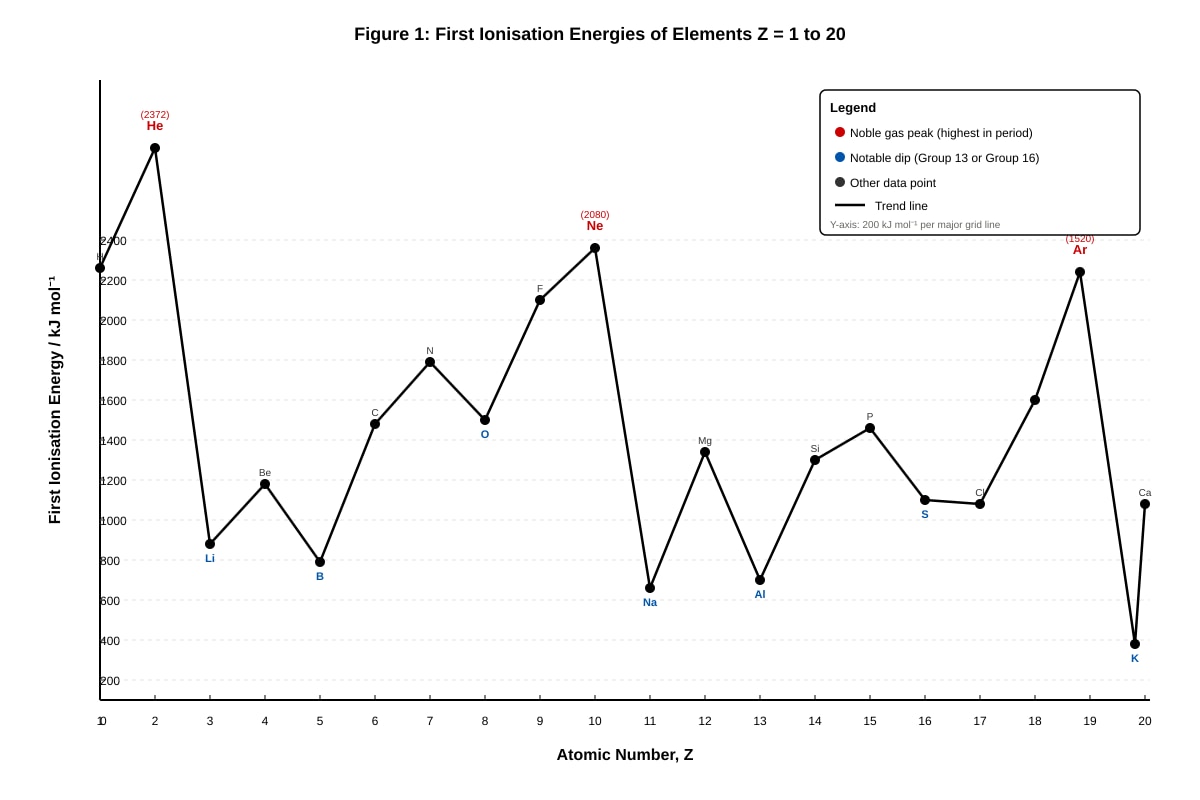
4. Figure 1 shows a sketch of the first ionisation energies of the elements with atomic numbers 1 to 20.

<image_placeholder> id: Q4-fig1 type: graph linked_question: Q4 description: A graph of first ionisation energy (y-axis, in kJ mol⁻¹) against atomic number (x-axis, 1 to 20). The graph shows a general upward trend from Z=1 to Z=2, a dip at Z=3, rise to Z=4, dip at Z=5, rise to Z=6, dip at Z=7, then a sharp rise to Z=8. From Z=9 to Z=10, IE rises sharply. From Z=10 to Z=11, a sharp drop. Rise to Z=12, dip at Z=13, rise to Z=14, dip at Z=15, rise to Z=16, dip at Z=17, sharp rise to Z=18. Drop at Z=19, rise to Z=20. Key labelled points: He (Z=2) highest in Period 1; Ne (Z=10) highest in Period 2; Ar (Z=18) highest in Period 3. Notable dips at Z=3 (Li), Z=5 (Be→B), Z=7 (N→O), Z=11 (Na), Z=13 (Mg→Al), Z=15 (P→S), Z=19 (K). labels: y-axis: "First Ionisation Energy / kJ mol⁻¹"; x-axis: "Atomic Number, Z"; labelled peaks at Z=2, Z=10, Z=18; labelled dips at Z=3, Z=5, Z=7, Z=11, Z=13, Z=15, Z=19 values: approximate IE values: H(1312), He(2372), Li(520), Be(900), B(801), C(1086), N(1402), O(1314), F(1681), Ne(2080), Na(496), Mg(736), Al(577), Si(786), P(1012), S(1000), Cl(1251), Ar(1520), K(419), Ca(590) must_show: general trend increasing within each period; group maxima at noble gases (Z=2, 10, 18); dips at Group 13 (Z=5, 13) and Group 16 (Z=7, 15); sharp drops from noble gas to next alkali metal </image_placeholder>

Figure 1

(a) From Figure 1, state the element with the highest first ionisation energy. Explain your answer. [2]

....................................................................................................................................................................................... .......................................................................................................................................................................................

(b) Using Figure 1 and your knowledge, explain why the first ionisation energy decreases from Z = 2 to Z = 3. [2]

....................................................................................................................................................................................... .......................................................................................................................................................................................

(c) Explain the decrease in first ionisation energy from Z = 7 to Z = 8. [2]

....................................................................................................................................................................................... .......................................................................................................................................................................................

[Total: 6]


5. The table below shows the melting points of the Period 3 oxides.

OxideNa₂OMgOAl₂O₃SiO₂P₄O₁₀SO₃
Melting point / °C113228522072171030017

(a) State the type of bonding present in MgO. [1]

.......................................................................................................................................................................................

(b) Explain why MgO has a higher melting point than Na₂O. [2]

....................................................................................................................................................................................... .......................................................................................................................................................................................

(c) Explain why SiO₂ has a much higher melting point than P₄O₁₀. [2]

....................................................................................................................................................................................... .......................................................................................................................................................................................

(d) Deduce the structure of SO₃ and explain its low melting point. [2]

....................................................................................................................................................................................... .......................................................................................................................................................................................

[Total: 7]


6. Chlorine has two stable isotopes: ³⁵Cl and ³⁷Cl. The relative atomic mass of chlorine is 35.5.

(a) Define the term relative atomic mass. [2]

....................................................................................................................................................................................... .......................................................................................................................................................................................

(b) Calculate the percentage abundance of each isotope of chlorine. Show your working. [2]

....................................................................................................................................................................................... .......................................................................................................................................................................................

[Total: 4]


7. The table below shows some properties of the Period 3 chlorides.

ChlorideNaClMgCl₂AlCl₃SiCl₄PCl₃
Melting point / °C801714192−70−94
Electrical conductivity (solid)PoorPoorPoorPoorPoor
Electrical conductivity (liquid)GoodGoodPoorPoorPoor

(a) Explain why NaCl conducts electricity in the liquid state but not in the solid state. [2]

....................................................................................................................................................................................... .......................................................................................................................................................................................

(b) Explain why AlCl₃ does not conduct electricity well in the liquid state. [2]

....................................................................................................................................................................................... .......................................................................................................................................................................................

(c) Suggest the type of bonding in SiCl₄. Explain your answer. [2]

....................................................................................................................................................................................... .......................................................................................................................................................................................

[Total: 6]


Section B: Group Trends (Questions 8–14)

8. (a) Describe the trend in atomic radius down Group II (Be to Ba). Explain this trend. [2]

....................................................................................................................................................................................... .......................................................................................................................................................................................

(b) Describe the trend in first ionisation energy down Group II. Explain this trend. [2]

....................................................................................................................................................................................... .......................................................................................................................................................................................

[Total: 4]


9. A student adds a small piece of magnesium ribbon to a test tube containing cold water. A second student adds a small piece of calcium to a separate test tube containing cold water.

(a) State one observation for each reaction. [2]

Magnesium: .......................................................................................................................................................................

Calcium: ...........................................................................................................................................................................

(b) Write an equation for the reaction of calcium with water. [1]

.......................................................................................................................................................................................

(c) Predict and explain the reactivity of barium with cold water compared to calcium. [2]

....................................................................................................................................................................................... .......................................................................................................................................................................................

[Total: 5]


10. The thermal stability of Group II carbonates increases down the group.

(a) Write an equation for the thermal decomposition of magnesium carbonate. [1]

.......................................................................................................................................................................................

(b) Explain why barium carbonate requires a higher temperature to decompose than magnesium carbonate. [3]

....................................................................................................................................................................................... ....................................................................................................................................................................................... .......................................................................................................................................................................................

[Total: 4]


11. The solubilities of Group II sulfates and hydroxides are shown below.

CompoundSolubility trend (top to bottom)
Group II sulfatesDecreases
Group II hydroxidesIncreases

(a) State whether magnesium sulfate or barium sulfate is more soluble in water. [1]

.......................................................................................................................................................................................

(b) State whether magnesium hydroxide or barium hydroxide is more soluble in water. [1]

.......................................................................................................................................................................................

(c) Suggest a reagent that could be used to distinguish between separate aqueous solutions of magnesium chloride and barium chloride. State the observations for each solution. [3]

....................................................................................................................................................................................... ....................................................................................................................................................................................... .......................................................................................................................................................................................

[Total: 5]


12. Chlorine gas is bubbled into separate solutions of potassium bromide and potassium iodide.

(a) Write an equation for each reaction that occurs. [2]

With potassium bromide: ....................................................................................................................................................

With potassium iodide: ......................................................................................................................................................

(b) State the observation for each reaction. [2]

With potassium bromide: ....................................................................................................................................................

With potassium iodide: ......................................................................................................................................................

(c) Explain, in terms of oxidising ability, the trend in reactivity of the halogens down Group VII. [2]

....................................................................................................................................................................................... .......................................................................................................................................................................................

[Total: 6]


13. A student carries out the following test: a few drops of aqueous silver nitrate are added to a solution of sodium chloride, followed by dilute aqueous ammonia.

(a) State the observation when silver nitrate is added. [1]

.......................................................................................................................................................................................

(b) State the observation when dilute ammonia is added. [1]

.......................................................................................................................................................................................

(c) Write an equation for the reaction between silver ions and chloride ions. [1]

.......................................................................................................................................................................................

(d) The student repeats the test using sodium bromide and then sodium iodide. State the observations and explain the difference in solubility of the precipitates in dilute ammonia. [3]

Sodium bromide: ...............................................................................................................................................................

Sodium iodide: ..................................................................................................................................................................

Explanation: ......................................................................................................................................................................

.......................................................................................................................................................................................

[Total: 6]


14. Figure 2 shows the standard electrode potentials for some half-equations involving halogens and halide ions.

Half-equationE° / V
F₂(g) + 2e⁻ ⇌ 2F⁻(aq)+2.87
Cl₂(g) + 2e⁻ ⇌ 2Cl⁻(aq)+1.36
Br₂(l) + 2e⁻ ⇌ 2Br⁻(aq)+1.07
I₂(s) + 2e⁻ ⇌ 2I⁻(aq)+0.54

Figure 2

(a) Use the data in Figure 2 to explain why chlorine can oxidise bromide ions but not fluoride ions. [3]

....................................................................................................................................................................................... ....................................................................................................................................................................................... .......................................................................................................................................................................................

(b) Calculate the E° value for the reaction between chlorine gas and bromide ions. [2]

....................................................................................................................................................................................... .......................................................................................................................................................................................

[Total: 5]


Section C: Transition Elements and Mixed Periodic Trends (Questions 15–20)

15. Copper, Cu (Z = 29), is a transition element.

(a) Write the electronic configuration of a copper atom. [1]

.......................................................................................................................................................................................

(b) Explain why copper is classified as a transition element. [1]

.......................................................................................................................................................................................

(c) Explain why copper compounds are often coloured. [2]

....................................................................................................................................................................................... .......................................................................................................................................................................................

[Total: 4]


16. Aqueous copper(II) sulfate is blue due to the [Cu(H₂O)₆]²⁺ ion.

(a) When concentrated hydrochloric acid is added to aqueous copper(II) sulfate, the solution turns green. Explain this observation. [2]

....................................................................................................................................................................................... .......................................................................................................................................................................................

(b) Write an equation for the reaction in (a). [1]

.......................................................................................................................................................................................

(c) When excess aqueous ammonia is added to aqueous copper(II) sulfate, a pale blue precipitate forms, which then dissolves to give a deep blue solution. Name the deep blue complex ion formed. [1]

.......................................................................................................................................................................................

[Total: 4]


17. Iron can exist in two common oxidation states: +2 and +3.

(a) Write the electronic configuration of Fe²⁺ and Fe³⁺. [2]

Fe²⁺: ...............................................................................................................................................................................

Fe³⁺: ...............................................................................................................................................................................

(b) Explain why Fe²⁺ is easily oxidised to Fe³⁺. [2]

....................................................................................................................................................................................... .......................................................................................................................................................................................

(c) Describe a test to distinguish between Fe²⁺(aq) and Fe³⁺(aq) using aqueous sodium hydroxide. State the observations. [2]

....................................................................................................................................................................................... .......................................................................................................................................................................................

[Total: 6]


18. Chromium, Cr (Z = 24), has the electronic configuration [Ar] 3d⁵ 4s¹ rather than the expected [Ar] 3d⁴ 4s².

(a) Explain why chromium has this anomalous electronic configuration. [2]

....................................................................................................................................................................................... .......................................................................................................................................................................................

(b) State the oxidation states commonly exhibited by chromium. [1]

.......................................................................................................................................................................................

(c) Explain why Cr³⁺ is more stable than Cr²⁺ in aqueous solution. [2]

....................................................................................................................................................................................... .......................................................................................................................................................................................

[Total: 5]


19. The table below shows the successive ionisation energies of titanium, Ti (Z = 22).

Ionisation1st2nd3rd4th5th6th
IE / kJ mol⁻¹659131026524175957311519

(a) Explain the large jump between the 4th and 5th ionisation energies. [2]

....................................................................................................................................................................................... .......................................................................................................................................................................................

(b) Deduce the most common oxidation state of titanium and explain your answer. [2]

....................................................................................................................................................................................... .......................................................................................................................................................................................

[Total: 4]


20. Vanadium exhibits multiple oxidation states from +2 to +5.

(a) State the oxidation state of vanadium in the following species: (i) V³⁺ [1]

.......................................................................................................................................................................................

(ii) VO₂⁺ [1]

.......................................................................................................................................................................................

(b) A solution containing VO₂⁺ ions is reduced by zinc in acidic solution. The colours observed during the reduction are: yellow → blue → green → violet. Assign each colour to the vanadium oxidation state. [2]

Yellow: .............................................................................................................................................................................

Blue: ...............................................................................................................................................................................

Green: .............................................................................................................................................................................

Violet: .............................................................................................................................................................................

(c) Write the half-equation for the reduction of VO₂⁺ to V³⁺ in acidic solution. [2]

.......................................................................................................................................................................................

[Total: 6]


END OF QUIZ

Answers

<!-- TuitionGoWhere generation metadata: stage=3-0; model=openrouter/owl-alpha; model_label=Owl Alpha; generated=2026-06-06; Sources: Stage 2-1 real exam-derived templates and Stage 2-2 exam-enriched syllabus. -->

A-Level Chemistry H2 Quiz - Periodic Table: Answer Key


Question 1 [5 marks]

(a) [2 marks]

The first ionisation energy is the energy required to remove one mole of electrons from one mole of gaseous atoms to form one mole of gaseous 1+ ions.

Marking notes:

  • 1 mark for "remove one electron from a gaseous atom" (or equivalent).
  • 1 mark for specifying "per mole" / one mole of gaseous atoms → one mole of gaseous ions.
  • Common error: omitting "gaseous" — no mark for state.

(b) [3 marks]

Element Q is aluminium (Al).

Reasoning:

  • There is a large jump between the 3rd IE (2745 kJ mol⁻¹) and the 4th IE (11577 kJ mol⁻¹). [1]
  • This indicates that the first 3 electrons are removed from the outer shell, and the 4th electron is removed from an inner shell (closer to the nucleus, much more tightly held). [1]
  • Therefore, Q has 3 valence electrons and is in Group 13. With relatively low first three IEs, it is aluminium in Period 3. [1]

Teaching note: A large jump in successive IEs signals moving from valence electrons to core electrons. The position of the jump tells you the group number (e.g., jump after 3rd IE → Group 13).


Question 2 [7 marks]

(a) [2 marks]

The atomic radius decreases across Period 3 from Na to Cl. [1] This is because the nuclear charge (number of protons) increases across the period, while electrons are added to the same shell (same principal quantum number). The increased nuclear attraction pulls the electron cloud closer to the nucleus. [1]

(b) [2 marks]

The outer electron in Al is in a 3p orbital, whereas in Mg the outer electrons are in the 3s orbital. [1] The 3p orbital is at a higher energy level (further from the nucleus) and is also slightly shielded by the 3s electrons, so the 3p electron is easier to remove. [1]

Common error: Students often say "Al has more electrons" without specifying the orbital type and shielding effect.

(c) [2 marks]

In phosphorus (P), the 3p orbitals are half-filled with one electron each (3p³), which is a stable arrangement. [1] In sulfur (S), one 3p orbital contains a pair of electrons. The electron-electron repulsion within this orbital makes it easier to remove one of the paired electrons. [1]

(d) [1 mark]

Argon does not form covalent bonds, so its atomic radius is measured as a van der Waals radius (not a covalent radius), which is significantly larger and not directly comparable to the covalent radii of the other elements.


Question 3 [4 marks]

(a)(i) [1 mark] 1s² 2s² 2p⁶ 3s² 3p⁴

(a)(ii) [1 mark] 1s² 2s² 2p⁶ 3s² 3p⁶ 3d¹ 4s² (or [Ar] 3d¹ 4s²)

(b) [2 marks]

Scandium is classified as a transition element because it can form at least one ion with an incomplete d subshell (Sc³⁺ has an empty 3d subshell, but Sc²⁺ has 3d¹; the definition requires the element to have an incomplete d subshell in one of its common oxidation states — Sc has [Ar] 3d¹ 4s² in its ground state). [1]

Sulfur is not a transition element because all its ions (e.g., S²⁻) have a complete d subshell or do not involve d orbitals at all — sulfur is a p-block element. [1]

Teaching note: The IUPAC definition of a transition element is an element that has an incomplete d subshell in any of its commonly occurring oxidation states. Scandium's ground state has 3d¹, satisfying this.


Question 4 [6 marks]

(a) [2 marks]

Helium (Z = 2) has the highest first ionisation energy. [1] This is because helium has a full 1s shell (1s²), a very stable configuration, and the electron is very close to the nucleus with no shielding from other electrons in the same shell, resulting in very strong nuclear attraction. [1]

(b) [2 marks]

From Z = 2 (He) to Z = 3 (Li), the first ionisation energy decreases sharply. [1] In Li, the outer electron is in the 2s orbital, which is further from the nucleus and is shielded by the inner 1s² electrons. This makes the outer electron easier to remove. [1]

(c) [2 marks]

From Z = 7 (N) to Z = 8 (O), the first ionisation energy decreases. [1] In oxygen, one of the 2p orbitals contains a pair of electrons. The electron-electron repulsion within this orbital makes it easier to remove one of the paired electrons compared to nitrogen, where each 2p orbital contains one electron (half-filled, stable). [1]


Question 5 [7 marks]

(a) [1 mark]

Ionic bonding.

(b) [2 marks]

Both Na₂O and MgO are ionic compounds. Mg²⁺ has a higher charge than Na⁺, and Mg²⁺ has a smaller ionic radius than Na⁺. [1] The greater charge density of Mg²⁺ results in stronger electrostatic attraction between Mg²⁺ and O²⁻ ions, requiring more energy to break the lattice, hence a higher melting point. [1]

(c) [2 marks]

SiO₂ has a giant covalent (macromolecular) structure where each Si atom is covalently bonded to four O atoms in a tetrahedral arrangement, forming a 3D network. Breaking this structure requires breaking many strong covalent bonds. [1] P₄O₁₀ has a simple molecular structure with weak intermolecular forces (van der Waals forces) between molecules, which require little energy to overcome. [1]

(d) [2 marks]

SO₃ has a simple molecular structure. [1] The molecules are held together by weak van der Waals forces, which require very little energy to overcome, resulting in a low melting point. [1]


Question 6 [4 marks]

(a) [2 marks]

The relative atomic mass is the weighted average mass of one atom of an element relative to 1/12 the mass of a carbon-12 atom. [2]

Marking notes: 1 mark for "weighted average mass of atoms of the element"; 1 mark for "relative to 1/12 mass of one atom of carbon-12."

(b) [2 marks]

Let the percentage abundance of ³⁵Cl = x%. Then ³⁷Cl = (100 − x)%.

35x+37(100x)100=35.5\frac{35x + 37(100 - x)}{100} = 35.5

35x+370037x=355035x + 3700 - 37x = 3550

2x=150-2x = -150

x=75x = 75

Therefore: ³⁵Cl = 75% and ³⁷Cl = 25%. [2]

Marking notes: 1 mark for correct setup; 1 mark for correct answer.


Question 7 [6 marks]

(a) [2 marks]

In solid NaCl, the ions (Na⁺ and Cl⁻) are held in fixed positions in the ionic lattice and cannot move freely, so they cannot carry charge. [1] In liquid (molten) NaCl, the ions are free to move and can carry electrical charge through the liquid, hence it conducts electricity. [1]

(b) [2 marks]

AlCl₃ is covalent (molecular) in the liquid state. [1] It does not contain free ions; the molecules are neutral, so there are no charge carriers to conduct electricity. [1]

(c) [2 marks]

SiCl₄ is covalent. [1] Silicon and chlorine have a small electronegativity difference, and SiCl₄ is a simple molecular compound with no ions present. It has a low melting point (−70 °C), consistent with weak intermolecular forces. [1]


Question 8 [4 marks]

(a) [2 marks]

The atomic radius increases down Group II. [1] This is because each successive element has an additional electron shell, so the outer electrons are further from the nucleus and more shielded from the nuclear charge. [1]

(b) [2 marks]

The first ionisation energy decreases down Group II. [1] The outer electrons are further from the nucleus and more shielded by inner electron shells, so the attractive force from the nucleus is weaker, making the electrons easier to remove. [1]


Question 9 [5 marks]

(a) [2 marks]

Magnesium: Very slow reaction / few bubbles of gas / the magnesium ribbon dissolves slowly. [1]

Calcium: Faster reaction / more vigorous bubbling / the calcium dissolves more quickly. [1]

(b) [1 mark]

Ca(s)+2H2O(l)Ca(OH)2(aq)+H2(g)Ca(s) + 2H_2O(l) \rightarrow Ca(OH)_2(aq) + H_2(g)

(c) [2 marks]

Barium will react more vigorously than calcium. [1] This is because barium is below calcium in Group II, so its outer electrons are further from the nucleus and more shielded, resulting in a lower ionisation energy and greater reactivity. [1]


Question 10 [4 marks]

(a) [1 mark]

MgCO3(s)MgO(s)+CO2(g)MgCO_3(s) \rightarrow MgO(s) + CO_2(g)

(b) [3 marks]

The thermal stability of Group II carbonates increases down the group because the cation size increases. [1] Ba²⁺ is larger than Mg²⁺, so it has a lower charge density. [1] The larger Ba²⁺ ion is less able to polarise the carbonate ion (CO₃²⁻), so the C–O bonds in the carbonate are less weakened, and more energy (higher temperature) is required to decompose it. [1]

Teaching note: This is a key application of polarising power (Fajan's rule). Smaller, highly charged cations distort the electron cloud of the anion more effectively, weakening the bonds within the anion.


Question 11 [5 marks]

(a) [1 mark]

Magnesium sulfate is more soluble than barium sulfate.

(b) [1 mark]

Barium hydroxide is more soluble than magnesium hydroxide.

(c) [3 marks]

Reagent: Aqueous sodium sulfate (or dilute sulfuric acid). [1]

Observations:

  • Magnesium chloride: No visible change / no precipitate. [1]
  • Barium chloride: White precipitate forms. [1]

Alternative acceptable answer: Aqueous sodium hydroxide — MgCl₂ gives a white precipitate (Mg(OH)₂), BaCl₂ gives no precipitate (Ba(OH)₂ is soluble enough in dilute solution). Full marks for correct reagent with correct observations.


Question 12 [6 marks]

(a) [2 marks]

With potassium bromide: Cl2(g)+2KBr(aq)2KCl(aq)+Br2(aq)Cl_2(g) + 2KBr(aq) \rightarrow 2KCl(aq) + Br_2(aq) [1]

With potassium iodide: Cl2(g)+2KI(aq)2KCl(aq)+I2(aq)Cl_2(g) + 2KI(aq) \rightarrow 2KCl(aq) + I_2(aq) [1]

(b) [2 marks]

With potassium bromide: The solution turns orange/brown. [1]

With potassium iodide: The solution turns brown (or purple in organic solvent). [1]

(c) [2 marks]

The oxidising ability of the halogens decreases down Group VII. [1] This is because the atomic radius increases down the group, so the outer shell is further from the nucleus and more shielded. The ability to attract and gain an electron (to form X⁻) decreases, so the oxidising power decreases. [1]


Question 13 [6 marks]

(a) [1 mark]

A white precipitate forms.

(b) [1 mark]

The precipitate dissolves in dilute ammonia.

(c) [1 mark]

Ag+(aq)+Cl(aq)AgCl(s)Ag^+(aq) + Cl^-(aq) \rightarrow AgCl(s)

(d) [3 marks]

Sodium bromide: A cream precipitate (AgBr) forms. The precipitate does not dissolve in dilute ammonia (it dissolves only in concentrated ammonia). [1]

Sodium iodide: A yellow precipitate (AgI) forms. The precipitate does not dissolve in dilute or concentrated ammonia. [1]

Explanation: The solubility of silver halides in ammonia decreases from AgCl to AgI. AgCl is the most soluble in dilute ammonia because the Ag⁺ ion forms a soluble complex ion [Ag(NH₃)₂]⁺ with ammonia. AgBr is less soluble and requires concentrated ammonia. AgI is so insoluble that it does not dissolve even in concentrated ammonia. [1]


Question 14 [5 marks]

(a) [3 marks]

From Figure 2, E°(Cl₂/Cl⁻) = +1.36 V and E°(Br₂/Br⁻) = +1.07 V. [1] Since E°(Cl₂/Cl⁻) > E°(Br₂/Br⁻), chlorine is a stronger oxidising agent than bromine and can oxidise bromide ions to bromine (the reaction is spontaneous because E°cell > 0). [1] However, E°(F₂/F⁻) = +2.87 V, which is more positive than E°(Cl₂/Cl⁻), so fluorine is a stronger oxidising agent than chlorine. Chlorine cannot oxidise fluoride ions because the reaction would have a negative E°cell (non-spontaneous). [1]

(b) [2 marks]

E°cell=E°reductionE°oxidationE°_{cell} = E°_{reduction} - E°_{oxidation}

E°cell=E°(Cl2/Cl)E°(Br2/Br)E°_{cell} = E°(Cl_2/Cl^-) - E°(Br_2/Br^-)

E°cell=(+1.36)(+1.07)=+0.29 VE°_{cell} = (+1.36) - (+1.07) = +0.29 \text{ V}

[1 mark for correct formula; 1 mark for correct answer with unit]


Question 15 [4 marks]

(a) [1 mark]

1s² 2s² 2p⁶ 3s² 3p⁶ 3d¹⁰ 4s¹ (or [Ar] 3d¹⁰ 4s¹)

(b) [1 mark]

Copper is a transition element because it has an incomplete d subshell in its common oxidation state Cu²⁺ (3d⁹). [1]

(c) [2 marks]

In a free Cu atom, all five 3d orbitals have the same energy (they are degenerate). [1] In a compound, the ligands cause the 3d orbitals to split into two sets of different energies. Electrons can absorb visible light to move (d-d transition) between these split d orbitals. The wavelength absorbed depends on the energy gap, and the complementary colour is observed. [1]


Question 16 [4 marks]

(a) [2 marks]

When concentrated HCl is added, the Cl⁻ ligands replace some of the H₂O ligands around Cu²⁺, forming the [CuCl₄]²⁻ complex ion (tetrachlorocuprate(II)). [1] The different ligand field strength of Cl⁻ compared to H₂O changes the energy gap between the split d orbitals, causing a different wavelength of light to be absorbed. The solution appears green (a mixture of blue from [Cu(H₂O)₆]²⁺ and yellow from [CuCl₄]²⁻). [1]

(b) [1 mark]

[Cu(H2O)6]2+(aq)+4Cl(aq)[CuCl4]2(aq)+6H2O(l)[Cu(H_2O)_6]^{2+}(aq) + 4Cl^-(aq) \rightleftharpoons [CuCl_4]^{2-}(aq) + 6H_2O(l)

(c) [1 mark]

[Cu(NH₃)₄(H₂O)₂]²⁺ (tetraamminecopper(II) ion)


Question 17 [6 marks]

(a) [2 marks]

Fe²⁺: 1s² 2s² 2p⁶ 3s² 3p⁶ 3d⁶ (or [Ar] 3d⁶) [1]

Fe³⁺: 1s² 2s² 2p⁶ 3s² 3p⁶ 3d⁵ (or [Ar] 3d⁵) [1]

(b) [2 marks]

Fe³⁺ has a 3d⁵ configuration, which is a half-filled d subshell. [1] A half-filled d subshell is particularly stable due to maximum exchange energy and symmetrical distribution of electrons. Therefore, Fe²⁺ (3d⁶) readily loses one electron to achieve this stable half-filled configuration. [1]

(c) [2 marks]

Add aqueous NaOH to separate samples of each solution. [1] Fe²⁺(aq): A green precipitate of Fe(OH)₂ forms (which slowly turns brown on exposure to air due to oxidation). [½] Fe³⁺(aq): A brown/rust-coloured precipitate of Fe(OH)₃ forms. [½]

Marking note: Award 1 mark for correct reagent and 1 mark for correct observations for both ions.


Question 18 [5 marks]

(a) [2 marks]

The 3d and 4s orbitals are very close in energy. [1] A half-filled d subshell (3d⁵) provides extra stability due to maximum exchange energy and symmetrical electron distribution. One electron from the 4s orbital is promoted to the 3d orbital to achieve this stable half-filled configuration. [1]

(b) [1 mark]

+2, +3, +6 (or Cr²⁺, Cr³⁺, CrO₄²⁻/Cr₂O₇²⁻)

(c) [2 marks]

Cr³⁺ has a 3d³ configuration. In an octahedral field, this gives a t₂g³ configuration (all three electrons in the lower-energy t₂g set), which is a stable half-filled t₂g level. [1] Cr²⁺ has a 3d⁴ configuration (t₂g³ eg¹), which is less stable. Cr²⁺ is also a strong reducing agent and is easily oxidised to Cr³⁺ in aqueous solution. [1]


Question 19 [4 marks]

(a) [2 marks]

The large jump between the 4th and 5th IE indicates that the first 4 electrons are removed from the outer shells (4s and 3d), while the 5th electron is removed from an inner shell (3p). [1] The 5th electron is much closer to the nucleus and experiences much less shielding, so significantly more energy is required to remove it. [1]

(b) [2 marks]

The most common oxidation state of titanium is +4. [1] This is because the large jump occurs after the 4th IE, meaning 4 electrons can be relatively easily removed (from the 4s² and 3d² orbitals), but removing a 5th electron requires much more energy. Therefore, Ti⁴⁺ is the most stable and common ion. [1]


Question 20 [6 marks]

(a)(i) [1 mark] +3

(a)(ii) [1 mark] +5 (O is −2 each, so V + 2(−2) = +1 → V = +5... wait: VO₂⁺: V + 2(−2) = +1, so V = +5)

(b) [2 marks]

Yellow: +5 (VO₂⁺) [½] Blue: +4 (VO²⁺) [½] Green: +3 (V³⁺) [½] Violet: +2 (V²⁺) [½]

(c) [2 marks]

VO2+(aq)+4H+(aq)+eV3+(aq)+2H2O(l)VO_2^+(aq) + 4H^+(aq) + e^- \rightarrow V^{3+}(aq) + 2H_2O(l)

Marking notes:

  • 1 mark for correct species and stoichiometry.
  • 1 mark for correct number of electrons and charge balance.
  • Check: Left side charge: +1 + 4 − 1 = +4. Right side: +3. Hmm, let me recalculate.

Corrected equation:

VO2+(aq)+4H+(aq)+2eV3+(aq)+2H2O(l)VO_2^+(aq) + 4H^+(aq) + 2e^- \rightarrow V^{3+}(aq) + 2H_2O(l)

Verification:

  • V: +5 in VO₂⁺ → +3 in V³⁺ (gain of 2 electrons) ✓
  • Left charge: +1 + 4 − 2 = +3; Right charge: +3 ✓

[1 mark for correct half-equation; 1 mark for correct balancing of charge and atoms]


END OF ANSWER KEY