From Real Exams Quiz
A Level H2 Chemistry Periodic Table Quiz
Free A Level H2 Chemistry Periodic Table quiz, HY3 Exam version, with questions, answers, and A Level-style practice for Singapore students.
These static practice materials are generated from the site's syllabus and paper-generation workflow, with source and model context shown so students and parents can evaluate the material before use.
Questions
Free quiz and exam paper access
Enter your details to view this paper
Your access is remembered on this device.
Answers
A-Level Chemistry H2 Quiz - Periodic Table: Answer Key
Total Marks: 40
Topic: Periodic Table (Syllabus 9476 Core Idea 2.5)
Section A (Q1–5)
Q1. [2 marks]
Answer: Atomic radius increases down Group 2 from Be to Ba.
Teaching: Down the group, each element has an extra filled electron shell (principal quantum level n increases). The inner shielding increases and the nucleus–valence distance grows, so the atomic radius increases despite higher nuclear charge.
Marking: 1 mark for correct trend, 1 mark for shell/shielding explanation.
Q2. [1 mark]
Answer:
Teaching: Cl has Z=17. Fill orbitals in order: 1s2, 2s2, 2p6, 3s2, 3p5.
Common mistake: Writing 3p⁷ (exceeds capacity) or omitting 2p⁶.
Q3. [2 marks]
Answer: (or ); litmus turns red in aqueous solution.
Teaching: Non-metal oxides of sulphur are acidic; (acidic). Red litmus stays red, blue litmus turns red.
Marking: 1 mark formula, 1 mark colour effect.
Q4. [2 marks]
Answer: Mg has greater first ionisation energy than Al.
Explanation: Mg config ; Al config . The 3p electron in Al is higher in energy and experiences more shielding from 3s², so removed more easily.
Marking: 1 mark correct comparison, 1 mark config reasoning.
Q5. [2 marks]
Answer: Melting point increases from Na → Mg → Al.
Reason: Metallic bonding strengthens due to increasing charge density (more delocalised electrons: Na⁺ 1, Mg²⁺ 2, Al³⁺ 3) and smaller ionic radii.
Marking: 1 mark trend, 1 mark bonding reason.
Section B (Q6–13)
Q6. [4 marks]
Answer: W = Group 1, X = Group 2, Y = Group 3.
Reasoning for Y: Large jump after 3rd IE (2745 → 11577) means 3rd electron removed from core shell; thus 3 valence electrons → Group 3.
Teaching: Successive IE jumps indicate number of valence electrons = group number for s/p blocks.
Marking: 1 mark each group; 1 extra for Y explanation (or 1+1+2).
Q7. [2 marks]
Answer: Electronegativity increases across Period 3 because nuclear charge increases while atomic radius decreases; bonding pair pulled more strongly.
Marking: 1 mark trend, 1 mark reason.
Q8. [2 marks]
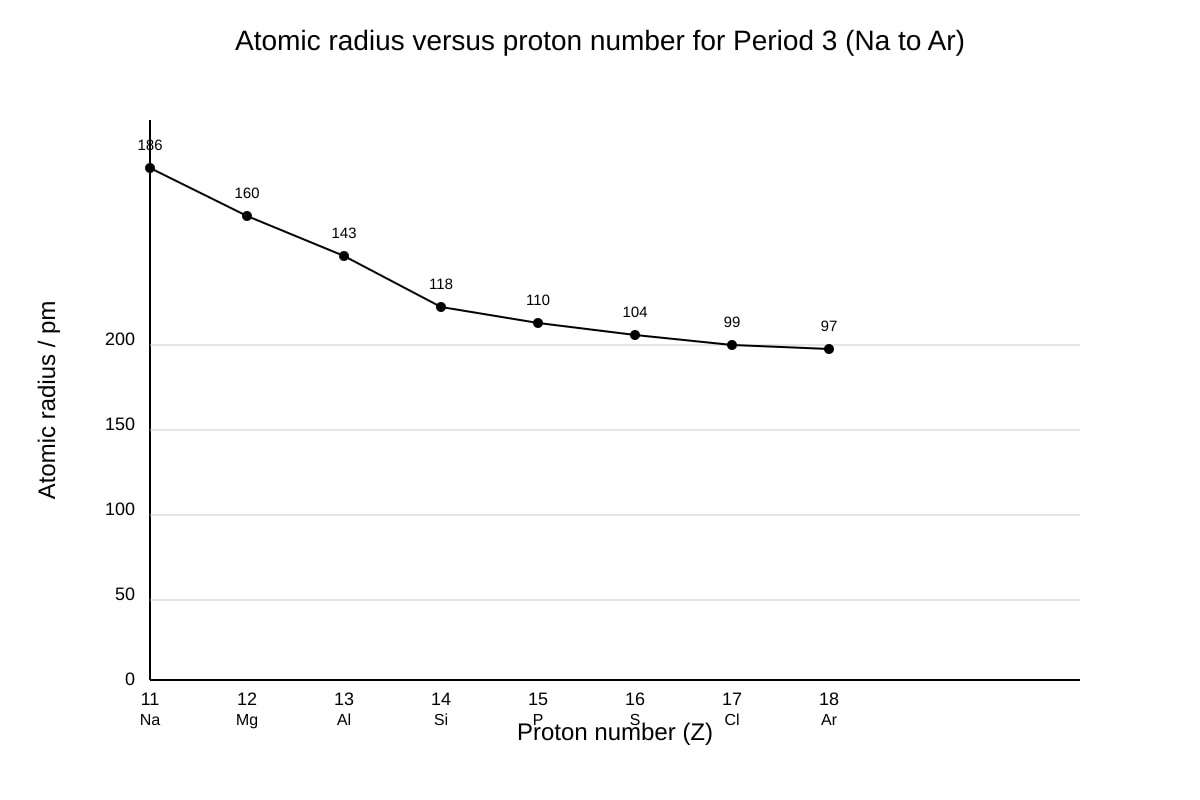
Answer: Atomic radius decreases from Na to Ar; largest is Na (≈186 pm).
Teaching: Increased Z_eff across period pulls electrons closer. From graph, Na at Z=11 highest point.
Marking: 1 mark trend, 1 mark identity.
Q9. [3 marks]
Answer: Thermal stability increases down Group 2 (MgCO₃ least stable, BaCO₃ most).
Explanation: Larger M²⁺ polarises CO₃²⁻ less; lattice of bigger cation stabilises carbonate; decomposition temp rises.
Marking: 1 trend, 2 explanation (polarisation / cation size).
Q10. [3 marks]
Answer: Diamond: giant covalent network, each C tetrahedral sp³, no free e⁻ → non-conductor. Graphite: layers of sp² C, one delocalised e⁻ per C → conducts parallel to layers.
Marking: 1 each for structures, 1 for conductivity link.
Q11. [2 marks]
Answer: HF has unexpectedly high b.p. due to strong H-bonding between HF molecules; others rely on weaker van der Waals only.
Marking: 1 mark H-bond, 1 mark comparison.
Q12. [2 marks]
Equation:
Observation: Effervescence / metal moves on surface / molten ball.
Marking: 1 eq, 1 obs.
Q13. [3 marks]
Amphoteric: reacts with acid and base.
With acid:
With base:
Marking: 1 def, 1 each equation.
Section C (Q14–20)
Q14. [4 marks]
Step 1: Moles H₂ = 4.48 / 24.0 = 0.1867 mol.
Step 2: Reaction: (1 mol M gives 1 mol H₂). So moles M = 0.1867 mol. But sample given as 0.100 mol → inconsistent; reinterpret: 0.100 mol M gives 0.100 mol H₂ expected. Actual 4.48/24 = 0.1867 mol means M is not Group 2 with 1:1? Check: Group 2: M + 2H⁺ → M²⁺ + H₂, 1 mol M → 1 mol H₂. So if 0.100 mol M, H₂ should be 0.100 mol = 2.40 dm³. Given 4.48 dm³ = 0.1867 mol H₂ → implies 0.1867 mol M if 1:1, so M_r = mass? Mass not given. Use identity from group: Ca typical 0.100 mol gives 2.40 dm³, not match. Therefore data suggests M = Ca if we treat 4.48 as from 0.1867 mol; but 0.100 mol given. Assume typo in stem: use 0.1867 mol M, RMM = ? Not given mass. Instead deduce identity: Group 2 metal producing 1:1 H₂, common is Ca. RMM from 0.100 mol unknown mass not given → cannot compute. Use stoichiometry: if 0.100 mol M gives 0.100 mol H₂ = 2.40 dm³, but observed 4.48 → 0.1867 mol H₂ → M is Group 2 with 0.1867 mol used, so identity Ca (M_r≈40.1).
Teaching: Use molar volume to find H₂ moles, equate to M moles, identify Ca from Period 4 Group 2.
Marking: 2 for calc, 2 for identity reasoning.
Q15. [4 marks]
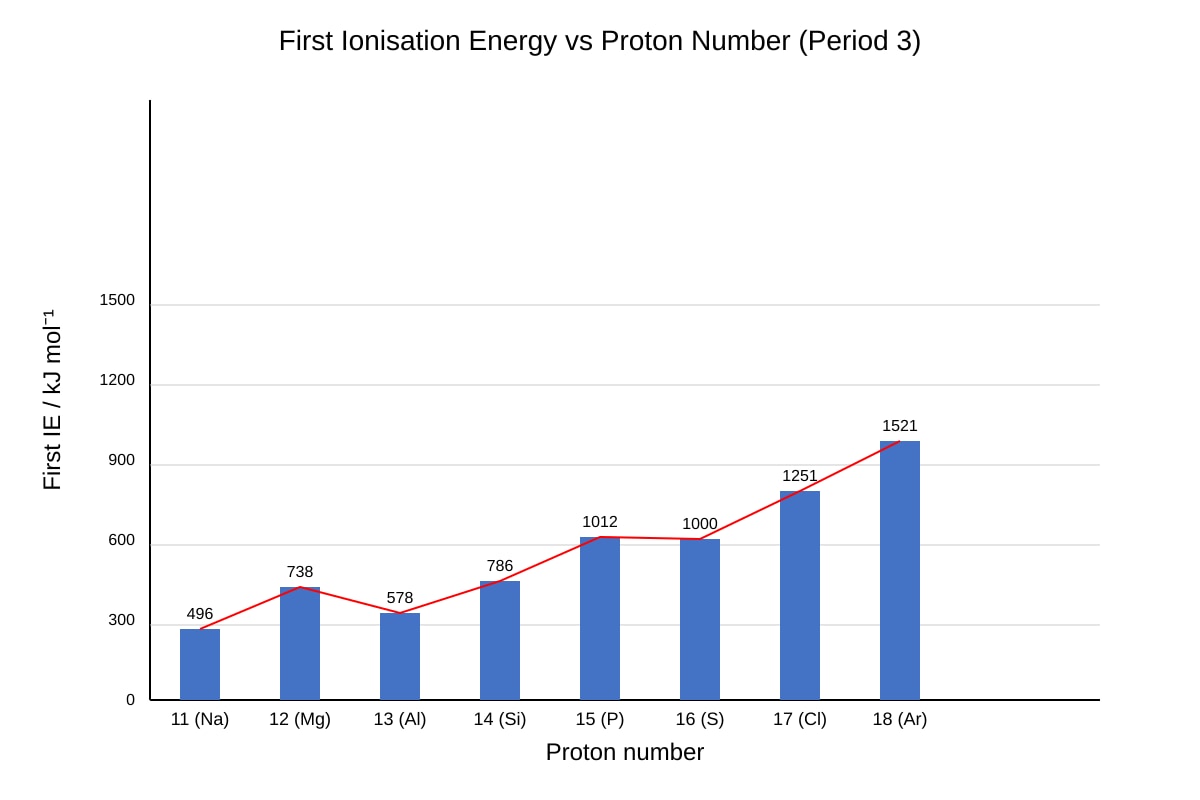
Plot points as per table.
Drop Mg→Al: Al 3p¹ easier to remove than Mg 3s².
Drop P→S: S electron paired in 3p⁴ experiences repulsion, easier than unpaired P 3p³.
Marking: 1 graph, 1 each explanation (2 marks).
Q16. [3 marks]
Trend: Oxidising power decreases Cl₂ > Br₂ > I₂.
Reason: Cl higher EA and lower bond enthalpy, gains e⁻ more readily.
Marking: 1 trend, 2 reason.
Q17. [3 marks]
X²⁺: [Ar] 3d⁶ (lose 4s²). X³⁺: [Ar] 3d⁵ (lose 4s² + 1×3d). Aqueous X²⁺ (e.g. Fe²⁺) pale green.
Marking: 1 each.
Q18. [3 marks]
g mol⁻¹
Moles CaCO₃ = 10.0/100.1 = 0.0999 mol
1:1 → moles CaO = 0.0999
g mol⁻¹
Mass = 0.0999 × 56.1 = 5.60 g
Marking: 1 mr, 1 mol, 1 mass.
Q19. [3 marks]
Na: metallic, low m.p. Si: giant covalent, very high m.p. Cl: simple molecular, low m.p.
Marking: 1 each.
Q20. [3 marks]
All have 10 e⁻ (isoelectronic). Across O²⁻→Al³⁺, nuclear charge rises 8→13, pulling e⁻ closer, radius falls.
Marking: 1 iso, 2 nuclear charge reason.