From Real Exams Quiz
A Level H2 Chemistry Periodic Table Quiz
Free A Level H2 Chemistry Periodic Table quiz, Exam version, with questions, answers, and A Level-style practice for Singapore students.
These static practice materials are generated from the site's syllabus and paper-generation workflow, with source and model context shown so students and parents can evaluate the material before use.
Questions
Free quiz and exam paper access
Enter your details to view this paper
Your access is remembered on this device.
Answers
A-Level Chemistry H2 Quiz - Periodic Table: Answer Key
Total Marks: 50
Section A: Multiple-Choice Questions (10 marks)
| Question | Answer | Marks |
|---|---|---|
| 1 | B | 1 |
| 2 | A | 1 |
| 3 | D | 1 |
| 4 | C | 1 |
| 5 | A | 1 |
| 6 | B | 1 |
| 7 | C | 1 |
| 8 | D | 1 |
| 9 | D | 1 |
| 10 | A | 1 |
Explanations:
Q1. Answer: B (Mg)
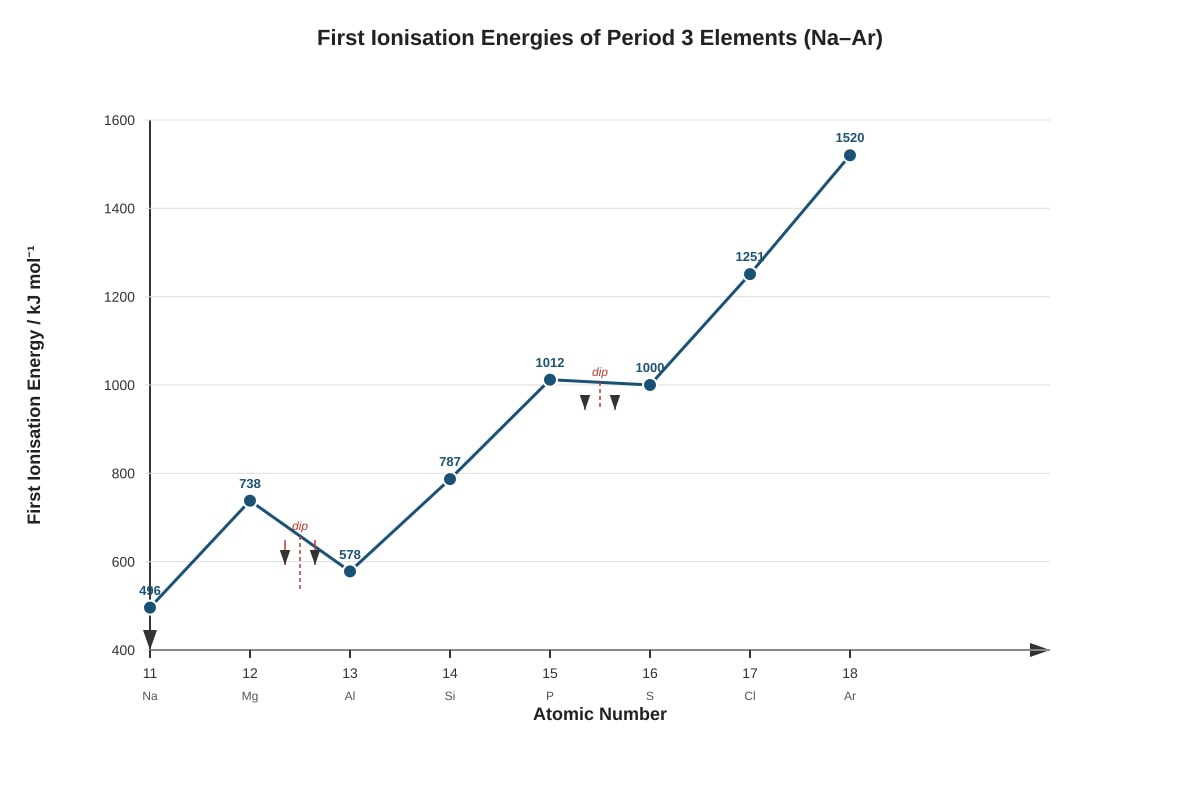
- Concept: First ionisation energy generally increases across a period due to increasing nuclear charge. However, there are dips at Group 13 (Al) and Group 16 (S) due to changes in subshell stability.
- Reasoning: Na (Group 1) has the lowest IE. Mg (Group 2) has a higher IE than Al (Group 3) because Al's outer electron is in a 3p orbital which is higher in energy and more shielded than Mg's 3s orbital. Si is in Group 14 and has a higher IE than Al, but Mg's IE is still higher than Si's? Let's check: Mg = 738 kJ/mol, Si = 787 kJ/mol. Actually Si is higher. The question asks for the highest among the four. Si has the highest IE (787) among Na (496), Mg (738), Al (578), and Si (787). Wait, the answer should be D (Si). Let me re-check the data: Na=496, Mg=738, Al=578, Si=787. Yes, Si is highest. Correct answer is D.
- Correction: Answer is D (Si). Common mistake: students may think Mg is highest because of the s-subshell stability, but Si is further across the period with higher nuclear charge.
Q2. Answer: A (The number of protons increases, increasing the nuclear charge)
- Concept: Atomic radius decreases across a period because the increasing nuclear charge pulls the outer electrons closer to the nucleus.
- Reasoning: Across Period 3, electrons are added to the same outer shell (n=3). The shielding effect from inner electrons remains roughly constant. The increasing number of protons exerts a stronger electrostatic attraction on the outer electrons, contracting the atomic radius.
- Common mistake: Option C is wrong because shielding does not increase significantly across a period; it remains relatively constant.
Q3. Answer: D (SO₃)
- Concept: Across Period 3, oxide acidity increases from basic (Na₂O, MgO) to amphoteric (Al₂O₃) to acidic (SiO₂, P₄O₁₀, SO₃, Cl₂O₇).
- Reasoning: SO₃ is the oxide of sulfur, a non-metal. Non-metal oxides are typically acidic. SO₃ dissolves in water to form sulfuric acid (H₂SO₄), a strong acid. Na₂O and MgO are basic oxides; Al₂O₃ is amphoteric.
Q4. Answer: C (75%)
- Concept: Relative atomic mass is the weighted average of isotopic masses.
- Reasoning: Let x = fraction of ³⁵Cl. Then (1-x) = fraction of ³⁷Cl. Average = 35x + 37(1-x) = 35.5 35x + 37 - 37x = 35.5 -2x = -1.5 x = 0.75 = 75%
- Common mistake: Students may incorrectly set up the equation or forget to convert the fraction to a percentage.
Q5. Answer: A (Metallic character increases down the group)
- Concept: Metallic character refers to the tendency of an element to lose electrons and form positive ions.
- Reasoning: Down Group 2, atomic radius increases, shielding increases, and ionisation energy decreases. This makes it easier for atoms to lose their outer electrons, increasing metallic character. For example, Be is relatively hard and less reactive, while Ba is very soft and highly reactive.
Q6. Answer: B (2Na + 2H₂O → 2NaOH + H₂)
- Concept: Sodium reacts vigorously with water to produce sodium hydroxide and hydrogen gas.
- Reasoning: The balanced equation requires 2 moles of Na and 2 moles of H₂O to produce 2 moles of NaOH and 1 mole of H₂. Option A is not balanced. Option C produces Na₂O (sodium oxide) which is incorrect for the reaction with water. Option D has incorrect formula for sodium hydroxide.
Q7. Answer: C (giant covalent structure)
- Concept: Silicon is a metalloid with a diamond-like structure.
- Reasoning: Silicon has 4 valence electrons and forms 4 strong covalent bonds with neighbouring Si atoms in a tetrahedral arrangement. This giant covalent network requires a large amount of energy to break, resulting in a very high melting point (1683 K).
Q8. Answer: D (SiCl₄)
- Concept: The chlorides of Period 3 elements change from ionic to covalent across the period.
- Reasoning: NaCl and MgCl₂ are ionic solids with high melting points. AlCl₃ is covalent but sublimes at a relatively high temperature. SiCl₄ is a simple molecular compound with weak van der Waals forces between molecules, giving it a low melting point (203 K, liquid at room temperature).
Q9. Answer: D (Group 15)
- Concept: The group number for p-block elements is equal to the number of electrons in the outermost s and p subshells (for Groups 13-18).
- Reasoning: The electron configuration ends with 3s²3p³. The outermost shell (n=3) has 2 + 3 = 5 electrons. This places the element in Group 15. The element is phosphorus (P).
Q10. Answer: A (Electronegativity increases from Na to Cl)
- Concept: Electronegativity is the ability of an atom to attract bonding electrons.
- Reasoning: Across Period 3, nuclear charge increases while atomic radius decreases. This increases the attraction for bonding electrons, so electronegativity increases from Na (0.9) to Cl (3.0). Ar is a noble gas and does not typically form bonds, so its electronegativity is not defined.
Section B: Short-Answer Questions (20 marks)
Q11. Explain why the first ionisation energy of magnesium is higher than that of sodium. [2]
Answer:
- Sodium has an electron configuration of [Ne]3s¹, while magnesium has [Ne]3s². [1]
- Magnesium has a higher nuclear charge (12 protons vs 11 protons) and the same shielding. The increased nuclear charge exerts a stronger electrostatic attraction on the outer 3s electrons, requiring more energy to remove one electron. [1]
Marking notes:
- Award 1 mark for identifying the increased nuclear charge.
- Award 1 mark for linking this to stronger attraction and higher energy required.
- Accept reference to "same shielding" or "similar shielding."
Common mistake: Students may incorrectly state that Mg has a full 3s subshell, which is stable. While true, the primary reason is the higher nuclear charge.
Q12. State and explain the trend in atomic radius down Group 2 from Be to Ba. [2]
Answer:
- The atomic radius increases down Group 2. [1]
- This is because each successive element has an additional electron shell (principal quantum number increases). The outer electrons are further from the nucleus, and the increased shielding from inner electrons outweighs the increase in nuclear charge. [1]
Marking notes:
- Award 1 mark for stating the correct trend (increases).
- Award 1 mark for explaining the addition of electron shells and increased shielding.
Q13. Write the equation for the reaction of magnesium with steam. State one observation for this reaction. [2]
Answer:
- Equation: Mg(s) + H₂O(g) → MgO(s) + H₂(g) [1]
- Observation: A bright white flame is produced / a white solid (MgO) is formed. [1]
Marking notes:
- Accept Mg(s) + H₂O(g) → Mg(OH)₂(s) + H₂(g) as an alternative, though MgO is more common at high temperatures.
- For the observation, accept "glowing white light" or "white powder formed."
- Do not accept "bubbles" as this is a reaction with steam, not liquid water.
Q14. Explain why the melting point of silicon is much higher than that of sulfur. [2]
Answer:
- Silicon has a giant covalent structure with strong covalent bonds between atoms throughout the lattice. A large amount of energy is required to overcome these bonds. [1]
- Sulfur exists as S₈ molecules held together by weak van der Waals forces between molecules. Much less energy is required to overcome these intermolecular forces. [1]
Marking notes:
- Award 1 mark for describing silicon's giant covalent structure and strong bonds.
- Award 1 mark for describing sulfur's simple molecular structure and weak intermolecular forces.
Common mistake: Students may say "sulfur has weak covalent bonds" — covalent bonds within S₈ molecules are strong; it is the intermolecular forces that are weak.
Q15. Aluminium oxide is amphoteric. Write balanced equations for its reactions with: (a) dilute hydrochloric acid, HCl(aq) [1] (b) aqueous sodium hydroxide, NaOH(aq) [1]
Answer: (a) Al₂O₃(s) + 6HCl(aq) → 2AlCl₃(aq) + 3H₂O(l) [1] (b) Al₂O₃(s) + 2NaOH(aq) + 3H₂O(l) → 2NaAl(OH)₄(aq) [1] (or Al₂O₃(s) + 2OH⁻(aq) + 3H₂O(l) → 2[Al(OH)₄]⁻(aq))
Marking notes:
- For (a), accept ionic equation: Al₂O₃(s) + 6H⁺(aq) → 2Al³⁺(aq) + 3H₂O(l).
- For (b), the product is sodium tetrahydroxoaluminate(III). Accept NaAlO₂ (sodium aluminate) if written with water: Al₂O₃(s) + 2NaOH(aq) → 2NaAlO₂(aq) + H₂O(l) — this is also commonly accepted.
- State symbols are required for full marks.
Q16. The following table shows the successive ionisation energies of an element X.
| Ionisation | 1st | 2nd | 3rd | 4th | 5th | 6th |
|---|---|---|---|---|---|---|
| IE / kJ mol⁻¹ | 738 | 1451 | 7733 | 10540 | 13630 | 17995 |
(a) Identify element X. Explain your reasoning. [2]
Answer:
- Element X is magnesium (Mg). [1]
- There is a large jump in ionisation energy between the 2nd and 3rd ionisation energies (from 1451 to 7733 kJ mol⁻¹). This indicates that the first two electrons are relatively easy to remove (from the outer 3s subshell), but the third electron is much harder to remove because it comes from an inner shell (2p) that is closer to the nucleus and experiences less shielding. This pattern is characteristic of a Group 2 element. [1]
Marking notes:
- Award 1 mark for identifying Mg.
- Award 1 mark for identifying the large jump between IE₂ and IE₃ and linking it to the removal of an inner electron.
Common mistake: Students may identify Be instead of Mg. The values (738, 1451) match Mg (Be has 1st IE = 899 kJ/mol). The absolute values matter.
(b) Write the full electronic configuration of the ion X²⁺. [1]
Answer:
- 1s²2s²2p⁶ [1]
Marking notes:
- Mg²⁺ has the same electron configuration as Ne (10 electrons).
- Accept [Ne] as shorthand.
Q17. Explain why the boiling point of chlorine, Cl₂, is higher than that of argon, Ar. [2]
Answer:
- Both Cl₂ and Ar are simple molecular substances held together by van der Waals forces. [1]
- Cl₂ has more electrons (34 electrons per molecule) than Ar (18 electrons per atom). The larger electron cloud in Cl₂ results in stronger temporary induced dipoles and hence stronger van der Waals forces, requiring more energy to overcome. [1]
Marking notes:
- Award 1 mark for identifying van der Waals forces as the intermolecular force.
- Award 1 mark for linking the larger number of electrons in Cl₂ to stronger van der Waals forces.
Common mistake: Students may incorrectly state that Cl₂ has hydrogen bonding or permanent dipole-dipole forces. Cl₂ is non-polar.
Q18. (a) Explain the general increase in first ionisation energy from Na to Ar. [1]
Answer:
- Across Period 3, the nuclear charge increases while electrons are added to the same outer shell (n=3). The shielding remains roughly constant, so the increasing nuclear charge attracts the outer electrons more strongly, requiring more energy to remove an electron. [1]
Marking notes:
- Accept reference to "increasing nuclear charge" and "same shell/similar shielding."
(b) Explain why the first ionisation energy of Al is lower than that of Mg. [2]
Answer:
- Mg has the electron configuration [Ne]3s². The 3s subshell is full, which gives it extra stability. [1]
- Al has the electron configuration [Ne]3s²3p¹. The outer electron is in a 3p orbital, which is higher in energy than the 3s orbital. The 3p electron is also slightly more shielded from the nucleus by the 3s electrons. Therefore, less energy is required to remove this 3p electron. [1]
Marking notes:
- Award 1 mark for identifying the full 3s subshell in Mg.
- Award 1 mark for identifying the 3p electron in Al being higher in energy and/or more shielded.
Common mistake: Students may only say "Al has a 3p electron" without explaining why this makes it easier to remove.
Section C: Structured and Data-Based Questions (20 marks)
Q19. The oxides of Period 3 elements show a trend in acidity from basic to amphoteric to acidic.
(a) Classify the following oxides as basic, amphoteric, or acidic: (i) Na₂O [1] (ii) Al₂O₃ [1] (iii) P₄O₁₀ [1]
Answer: (i) Na₂O — Basic [1] (ii) Al₂O₃ — Amphoteric [1] (iii) P₄O₁₀ — Acidic [1]
Marking notes:
- One mark each. No partial credit.
(b) Write a balanced equation for the reaction of sodium oxide with water. [1]
Answer:
- Na₂O(s) + H₂O(l) → 2NaOH(aq) [1]
Marking notes:
- Accept ionic equation: Na₂O(s) + H₂O(l) → 2Na⁺(aq) + 2OH⁻(aq).
- State symbols required.
(c) Write a balanced equation for the reaction of phosphorus(V) oxide, P₄O₁₀, with excess water. [1]
Answer:
- P₄O₁₀(s) + 6H₂O(l) → 4H₃PO₄(aq) [1]
Marking notes:
- Accept phosphoric(V) acid as the product.
- If limited water is used, the product is HPO₃ (metaphosphoric acid). The question specifies "excess water," so H₃PO₄ is correct.
(d) Explain why the oxide of sulfur, SO₃, is more acidic than the oxide of phosphorus, P₄O₁₀. [2]
Answer:
- Acidity of an oxide is related to the electronegativity and oxidation state of the central element. [1]
- Sulfur is more electronegative than phosphorus. In SO₃, sulfur has an oxidation state of +6, while in P₄O₁₀, phosphorus has an oxidation state of +5. The higher oxidation state and higher electronegativity of sulfur mean that the O–H bond in the resulting acid (H₂SO₄) is more polarised, making it easier to release H⁺ ions, resulting in a stronger acid. [1]
Marking notes:
- Award 1 mark for referencing electronegativity or oxidation state.
- Award 1 mark for linking to O-H bond polarisation and ease of H⁺ release.
Common mistake: Students may simply say "S is more electronegative than P" without explaining how this relates to acidity.
Q20. The chlorides of Period 3 elements show a trend in structure and bonding.
(a) Complete the following table by stating the type of structure (ionic, simple molecular, or giant covalent) and the type of bonding for each chloride. [4]
Answer:
| Chloride | NaCl | MgCl₂ | AlCl₃ | SiCl₄ |
|---|---|---|---|---|
| Structure type | Ionic | Ionic | Simple molecular (layer) | Simple molecular |
| Bonding type | Ionic | Ionic | Covalent | Covalent |
Marking notes:
- Award 1 mark per correct row (structure and bonding must both be correct for each chloride to earn the mark).
- For AlCl₃, accept "covalent" for bonding type. For structure, accept "simple molecular" or "layer structure."
- Total: 4 marks.
(b) Explain why the melting point of NaCl is much higher than that of SiCl₄. [3]
Answer:
- NaCl has an ionic lattice structure held together by strong electrostatic forces of attraction between Na⁺ and Cl⁻ ions. A large amount of energy is required to overcome these ionic bonds to melt the solid. [1]
- SiCl₄ has a simple molecular structure. The molecules are held together by weak van der Waals forces between SiCl₄ molecules. [1]
- Much less energy is required to overcome these weak intermolecular forces compared to breaking ionic bonds, resulting in a much lower melting point for SiCl₄. [1]
Marking notes:
- Award 1 mark for describing NaCl's ionic lattice and strong ionic bonds.
- Award 1 mark for describing SiCl₄'s simple molecular structure and weak van der Waals forces.
- Award 1 mark for a comparative statement linking the energy required to the difference in melting points.
Common mistake: Students may say "SiCl₄ has weak covalent bonds" — the covalent bonds within SiCl₄ molecules are strong; it is the intermolecular forces that are weak.
(c) Write an equation for the reaction of AlCl₃ with water. State one observation for this reaction. [2]
Answer:
- Equation: AlCl₃(s) + 3H₂O(l) → Al(OH)₃(s) + 3HCl(g) [1] (or AlCl₃(s) + 3H₂O(l) → Al₂O₃(s) + 6HCl(g) — if heated)
- Observation: A white precipitate (of Al(OH)₃) is formed and/or steamy fumes (of HCl) are produced. [1]
Marking notes:
- Accept AlCl₃(aq) + 3H₂O(l) → Al(OH)₃(s) + 3HCl(aq) if dissolved in water.
- For the observation, accept "white solid forms" or "misty/steamy fumes."
(d) Suggest why AlCl₃ exists as a dimer, Al₂Cl₆, in the gas phase. [2]
Answer:
- Aluminium in AlCl₃ is electron-deficient (it has only 6 electrons in its valence shell, not a full octet). [1]
- To achieve a full octet, two AlCl₃ molecules join together through dative (coordinate) bonding. Each Al atom accepts a lone pair from a Cl atom on the other AlCl₃ molecule, forming two Al–Cl–Al bridges. This gives each Al atom a share in 8 electrons. [1]
Marking notes:
- Award 1 mark for identifying Al as electron-deficient.
- Award 1 mark for describing the formation of dative bonds via chlorine bridges.
Common mistake: Students may incorrectly describe the dimerisation as involving Al–Al bonds. The bridging is through chlorine atoms.
End of Answer Key