From Real Exams Quiz
A Level H2 Chemistry Periodic Table Quiz
Free A Level H2 Chemistry Periodic Table quiz, Exam version, with questions, answers, and A Level-style practice for Singapore students.
These static practice materials are generated from the site's syllabus and paper-generation workflow, with source and model context shown so students and parents can evaluate the material before use.
Questions
Free quiz and exam paper access
Enter your details to view this paper
Your access is remembered on this device.
Answers
A-Level Chemistry H2 Quiz - Periodic Table: Answer Key
Total Marks: 50
Section A: Multiple Choice Questions (Questions 1–5)
2 marks each
Question 1
Answer: B) Magnesium
Explanation: First ionisation energy generally increases across a period due to increasing nuclear charge and decreasing atomic radius. Across Period 3 (Na → Ar), the trend is generally upward. However, there is a drop at Al (due to the 3p electron being higher in energy than the 3s) and a drop at S (due to electron-electron repulsion in the paired 3p orbital).
Comparing Na, Mg, Al, and Si:
- Na: 496 kJ/mol
- Mg: 738 kJ/mol
- Al: 578 kJ/mol
- Si: 786 kJ/mol
Magnesium has a higher first ionisation energy than aluminium because the 3s electron in Mg is closer to the nucleus and more strongly attracted than the 3p electron in Al. Silicon has the highest of the four, but among the options given, Mg > Al and Mg > Na. Wait — Si (786) > Mg (738). However, the question asks for the highest among Na, Mg, Al, and Si. Silicon (786 kJ/mol) is actually higher than magnesium (738 kJ/mol).
Corrected Answer: D) Silicon
Explanation: First ionisation energy generally increases across a period due to increasing nuclear charge and decreasing atomic radius. Across Period 3 (Na → Ar), the trend is generally upward, with drops at Al and S. Silicon has a higher first ionisation energy than magnesium because:
- Silicon has a greater nuclear charge (14+ vs 12+)
- Silicon has a smaller atomic radius
- The 3p electron in Si is closer to the nucleus than the 3s electron in Mg
Marking:
- 2 marks for correct answer
- 0 marks for incorrect answer
Question 2
Answer: C) Al₂O₃
Explanation: Across Period 3, the oxides change from basic to acidic:
- Na₂O: strongly basic (ionic oxide)
- MgO: basic (ionic oxide)
- Al₂O₃: amphoteric (can react with both acids and bases)
- SiO₂: weakly acidic (giant covalent)
- P₄O₁₀, SO₃, Cl₂O₇: acidic (covalent oxides)
Al₂O₃ is amphoteric because it reacts with both acids and bases:
- With acid: Al₂O₃ + 6HCl → 2AlCl₃ + 3H₂O
- With base: Al₂O₃ + 2NaOH + 3H₂O → 2NaAl(OH)₄
Marking:
- 2 marks for correct answer
- 0 marks for incorrect answer
Question 3
Answer: A) The first ionisation energy decreases down the group because the atomic radius increases.
Explanation: Down Group 2 (Be → Ba):
- Atomic radius increases (more electron shells)
- Shielding increases
- First ionisation energy decreases (outer electron is further from nucleus and more shielded)
- Reactivity with water increases down the group (not decreases)
- Oxides become more basic down the group (not more acidic)
- Melting point generally decreases down the group (not increases)
Marking:
- 2 marks for correct answer
- 0 marks for incorrect answer
Question 4
Answer: A) NaCl and NaClO
Explanation: Chlorine undergoes disproportionation with cold, dilute NaOH: Cl₂ + 2NaOH → NaCl + NaClO + H₂O
Chlorine is simultaneously oxidised (0 → +1 in NaClO) and reduced (0 → −1 in NaCl).
With hot, concentrated NaOH, the reaction is: 3Cl₂ + 6NaOH → 5NaCl + NaClO₃ + 3H₂O
Marking:
- 2 marks for correct answer
- 0 marks for incorrect answer
Question 5
Answer: B) MgCO₃ < CaCO₃ < SrCO₃ < BaCO₃
Explanation: Thermal stability of Group 2 carbonates increases down the group. This is because the cation becomes larger down the group, and the charge density decreases. A smaller cation with high charge density (Mg²⁺) polarises the carbonate ion more strongly, weakening the C–O bonds and making it easier to decompose.
The polarising power of the cation decreases down the group (larger ionic radius, same charge), so the carbonate ion is less distorted and more thermally stable.
Marking:
- 2 marks for correct answer
- 0 marks for incorrect answer
Section B: Short Answer Questions (Questions 6–10)
3 marks each
Question 6
Answer: The atomic radius decreases across Period 3 from sodium to argon.
Explanation: As we move from Na to Ar:
- The nuclear charge increases (11+ to 18+)
- Electrons are added to the same principal quantum shell (n = 3)
- Shielding by inner electrons remains approximately constant (all have the same inner shells: 1s², 2s², 2p⁶)
- The increased nuclear charge pulls the outer electrons closer to the nucleus
- Therefore, the atomic radius decreases
Marking:
- 1 mark: State that atomic radius decreases
- 1 mark: Increasing nuclear charge
- 1 mark: Same shell / constant shielding, so outer electrons are pulled closer
Common mistake: Students may say "more protons" without explaining why this causes a smaller radius. Always link to the effect on the outer electrons.
Question 7
Answer: The first ionisation energy of magnesium is higher than that of aluminium because:
- In Mg, the electron removed is a 3s electron; in Al, the electron removed is a 3p electron
- The 3p orbital is higher in energy than the 3s orbital
- The 3p electron in Al is further from the nucleus and experiences more shielding from the 3s electrons
- Therefore, the 3p electron in Al is more easily removed despite the higher nuclear charge
Explanation: This is an exception to the general trend of increasing first ionisation energy across a period. The drop at Al occurs because the new electron enters a higher-energy 3p subshell, which is further from the nucleus and less penetrating than the 3s orbital.
Marking:
- 1 mark: Identify that the electron removed is from a different subshell (3s vs 3p)
- 1 mark: 3p orbital is higher in energy / further from nucleus
- 1 mark: Less energy required to remove the 3p electron
Common mistake: Students may incorrectly state that Al has a lower nuclear charge. The nuclear charge actually increases from Mg to Al; the drop is due to the orbital energy difference.
Question 8
Answer: Equation: 3Cl₂ + 6NaOH → 5NaCl + NaClO₃ + 3H₂O
Oxidation states of chlorine:
- In NaCl: −1
- In NaClO₃: +5
Explanation: Chlorine undergoes disproportionation in hot concentrated NaOH. Chlorine (oxidation state 0) is simultaneously:
- Reduced to −1 in NaCl
- Oxidised to +5 in NaClO₃
This is a disproportionation reaction because the same element is both oxidised and reduced.
Marking:
- 1 mark: Correct balanced equation
- 1 mark: Oxidation state of Cl in NaCl (−1)
- 1 mark: Oxidation state of Cl in NaClO₃ (+5)
Common mistake: Students may write the cold dilute NaOH equation instead. Remember: cold dilute gives NaCl + NaClO; hot concentrated gives NaCl + NaClO₃.
Question 9
Answer: The thermal stability of Group 2 nitrates increases down the group because:
- The cation size increases down the group (Mg²⁺ < Ca²⁺ < Sr²⁺ < Ba²⁺)
- The charge density of the cation decreases down the group
- A smaller cation with higher charge density (e.g., Mg²⁺) has greater polarising power
- The cation distorts the nitrate ion, weakening the N–O bonds
- Down the group, the polarising power decreases, so the nitrate ion is less distorted and requires more heat to decompose
Explanation: The decomposition of Group 2 nitrates produces the metal oxide, nitrogen dioxide, and oxygen: 2M(NO₃)₂ → 2MO + 4NO₂ + O₂
The cation's polarising power is the key factor. Smaller cations with higher charge density polarise the nitrate ion more, making it less stable.
Marking:
- 1 mark: Cation size increases / charge density decreases down the group
- 1 mark: Smaller cation has greater polarising power
- 1 mark: Less distortion of nitrate ion down the group → more stable
Common mistake: Students may confuse this with the trend for carbonates. The same principle applies (polarising power), but the equations and products are different.
Question 10
Answer: Electronegativity increases across Period 3 from sodium to chlorine.
Explanation:
- Electronegativity is the ability of an atom to attract bonding electrons in a covalent bond
- Across Period 3, the nuclear charge increases (11+ to 17+)
- The atomic radius decreases
- The shielding remains approximately constant (same inner shells)
- Therefore, the attraction for bonding electrons increases
- Argon is not considered because it does not form bonds (it has a complete octet)
Marking:
- 1 mark: State that electronegativity increases across the period
- 1 mark: Increasing nuclear charge / decreasing atomic radius
- 1 mark: Stronger attraction for bonding electrons
Common mistake: Students may include argon in the trend. Argon is a noble gas and does not form bonds, so it is excluded from electronegativity trends.
Section C: Structured Questions (Questions 11–15)
4 marks each
Question 11
(a) Answer:
- NaCl: Giant ionic lattice structure with ionic bonding
- SiCl₄: Simple molecular structure with covalent bonding
Explanation: NaCl is an ionic compound formed between a metal (Na) and a non-metal (Cl). It forms a giant ionic lattice with strong electrostatic forces between oppositely charged ions.
SiCl₄ is a covalent compound. Silicon shares electrons with four chlorine atoms to form a simple molecular structure. The molecules are held together by weak van der Waals forces.
Marking:
- 1 mark: NaCl — giant ionic lattice / ionic bonding
- 1 mark: SiCl₄ — simple molecular / covalent bonding
(b) Answer: AlCl₃ is covalent while MgCl₂ is ionic. The covalent bonds in AlCl₃ form a simple molecular structure (or layer structure) with weak van der Waals forces between molecules. MgCl₂ has strong electrostatic forces between ions in a giant ionic lattice, which require more energy to overcome.
Explanation: Aluminium has a higher charge density than magnesium, which polarises the chloride ions to such an extent that the bonding becomes predominantly covalent. AlCl₃ exists as a dimer (Al₂Cl₆) with a simple molecular structure. The weak intermolecular forces require less energy to overcome than the strong ionic bonds in MgCl₂.
Marking:
- 1 mark: AlCl₃ is covalent / simple molecular; MgCl₂ is ionic / giant lattice
- 1 mark: Weaker intermolecular forces in AlCl₃ vs strong ionic bonds in MgCl₂
Common mistake: Students may say AlCl₃ has a lower melting point because the Al–Cl bond is weaker. The melting point depends on the forces BETWEEN particles, not within the molecule.
Question 12
(a) Answer: Na₂O + H₂O → 2NaOH
Explanation: Sodium oxide is a basic oxide. It reacts with water to form sodium hydroxide, an alkali.
Marking:
- 1 mark: Correct balanced equation
(b) Answer: P₄O₁₀ + 6H₂O → 4H₃PO₄
Explanation: Phosphorus(V) oxide is an acidic oxide. It reacts with water to form phosphoric acid.
Marking:
- 1 mark: Correct balanced equation
(c) Answer: Al₂O₃ is amphoteric because it reacts with both acids and bases:
With acid: Al₂O₃ + 6HCl → 2AlCl₃ + 3H₂O With base: Al₂O₃ + 2NaOH + 3H₂O → 2NaAl(OH)₄
Explanation: Amphoteric substances can act as both acids and bases. Al₂O₃ has both acidic and basic character because aluminium is a metal with relatively high charge density, giving it some covalent character in its oxide. It can react with acids (acting as a base) and with strong bases (acting as an acid).
Marking:
- 1 mark: Correct equation with acid
- 1 mark: Correct equation with base
Common mistake: Students may write Al₂O₃ + 2NaOH → 2NaAlO₂ + H₂O. This is acceptable in some contexts, but the aqueous reaction forming NaAl(OH)₄ is more accurate for A-Level.
Question 13
(a) Answer: Cl₂ + H₂O ⇌ HCl + HClO
Explanation: Chlorine undergoes disproportionation with water. It is simultaneously reduced to −1 (in HCl) and oxidised to +1 (in HClO).
Marking:
- 1 mark: Correct balanced equation with reversible arrow
(b) Answer: The chlorine water becomes colourless and bubbles of oxygen gas are released.
Explanation: In sunlight, the HClO decomposes: 2HClO → 2HCl + O₂
The equilibrium shifts to the right, and eventually all the chlorine is converted to HCl and O₂. The pale green-yellow colour of chlorine disappears.
Marking:
- 1 mark: Colourless / oxygen gas released
(c) Answer: In sunlight, HClO decomposes: 2HClO → 2HCl + O₂. This removes HClO from the equilibrium, causing the equilibrium to shift to the right. More HCl is produced, which is a strong acid, so the pH decreases.
Explanation: The decomposition of HClO produces HCl, a strong acid that fully dissociates in water. As the equilibrium shifts to produce more HCl, the concentration of H⁺ ions increases, and the pH decreases.
Marking:
- 1 mark: HClO decomposes in sunlight
- 1 mark: More HCl produced / H⁺ concentration increases → pH decreases
Common mistake: Students may say "chlorine is acidic" without explaining the mechanism. The key is the decomposition of HClO and the production of HCl.
Question 14
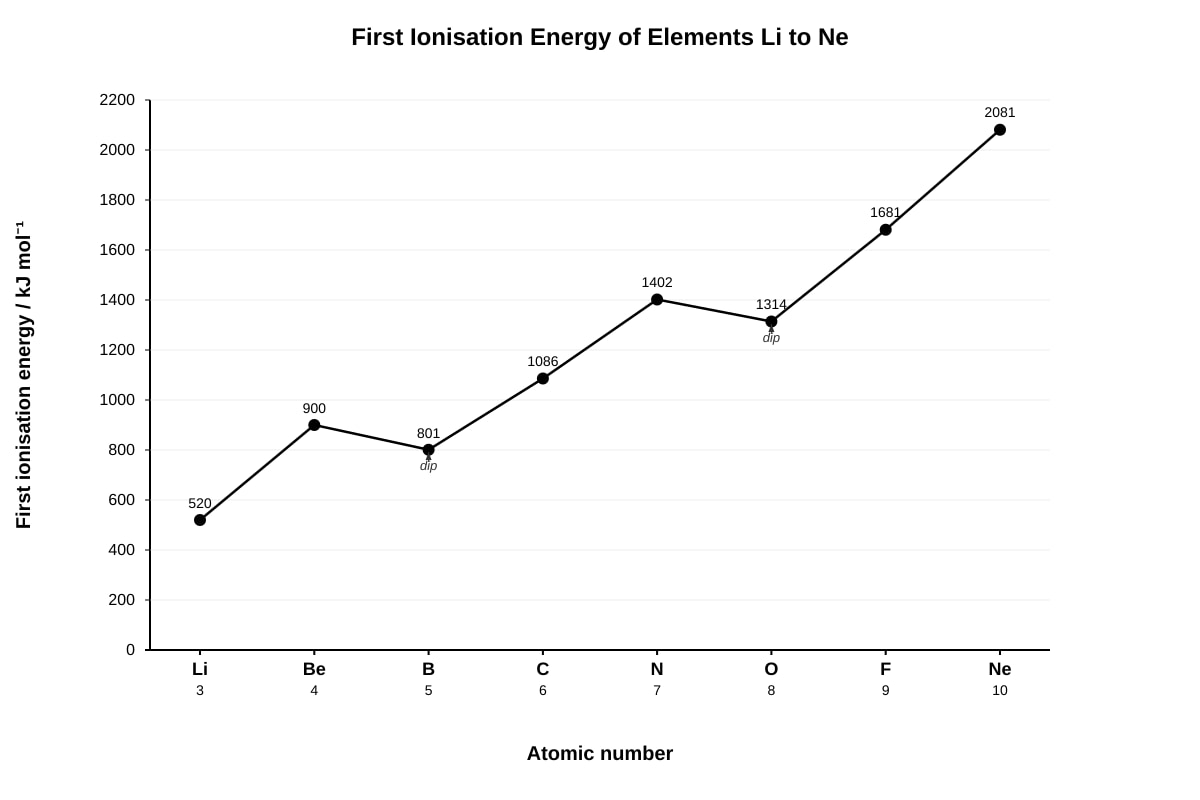
(a) Answer: The first ionisation energy generally increases across Period 2 from lithium to neon.
Explanation: This is the general trend due to increasing nuclear charge and decreasing atomic radius.
Marking:
- 1 mark: General increase across the period
(b) Answer: The drop between beryllium and boron occurs because:
- In Be, the electron removed is a 2s electron
- In B, the electron removed is a 2p electron
- The 2p orbital is higher in energy than the 2s orbital
- The 2p electron in B is further from the nucleus and more shielded by the 2s electrons
- Therefore, less energy is required to remove the 2p electron from B
Explanation: This is the same pattern seen between Mg and Al in Period 3. The new electron enters a higher-energy subshell, making it easier to remove.
Marking:
- 1 mark: Electron removed from 2p (higher energy) vs 2s in Be
- 1 mark: 2p electron is further from nucleus / more shielded / higher energy
(c) Answer: The drop between nitrogen and oxygen occurs because:
- In N, the electron removed is from a singly-occupied 2p orbital
- In O, the electron removed is from a doubly-occupied 2p orbital
- The paired electrons in O experience electron-electron repulsion
- This repulsion makes it easier to remove one of the paired electrons
Explanation: Hund's rule states that electrons fill orbitals singly before pairing. In N, all three 2p orbitals are singly occupied. In O, one 2p orbital contains a pair of electrons. The repulsion between these paired electrons reduces the energy required to remove one.
Marking:
- 1 mark: Paired electrons in O experience repulsion / electron-electron repulsion
Common mistake: Students may confuse this with the Be–B drop. The Be–B drop is due to subshell change (2s → 2p); the N–O drop is due to electron pairing.
Question 15
(a) Answer: SiCl₄ + 4H₂O → Si(OH)₄ + 4HCl
(or SiCl₄ + 2H₂O → SiO₂ + 4HCl)
Explanation: Silicon tetrachloride undergoes hydrolysis. Silicon has vacant 3d orbitals and can accept lone pairs from water molecules, allowing the reaction to proceed.
Marking:
- 1 mark: Correct balanced equation (either form acceptable)
(b) Answer: White fumes of HCl are observed, and a white solid (silica or silicic acid) forms.
Explanation: The HCl produced reacts with moisture in the air to form white fumes of hydrochloric acid mist. The silicon product is a white solid.
Marking:
- 1 mark: White fumes / white solid formed
(c) Answer: SiCl₄ reacts vigorously with water because silicon has vacant 3d orbitals that can accept lone pairs from water molecules, allowing the formation of an intermediate complex. Carbon does not have accessible d orbitals (it is in Period 2), so CCl₄ cannot form such an intermediate and is unreactive with water.
Explanation: The key difference is the availability of d orbitals. Silicon (Period 3) has 3d orbitals that can accept electron pairs, enabling nucleophilic attack by water. Carbon (Period 2) has no d orbitals, so the water molecule cannot attack the carbon atom.
Marking:
- 1 mark: Si has vacant 3d orbitals
- 1 mark: C has no d orbitals / cannot form intermediate
Common mistake: Students may say CCl₄ is unreactive because the C–Cl bond is too strong. While bond strength is a factor, the key A-Level explanation is the availability of d orbitals for the reaction mechanism.
Section D: Data-Based Question (Questions 16–20)
2 marks each
Question 16
Answer: Silicon has a giant covalent (macromolecular) structure with strong covalent bonds between atoms, requiring much energy to break. Phosphorus has a simple molecular structure (P₄ molecules) with weak van der Waals forces between molecules, requiring less energy to overcome.
Explanation: The melting point depends on the strength of forces between particles:
- Silicon: giant covalent lattice — millions of strong covalent bonds must be broken
- Phosphorus: P₄ molecules held together by weak van der Waals forces
Marking:
- 1 mark: Si has giant covalent structure / strong covalent bonds
- 1 mark: P has simple molecular structure / weak van der Waals forces
Common mistake: Students may say "Si has stronger bonds" without specifying the type of structure. Always link structure to the forces that must be overcome.
Question 17
Answer: Sodium, magnesium, and aluminium are metals with delocalised electrons that are free to move and carry charge. Phosphorus and sulfur are non-metals with covalent bonds; their electrons are localised in bonds and cannot move freely, so they are poor conductors.
Explanation: Metallic bonding involves a lattice of positive ions surrounded by a "sea" of delocalised electrons. These mobile electrons conduct electricity. In covalent substances like P₄ and S₈, electrons are shared between specific atoms and are not free to move.
Marking:
- 1 mark: Metals have delocalised electrons / mobile electrons
- 1 mark: Non-metals have localised electrons / no free electrons
Common mistake: Students may say "metals conduct because they have free electrons" without mentioning delocalisation. Be precise with terminology.
Question 18
Answer: The melting point increases from sodium to aluminium because:
- The charge on the metal ion increases (Na⁺ → Mg²⁺ → Al³⁺)
- The number of delocalised electrons per atom increases
- The strength of the metallic bond increases
- More energy is required to overcome the stronger metallic bonding
Explanation: As the charge on the cation increases and more electrons are delocalised, the electrostatic attraction between the cations and the electron sea becomes stronger. This requires more energy to break the metallic lattice.
Marking:
- 1 mark: Increasing ionic charge / more delocalised electrons
- 1 mark: Stronger metallic bonding / more energy required
Common mistake: Students may mention atomic radius changes. While the radius decreases slightly, the key factor is the charge and number of delocalised electrons.
Question 19
Answer: Chlorine exists as Cl₂ molecules with a simple molecular structure. The molecules are held together by weak van der Waals forces, which require very little energy to overcome. Therefore, chlorine has a very low melting point.
Explanation: Chlorine is a non-metal that forms diatomic molecules. The covalent bond within each Cl₂ molecule is strong, but the forces BETWEEN molecules are weak van der Waals forces. Only these weak intermolecular forces need to be overcome during melting.
Marking:
- 1 mark: Simple molecular structure / Cl₂ molecules
- 1 mark: Weak van der Waals forces between molecules
Common mistake: Students may say "the covalent bond is weak." The covalent bond in Cl₂ is actually strong; it is the intermolecular forces that are weak.
Question 20
Answer: Argon is a noble gas that exists as single atoms (monatomic). The atoms are held together by very weak van der Waals forces (London dispersion forces) because argon atoms are non-polar and have no permanent dipole. These weak forces require very little energy to overcome, so argon has a very low melting point and exists as a gas at room temperature.
Explanation: Argon has a complete octet and does not form bonds with other atoms. It exists as isolated atoms. The only forces between argon atoms are instantaneous induced dipole-induced dipole interactions (London forces), which are the weakest type of intermolecular force.
Marking:
- 1 mark: Monatomic / exists as single atoms
- 1 mark: Very weak van der Waals forces / no permanent dipole
Common mistake: Students may say argon has "no forces" between atoms. There are weak London forces; they are just very weak.
END OF ANSWER KEY