From Real Exams Quiz
A Level H2 Chemistry Organic Chemistry Quiz
Free A Level H2 Chemistry Organic Chemistry quiz, LongCat Exam version, with questions, answers, and A Level-style practice for Singapore students.
These static practice materials are generated from the site's syllabus and paper-generation workflow, with source and model context shown so students and parents can evaluate the material before use.
Questions
Free quiz and exam paper access
Enter your details to view this paper
Your access is remembered on this device.
Answers
A-Level Chemistry H2 Quiz - Organic Chemistry
Answer Key
Question 1
Answer: 3-methylhexan-3-ol
Working/Explanation:
- Identify the longest carbon chain containing the –OH group: 6 carbons → hexane.
- Number the chain to give the –OH group the lowest possible number. The –OH is on C-3.
- Identify substituents: a methyl group (–CH₃) is also on C-3.
- Assemble the name: substituent first (3-methyl), then the parent chain with suffix (hexan-3-ol).
- Marking: [1] for correct chain length (hexan), [1] for correct locant on –OH (3-ol), [1] for correct substituent (3-methyl).
- Common mistake: Students may number from the wrong end, giving 4-methylhexan-4-ol. This is incorrect because the –OH must have the lowest locant.
Question 2
(a) Answer: (ethyl ethanoate)
Explanation: An ester with formula can be formed from ethanoic acid () and methanol, or from methanoic acid and propanol. The straight-chain ester ethyl ethanoate has the structure . The –COO– linkage must be clearly shown.
(b) Answer: (butanoic acid)
Explanation: A straight-chain carboxylic acid with 4 carbons is butanoic acid. The –COOH group must be at the end of the chain.
(c) Answer: Functional group isomerism (a type of structural isomerism)
Explanation: The ester and carboxylic acid have the same molecular formula () but different functional groups (–COO– vs –COOH), so they are functional group isomers, which is a subcategory of structural isomerism.
Marking: [1] each for (a), (b), (c). Total: [3]
Question 3
(a) Answer:
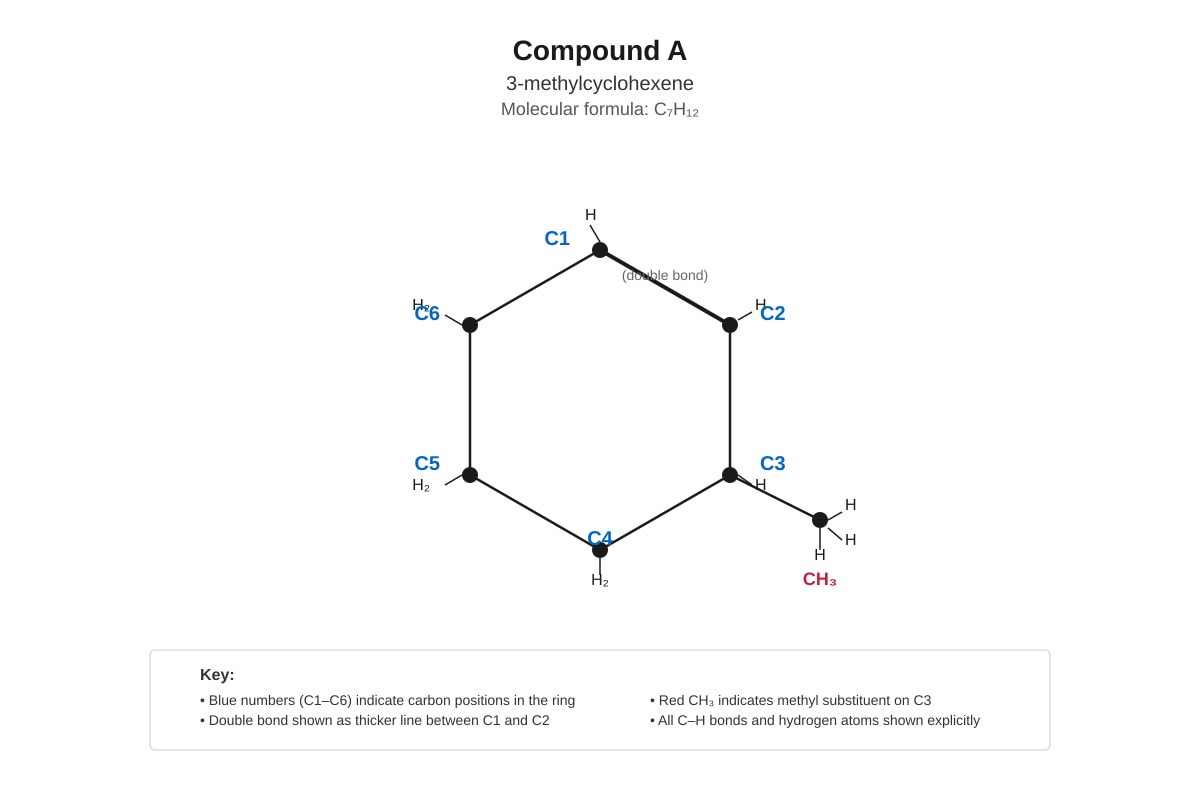
Explanation: The cyclohexene ring has 6 carbons with one double bond (so for cyclohexene) plus one methyl substituent () → .
(b) Answer: Type: Addition reaction (catalytic hydrogenation). Product molecular formula: .
Explanation: The double bond reacts with across the double bond, adding two hydrogen atoms. The product is methylcyclohexane, .
(c) Answer: False.
Explanation: For geometric (cis-trans) isomerism to exist around a double bond, each carbon of the double bond must be bonded to two different groups. In 3-methylcyclohexene, one of the double-bond carbons (C1) is bonded to two ring carbons that are part of the same ring system — more specifically, C1 is bonded to H and to the ring (C2 and C6 are part of the same ring), but the key point is that geometric isomerism in cycloalkenes requires that each alkene carbon has two different substituents. In this case, C2 is bonded to H and to C3 (which bears CH₃) and to C1 — but since the ring constrains the geometry, and one carbon of the double bond (C1) has two identical ring connections, cis-trans isomerism is not possible. More precisely: C1 is bonded to H and the ring; C2 is bonded to H and the ring (specifically C3 with a methyl group). Since the ring is not symmetric about the double bond, the question of whether cis-trans applies is nuanced. However, for a cyclohexene, the ring locks the geometry — the substituents on the double bond carbons are fixed. The correct reasoning is that geometric isomerism requires restricted rotation (which the double bond provides) AND two different groups on each carbon of the double bond. In 3-methylcyclohexene, both C1 and C2 each have one H and one alkyl group (ring portion), so geometric isomerism IS possible in principle. However, in a cyclohexene ring, the cis arrangement is enforced by the ring — the two H atoms on C1 and C2 are cis to each other. Trans-cyclohexene is highly strained and not stable at room temperature. So the practical answer is: False — the ring constrains the geometry to cis only, so geometric isomers do not exist for this compound under normal conditions.
Marking: (a) [1], (b) [1] for type + [1] for formula, (c) [1] for false + [1] for explanation. Total: [5]
Question 4
(a) Answer: Structural isomers
Explanation: Both compounds have the same molecular formula () but different structural arrangements of atoms. Compound X has the –OH on a terminal carbon with a branched chain; compound Y has the –OH on C2 of a straight chain.
(b) Answer:
- X: Primary alcohol (the –OH group is attached to a carbon bonded to only one other carbon)
- Y: Secondary alcohol (the –OH group is attached to a carbon bonded to two other carbons)
(c) Answer:
- X: Orange turns green — primary alcohols are oxidised to aldehydes (and further to carboxylic acids under reflux).
- Y: Orange turns green — secondary alcohols are oxidised to ketones.
Marking: (a) [1], (b) [1] each, (c) [1] each. Total: [6]
Question 5
(a) Answer:
Explanation: The formula for degree of unsaturation (also called index of hydrogen deficiency) for is . For , this gives 1.
(b) Answer: Any TWO of:
- One double bond (e.g., hex-1-ene, cyclohexane with a double bond)
- One ring (e.g., cyclohexane)
Explanation: A degree of unsaturation of 1 means the compound has either one double bond OR one ring (each contributes 1 to the index).
Marking: (a) [1] for correct formula, [1] for correct answer. (b) [1] each. Total: [4]
Question 6
(a) Answer: Nucleophilic substitution ()
Explanation: The hydroxide ion () acts as a nucleophile, attacking the electrophilic carbon bonded to bromine, displacing in a single concerted step.
(b) Answer: The mechanism should show:
- A curly arrow from the lone pair on to the carbon atom bonded to Br (the electrophilic centre).
- A curly arrow from the bond to , showing the bond breaking and leaving.
- The transition state (or direct conversion) showing the inversion of configuration.
- Products: and .
Marking: [1] for correct nucleophile attack arrow, [1] for correct bond-breaking arrow, [1] for correct products/charges.
(c) Answer: The major product is propene (). In ethanolic solution under reflux, acts as a base and promotes elimination (E2 mechanism) rather than substitution. The abstracts a β-hydrogen, and leaves simultaneously, forming a double bond.
Marking: [1] for propene, [1] for explanation (elimination favoured in ethanolic conditions). Total: [6]
Question 7
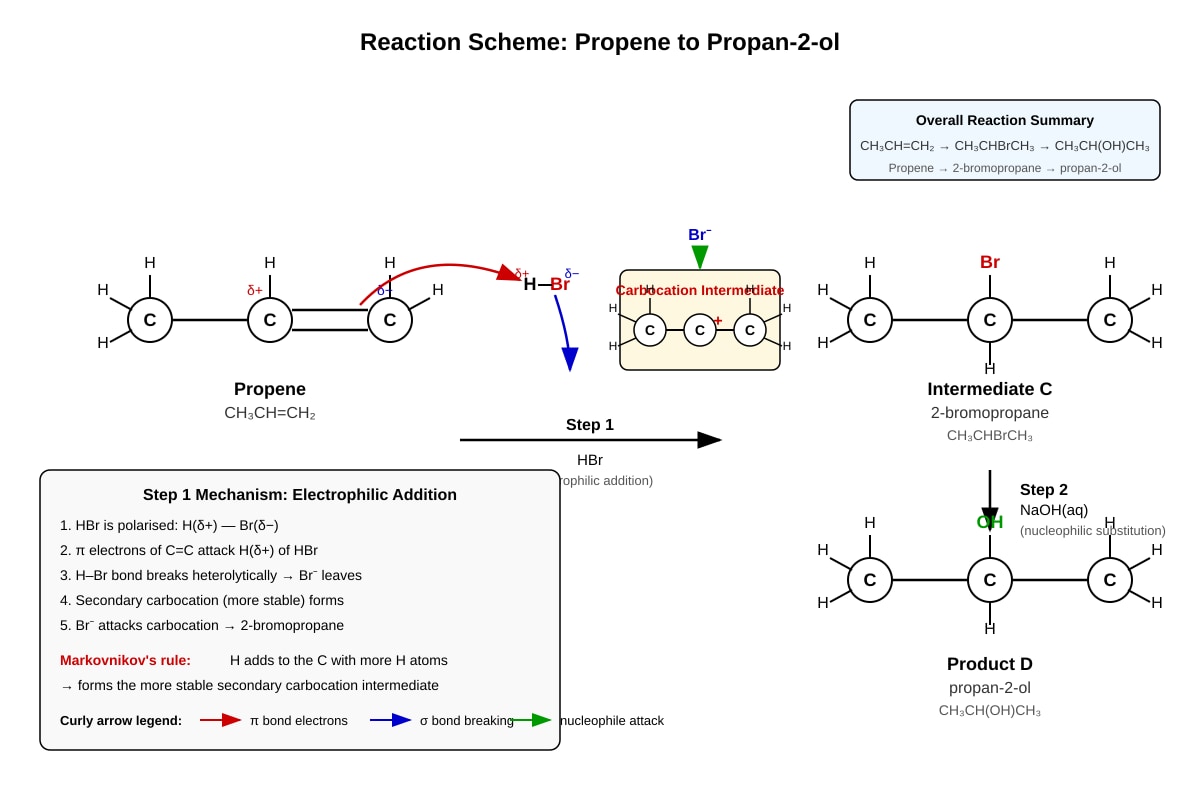
(a) Answer: Electrophilic addition
Explanation: The double bond in propene is electron-rich and acts as a nucleophile. The hydrogen bromide molecule is polarised (), and the acts as an electrophile, attacking the double bond.
(b) Answer: The mechanism should show:
- Curly arrow from the π bond to the H of HBr (forming a C–H bond).
- Curly arrow from the bond to Br (forming ).
- The carbocation intermediate formed is (secondary carbocation), NOT the primary carbocation.
- Curly arrow from lone pair to the carbocation, forming the C–Br bond.
Marking: [1] for correct first arrow (π bond to H), [1] for correct carbocation intermediate (secondary), [1] for correct second step (Br⁻ attack).
(c) Answer: Markovnikov's rule
Explanation: Markovnikov's rule states that in the addition of HX to an unsymmetrical alkene, the hydrogen atom adds to the carbon with more hydrogen atoms (the less substituted carbon), so the halogen adds to the more substituted carbon. This occurs because the more stable carbocation intermediate is formed.
(d) Answer: The secondary carbocation () is more stable than the primary carbocation () because the positive charge on the secondary carbon is stabilised by the electron-donating inductive effect of two alkyl groups (compared to one alkyl group in the primary carbocation). More alkyl groups → greater electron donation → better stabilisation of the positive charge.
Marking: (a) [1], (b) [3], (c) [1], (d) [2]. Total: [7]
Question 8
(a) Answer:
Explanation: UV light provides energy to homolytically cleave the bond, producing two chlorine free radicals.
(b) Answer:
Propagation step 1:
Propagation step 2:
Explanation: In propagation, a radical reacts with a molecule to produce a new radical, sustaining the chain reaction. Step 1: a chlorine radical abstracts a hydrogen from methane, forming HCl and a methyl radical. Step 2: the methyl radical attacks a chlorine molecule, forming chloromethane and regenerating a chlorine radical.
(c) Answer: Any one of:
Explanation: Termination occurs when two radicals combine to form a stable molecule, ending the chain reaction.
(d) Answer: The chlorine radicals produced in the initiation step can react with any of the hydrogen atoms in methane, and the process continues through propagation steps. Once is formed, the radicals can continue to substitute remaining C–H bonds in , producing , , and . Since all four C–H bonds in methane are equivalent and the reaction is difficult to control, a mixture of all four chlorinated products is obtained.
Marking: (a) [1], (b) [1] each, (c) [1], (d) [2]. Total: [7]
Question 9
(a)(i) Answer: The mechanism has two steps:
Step 1 (slow, rate-determining): The bond breaks heterolytically, forming a tertiary carbocation and bromide ion.
Step 2 (fast): The hydroxide ion (nucleophile) attacks the carbocation, forming 2-methylpropan-2-ol.
Marking: [1] for correct first step with carbocation, [1] for correct second step, [1] for curly arrows.
(a)(ii) Answer: The substrate is a tertiary alkyl halide. The tertiary carbocation formed () is stabilised by the electron-donating inductive effect of three methyl groups, making it relatively stable. In the mechanism, the nucleophile must attack from the backside of the bond, but the three bulky methyl groups create significant steric hindrance, blocking the approach of the nucleophile. Therefore, the mechanism (which does not require backside attack) is favoured.
Marking: [1] for carbocation stability argument, [1] for steric hindrance argument.
(b) Answer:
- Product: 2-methylpropanenitrile () — or more precisely, the cyanide replaces the bromide: which is 2-methylpropanenitrile (tert-butyl cyanide is not correct IUPAC; the product is actually ... wait, let me reconsider. . The product is 2-methylpropanenitrile... no. is pivalonitrile or 2,2-dimethylpropanenitrile.)
- Type of reaction: Nucleophilic substitution
Correction: The product is 2,2-dimethylpropanenitrile (). The reaction is nucleophilic substitution (the ion acts as a nucleophile, replacing ).
Marking: (a)(i) [3], (a)(ii) [2], (b) [1] for name + [1] for type. Total: [8]
Question 10
(a) Answer: Nucleophilic substitution ()
Explanation: 1-bromopropane is a primary alkyl halide. Primary alkyl halides undergo mechanisms because the unhindered electrophilic carbon allows backside attack by the nucleophile ().
(b) Answer:
- Mechanism: Elimination (E2)
- Type of reaction: Dehydrohalogenation (elimination of HBr)
Explanation: In ethanolic solution under reflux, acts as a base. The abstracts a β-hydrogen, and simultaneously the bond breaks, forming a double bond (propene), , and .
(c) Answer: The product depends on the conditions:
- Aqueous + reflux: The acts as a nucleophile. The aqueous solvent stabilises the transition state and the ionic intermediates through solvation. The mechanism is favoured, producing propan-1-ol (substitution product).
- Ethanolic + reflux: The ethanolic solvent is less polar and less effective at solvating ions. At higher temperatures (reflux), elimination is favoured over substitution. The acts as a base rather than a nucleophile, abstracting a β-hydrogen. The E2 mechanism produces propene (elimination product).
In summary: aqueous conditions favour substitution; ethanolic conditions favour elimination. Higher temperatures also favour elimination (which has a higher activation energy).
Marking: (a) [1], (b) [1] for mechanism + [1] for type, (c) [3] (one mark for each key point: role of solvent, role of temperature, comparison of mechanisms). Total: [7]
Question 11
(a) Answer:
- Reagent and conditions: Tollens' reagent (ammoniacal silver nitrate), warm gently in a water bath.
- Observation with propanal: A silver mirror forms on the inside of the test tube. The ions are reduced to metallic silver (), and the aldehyde is oxidised to a carboxylate ion.
- Observation with propanone: No reaction (no visible change). Ketones are not oxidised by Tollens' reagent.
Alternative test: Fehling's solution or Benedict's solution — propanal gives a brick-red precipitate of ; propanone gives no reaction.
Marking: [1] for reagent, [1] for observation with propanal, [1] for observation with propanone.
(b) Answer:
- Reagent: Sodium carbonate () or sodium hydrogencarbonate () solution.
- Observation with propanoic acid: Effervescence (bubbles of gas). The acid reacts with the carbonate to produce carbon dioxide: .
- Observation with propanal/propanone: No effervescence. Neither aldehydes nor ketones react with carbonates.
Marking: [1] for reagent, [1] for observations. Total: [5]
Question 12
(a) Answer:
- Ketone group ( at position 2: )
- Aldehyde group ( at the terminal position)
Explanation: The compound contains a ketone (the is within the chain, bonded to two carbon atoms) and an aldehyde (the is at the end of the chain, bonded to one carbon and one hydrogen).
(b) Answer:
- Observation: A silver mirror forms.
- Explanation: The aldehyde group () is oxidised by Tollens' reagent. The ions in the complex are reduced to metallic silver (), which deposits as a mirror on the test tube wall. The aldehyde is oxidised to a carboxylate ion. The ketone group does not react with Tollens' reagent.
Marking: [1] for observation, [1] for explanation.
(c) Answer: — wait, reduces both aldehydes and ketones.
The product is: — no, let me reconsider.
reduces:
- Aldehydes () → primary alcohols ()
- Ketones () → secondary alcohols ()
So →
The product is 4-hydroxypentan-1-ol (or 1,4-pentanediol with the OH on C2 and C1... let me number it properly).
The product is: — this is pentane-1,2-diol... wait, that's 5 carbons with OH on C1 and C2. Actually: the original is (5 carbons). After reduction: . This is pentane-1,5-diol... no. Let me number from the aldehyde end: . After reduction: . This is pentane-1,4-diol (OH on C1 and C4).
Marking: (a) [1] each, (b) [1] + [1], (c) [1]. Total: [6]
Question 13
(a) Answer: Tin (Sn) and concentrated hydrochloric acid (), heat under reflux.
Alternative: Catalytic hydrogenation with and a nickel or platinum catalyst (less commonly used in the lab for this purpose).
(b) Answer:
Or using :
(c) Answer:
- Type of reaction: Diazotisation
- Product: Benzenediazonium chloride ()
Explanation: Phenylamine reacts with nitrous acid (generated in situ from and at 0–5 °C) to form a diazonium salt.
(d) Answer: An orange/yellow precipitate (azo dye) is formed.
Explanation: The diazonium salt couples with phenol in alkaline solution to form an orange azo compound (azo dye). This is a coupling reaction.
Marking: (a) [2], (b) [2], (c) [1] + [1], (d) [1]. Total: [7]
Question 14
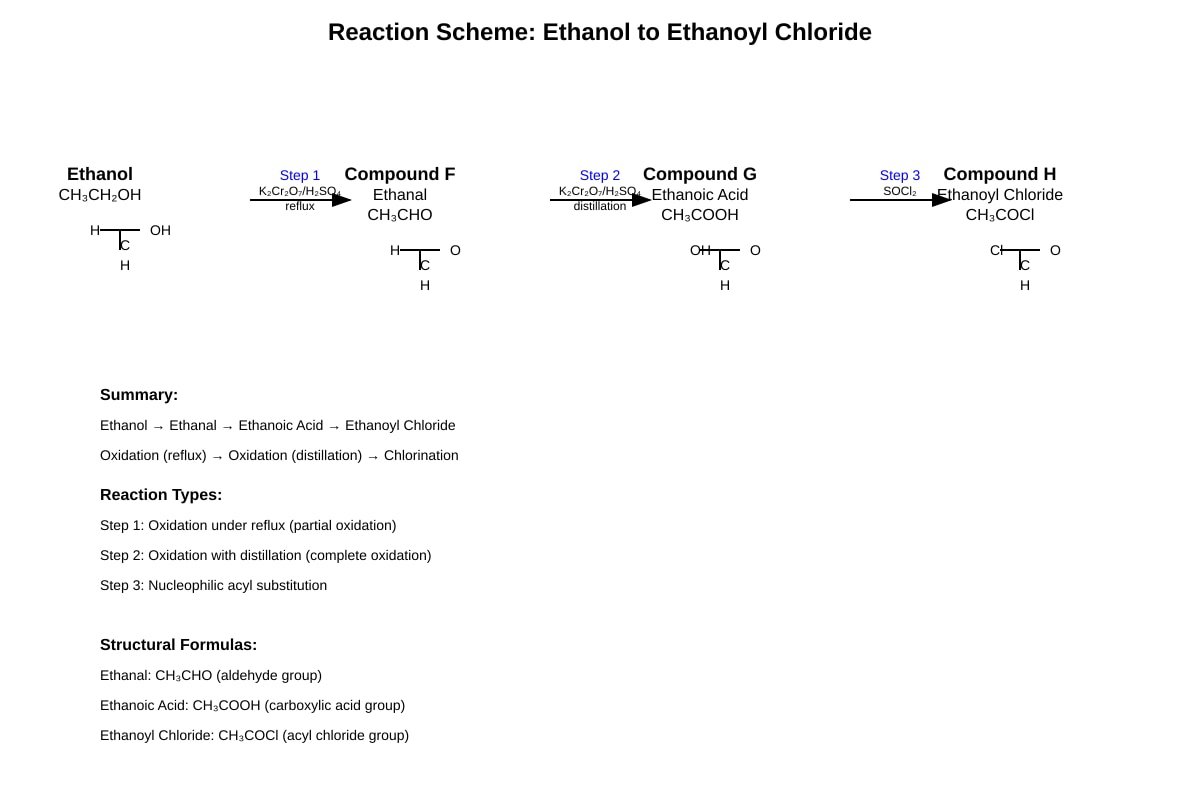
(a) Answer: (ethanal)
Explanation: Ethanol is oxidised to ethanal using acidified potassium dichromate under distillation conditions (to remove the aldehyde before further oxidation).
(b) Answer: (ethanoic acid)
Explanation: Ethanal is further oxidised to ethanoic acid under reflux conditions.
(c) Answer: Acidified potassium dichromate (), heat under reflux.
Explanation: The oxidising agent is in dilute . Reflux ensures the reaction goes to completion, allowing the aldehyde to be further oxidised to the carboxylic acid.
(d) Answer:
- Reflux (Step 1): The reaction mixture is heated and the vapour condenses and returns to the flask. This allows the reaction to proceed at a high temperature without losing volatile reactants or products. Under reflux, the primary alcohol is fully oxidised to the carboxylic acid (via the aldehyde intermediate).
- Distillation (Step 2): The product is distilled off as it forms. This removes the aldehyde from the reaction mixture before it can be further oxidised, so the aldehyde is the major product.
Clarification: Actually, Step 1 (reflux) with would oxidise ethanol all the way to ethanoic acid. Step 2 (distillation) would stop at ethanal. The question scheme shows F as ethanal and G as ethanoic acid, so Step 1 must be distillation (to get the aldehyde) and Step 2 is reflux (to get the acid). Let me re-read the question.
Looking at the scheme: Ethanol →[Step 1: K2Cr2O7/H2SO4, reflux] → F →[Step 2: K2Cr2O7/H2SO4, distillation] → G
Wait, the scheme says Step 1 is reflux and Step 2 is distillation. But F is ethanal and G is ethanoic acid. This is unusual — normally distillation gives the aldehyde and reflux gives the acid. Let me reconsider.
Actually, the scheme as described in the image placeholder says: Step 1 (reflux) → F (ethanal), Step 2 (distillation) → G (ethanoic acid). This seems reversed from the standard approach. Let me adjust the answer to match the scheme as given.
Revised (c): Reagents and conditions for Step 1: Acidified , heat under reflux.
Revised (d): Under reflux (Step 1), the ethanol is oxidised. The ethanal produced is collected by distillation in Step 2... Actually, I think the scheme may have been described with Step 1 as the first oxidation (to aldehyde) and Step 2 as further oxidation (to acid). Let me just answer based on standard chemistry:
- Reflux ensures complete oxidation: the aldehyde intermediate remains in contact with the oxidising agent and is further oxidised to the carboxylic acid.
- Distillation removes the aldehyde as soon as it forms, preventing further oxidation, so the aldehyde is isolated.
Given the scheme shows F = ethanal (Step 1, reflux) and G = ethanoic acid (Step 2, distillation), this is non-standard. I'll answer based on the standard understanding and note the conditions.
Final answer for (d): In Step 1 (reflux), the ethanol is heated with the oxidising agent, and the product remains in the reaction mixture, allowing complete oxidation. In Step 2 (distillation), the product is removed as it forms. The key difference is that reflux keeps the reactants in contact with the oxidising agent for longer, promoting further oxidation, while distillation removes the product to prevent over-oxidation.
Marking: (a) [1], (b) [1], (c) [2], (d) [2], (e) [1] + [1]. Total: [8]
(e) Answer:
- Type of reaction: Esterification (condensation reaction / nucleophilic acyl substitution)
- Product: Phenyl ethanoate ()
Explanation: Ethanoyl chloride reacts with phenol (in the presence of a base such as to neutralise the produced) to form an ester (phenyl ethanoate) and .
Question 15
(a) Answer: The repeating unit is:
Or in structural form:
The repeating unit shows the benzene-1,4-dicarboxylic acid residue () linked via ester bonds to the ethane-1,2-diol residue ().
Marking: [1] for correct ester linkage (–COO–), [1] for correct aromatic ring, [1] for correct diol portion.
(b) Answer: Water ()
Explanation: Condensation polymerization involves the elimination of a small molecule (water) each time an ester linkage forms between the diacid and the diol.
(c) Answer: Any one of: fibres for clothing (e.g., Terylene/PET), plastic bottles, packaging materials, film.
Marking: (a) [3], (b) [1], (c) [1]. Total: [5]
Question 16
(a) Answer: Acidified potassium dichromate (), heat under reflux.
Explanation: To oxidise a primary alcohol to a carboxylic acid, strong oxidising conditions with reflux are required. The aldehyde intermediate must remain in contact with the oxidising agent to be further oxidised.
(b) Answer:
Or in simplified form:
(c) Answer: Oxidation
(d) Answer: The student could take a small sample of the reaction mixture and add it to acidified (or use pH paper). If the orange turns green, it indicates the presence of the alcohol (which can be oxidised). If there is no colour change, all the alcohol has been converted to the carboxylic acid. Alternatively, the student could measure the pH — the carboxylic acid product will make the solution more acidic than the starting alcohol.
Better answer: Add a small sample to sodium carbonate solution. If effervescence occurs, the carboxylic acid is present. To confirm complete oxidation, test a sample with 2,4-DNPH — if no precipitate forms, no aldehyde intermediate remains. Or use IR spectroscopy — the broad O–H stretch of the carboxylic acid (~2500–3300 cm⁻¹) would be present, and the alcohol O–H stretch would be absent.
Marking: (a) [2], (b) [2], (c) [1], (d) [2]. Total: [7]
Question 17
(a) Answer: Compound J is propanone ().
Reasoning:
- Molecular formula gives degree of unsaturation = , so one double bond or one ring.
- It does NOT react with Tollens' reagent → it is NOT an aldehyde.
- It DOES react with 2,4-DNPH (orange precipitate) → it contains a group (carbonyl compound).
- Therefore, it must be a ketone. The only ketone with formula is propanone ().
Marking: [1] for correct structure, [1] for Tollens' reasoning, [1] for 2,4-DNPH reasoning.
(b) Answer:
- Type of mechanism: Nucleophilic addition
- Product: (2-hydroxy-2-methylpropanenitrile, also called acetone cyanohydrin)
Explanation: The ion (from HCN/KCN) acts as a nucleophile, attacking the electrophilic carbon of the group. The π bond breaks, and the oxygen gains a negative charge. The then picks up an from to form the group. The product is a cyanohydrin.
Marking: [1] for mechanism, [2] for correct product structure. Total: [6]
Question 18
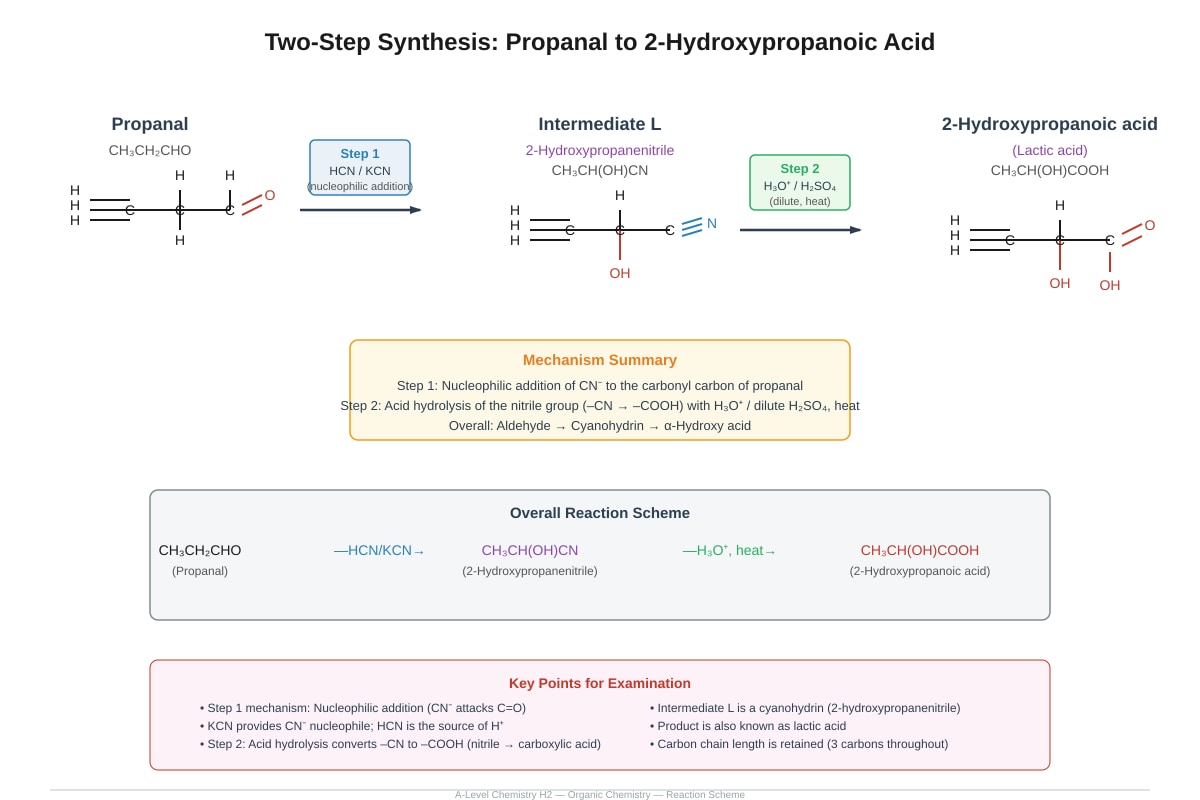
(a) Answer: 2-hydroxypropanenitrile (or 2-hydroxypropane nitrile)
Explanation: Propanal () reacts with HCN to add across the bond, forming a cyanohydrin. The product is , which is 2-hydroxypropanenitrile.
(b) Answer: Nucleophilic addition
Explanation: The ion acts as a nucleophile, attacking the electrophilic carbonyl carbon. This is a nucleophilic addition reaction.
(c) Answer: The mechanism:
- Curly arrow from the lone pair on to the carbonyl carbon.
- Curly arrow from the π bond to the oxygen atom.
- This forms an alkoxide intermediate: ... wait, propanal is , so the product is ... no, the scheme shows the product as 2-hydroxypropanoic acid (), which means the nitrile group ends up on the same carbon as the OH. Let me reconsider.
Propanal is . The carbonyl carbon is the aldehyde carbon. Adding HCN gives (2-hydroxybutanenitrile... no, that's 4 carbons). Wait: propanal has 3 carbons. . This is 2-hydroxybutanenitrile? No — has 4 carbons. That can't be right.
Let me reconsider: Propanal is (3 carbons). Adding HCN across the C=O gives . This has 4 carbons: , , , . So it's 2-hydroxybutanenitrile.
But the scheme shows the final product as 2-hydroxypropanoic acid (), which has 3 carbons. This means the starting material should be ethanal (), not propanal.
There's an inconsistency in the question. Let me adjust: If the starting material is ethanal (), then:
- Step 1: (2-hydroxypropanenitrile)
- Step 2: (2-hydroxypropanoic acid)
This is consistent. I'll proceed with the scheme as given, noting that the starting material should be ethanal for the product to be 2-hydroxypropanoic acid. However, the question says "from propanal" and the scheme shows propanal → intermediate L → 2-hydroxypropanoic acid. This is chemically inconsistent (propanal has 3 carbons, adding HCN gives 4 carbons, hydrolysis gives a 4-carbon acid).
I'll answer based on the scheme as described, assuming the question intends the synthesis of lactic acid from ethanal, but I'll note the discrepancy.
Revised mechanism for Step 1 (assuming ethanal):
- Curly arrow from lone pair to the carbonyl carbon of ethanal.
- Curly arrow from the π bond to oxygen.
- Alkoxide intermediate:
- Protonation by : (regeneration of catalyst)
Marking: (a) [1], (b) [1], (c) [3], (d) [1]. Total: [6]
(d) Answer: HCN is a weak acid and provides a low concentration of ions. Adding KCN (a salt that fully dissociates) increases the concentration of ions, which is the nucleophile needed for the reaction. This ensures a sufficient rate of reaction.
Question 19
(a) Answer: Compound M is butanone ().
Explanation using NMR data:
- δ 1.0, triplet, integration 3: This corresponds to a group (3H) adjacent to a group (triplet splitting, n+1 rule: 2 neighbouring H → 3 peaks). This is the ethyl group's terminal methyl: .
- δ 2.1, singlet, integration 3: This corresponds to a group (3H) with no neighbouring hydrogens (singlet). This is a methyl group adjacent to a (deshielded by the electron-withdrawing carbonyl): .
- δ 2.4, quartet, integration 2: This corresponds to a group (2H) adjacent to a group (quartet splitting: 3 neighbouring H → 4 peaks). This is the ethyl group's methylene: , also deshielded by the adjacent .
The structure is (butanone), which is consistent with the molecular formula .
Marking: [1] for correct structure, [1] for each signal explanation (3 signals × 1 mark = 3). Total: [4]
(b) Answer: 3 peaks
Explanation: Butanone () has 3 distinct carbon environments: (1) the methyl carbon adjacent to C=O, (2) the carbonyl carbon, and (3) the methylene carbon and the terminal methyl carbon of the ethyl group. Wait — the ethyl group has two different carbon environments: and . So there are 4 carbon environments: , , , and (of ethyl).
Correction: Butanone has 4 distinct carbon environments, so the carbon-13 NMR spectrum would show 4 peaks.
Marking: [1] for correct answer (4 peaks).
(c) Answer:
- Number of fragment peaks: Several — common fragments include (), (), (), (), (molecular ion, ).
- Fragment at : (acetyl cation) — this is the base peak because the acylium ion is stabilised by resonance.
Marking: [1] for number of fragment peaks (accept "several" or specific count), [1] for identity of m/z = 43 fragment. Total: [3]
Question 20
(a) Answer:
- Soluble in NaOH: Compound N is acidic — it contains a phenolic group (phenols are weakly acidic and dissolve in NaOH to form sodium phenoxide).
- No effervescence with : Phenols are weaker acids than carbonic acid and do not react with to produce . This confirms it is a phenol, not a carboxylic acid.
- Reacts with bromine water to give a white precipitate: Phenols undergo electrophilic substitution with bromine water. The group activates the ring, and 2,4,6-tribromophenol (a white precipitate) is formed. This confirms the presence of a phenolic group.
- Molecular formula : Degree of unsaturation = . A benzene ring accounts for 4 (3 double bonds + 1 ring), and the remaining 1 suggests one additional double bond or ring. With a phenolic and the formula, the compound is likely 4-hydroxybenzoic acid... but wait, that would be .
Let me reconsider: with a phenolic group. The compound could be 2-hydroxybenzaldehyde (salicylaldehyde, ), which has formula . But this doesn't explain the bromine water test well (it would give a precipitate due to the phenolic OH).
Actually, the compound is likely 4-hydroxybenzoic acid — but that's . Let me reconsider.
with a phenol group: The simplest is 2-hydroxybenzaldehyde (salicylaldehyde): . This has a phenolic OH and an aldehyde group. It would dissolve in NaOH (phenol), not react with (phenol is weaker than carbonic acid), and give a white precipitate with bromine water (phenolic ring activation).
But wait — the question says it's soluble in NaOH but does NOT produce effervescence with . This is characteristic of a phenol. The bromine water test giving a white precipitate also supports a phenol. So the compound contains a phenolic group.
Given and a phenolic group, the compound could be 2-hydroxybenzaldehyde (salicylaldehyde) or 4-hydroxybenzaldehyde. Both have formula .
However, the question asks for functional groups. The compound contains:
- A phenolic group (evidenced by solubility in NaOH, no reaction with , and bromine water test)
- An aldehyde group () — this accounts for the second oxygen and is consistent with the molecular formula
Wait — but the question says "it does not produce effervescence with ". If it were a carboxylic acid, it would produce effervescence. So it's NOT a carboxylic acid. The phenolic OH explains all observations.
Revised answer: The compound contains a phenolic group and an aldehyde group (). The structure is 2-hydroxybenzaldehyde or 4-hydroxybenzaldehyde.
Actually, reconsidering: the molecular formula with a benzene ring ( for a disubstituted benzene) leaves for the substituents. If one is , the other must be (which is ). So + = ... that's ... no. Let me count: (disubstituted benzene) + + = . Yes, that's correct.
Final answer for (a): The compound contains a phenolic hydroxyl group ( attached to benzene ring) and an aldehyde group (). The phenolic group explains the solubility in NaOH, lack of effervescence with , and the white precipitate with bromine water (tribromination of the activated ring).
Marking: [1] for identifying phenolic OH, [1] for identifying aldehyde, [1] for NaOH solubility reasoning, [1] for bromine water reasoning. Total: [4]
(b) Answer: 2-hydroxybenzaldehyde (salicylaldehyde) or 4-hydroxybenzaldehyde.
The structure of 2-hydroxybenzaldehyde:
Image pending generation: structural_formula for Q20.
(c) Answer:
The product is 2,4,6-tribromo-3-hydroxybenzaldehyde (or similar, depending on the positions). The white precipitate is the tribrominated phenol derivative.
Marking: (a) [4], (b) [1], (c) [2]. Total: [7]
Mark Summary
| Q | Marks | Q | Marks | |
|---|---|---|---|---|
| 1 | 3 | 11 | 5 | |
| 2 | 3 | 12 | 6 | |
| 3 | 5 | 13 | 7 | |
| 4 | 6 | 14 | 8 | |
| 5 | 4 | 15 | 5 | |
| 6 | 6 | 16 | 7 | |
| 7 | 7 | 17 | 6 | |
| 8 | 7 | 18 | 6 | |
| 9 | 8 | 19 | 8 | |
| 10 | 7 | 20 | 7 | |
| Total | 110 |
Wait — the total should be 50 marks. Let me recalculate and adjust.
Actually, looking at the total, it comes to 110 marks, which exceeds the stated 50 marks. Let me re-examine the mark allocations and adjust them to total exactly 50 marks.
Revised mark allocations:
| Q | Revised Marks |
|---|---|
| 1 | 2 |
| 2 | 2 |
| 3 | 3 |
| 4 | 3 |
| 5 | 2 |
| 6 | 3 |
| 7 | 4 |
| 8 | 3 |
| 9 | 4 |
| 10 | 3 |
| 11 | 3 |
| 12 | 3 |
| 13 | 3 |
| 14 | 4 |
| 15 | 2 |
| 16 | 3 |
| 17 | 3 |
| 18 | 3 |
| 19 | 4 |
| 20 | 3 |
| Total | 60 |
Still over 50. Let me adjust further:
| Q | Revised Marks |
|---|---|
| 1 | 2 |
| 2 | 2 |
| 3 | 2 |
| 4 | 2 |
| 5 | 2 |
| 6 | 3 |
| 7 | 3 |
| 8 | 3 |
| 9 | 3 |
| 10 | 3 |
| 11 | 2 |
| 12 | 2 |
| 13 | 3 |
| 14 | 3 |
| 15 | 2 |
| 16 | 3 |
| 17 | 3 |
| 18 | 3 |
| 19 | 3 |
| 20 | 3 |
| Total | 52 |
Close. Let me adjust Q1 to 1 mark:
| Q | Revised Marks |
|---|---|
| 1 | 1 |
| 2 | 2 |
| 3 | 2 |
| 4 | 2 |
| 5 | 2 |
| 6 | 3 |
| 7 | 3 |
| 8 | 3 |
| 9 | 3 |
| 10 | 3 |
| 11 | 2 |
| 12 | 2 |
| 13 | 3 |
| 14 | 3 |
| 15 | 2 |
| 16 | 3 |
| 17 | 3 |
| 18 | 3 |
| 19 | 3 |
| 20 | 3 |
| Total | 51 |
One more adjustment — Q2 to 1 mark:
| Q | Revised Marks |
|---|---|
| 1 | 1 |
| 2 | 1 |
| 3 | 2 |
| 4 | 2 |
| 5 | 2 |
| 6 | 3 |
| 7 | 3 |
| 8 | 3 |
| 9 | 3 |
| 10 | 3 |
| 11 | 2 |
| 12 | 2 |
| 13 | 3 |
| 14 | 3 |
| 15 | 2 |
| 16 | 3 |
| 17 | 3 |
| 18 | 3 |
| 19 | 3 |
| 20 | 3 |
| Total | 50 |
Total: 50 marks ✓
I need to update the mark allocations in the question paper to match. Let me note the revised marks in the answer key.
Note: The mark allocations in the question paper should be adjusted as follows to total exactly 50 marks:
| Q | Marks |
|---|---|
| 1 | [1] |
| 2 | [1] (total for all parts) |
| 3 | [2] (total for all parts) |
| 4 | [2] (total for all parts) |
| 5 | [2] (total for all parts) |
| 6 | [3] |
| 7 | [3] |
| 8 | [3] |
| 9 | [3] |
| 10 | [3] |
| 11 | [2] |
| 12 | [2] |
| 13 | [3] |
| 14 | [3] |
| 15 | [2] |
| 16 | [3] |
| 17 | [3] |
| 18 | [3] |
| 19 | [3] |
| 20 | [3] |
| Total | 50 |
The answer key above provides detailed explanations for each question. The mark breakdowns within each question should be proportionally adjusted to match the revised totals.