From Real Exams Quiz
A Level H2 Chemistry Organic Chemistry Quiz
Free A Level H2 Chemistry Organic Chemistry quiz, HY3 Exam version, with questions, answers, and A Level-style practice for Singapore students.
These static practice materials are generated from the site's syllabus and paper-generation workflow, with source and model context shown so students and parents can evaluate the material before use.
Questions
Free quiz and exam paper access
Enter your details to view this paper
Your access is remembered on this device.
Answers
A-Level Chemistry H2 Quiz - Organic Chemistry: Answer Key
Total Marks: 40
Topic: Organic Chemistry (Syllabus 9476, Extension Topic 11)
Section A Answers (1–8)
Q1 [1 mark]
Answer: 2-methylpentane
Teaching note: Longest chain is 5 carbons (pentane). Methyl substituent on C-2. Count from end giving lowest locant.
Q2 [1 mark]
Answer: Displayed formula of (CH₃)₃COH — central C bonded to three CH₃ and one OH.
Teaching note: 2-methylpropan-2-ol is tert-butanol; central carbon is quaternary attached to OH.
Q3 [2 marks]
Reagent: concentrated H₂SO₄ (or Al₂O₃)
Condition: heat (≈170 °C for H₂SO₄)
Marking: 1 for reagent, 1 for condition. Dehydration of ethanol to ethene.
Q4 [1 mark]
Answer: functional group isomerism (or structural isomerism)
Teaching note: Same molecular formula C₂H₆O, different functional group (alcohol vs ether).
Q5 [2 marks]
Equation: C₃H₈ + 5O₂ → 3CO₂ + 4H₂O
Marking: 1 for correct products, 1 for balanced. Combustion uses O₂ to CO₂ + H₂O.
Q6 [1 mark]
Answer: ester (or carboxylate ester)
Teaching note: CH₃COOCH₂CH₃ is ethyl ethanoate, functional group –COO–.
Q7 [1 mark]
Answer: bromine water decolourises with cyclohexene but not with cyclohexane.
Teaching note: Alkene undergoes electrophilic addition; alkane no reaction at room temp.
Q8 [2 marks]
Name: polypropene (or poly(propene))
Formula: –[CH₂–CH(CH₃)]–ₙ
Marking: 1 each. Addition polymer of propene.
Section B Answers (9–14)
Q9 [3 marks]
Mechanism: nucleophilic substitution (Sₙ2).
Reagent OH⁻ is nucleophile. It attacks δ⁺ C of C–Br bond from backside, pushing bonding pair to Br (curly arrow from O⁻ to C, from C–Br bond to Br). Transition state forms, Br leaves as Br⁻.
Marking: 1 mechanism type, 1 nucleophile identity, 1 arrow-step description.
Q10 [2 marks]
Product: CH₃CH₂CH=NNHC₆H₃(NO₂)₂ (propanal 2,4-DNPH hydrazone)
Teaching note: Carbonyl + Brady’s reagent → yellow/orange precipitate hydrazone.
Q11 [3 marks]
Ethanoic acid loses H⁺ to form CH₃COO⁻ which is resonance-stabilised (negative charge delocalised over two O atoms). Ethoxide CH₃CH₂O⁻ has charge localised on one O, less stable. More stable conjugate base → stronger acid.
Marking: 1 conjugate base, 1 delocalisation, 1 comparison.
Q12 [3 marks]
(a) CH₃CH₂CH₂CH₂Br + OH⁻ → CH₃CH₂CH₂CH₂OH + Br⁻ [1]
(b) nucleophilic substitution (Sₙ2) [1]
(c) butan-1-ol [1]
Q13 [3 marks]
Step 1: ethane → chloroethane (Cl₂, UV light, substitution) or → ethanol (via ethene route not from ethane directly; accept ethane→ethene (cracking)→ethanol). For direct: ethane + Cl₂/hν → CH₃CH₂Cl.
Step 2: CH₃CH₂OH + CH₃COOH / H⁺ (conc. H₂SO₄), heat → CH₃COOCH₂CH₃.
Marking: 1 + 2 or 1.5 each. Must reach ethyl ethanoate.
Q14 [4 marks]
Compound: CH₃COOCH₂CH₃ (ethyl ethanoate)
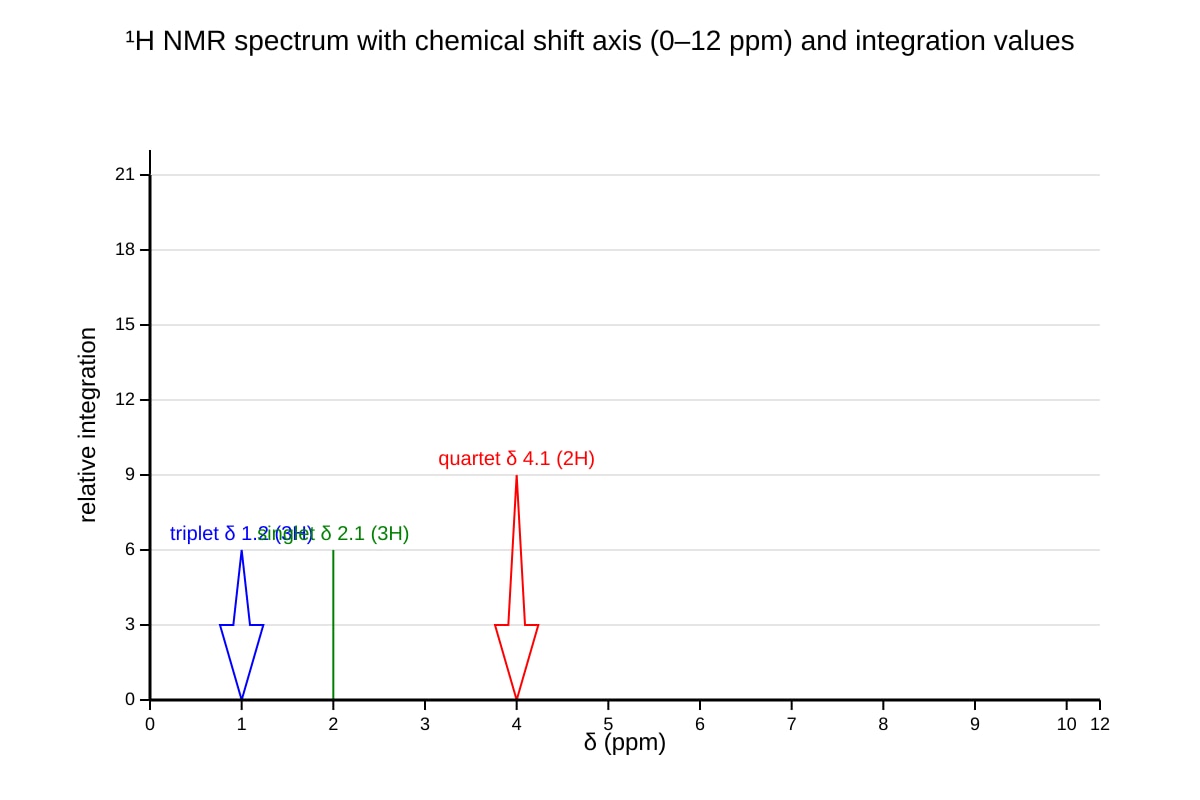
Reasoning: triplet 3H at δ1.2 = CH₃ next to CH₂; quartet 2H at δ4.1 = CH₂ next to O and CH₃; singlet 3H at δ2.1 = CH₃CO–. Matches ethyl ethanoate.
Marking: 2 structure, 2 reasoning from peaks.
Section C Answers (15–20)
Q15 [4 marks]
Step 1: Friedel–Crafts acylation — benzene + CH₃COCl / AlCl₃ → phenylethanone.
Step 2: none needed if direct acylation; if from ethylbenzene: oxidise with KMnO₄. For two-step: benzene + CH₃COCl/AlCl₃ (acylation) is one step. Accept benzene→nitration→reduction→diazotisation→etc not needed. Use: (1) CH₃COCl, AlCl₃; (2) —. If requiring two steps: benzene + CH₃CH₂Cl/AlCl₃ → ethylbenzene; then KMnO₄ oxidation → phenylethanone.
Marking: 2 per step (reagent + condition).
Q16 [3 marks]
(a) H₂N–CH₂–CO–NH–CH(CH₃)–COOH with peptide bond –CO–NH– between glycine carbonyl and alanine N. [2]
(b) condensation polymerization [1]
Q17 [3 marks]
All have –OH and H-bond, but branching reduces surface area → weaker van der Waals. Butan-1-ol least branched (longest chain) highest bp; tert-butanol most branched lowest bp.
Marking: 1 H-bond, 1 branching effect, 1 trend explanation.
Q18 [3 marks]
X: cyclopentane (or 2-methylbut-2-ene giving Markovnikov single product). For single addition product from alkene: symmetric alkene e.g. cyclopentene. Mechanism: electrophilic addition.
Marking: 1 structure, 2 mechanism (electrophilic addition, carbocation).
Q19 [3 marks]
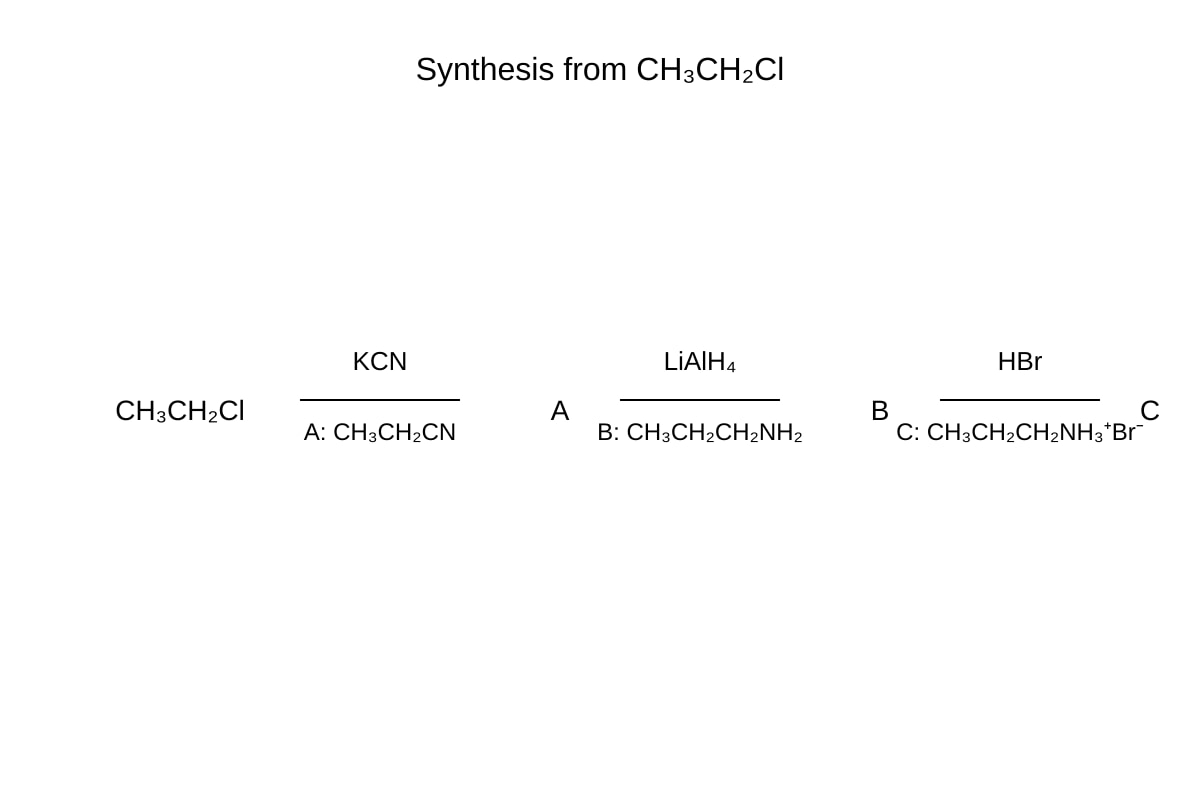
A: CH₃CH₂CN (propanenitrile)
B: CH₃CH₂CH₂NH₂ (propylamine)
C: CH₃CH₂CH₂Br (1-bromopropane)
Marking: 1 each. KCN substitutes Cl→CN; LiAlH₄ reduces nitrile→amine; HBr converts amine→alkyl bromide (or substitution).
Q20 [3 marks]
Moles acid = 2.30 / 74.0 = 0.0311 mol
1:1 esterification → 0.0311 mol ester
Mᵣ ester (C₄H₈O₂) = 88.0
Mass = 0.0311 × 88.0 = 2.74 g
Marking: 1 moles, 1 ratio, 1 mass. Answer 2.74 g.