From Real Exams Quiz

A Level H2 Chemistry Kinetics Equilibrium Quiz

Free Exam-Derived Owl Alpha A Level H2 Chemistry Kinetics Equilibrium quiz with questions and answers for Singapore students. This page is rendered as a direct URL so the questions and answers can be discovered without pressing in-page buttons.

These static practice materials are generated from the site's syllabus and paper-generation workflow, with source and model context shown so students and parents can evaluate the material before use.

A Level H2 Chemistry From Real Exams Generated by Owl Alpha Updated 2026-06-07

Questions

<!-- TuitionGoWhere generation metadata: stage=3-0; model=openrouter/owl-alpha; model_label=Owl Alpha; generated=2026-06-06; Sources: Stage 2-1 real exam-derived templates and Stage 2-2 exam-enriched syllabus. -->

A-Level Chemistry H2 Quiz - Kinetics Equilibrium

Name: ___________________________
Class: ___________________________
Date: ___________________________
Score: ________ / 60

Duration: 75 minutes
Total Marks: 60

Instructions:

  • Answer ALL questions.
  • Show all working clearly in the spaces provided.
  • The number of marks for each question is shown in brackets [ ].
  • You may use a calculator.
  • The use of the Data Booklet is permitted.
  • Write your answers in the spaces provided.

Section A: Multiple Choice (Questions 1–5)

Each question carries 2 marks. Choose the most appropriate answer.


1. The rate equation for the reaction between substances X and Y is:

rate=k[X]2[Y]\text{rate} = k[\text{X}]^2[\text{Y}]

Which statement about this reaction is correct?

A. The reaction is first order overall.
B. Doubling the concentration of X doubles the rate.
C. The units of the rate constant kk are mol2 dm6 s1\text{mol}^{-2}\text{ dm}^{6}\text{ s}^{-1}.
D. The order of reaction with respect to Y is 2.

...........................................................................................
...........................................................................................

[2]


2. For the equilibrium:

2SO2(g)+O2(g)2SO3(g)ΔH=197 kJ mol12\text{SO}_2(g) + \text{O}_2(g) \rightleftharpoons 2\text{SO}_3(g) \quad \Delta H = -197 \text{ kJ mol}^{-1}

Which change will increase the value of the equilibrium constant KcK_c?

A. Adding a catalyst
B. Increasing the pressure
C. Decreasing the temperature
D. Increasing the concentration of SO2\text{SO}_2

...........................................................................................
...........................................................................................

[2]


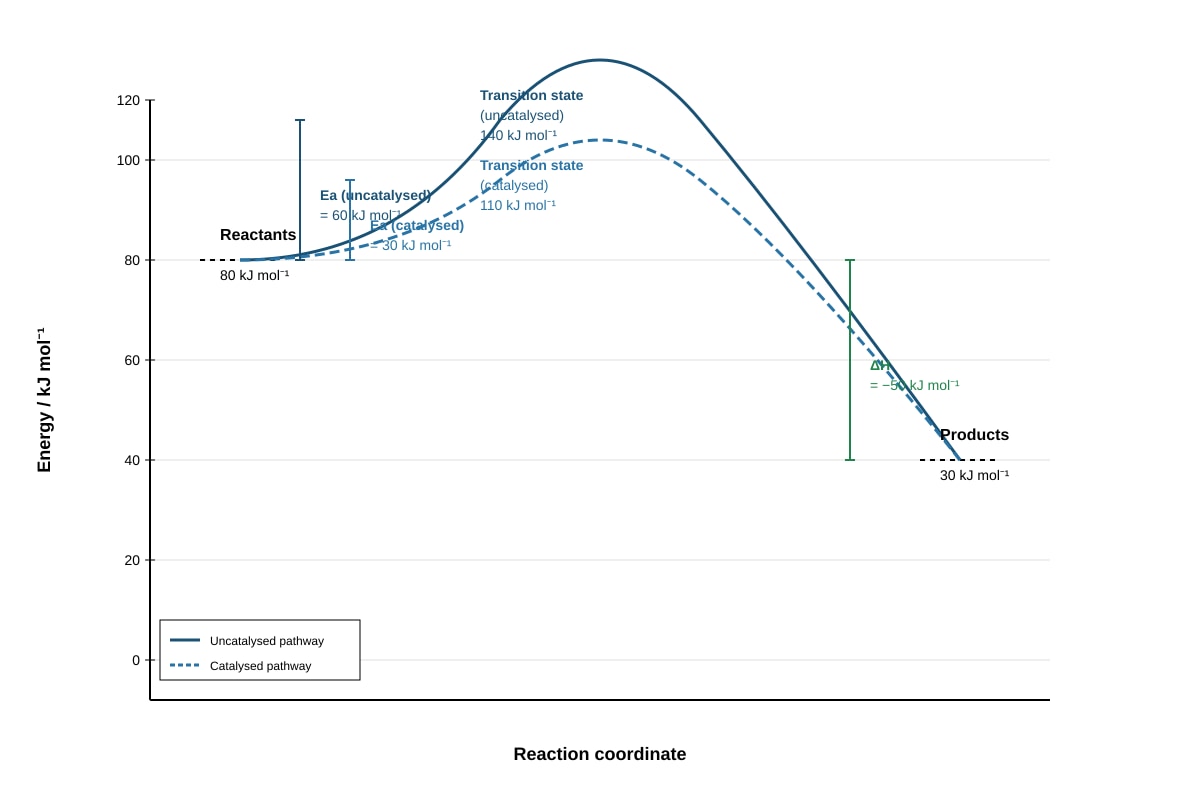
3. A reaction has the following energy profile diagram.

<image_placeholder> id: Q3-fig1 type: graph linked_question: Q3 description: Energy profile diagram showing reaction pathway. The x-axis is "Reaction coordinate" and the y-axis is "Energy / kJ mol⁻¹". The reactants start at 80 kJ mol⁻¹, rise to a peak at 140 kJ mol⁻¹ (the transition state), and the products end at 30 kJ mol⁻¹. A second, lower peak is shown at 110 kJ mol⁻¹, representing the catalysed pathway. labels: Reactants at 80 kJ mol⁻¹, Transition state (uncatalysed) at 140 kJ mol⁻¹, Transition state (catalysed) at 110 kJ mol⁻¹, Products at 30 kJ mol⁻¹, Ea (uncatalysed) arrow from 80 to 140, Ea (catalysed) arrow from 80 to 110, ΔH arrow from 80 down to 30 values: Ea (uncatalysed) = 60 kJ mol⁻¹, Ea (catalysed) = 30 kJ mol⁻¹, ΔH = −50 kJ mol⁻¹ must_show: Both catalysed and uncatalysed pathways clearly labelled, energy levels of reactants and products, activation energy arrows, ΔH arrow </image_placeholder>

What is the activation energy for the catalysed reaction?

A. 30 kJ mol⁻¹
B. 50 kJ mol⁻¹
C. 60 kJ mol⁻¹
D. 110 kJ mol⁻¹

...........................................................................................
...........................................................................................

[2]


4. The equilibrium constant KpK_p for the reaction:

N2(g)+3H2(g)2NH3(g)\text{N}_2(g) + 3\text{H}_2(g) \rightleftharpoons 2\text{NH}_3(g)

is 4.3×1044.3 \times 10^{-4} at 300 °C. What are the units of KpK_p?

A. atm²
B. atm⁻¹
C. atm⁻²
D. No units

...........................................................................................
...........................................................................................

[2]


5. In a kinetics experiment, the concentration of reactant A was measured over time. A graph of ln[A]\ln[\text{A}] against time gave a straight line with a gradient of 0.025 s1-0.025 \text{ s}^{-1}. What is the half-life of the reaction?

A. 0.017 s
B. 27.7 s
C. 40.0 s
D. 55.4 s

...........................................................................................
...........................................................................................

[2]


Section B: Structured Questions (Questions 6–15)


6. Consider the following equilibrium at 400 K:

2NO2(g)N2O4(g)ΔH=57.2 kJ mol12\text{NO}_2(g) \rightleftharpoons \text{N}_2\text{O}_4(g) \quad \Delta H = -57.2 \text{ kJ mol}^{-1}

At equilibrium in a 2.0 dm³ flask, there are 0.040 mol of NO2\text{NO}_2 and 0.060 mol of N2O4\text{N}_2\text{O}_4.

(a) Write an expression for the equilibrium constant KcK_c for this reaction.

[1]

(b) Calculate the value of KcK_c at 400 K. Give your answer to 2 significant figures.

...........................................................................................
...........................................................................................
...........................................................................................

[2]

(c) Predict and explain the effect on the value of KcK_c if the temperature is increased to 500 K.

...........................................................................................
...........................................................................................
...........................................................................................

[2]

(d) Predict and explain the effect on the position of equilibrium if the pressure is increased, and state whether KcK_c changes.

...........................................................................................
...........................................................................................
...........................................................................................

[2]

[Total: 7]


7. The decomposition of hydrogen peroxide was studied at 25 °C:

2H2O2(aq)2H2O(l)+O2(g)2\text{H}_2\text{O}_2(aq) \rightarrow 2\text{H}_2\text{O}(l) + \text{O}_2(g)

The following data were obtained:

ExperimentInitial [H₂O₂] / mol dm⁻³Initial rate / mol dm⁻³ s⁻¹
10.101.2×1041.2 \times 10^{-4}
20.202.4×1042.4 \times 10^{-4}
30.303.6×1043.6 \times 10^{-4}

(a) Determine the order of reaction with respect to H2O2\text{H}_2\text{O}_2. Explain your reasoning.

...........................................................................................
...........................................................................................
...........................................................................................

[2]

(b) Write the rate equation for this reaction.

[1]

(c) Calculate the rate constant, kk, including its units.

...........................................................................................
...........................................................................................
...........................................................................................

[2]

(d) Predict the initial rate when [H2O2]=0.50 mol dm3[\text{H}_2\text{O}_2] = 0.50 \text{ mol dm}^{-3}.

...........................................................................................
...........................................................................................

[1]

[Total: 6]


8. Nitrogen dioxide decomposes according to the equation:

2NO2(g)2NO(g)+O2(g)2\text{NO}_2(g) \rightarrow 2\text{NO}(g) + \text{O}_2(g)

The rate equation is:

rate=k[NO2]2\text{rate} = k[\text{NO}_2]^2

(a) State the order of reaction with respect to NO2\text{NO}_2 and the overall order of reaction.

...........................................................................................

[1]

(b) A 1.0 dm³ vessel contains 0.020 mol of NO2\text{NO}_2. After 50 seconds, 0.012 mol of NO2\text{NO}_2 remains. Calculate the average rate of reaction over this 50-second period, in mol dm⁻³ s⁻¹.

...........................................................................................
...........................................................................................
...........................................................................................

[2]

(c) Explain, using collision theory, why the rate of reaction decreases as the reaction proceeds.

...........................................................................................
...........................................................................................
...........................................................................................

[2]

[Total: 5]


9. The reaction between nitrogen monoxide and hydrogen was studied:

2NO(g)+2H2(g)N2(g)+2H2O(g)2\text{NO}(g) + 2\text{H}_2(g) \rightarrow \text{N}_2(g) + 2\text{H}_2\text{O}(g)

The following mechanism has been proposed:

Step 1 (slow): NO+NON2O2\text{NO} + \text{NO} \rightarrow \text{N}_2\text{O}_2
Step 2 (fast): N2O2+H2N2O+H2O\text{N}_2\text{O}_2 + \text{H}_2 \rightarrow \text{N}_2\text{O} + \text{H}_2\text{O}
Step 3 (fast): N2O+H2N2+H2O\text{N}_2\text{O} + \text{H}_2 \rightarrow \text{N}_2 + \text{H}_2\text{O}

(a) Identify the rate-determining step. Explain your choice.

...........................................................................................
...........................................................................................

[1]

(b) Write the rate equation that is consistent with this mechanism.

...........................................................................................

[1]

(c) Identify one intermediate in this mechanism. Explain how you identified it.

...........................................................................................
...........................................................................................

[1]

[Total: 3]


10. The equilibrium between dinitrogen tetroxide and nitrogen dioxide is represented by:

N2O4(g)2NO2(g)ΔH=+58.0 kJ mol1\text{N}_2\text{O}_4(g) \rightleftharpoons 2\text{NO}_2(g) \quad \Delta H = +58.0 \text{ kJ mol}^{-1}

At 25 °C, Kc=0.14K_c = 0.14 for this equilibrium.

(a) A 1.0 dm³ flask at 25 °C initially contains 0.20 mol of N2O4\text{N}_2\text{O}_4 and no NO2\text{NO}_2. Calculate the equilibrium concentrations of both species.

...........................................................................................
...........................................................................................
...........................................................................................
...........................................................................................
...........................................................................................

[3]

(b) The flask is now heated to 50 °C. State and explain what happens to the value of KcK_c and the position of equilibrium.

...........................................................................................
...........................................................................................
...........................................................................................

[2]

(c) Brown colour of the gas mixture is observed to deepen on heating. Explain this observation with reference to Le Chatelier's principle.

...........................................................................................
...........................................................................................

[1]

[Total: 6]


11. The Haber process for the manufacture of ammonia is represented by:

N2(g)+3H2(g)2NH3(g)ΔH=92 kJ mol1\text{N}_2(g) + 3\text{H}_2(g) \rightleftharpoons 2\text{NH}_3(g) \quad \Delta H = -92 \text{ kJ mol}^{-1}

In industry, the process is carried out at 450 °C and 200 atm, using an iron catalyst.

(a) Explain why a temperature of 450 °C is used instead of a lower temperature, even though a lower temperature would give a higher yield of ammonia.

...........................................................................................
...........................................................................................
...........................................................................................
...........................................................................................

[2]

(b) Explain the effect of using 200 atm pressure on the yield of ammonia, with reference to Le Chatelier's principle.

...........................................................................................
...........................................................................................
...........................................................................................

[2]

(c) State the purpose of the iron catalyst and explain why it does not affect the yield of ammonia at equilibrium.

...........................................................................................
...........................................................................................
...........................................................................................

[2]

[Total: 6]


12. The rate constant for a first-order reaction is 3.46×10³ s13.46 \times 10^{-3} \text{ s}^{-1} at 298 K and 8.76×10³ s18.76 \times 10^{-3} \text{ s}^{-1} at 318 K.

(a) Use the Arrhenius equation to calculate the activation energy, EaE_a, for this reaction.

The Arrhenius equation in two-temperature form is:

lnk2k1=EaR(1T11T2)\ln\frac{k_2}{k_1} = \frac{E_a}{R}\left(\frac{1}{T_1} - \frac{1}{T_2}\right)

where R=8.31 J mol1 K1R = 8.31 \text{ J mol}^{-1}\text{ K}^{-1}.

...........................................................................................
...........................................................................................
...........................................................................................
...........................................................................................
...........................................................................................

[3]

(b) Explain, in terms of the Maxwell-Boltzmann distribution, why a small increase in temperature leads to a significant increase in the rate constant.

...........................................................................................
...........................................................................................
...........................................................................................
...........................................................................................

[2]

[Total: 5]


13. Consider the equilibrium:

CO(g)+2H2(g)CH3OH(g)ΔH=91 kJ mol1\text{CO}(g) + 2\text{H}_2(g) \rightleftharpoons \text{CH}_3\text{OH}(g) \quad \Delta H = -91 \text{ kJ mol}^{-1}

At equilibrium at a certain temperature, the concentrations are:

[CO]=0.15 mol dm3[\text{CO}] = 0.15 \text{ mol dm}^{-3}, [H2]=0.30 mol dm3[\text{H}_2] = 0.30 \text{ mol dm}^{-3}, [CH3OH]=0.25 mol dm3[\text{CH}_3\text{OH}] = 0.25 \text{ mol dm}^{-3}

(a) Write the expression for KcK_c and calculate its value, including units.

...........................................................................................
...........................................................................................
...........................................................................................
...........................................................................................

[2]

(b) The volume of the container is suddenly halved. Predict and explain the effect on:

  • (i) the position of equilibrium
  • (ii) the value of KcK_c

...........................................................................................
...........................................................................................
...........................................................................................
...........................................................................................

[2]

(c) Helium gas is added to the equilibrium mixture at constant volume. State and explain the effect, if any, on the position of equilibrium and the value of KcK_c.

...........................................................................................
...........................................................................................
...........................................................................................

[2]

[Total: 6]


14. The reaction between bromoethane and aqueous sodium hydroxide was studied:

CH3CH2Br+OHCH3CH2OH+Br\text{CH}_3\text{CH}_2\text{Br} + \text{OH}^- \rightarrow \text{CH}_3\text{CH}_2\text{OH} + \text{Br}^-

The following data were collected:

Experiment[CH₃CH₂Br] / mol dm⁻³[OH⁻] / mol dm⁻³Initial rate / mol dm⁻³ s⁻¹
10.100.105.0×1055.0 \times 10^{-5}
20.200.101.0×1041.0 \times 10^{-4}
30.100.201.0×1041.0 \times 10^{-4}

(a) Determine the order of reaction with respect to CH3CH2Br\text{CH}_3\text{CH}_2\text{Br} and OH\text{OH}^-. Show your reasoning.

...........................................................................................
...........................................................................................
...........................................................................................
...........................................................................................

[2]

(b) Write the rate equation and state the overall order of reaction.

...........................................................................................

[1]

(c) Calculate the rate constant, kk, including units.

...........................................................................................
...........................................................................................
...........................................................................................

[2]

(d) Suggest, with reasoning, whether this reaction proceeds via an SN1\text{S}_\text{N}1 or SN2\text{S}_\text{N}2 mechanism.

...........................................................................................
...........................................................................................
...........................................................................................

[2]

[Total: 7]


15. The esterification reaction is represented by:

CH3COOH+C2H5OHCH3COOC2H5+H2O\text{CH}_3\text{COOH} + \text{C}_2\text{H}_5\text{OH} \rightleftharpoons \text{CH}_3\text{COOC}_2\text{H}_5 + \text{H}_2\text{O}

(a) Write the expression for the equilibrium constant, KcK_c.

[1]

(b) In an experiment, 0.50 mol of ethanoic acid and 0.50 mol of ethanol were mixed in a 1.0 dm³ flask. At equilibrium, 0.33 mol of ethyl ethanoate was formed. Calculate KcK_c.

...........................................................................................
...........................................................................................
...........................................................................................
...........................................................................................
...........................................................................................

[3]

(c) State and explain the effect on KcK_c of adding a small amount of concentrated sulfuric acid (which acts as a catalyst).

...........................................................................................
...........................................................................................
...........................................................................................

[2]

[Total: 6]


Section C: Data Interpretation (Questions 16–20)


16. The following data were obtained for the reaction:

PCl5(g)PCl3(g)+Cl2(g)\text{PCl}_5(g) \rightleftharpoons \text{PCl}_3(g) + \text{Cl}_2(g)

at two different temperatures:

Temperature / KKcK_c / mol dm⁻³
5004.17×1024.17 \times 10^{-2}
6001.561.56

(a) Using Le Chatelier's principle, determine whether the forward reaction is exothermic or endothermic. Explain your reasoning.

...........................................................................................
...........................................................................................
...........................................................................................

[2]

(b) At 500 K, 0.50 mol of PCl5\text{PCl}_5 was placed in a 2.0 dm³ flask. Calculate the equilibrium concentrations of all three species.

...........................................................................................
...........................................................................................
...........................................................................................
...........................................................................................
...........................................................................................

[3]

(c) Calculate the percentage dissociation of PCl5\text{PCl}_5 at 500 K.

...........................................................................................
...........................................................................................

[1]

[Total: 6]


17. A student investigated the kinetics of the reaction between iodine and propanone in acidic solution:

I2+CH3COCH3CH3COCH2I+HI\text{I}_2 + \text{CH}_3\text{COCH}_3 \rightarrow \text{CH}_3\text{COCH}_2\text{I} + \text{HI}

The rate equation was found to be:

rate=k[CH3COCH3][H+]\text{rate} = k[\text{CH}_3\text{COCH}_3][\text{H}^+]

The reaction is zero order with respect to I2\text{I}_2.

(a) Explain what is meant by "zero order with respect to I2\text{I}_2".

...........................................................................................
...........................................................................................

[1]

(b) A proposed mechanism involves the following steps:

Step 1 (slow): CH3COCH3+H+intermediate\text{CH}_3\text{COCH}_3 + \text{H}^+ \rightarrow \text{intermediate}
Step 2 (fast): intermediate+I2products\text{intermediate} + \text{I}_2 \rightarrow \text{products}

Explain whether this mechanism is consistent with the rate equation.

...........................................................................................
...........................................................................................
...........................................................................................

[2]

(c) The student repeated the experiment at a higher temperature. State the effect on the rate constant kk and explain your answer using the concept of activation energy.

...........................................................................................
...........................................................................................
...........................................................................................

[2]

[Total: 5]


18. The contact process for the manufacture of sulfuric acid involves the equilibrium:

2SO2(g)+O2(g)2SO3(g)ΔH=197 kJ mol12\text{SO}_2(g) + \text{O}_2(g) \rightleftharpoons 2\text{SO}_3(g) \quad \Delta H = -197 \text{ kJ mol}^{-1}

At equilibrium at 700 K and 1 atm, the partial pressures are:

pSO2=0.050 atmp_{\text{SO}_2} = 0.050 \text{ atm}, pO2=0.025 atmp_{\text{O}_2} = 0.025 \text{ atm}, pSO3=0.925 atmp_{\text{SO}_3} = 0.925 \text{ atm}

(a) Write the expression for KpK_p.

[1]

(b) Calculate the value of KpK_p at 700 K, including units.

...........................................................................................
...........................................................................................
...........................................................................................

[2]

(c) In practice, a temperature of 700 K is used with a vanadium(V) oxide catalyst. Explain why 700 K is chosen rather than a much lower temperature such as 400 K.

...........................................................................................
...........................................................................................
...........................................................................................
...........................................................................................

[2]

(d) Explain why a pressure of 1 atm is used rather than a higher pressure, even though higher pressure would increase the yield.

...........................................................................................
...........................................................................................
...........................................................................................

[2]

[Total: 7]


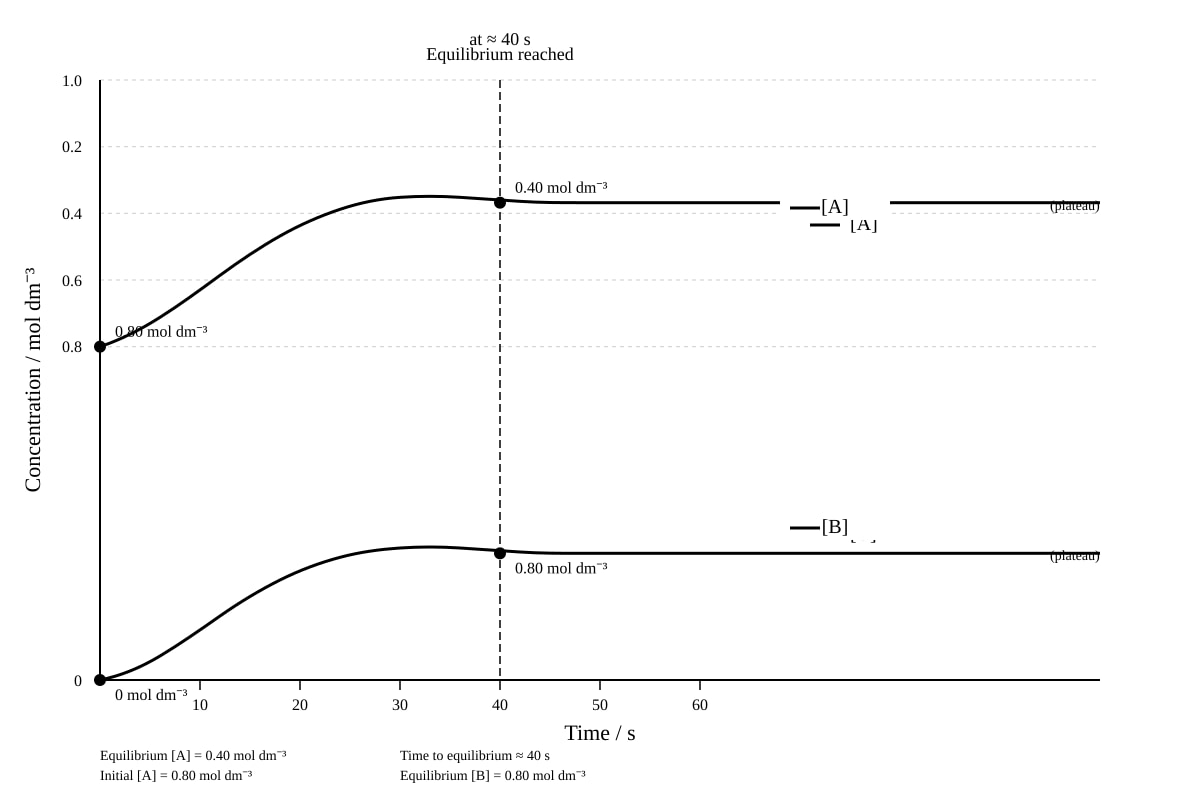
19. The following graph shows the concentration of reactant A and product B over time for a reversible reaction:

A(g)2B(g)\text{A}(g) \rightleftharpoons 2\text{B}(g)

<image_placeholder> id: Q19-fig1 type: graph linked_question: Q19 description: Concentration-time graph for a reversible reaction A ⇌ 2B. The x-axis is "Time / s" from 0 to 60. The y-axis is "Concentration / mol dm⁻³" from 0 to 1.0. The [A] curve starts at 0.80 mol dm⁻³ at t=0 and decreases, levelling off at 0.40 mol dm⁻³ after about 40 s. The [B] curve starts at 0 mol dm⁻³ at t=0 and increases, levelling off at 0.80 mol dm⁻³ after about 40 s. Both curves plateau (become horizontal) after approximately 40 seconds, indicating equilibrium has been reached. labels: [A] curve (decreasing, starting at 0.80, plateau at 0.40), [B] curve (increasing, starting at 0, plateau at 0.80), equilibrium reached at ~40 s values: Initial [A] = 0.80 mol dm⁻³, Equilibrium [A] = 0.40 mol dm⁻³, Equilibrium [B] = 0.80 mol dm⁻³, Time to equilibrium ≈ 40 s must_show: Both concentration curves clearly labelled, plateau region showing equilibrium, initial values, equilibrium values, axes with units </image_placeholder>

(a) From the graph, state the time at which equilibrium is first established.

...........................................................................................

[1]

(b) Calculate the equilibrium concentrations of A and B.

...........................................................................................

[1]

(c) Write the expression for KcK_c and calculate its value.

...........................................................................................
...........................................................................................

[2]

(d) At time t=50t = 50 s, the volume of the container is suddenly halved. On the axes above, sketch the changes in concentration of A and B that would occur. (Describe your sketch in words.)

...........................................................................................
...........................................................................................
...........................................................................................
...........................................................................................

[2]

[Total: 6]


20. The reaction between nitrogen dioxide and carbon monoxide was studied:

NO2(g)+CO(g)NO(g)+CO2(g)\text{NO}_2(g) + \text{CO}(g) \rightarrow \text{NO}(g) + \text{CO}_2(g)

The following mechanism has been proposed:

Step 1 (slow): NO2+NO2NO3+NO\text{NO}_2 + \text{NO}_2 \rightarrow \text{NO}_3 + \text{NO}
Step 2 (fast): NO3+CONO2+CO2\text{NO}_3 + \text{CO} \rightarrow \text{NO}_2 + \text{CO}_2

(a) Write the rate equation consistent with this mechanism.

...........................................................................................

[1]

(b) Identify the intermediate in this mechanism and explain how you identified it.

...........................................................................................
...........................................................................................

[1]

(c) The experimentally determined rate equation is:

rate=k[NO2]2\text{rate} = k[\text{NO}_2]^2

Explain whether the proposed mechanism is consistent with the experimental rate equation.

...........................................................................................
...........................................................................................
...........................................................................................

[2]

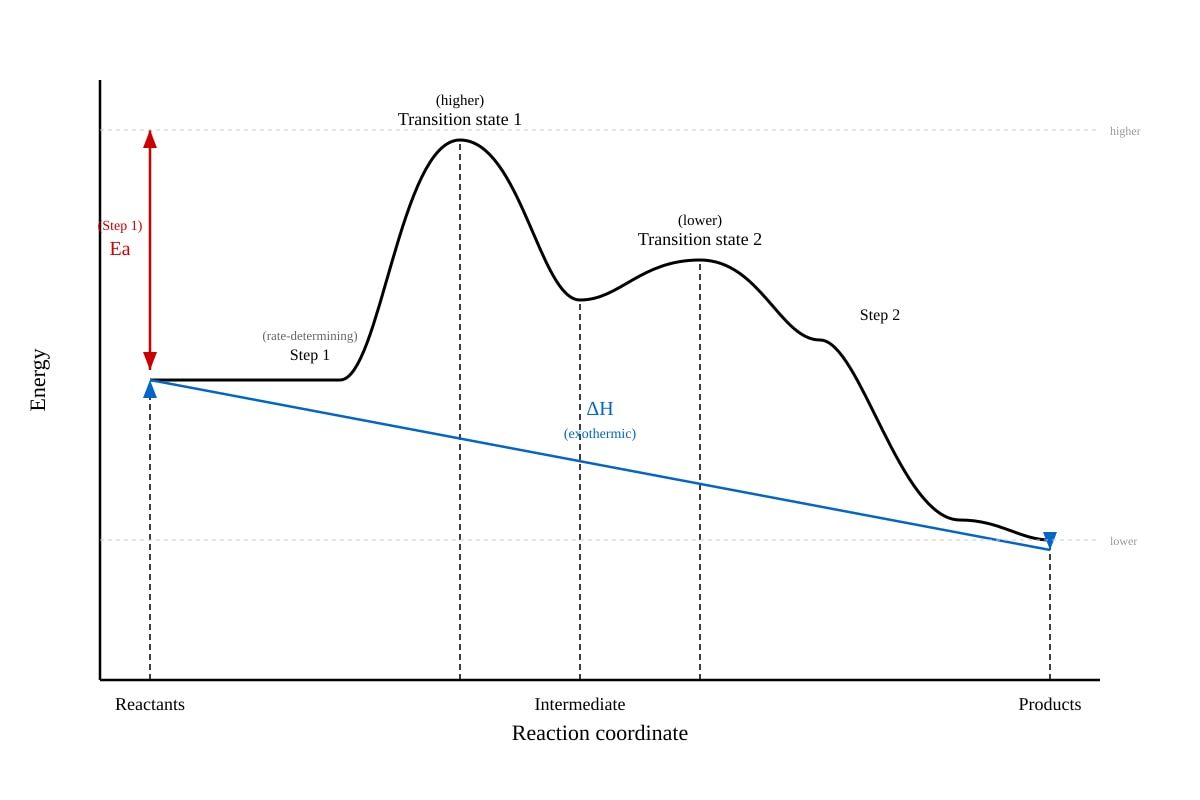
(d) Sketch a labelled energy profile diagram for this reaction, given that the overall reaction is exothermic. On your diagram, show the activation energy for the rate-determining step and label the position of the intermediate.

<image_placeholder> id: Q20-fig1 type: graph linked_question: Q20 description: Energy profile diagram for a two-step exothermic reaction. The x-axis is "Reaction coordinate" and the y-axis is "Energy". The diagram should show two peaks (two humps). The first peak (Step 1, rate-determining) is higher than the second peak (Step 2). Reactants start at a higher energy level, the first transition state is at the highest point, then energy drops to a trough (the intermediate), then rises to a second lower transition state, and finally drops to products at the lowest energy level. An arrow labelled Ea shows the energy difference between reactants and the first (higher) transition state. ΔH arrow shows the overall energy drop from reactants to products. labels: Reactants, Transition state 1 (higher), Intermediate (trough between peaks), Transition state 2 (lower), Products, Ea (activation energy for step 1), ΔH (overall enthalpy change, negative) values: Ea shown as large arrow from reactants to first peak, ΔH shown as downward arrow from reactants to products must_show: Two distinct peaks with first higher than second, intermediate trough between peaks, Ea labelled for step 1, ΔH labelled as exothermic (downward), all species labelled </image_placeholder>

Describe the key features that your diagram must show.

...........................................................................................
...........................................................................................
...........................................................................................
...........................................................................................

[2]

[Total: 6]


END OF QUIZ

Total Marks: 60

Answers

<!-- TuitionGoWhere generation metadata: stage=3-0; model=openrouter/owl-alpha; model_label=Owl Alpha; generated=2026-06-06; Sources: Stage 2-1 real exam-derived templates and Stage 2-2 exam-enriched syllabus. -->

A-Level Chemistry H2 Quiz - Kinetics Equilibrium

Answer Key


Section A: Multiple Choice

1. Answer: C

Explanation:
The rate equation is rate=k[X]2[Y]\text{rate} = k[\text{X}]^2[\text{Y}]. The overall order = 2 + 1 = 3 (third order overall), so A is incorrect. Doubling [X] would increase the rate by a factor of 22=42^2 = 4 (quadruples), so B is incorrect. The order with respect to Y is 1, so D is incorrect.

For units of kk:
rate=k[X]2[Y]\text{rate} = k[\text{X}]^2[\text{Y}]
mol dm3 s1=k×(mol dm3)2×(mol dm3)\text{mol dm}^{-3}\text{ s}^{-1} = k \times (\text{mol dm}^{-3})^2 \times (\text{mol dm}^{-3})
mol dm3 s1=k×mol3 dm9\text{mol dm}^{-3}\text{ s}^{-1} = k \times \text{mol}^3\text{ dm}^{-9}
k=mol dm3 s1mol3 dm9=mol2 dm6 s1k = \frac{\text{mol dm}^{-3}\text{ s}^{-1}}{\text{mol}^3\text{ dm}^{-9}} = \text{mol}^{-2}\text{ dm}^{6}\text{ s}^{-1}

Common mistake: Students often add orders incorrectly or confuse the effect of concentration changes on rate.

[2]


2. Answer: C

Explanation:
The reaction is exothermic (ΔH=197\Delta H = -197 kJ mol⁻¹). KcK_c depends only on temperature. For an exothermic reaction, decreasing the temperature shifts the equilibrium to the right (favouring products), which increases the value of KcK_c. Adding a catalyst does not change KcK_c (it only speeds up the rate at which equilibrium is reached). Increasing pressure or concentration shifts the position but does not change KcK_c.

Common mistake: Students often confuse changes in position of equilibrium with changes in the value of KcK_c. Only temperature changes affect KcK_c.

[2]


3. Answer: A

Explanation:
The activation energy for the catalysed reaction is the energy difference between the reactants (80 kJ mol⁻¹) and the catalysed transition state (110 kJ mol⁻¹):

Ea=11080=30E_a = 110 - 80 = 30 kJ mol⁻¹

The diagram shows the catalysed pathway with a lower peak. The activation energy is measured from the energy level of the reactants up to the transition state of the catalysed pathway.

Common mistake: Students may read the absolute energy value at the peak (110 kJ mol⁻¹) instead of calculating the difference from the reactant energy level.

[2]


4. Answer: C

Explanation:
For the reaction N2(g)+3H2(g)2NH3(g)\text{N}_2(g) + 3\text{H}_2(g) \rightleftharpoons 2\text{NH}_3(g):

Kp=(pNH3)2(pN2)(pH2)3K_p = \frac{(p_{\text{NH}_3})^2}{(p_{\text{N}_2})(p_{\text{H}_2})^3}

Units of Kp=atm2atm×atm3=atm2atm4=atm2K_p = \frac{\text{atm}^2}{\text{atm} \times \text{atm}^3} = \frac{\text{atm}^2}{\text{atm}^4} = \text{atm}^{-2}

Common mistake: Students forget to raise partial pressures to their stoichiometric coefficients when determining units.

[2]


5. Answer: B

Explanation:
For a first-order reaction, a plot of ln[A]\ln[\text{A}] against time gives a straight line with gradient =k= -k.
So k=0.025k = 0.025 s⁻¹.

The half-life for a first-order reaction is:

t1/2=ln2k=0.6930.025=27.7 st_{1/2} = \frac{\ln 2}{k} = \frac{0.693}{0.025} = 27.7 \text{ s}

Common mistake: Students may use the zero-order or second-order half-life formula instead of the first-order formula.

[2]


Section B: Structured Questions

6.

(a) Kc=[N2O4][NO2]2K_c = \frac{[\text{N}_2\text{O}_4]}{[\text{NO}_2]^2}

[1] — 1 mark for correct expression with products over reactants and correct powers.

(b)
[NO2]=0.0402.0=0.020[\text{NO}_2] = \frac{0.040}{2.0} = 0.020 mol dm⁻³
[N2O4]=0.0602.0=0.030[\text{N}_2\text{O}_4] = \frac{0.060}{2.0} = 0.030 mol dm⁻³

Kc=0.030(0.020)2=0.0304.0×104=75 mol1 dm3K_c = \frac{0.030}{(0.020)^2} = \frac{0.030}{4.0 \times 10^{-4}} = 75 \text{ mol}^{-1}\text{ dm}^{3}

[2] — 1 mark for correct concentrations, 1 mark for correct KcK_c value (75) with correct units.

(c)
The reaction is exothermic (ΔH=57.2\Delta H = -57.2 kJ mol⁻¹). Increasing the temperature adds heat to the system. By Le Chatelier's principle, the equilibrium shifts to the left (towards reactants) to absorb the added heat. This decreases the value of KcK_c because [N2O4][\text{N}_2\text{O}_4] decreases and [NO2][\text{NO}_2] increases.

[2] — 1 mark for stating KcK_c decreases, 1 mark for correct explanation linking temperature increase to endothermic direction (reverse) and the effect on KcK_c.

(d)
Increasing the pressure shifts the position of equilibrium to the right (towards fewer moles of gas — 2 moles → 1 mole). This increases the yield of N2O4\text{N}_2\text{O}_4. However, KcK_c does not change because KcK_c depends only on temperature, not pressure.

[2] — 1 mark for stating equilibrium shifts right (towards products), 1 mark for stating KcK_c does not change because it is temperature-dependent only.

[Total: 7]


7.

(a)
Comparing Experiments 1 and 2: when [H2O2][\text{H}_2\text{O}_2] doubles from 0.10 to 0.20, the rate doubles from 1.2×1041.2 \times 10^{-4} to 2.4×1042.4 \times 10^{-4}.
2.4×1041.2×104=2\frac{2.4 \times 10^{-4}}{1.2 \times 10^{-4}} = 2 and 0.200.10=2\frac{0.20}{0.10} = 2, so 2=2n2 = 2^n, giving n=1n = 1.

The reaction is first order with respect to H2O2\text{H}_2\text{O}_2.

[2] — 1 mark for correct comparison showing rate doubles when concentration doubles, 1 mark for stating first order.

(b)
rate=k[H2O2]\text{rate} = k[\text{H}_2\text{O}_2]

[1]

(c)
Using data from Experiment 1:
k=rate[H2O2]=1.2×1040.10=1.2×10³k = \frac{\text{rate}}{[\text{H}_2\text{O}_2]} = \frac{1.2 \times 10^{-4}}{0.10} = 1.2 \times 10^{-3}

Units: mol dm3 s1mol dm3=s1\frac{\text{mol dm}^{-3}\text{ s}^{-1}}{\text{mol dm}^{-3}} = \text{s}^{-1}

k=1.2×10³ s1k = 1.2 \times 10^{-3} \text{ s}^{-1}

[2] — 1 mark for correct value, 1 mark for correct units.

(d)
rate=1.2×103×0.50=6.0×10⁵\text{rate} = 1.2 \times 10^{-3} \times 0.50 = 6.0 \times 10^{-5} mol dm⁻³ s⁻¹

[1]

[Total: 6]


8.

(a)
Order with respect to NO2\text{NO}_2 = 2. Overall order = 2.

[1]

(b)
Δ[NO2]=0.0200.0121.0=0.008\Delta[\text{NO}_2] = \frac{0.020 - 0.012}{1.0} = 0.008 mol dm⁻³

Average rate of disappearance of NO2=0.00850=1.6×10⁴\text{NO}_2 = \frac{0.008}{50} = 1.6 \times 10^{-4} mol dm⁻³ s⁻¹

From the stoichiometry:
rate of reaction=12×rate of disappearance of NO2=1.6×1042=8.0×10⁵\text{rate of reaction} = \frac{1}{2} \times \text{rate of disappearance of NO}_2 = \frac{1.6 \times 10^{-4}}{2} = 8.0 \times 10^{-5} mol dm⁻³ s⁻¹

[2] — 1 mark for correct change in concentration over time, 1 mark for dividing by 2 for the stoichiometric coefficient.

(c)
As the reaction proceeds, the concentration of NO2\text{NO}_2 decreases. According to collision theory, the rate of reaction depends on the frequency of effective collisions between reactant molecules. With fewer NO2\text{NO}_2 molecules per unit volume, the collision frequency decreases, so the rate of reaction decreases.

[2] — 1 mark for linking decreasing concentration to fewer collisions, 1 mark for explaining that fewer collisions means lower rate.

[Total: 5]


9.

(a)
The rate-determining step is Step 1 because it is the slowest step. The slowest step in a reaction mechanism controls the overall rate of reaction.

[1]

(b)
The rate equation is based on the rate-determining step:
rate=k[NO]2\text{rate} = k[\text{NO}]^2

[1]

(c)
N2O2\text{N}_2\text{O}_2 is an intermediate. It is produced in Step 1 and consumed in Step 2, so it does not appear in the overall equation. An intermediate is a species that is formed in one step and used up in a subsequent step.

[1]

[Total: 3]


10.

(a)
Let xx = amount of N2O4\text{N}_2\text{O}_4 that dissociates.

N2O42NO2\text{N}_2\text{O}_4 \rightleftharpoons 2\text{NO}_2

N2O4\text{N}_2\text{O}_4NO2\text{NO}_2
Initial / mol0.200
Change / molx-x+2x+2x
Equilibrium / mol0.20x0.20 - x2x2x

Equilibrium concentrations (in 1.0 dm³): [N2O4]=0.20x[\text{N}_2\text{O}_4] = 0.20 - x, [NO2]=2x[\text{NO}_2] = 2x

Kc=(2x)20.20x=0.14K_c = \frac{(2x)^2}{0.20 - x} = 0.14

4x20.20x=0.14\frac{4x^2}{0.20 - x} = 0.14

4x2=0.14(0.20x)=0.0280.14x4x^2 = 0.14(0.20 - x) = 0.028 - 0.14x

4x2+0.14x0.028=04x^2 + 0.14x - 0.028 = 0

Using the quadratic formula: x=0.14+(0.14)2+4(4)(0.028)2(4)=0.14+0.0196+0.4488=0.14+0.46768=0.14+0.6848=0.5448=0.068x = \frac{-0.14 + \sqrt{(0.14)^2 + 4(4)(0.028)}}{2(4)} = \frac{-0.14 + \sqrt{0.0196 + 0.448}}{8} = \frac{-0.14 + \sqrt{0.4676}}{8} = \frac{-0.14 + 0.684}{8} = \frac{0.544}{8} = 0.068

[N2O4]=0.200.068=0.132[\text{N}_2\text{O}_4] = 0.20 - 0.068 = 0.132 mol dm⁻³ ≈ 0.13 mol dm⁻³
[NO2]=2(0.068)=0.136[\text{NO}_2] = 2(0.068) = 0.136 mol dm⁻³ ≈ 0.14 mol dm⁻³

[3] — 1 mark for correct ICE table setup, 1 mark for correct quadratic solution, 1 mark for correct equilibrium concentrations.

(b)
The forward reaction is endothermic (ΔH=+58.0\Delta H = +58.0 kJ mol⁻¹). Increasing the temperature favours the endothermic (forward) direction. The equilibrium shifts to the right, producing more NO2\text{NO}_2. The value of KcK_c increases because the ratio [NO2]2[N2O4]\frac{[\text{NO}_2]^2}{[\text{N}_2\text{O}_4]} increases.

[2] — 1 mark for stating KcK_c increases, 1 mark for correct explanation.

(c)
NO2\text{NO}_2 is a brown gas while N2O4\text{N}_2\text{O}_4 is colourless. On heating, the equilibrium shifts to the right (towards more NO2\text{NO}_2), so the concentration of brown NO2\text{NO}_2 increases, causing the brown colour to deepen.

[1]

[Total: 6]


11.

(a)
The forward reaction is exothermic, so a lower temperature would favour a higher equilibrium yield of ammonia. However, at low temperatures, the rate of reaction is extremely slow. A temperature of 450 °C is a compromise: it provides a reasonable rate of reaction (acceptable kinetics) while still giving a moderate yield. The iron catalyst also helps to increase the rate at this temperature.

[2] — 1 mark for explaining the rate-yield compromise, 1 mark for mentioning that 450 °C balances rate and yield.

(b)
The forward reaction proceeds with a decrease in the number of moles of gas (4 moles → 2 moles). By Le Chatelier's principle, increasing the pressure shifts the equilibrium to the side with fewer moles of gas, i.e., to the right, increasing the yield of ammonia.

[2] — 1 mark for stating equilibrium shifts to the right, 1 mark for linking to fewer moles of gas.

(c)
The iron catalyst increases the rate of both the forward and reverse reactions equally by providing an alternative reaction pathway with a lower activation energy. It does not change the position of equilibrium or the yield of ammonia because it affects the kinetics, not the thermodynamics. The catalyst allows equilibrium to be reached faster.

[2] — 1 mark for stating catalyst increases rate, 1 mark for explaining it does not affect yield (lowers EaE_a for both directions equally).

[Total: 6]


12.

(a)
lnk2k1=EaR(1T11T2)\ln\frac{k_2}{k_1} = \frac{E_a}{R}\left(\frac{1}{T_1} - \frac{1}{T_2}\right)

ln8.76×1033.46×103=Ea8.31(12981318)\ln\frac{8.76 \times 10^{-3}}{3.46 \times 10^{-3}} = \frac{E_a}{8.31}\left(\frac{1}{298} - \frac{1}{318}\right)

ln(2.532)=Ea8.31(3.356×1033.145×103)\ln(2.532) = \frac{E_a}{8.31}\left(3.356 \times 10^{-3} - 3.145 \times 10^{-3}\right)

0.929=Ea8.31×2.11×1040.929 = \frac{E_a}{8.31} \times 2.11 \times 10^{-4}

Ea=0.929×8.312.11×104=7.7202.11×104=3.66×10⁴E_a = \frac{0.929 \times 8.31}{2.11 \times 10^{-4}} = \frac{7.720}{2.11 \times 10^{-4}} = 3.66 \times 10^{4} J mol⁻¹

Ea=36.6E_a = 36.6 kJ mol⁻¹

[3] — 1 mark for correct substitution, 1 mark for correct rearrangement, 1 mark for correct answer with units.

(b)
The Maxwell-Boltzmann distribution shows that at higher temperatures, a greater proportion of molecules possess energy equal to or greater than the activation energy. A small increase in temperature shifts the distribution curve to the right and flattens it, significantly increasing the area under the curve beyond EaE_a. This means many more molecules can overcome the energy barrier, leading to a significant increase in the rate constant.

[2] — 1 mark for describing the shift in distribution, 1 mark for linking increased proportion of molecules with EEaE \geq E_a to increased rate constant.

[Total: 5]


13.

(a)
Kc=[CH3OH][CO][H2]2=0.25(0.15)(0.30)2=0.250.15×0.09=0.250.0135=18.5K_c = \frac{[\text{CH}_3\text{OH}]}{[\text{CO}][\text{H}_2]^2} = \frac{0.25}{(0.15)(0.30)^2} = \frac{0.25}{0.15 \times 0.09} = \frac{0.25}{0.0135} = 18.5

Units: mol dm3(mol dm3)(mol dm3)2=mol dm3mol3 dm9=mol2 dm6\frac{\text{mol dm}^{-3}}{(\text{mol dm}^{-3})(\text{mol dm}^{-3})^2} = \frac{\text{mol dm}^{-3}}{\text{mol}^3\text{ dm}^{-9}} = \text{mol}^{-2}\text{ dm}^{6}

Kc=18.5K_c = 18.5 mol⁻² dm⁶ (or 19 to 2 s.f.)

[2] — 1 mark for correct expression and substitution, 1 mark for correct value with units.

(b)
(i) Halving the volume doubles all concentrations. The reaction quotient QcQ_c becomes:

Qc=2×0.25(2×0.15)(2×0.30)2=0.500.30×0.36=0.500.108=4.63Q_c = \frac{2 \times 0.25}{(2 \times 0.15)(2 \times 0.30)^2} = \frac{0.50}{0.30 \times 0.36} = \frac{0.50}{0.108} = 4.63

Since Qc<KcQ_c < K_c (4.63 < 18.5), the equilibrium shifts to the right (towards products) to restore equilibrium.

Alternatively: there are 3 moles of gas on the left and 1 mole on the right. Increasing pressure (by reducing volume) shifts equilibrium to the side with fewer moles of gas (to the right).

(ii) KcK_c does not change because it depends only on temperature, which has not changed.

[2] — 1 mark for stating equilibrium shifts right, 1 mark for stating KcK_c unchanged.

(c)
Adding helium at constant volume does not change the concentrations (or partial pressures) of the reacting gases, because the total volume is unchanged and helium does not participate in the reaction. Since the concentrations of reactants and products remain the same, the position of equilibrium is unaffected, and KcK_c remains unchanged.

[2] — 1 mark for stating no effect on equilibrium position, 1 mark for correct explanation (concentrations unchanged at constant volume).

[Total: 6]


14.

(a)
Order with respect to CH3CH2Br\text{CH}_3\text{CH}_2\text{Br}:
Compare Experiments 1 and 2 ( [OH][\text{OH}^-] constant):
1.0×1045.0×105=2.0\frac{1.0 \times 10^{-4}}{5.0 \times 10^{-5}} = 2.0 and 0.200.10=2.0\frac{0.20}{0.10} = 2.0
2.0=2.0nn=12.0 = 2.0^n \Rightarrow n = 1first order

Order with respect to OH\text{OH}^-:
Compare Experiments 1 and 3 ( [CH3CH2Br][\text{CH}_3\text{CH}_2\text{Br}] constant):
1.0×1045.0×105=2.0\frac{1.0 \times 10^{-4}}{5.0 \times 10^{-5}} = 2.0 and 0.200.10=2.0\frac{0.20}{0.10} = 2.0
2.0=2.0nn=12.0 = 2.0^n \Rightarrow n = 1first order

[2] — 1 mark for each order with correct reasoning.

(b)
rate=k[CH3CH2Br][OH]\text{rate} = k[\text{CH}_3\text{CH}_2\text{Br}][\text{OH}^-]
Overall order = 1 + 1 = 2 (second order)

[1]

(c)
Using Experiment 1:
k=5.0×10⁵(0.10)(0.10)=5.0×1050.010=5.0×10³k = \frac{5.0 \times 10^{-5}}{(0.10)(0.10)} = \frac{5.0 \times 10^{-5}}{0.010} = 5.0 \times 10^{-3}

Units: mol dm3 s1(mol dm3)2=mol1 dm3 s1\frac{\text{mol dm}^{-3}\text{ s}^{-1}}{(\text{mol dm}^{-3})^2} = \text{mol}^{-1}\text{ dm}^{3}\text{ s}^{-1}

k=5.0×10³k = 5.0 \times 10^{-3} mol⁻¹ dm³ s⁻¹

[2] — 1 mark for correct value, 1 mark for correct units.

(d)
The rate equation shows that both CH3CH2Br\text{CH}_3\text{CH}_2\text{Br} and OH\text{OH}^- appear in the rate equation, meaning both species are involved in the rate-determining step. This is consistent with an SN2\text{S}_\text{N}2 mechanism, which is a bimolecular nucleophilic substitution where the nucleophile attacks the substrate in a single concerted step. An SN1\text{S}_\text{N}1 mechanism would show first order only in the substrate (the nucleophile would not appear in the rate equation).

[2] — 1 mark for suggesting SN2\text{S}_\text{N}2, 1 mark for correct reasoning linking rate equation to mechanism.

[Total: 7]


15.

(a)
Kc=[CH3COOC2H5][H2O][CH3COOH][C2H5OH]K_c = \frac{[\text{CH}_3\text{COOC}_2\text{H}_5][\text{H}_2\text{O}]}{[\text{CH}_3\text{COOH}][\text{C}_2\text{H}_5\text{OH}]}

[1]

(b)

CH3COOH\text{CH}_3\text{COOH}C2H5OH\text{C}_2\text{H}_5\text{OH}CH3COOC2H5\text{CH}_3\text{COOC}_2\text{H}_5H2O\text{H}_2\text{O}
Initial / mol0.500.5000
Change / mol−0.33−0.33+0.33+0.33
Equilibrium / mol0.170.170.330.33

In 1.0 dm³, concentrations = moles:

Kc=(0.33)(0.33)(0.17)(0.17)=0.10890.0289=3.773.8K_c = \frac{(0.33)(0.33)}{(0.17)(0.17)} = \frac{0.1089}{0.0289} = 3.77 \approx 3.8

[3] — 1 mark for correct ICE table, 1 mark for correct equilibrium concentrations, 1 mark for correct KcK_c value.

(c)
Adding a catalyst (concentrated H2SO4\text{H}_2\text{SO}_4) does not change the value of KcK_c. A catalyst increases the rates of the forward and reverse reactions equally, allowing equilibrium to be reached faster, but it does not change the position of equilibrium or the equilibrium constant. KcK_c depends only on temperature.

[2] — 1 mark for stating KcK_c does not change, 1 mark for correct explanation.

[Total: 6]


Section C: Data Interpretation

16.

(a)
As temperature increases from 500 K to 600 K, KcK_c increases from 4.17×1024.17 \times 10^{-2} to 1.561.56. By Le Chatelier's principle, increasing temperature favours the endothermic direction. Since KcK_c increases (more products at equilibrium), the forward reaction must be endothermic.

[2] — 1 mark for stating endothermic, 1 mark for correct reasoning.

(b)
Let xx = amount of PCl5\text{PCl}_5 that dissociates.

PCl5PCl3+Cl2\text{PCl}_5 \rightleftharpoons \text{PCl}_3 + \text{Cl}_2

PCl5\text{PCl}_5PCl3\text{PCl}_3Cl2\text{Cl}_2
Initial / mol dm⁻³0.2500
Change / mol dm⁻³x-x+x+x+x+x
Equilibrium / mol dm⁻³0.25x0.25 - xxxxx

Kc=x20.25x=4.17×10²K_c = \frac{x^2}{0.25 - x} = 4.17 \times 10^{-2}

x2=4.17×10²(0.25x)=1.0425×1024.17×102xx^2 = 4.17 \times 10^{-2}(0.25 - x) = 1.0425 \times 10^{-2} - 4.17 \times 10^{-2}x

x2+4.17×102x1.0425×102=0x^2 + 4.17 \times 10^{-2}x - 1.0425 \times 10^{-2} = 0

x=4.17×10²+(4.17×10²)2+4(1.0425×10²)2x = \frac{-4.17 \times 10^{-2} + \sqrt{(4.17 \times 10^{-2})^2 + 4(1.0425 \times 10^{-2})}}{2}

x=0.0417+1.739×10³+4.170×1022=0.0417+4.344×1022=0.0417+0.20842=0.16672=0.0834x = \frac{-0.0417 + \sqrt{1.739 \times 10^{-3} + 4.170 \times 10^{-2}}}{2} = \frac{-0.0417 + \sqrt{4.344 \times 10^{-2}}}{2} = \frac{-0.0417 + 0.2084}{2} = \frac{0.1667}{2} = 0.0834

[PCl5]=0.250.0834=0.167[\text{PCl}_5] = 0.25 - 0.0834 = 0.167 mol dm⁻³ ≈ 0.17 mol dm⁻³
[PCl3]=[Cl2]=0.0834[\text{PCl}_3] = [\text{Cl}_2] = 0.0834 mol dm⁻³ ≈ 0.083 mol dm⁻³

[3] — 1 mark for correct ICE table, 1 mark for correct quadratic solution, 1 mark for correct equilibrium concentrations.

(c)
Percentage dissociation =0.08340.25×100=33.4%33%= \frac{0.0834}{0.25} \times 100 = 33.4\% \approx 33\%

[1]

[Total: 6]


17.

(a)
Zero order with respect to I2\text{I}_2 means that the concentration of I2\text{I}_2 does not affect the rate of reaction. Changing [I2][\text{I}_2] has no effect on the rate. The rate equation does not include [I2][\text{I}_2].

[1]

(b)
Step 1 is the slow (rate-determining) step and involves CH3COCH3\text{CH}_3\text{COCH}_3 and H+\text{H}^+. The rate equation based on Step 1 would be: rate=k[CH3COCH3][H+]\text{rate} = k[\text{CH}_3\text{COCH}_3][\text{H}^+], which matches the experimentally determined rate equation. I2\text{I}_2 is not involved in the rate-determining step, consistent with zero order in I2\text{I}_2. Therefore, the mechanism is consistent with the rate equation.

[2] — 1 mark for identifying Step 1 as rate-determining, 1 mark for showing consistency with rate equation.

(c)
At a higher temperature, the rate constant kk increases. This is because more molecules possess energy equal to or greater than the activation energy. The Maxwell-Boltzmann distribution shifts so that a greater proportion of molecules have sufficient energy to overcome the energy barrier, leading to more frequent effective collisions and a larger rate constant.

[2] — 1 mark for stating kk increases, 1 mark for explanation in terms of activation energy and molecular energy distribution.

[Total: 5]


18.

(a)
Kp=(pSO3)2(pSO2)2(pO2)K_p = \frac{(p_{\text{SO}_3})^2}{(p_{\text{SO}_2})^2(p_{\text{O}_2})}

[1]

(b)
Kp=(0.925)2(0.050)2(0.025)=0.85562.5×103×0.025=0.85566.25×105=1.37×10⁴K_p = \frac{(0.925)^2}{(0.050)^2(0.025)} = \frac{0.8556}{2.5 \times 10^{-3} \times 0.025} = \frac{0.8556}{6.25 \times 10^{-5}} = 1.37 \times 10^{4}

Units: atm2atm2×atm=atm1\frac{\text{atm}^2}{\text{atm}^2 \times \text{atm}} = \text{atm}^{-1}

Kp=1.37×10⁴K_p = 1.37 \times 10^{4} atm⁻¹

[2] — 1 mark for correct substitution, 1 mark for correct value with units.

(c)
The forward reaction is exothermic. A lower temperature (e.g., 400 K) would give a higher equilibrium yield of SO3\text{SO}_3. However, at 400 K, the rate of reaction would be too slow for industrial production, even with a catalyst. A temperature of 700 K is a compromise between a reasonable yield and a fast enough rate of reaction. The V2O5\text{V}_2\text{O}_5 catalyst helps increase the rate at this temperature.

[2] — 1 mark for explaining the rate-yield compromise, 1 mark for mentioning the role of the catalyst.

(d)
The forward reaction proceeds with a decrease in moles of gas (3 moles → 2 moles), so a higher pressure would increase the yield. However, the yield at 1 atm is already very high (92.5% SO3\text{SO}_3 at equilibrium). The cost of building and operating equipment to withstand high pressures would not be justified by the small additional increase in yield. Additionally, a high-pressure process poses greater safety risks.

[2] — 1 mark for stating that yield is already high at 1 atm, 1 mark for mentioning cost/safety considerations.

[Total: 7]


19.

(a)
Equilibrium is first established at approximately t = 40 s (where the concentrations become constant/plateau).

[1]

(b)
From the graph:
Equilibrium [A]=0.40[\text{A}] = 0.40 mol dm⁻³
Equilibrium [B]=0.80[\text{B}] = 0.80 mol dm⁻³

[1]

(c)
Kc=[B]2[A]=(0.80)20.40=0.640.40=1.6 mol dm3K_c = \frac{[\text{B}]^2}{[\text{A}]} = \frac{(0.80)^2}{0.40} = \frac{0.64}{0.40} = 1.6 \text{ mol dm}^{-3}

[2] — 1 mark for correct expression, 1 mark for correct value.

(d)
When the volume is halved at t=50t = 50 s, the concentrations of both A and B instantly double: [A][\text{A}] jumps from 0.40 to 0.80 mol dm⁻³, and [B][\text{B}] jumps from 0.80 to 1.60 mol dm⁻³. Since there are more moles of gas on the right (2 moles of B vs 1 mole of A), the equilibrium shifts to the left (towards reactants). Over time, [A][\text{A}] increases from 0.80 and [B][\text{B}] decreases from 1.60 until a new equilibrium is established. Both curves level off at new constant values, with the new [A][\text{A}] higher than 0.40 and new [B][\text{B}] higher than 0.80 (but lower than 1.60).

[2] — 1 mark for describing the instantaneous doubling of concentrations, 1 mark for describing the shift to the left and new equilibrium.

[Total: 6]


20.

(a)
The rate-determining step is Step 1 (slow step). The rate equation based on this step is:
rate=k[NO2]2\text{rate} = k[\text{NO}_2]^2

[1]

(b)
NO3\text{NO}_3 is the intermediate. It is produced in Step 1 and consumed in Step 2, so it does not appear in the overall equation. An intermediate is formed in one elementary step and used up in a subsequent step.

[1]

(c)
The proposed mechanism gives a rate equation of rate=k[NO2]2\text{rate} = k[\text{NO}_2]^2, which matches the experimentally determined rate equation exactly. Therefore, the proposed mechanism is consistent with the experimental rate equation.

[2] — 1 mark for stating the mechanism gives rate=k[NO2]2\text{rate} = k[\text{NO}_2]^2, 1 mark for confirming consistency with experiment.

(d)
The energy profile diagram must show:

  • Two peaks (two humps) representing the two steps, with the first peak higher than the second (Step 1 is rate-determining, so it has the higher activation energy).
  • A trough (valley) between the two peaks representing the intermediate NO3\text{NO}_3.
  • Reactants at a higher energy level than products (exothermic reaction, ΔH<0\Delta H < 0).
  • The activation energy EaE_a shown as the energy difference between reactants and the first (higher) transition state.
  • ΔH\Delta H shown as a downward arrow from reactants to products (negative value).

[2] — 1 mark for describing two peaks with first higher, 1 mark for describing intermediate trough and exothermic overall.

[Total: 6]


END OF ANSWER KEY

Total Marks: 60

Mark Distribution Summary:

SectionQuestionsMarks
A: Multiple Choice1–510
B: Structured Questions6–1532
C: Data Interpretation16–2018
Total20 questions60