From Real Exams Quiz
A Level H2 Chemistry Atomic Structure Bonding Quiz
Free A Level H2 Chemistry Atomic Structure Bonding quiz, LongCat Exam version, with questions, answers, and A Level-style practice for Singapore students.
These static practice materials are generated from the site's syllabus and paper-generation workflow, with source and model context shown so students and parents can evaluate the material before use.
Questions
Free quiz and exam paper access
Enter your details to view this paper
Your access is remembered on this device.
Answers
A-Level Chemistry H2 Quiz - Atomic Structure Bonding
Answer Key and Marking Scheme
Question 1 [3 marks]
(a) Element X is phosphorus (P). [1]
- The electron configuration corresponds to 15 electrons, so , which is phosphorus.
(b) 7 occupied orbitals [1]
- Counting occupied orbitals: (1), (1), (3), (1), (3) = 9 orbitals total, but only those with electrons count. All listed subshells are occupied: , , , , = 1+1+3+1+3 = 9 occupied orbitals.
- Correction: Each orbital listed is occupied. (1 orbital), (1), (3), (1), (3) = 9 occupied orbitals.
- Common mistake: Students may count subshells instead of individual orbitals. The subshell has 3 orbitals, has 5, has 7.
(c) [1]
- has gained 3 electrons (15 + 3 = 18 electrons), giving the configuration of argon.
Question 2 [5 marks]
(a) Each successive ionisation energy increases because: [2]
- The electrons are being removed from an increasingly positive ion (greater effective nuclear charge per remaining electron). [1]
- The remaining electrons experience a stronger electrostatic attraction to the nucleus and are held more tightly. [1]
- Note: It is NOT because the electron is further from the nucleus — the main factor is the increasing charge on the ion.
(b) Element Y is in Group 3 [1 mark for group, 1 mark for reasoning]
- There is a large jump between the 3rd and 4th ionisation energies (2745 → 11578 kJ mol). [1]
- This indicates that the 4th electron is being removed from an inner shell (closer to the nucleus), meaning 3 electrons were in the outermost shell. [1]
(c) Element Y is aluminium (Al) [1]
- 3 valence electrons → Group 13 (old Group 3). The IE values match aluminium.
Question 3 [5 marks]
(a) First ionisation energy is the energy required to remove one mole of electrons from one mole of gaseous atoms to form one mole of gaseous unipositive ions. [2]
- Must include: "one mole", "gaseous atoms", "gaseous ions", "remove one electron per atom".
- Common mistake: Omitting "gaseous" or "one mole" loses marks.
(b) [3 marks]
- Nitrogen has the electron configuration with a half-filled subshell, which is particularly stable. [1]
- Oxygen has the configuration , so one orbital contains a pair of electrons. [1]
- The paired electrons in the same orbital experience electron-electron repulsion, making one of them easier to remove. [1]
- Therefore, despite oxygen having a greater nuclear charge, the electron-electron repulsion in the paired orbital outweighs this, resulting in a lower first IE.
Question 4 [4 marks]
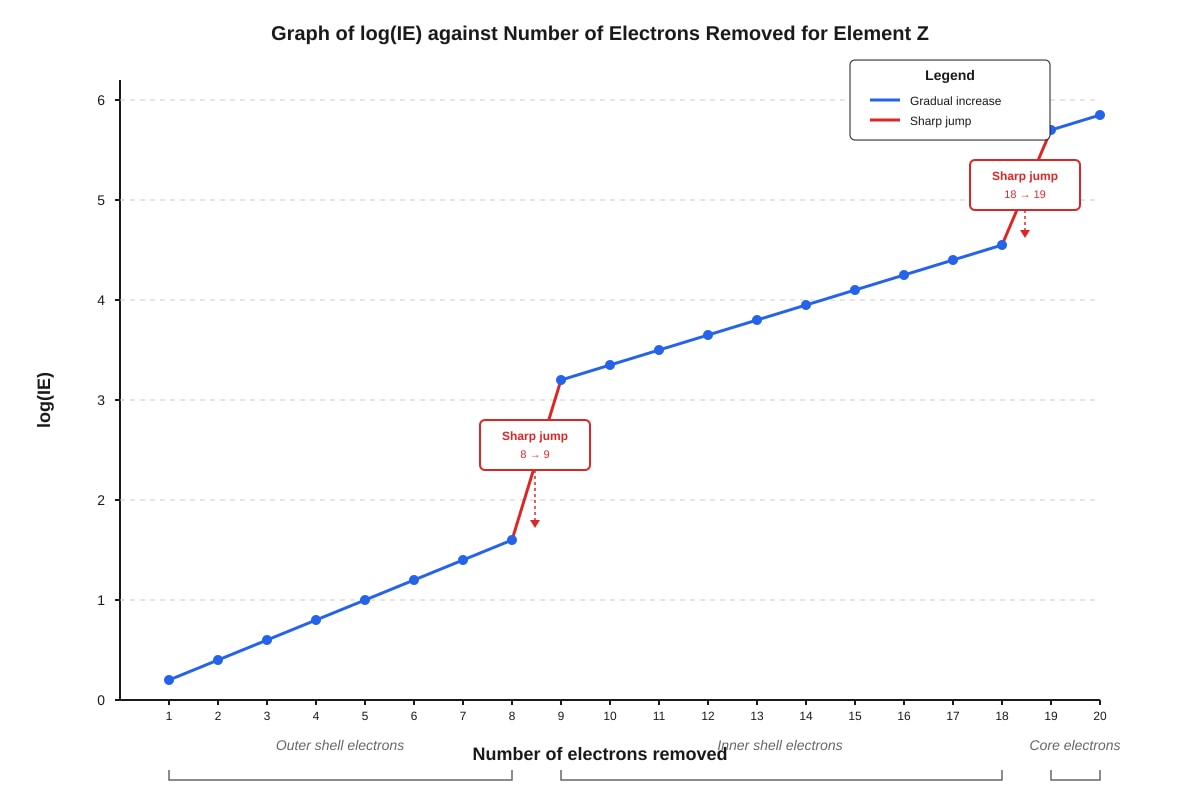
(a) The sharp jump between the 8th and 9th electrons indicates that: [2]
- The first 8 electrons are in the outer shell (valence shell). [1]
- The 9th electron is being removed from an inner shell (closer to the nucleus, more strongly attracted). [1]
- This means the element has 8 electrons in its outermost shell.
(b) Element Z is chlorine (Cl) or an element with 17 electrons [1]
- 8 outer electrons + 9 inner electrons (2 in first shell, 7 remaining) = 17 electrons total → chlorine.
- Alternatively: 2 electrons in first shell, 8 in second shell, 7 in third shell = 17 electrons → Cl.
(c) [1]
Question 5 [4 marks]
(a) 2 electrons [1]
- Each orbital (regardless of type) can hold a maximum of 2 electrons with opposite spins (Pauli exclusion principle).
(b) [2 marks]
- A half-filled subshell is more stable than a configuration due to symmetry and exchange energy. [1]
- One electron from the orbital is promoted to the orbital to achieve the more stable half-filled configuration. [1]
- The energy cost of promotion is compensated by the extra stability gained.
(c) 6 unpaired electrons [1]
- : five unpaired electrons in the five orbitals + one unpaired in = 6 unpaired electrons.
Question 6 [3 marks]
(a) [1]
- Using the Aufbau principle and the rule:
- :
- : (lower fills first when is equal, but is lower than )
- :
- :
(b) [2 marks]
- The orbital has a lower energy than the orbital due to the Aufbau principle. [1]
- Electrons fill orbitals in order of increasing energy; the orbital penetrates closer to the nucleus (less shielded) than , so it is filled first. [1]
- Note: Although fills before , once occupied, is higher in energy than , which is why electrons are removed first during ionisation.
Question 7 [3 marks]
(a) Atomic number of M = 26 [1]
- has 24 electrons (2+2+6+2+6+6 = 24). Neutral M has 24 + 2 = 26 electrons → (iron).
(b) 4 unpaired electrons [1]
- : . Using Hund's rule: ↑↓ ↑ ↑ ↑ ↑ = 4 unpaired electrons.
(c) Paramagnetic [1]
- The ion has unpaired electrons, so it is attracted to a magnetic field (paramagnetic).
- Diamagnetic substances have all electrons paired and are weakly repelled by a magnetic field.
Question 8 [5 marks]
(a) Electronegativity is the relative tendency of an atom to attract a bonding pair of electrons towards itself in a covalent bond. [1]
- Must mention "bonding pair" and "attract towards itself".
(b) [2 marks]
- Fluorine has the smallest atomic radius in Period 2 (excluding noble gases), so the bonding pair is closest to the nucleus. [1]
- It also has a high effective nuclear charge with relatively little shielding. [1]
- Note: Fluorine does NOT have the highest effective nuclear charge overall, but combined with the smallest size, it has the greatest electron-attracting power.
(c) [2 marks]
- Electronegativity difference: (using Pauling values). [1]
- Since (approximately), the bond is polar covalent, not ionic. [1]
- Note: The boundary between ionic and covalent is not absolute. HF is generally classified as polar covalent. Some sources use as ionic; HF with is borderline but typically considered polar covalent.
Question 9 [6 marks]
(a) Element W (electronegativity 0.9) [1 mark for element, 1 mark for explanation]
- W has the lowest electronegativity, meaning it has the least tendency to attract bonding electrons and the greatest tendency to lose electrons. [1]
- It will readily lose electrons to form a cation.
(b) Ionic bonding [1 mark for type, 1 mark for reasoning]
- , which is a large difference. [1]
- W will transfer electrons to Z, forming and ions held together by electrostatic attraction.
(c) Covalent bonding [1 mark for type, 1 mark for reasoning]
- , which is a moderate/small difference. [1]
- Neither atom can completely transfer electrons to the other, so they share electrons.
Question 10 [6 marks]
(a) Dot-and-cross diagram for : [2]
- Nitrogen at the centre with 5 valence electrons (3 used in bonding, 1 lone pair).
- Three hydrogen atoms each sharing one electron with nitrogen.
- Three N–H bonding pairs and one lone pair on nitrogen.
- Marking: 1 mark for correct number of bonds, 1 mark for correct lone pair.
(b) Shape: Trigonal pyramidal [1]
- Bond angle: 107° (accept 106–108°) [1]
(c) [2 marks]
- There are 4 electron pairs around nitrogen (3 bonding + 1 lone pair). [1]
- The lone pair repels more strongly than bonding pairs, compressing the H–N–H bond angles from the ideal tetrahedral angle of 109.5° to approximately 107°. [1]
Question 11 [6 marks]
(a) [3 marks — 1 each]
- (i) : London dispersion forces (van der Waals forces) — is non-polar.
- (ii) : Hydrogen bonding — H bonded to O (highly electronegative, small atom with lone pairs).
- (iii) : Permanent dipole-dipole interactions — HCl is polar but Cl is not electronegative enough (and too large) for hydrogen bonding.
(b) [3 marks]
- molecules are held together by hydrogen bonds, which are strong intermolecular forces. [1]
- molecules are held together by permanent dipole-dipole interactions (and London forces), which are weaker than hydrogen bonds. [1]
- More energy is required to overcome the hydrogen bonds in water, hence the higher boiling point. [1]
- Key point: Sulfur is not electronegative enough (and is too large) to form hydrogen bonds.
Question 12 [6 marks]
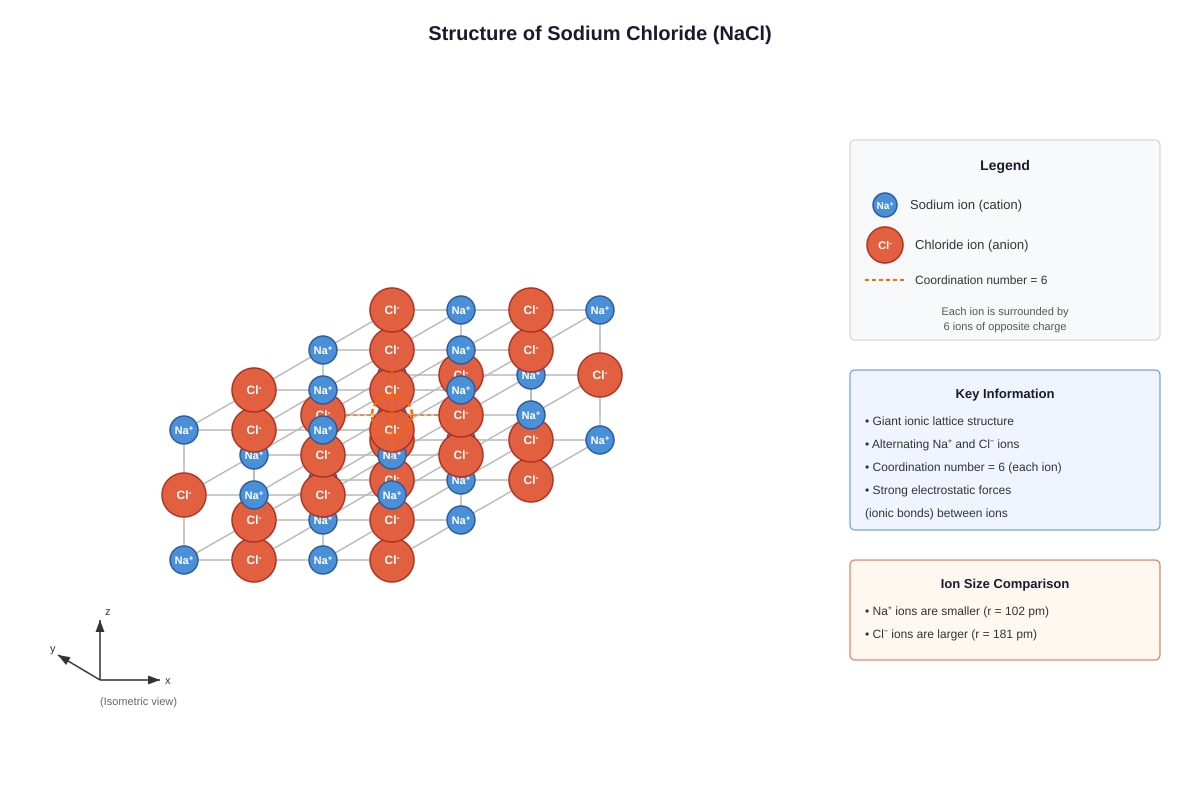
(a) Giant ionic lattice (or crystal lattice) [1]
(b) Ionic bonding [1]
(c) [2 marks]
- There are strong electrostatic forces of attraction between the oppositely charged ions. [1]
- A large amount of energy is required to overcome these strong forces. [1]
(d) [2 marks — 1 for property, 1 for explanation]
- Property: Hard but brittle / conducts electricity when molten or in aqueous solution / soluble in water.
- Explanation (if conductivity): In the solid state, ions are fixed in position and cannot move, so no current flows. When molten/aqueous, ions are free to move and carry charge.
- Explanation (if brittle): Applying force causes layers of ions to shift, bringing like charges adjacent, causing repulsion and fracture.
Question 13 [6 marks]
(a) [3 marks]
- Both and are ionic compounds with giant ionic lattices. [1]
- has a greater charge than , and has a greater charge than . [1]
- The electrostatic attraction between and is stronger than between and , requiring more energy to overcome. [1]
- Note: The ionic radii also differ, but the charge difference is the dominant factor.
(b) [3 marks]
- has a giant covalent (macromolecular) structure with strong covalent bonds throughout the lattice. [1]
- has a simple molecular structure with weak London dispersion forces between molecules. [1]
- Breaking covalent bonds in requires much more energy than overcoming intermolecular forces in . [1]
Question 14 [6 marks]
(a) Shape: Trigonal planar [1]
- Bond angle: 120° [1]
(b) [2 marks]
- Boron has 3 bonding pairs of electrons and no lone pairs around it. [1]
- The 3 bonding pairs repel each other equally and adopt positions as far apart as possible, giving a trigonal planar arrangement with 120° bond angles. [1]
(c) Non-polar molecule [1 mark for answer, 1 mark for explanation]
- Although each B–F bond is polar (F is more electronegative), the symmetrical trigonal planar shape means the bond dipoles cancel out. [1]
- The vector sum of the three bond dipoles is zero, so the molecule has no net dipole moment.
Question 15 [7 marks]
(a) [3 marks — 1 each]
- P: Giant ionic — high MP/BP, conducts when liquid but not solid.
- Q: Simple molecular — low MP/BP, does not conduct in any state.
- R: Giant covalent (metallic or macromolecular) — very high MP/BP, conducts in both states. Given the extreme MP/BP, R is likely giant covalent (e.g., graphite or silicon). However, since it conducts in both solid and liquid states, R is most likely a metal (metallic bonding) or graphite (giant covalent with delocalised electrons). Given the extremely high MP/BP (3550°C), R is most likely graphite (giant covalent) or a metal like tungsten. The best answer is metallic (e.g., tungsten) since it conducts in both states and has very high MP/BP. Alternatively, graphite (giant covalent) also fits.
(b) [2 marks]
- In the solid state, ions are fixed in position in the lattice and cannot move freely, so they cannot carry charge. [1]
- In the liquid (molten) state, ions are free to move and can carry electrical charge through the liquid. [1]
(c) [2 marks]
- R is a metal (e.g., tungsten) [1]
- Reason: It has a very high melting point and conducts electricity in both solid and liquid states due to delocalised electrons that are free to move and carry charge. [1]
- Alternative: R could be graphite (giant covalent) — conducts due to delocalised electrons between layers, very high MP due to strong covalent bonds within layers.
Question 16 [4 marks]
(a) [2 marks]
- Atomic radius decreases across Period 3 from Na to Ar. [1]
- This is because the nuclear charge increases while electrons are added to the same shell (same shielding), so the effective nuclear charge increases, pulling electrons closer to the nucleus. [1]
(b) [2 marks]
- Gallium is in Period 4, so it has an extra shell of electrons compared to aluminium. [1]
- However, between Period 3 and Period 4, the 3d orbitals are filled (the d-block contraction). The 3d electrons shield poorly, so the effective nuclear charge experienced by the outer electrons in gallium is higher than expected, pulling the outer electrons closer and making the atomic radius similar to aluminium. [1]
- This is known as the d-block contraction.
Question 17 [5 marks]
(a) [2 marks — 1 each]
- (i) : hybridisation
- (ii) : hybridisation
(b) [3 marks]
- Each carbon atom forms 3 sigma () bonds: one C–C bond and two C–H bonds. [1]
- The C–C bond also has one pi () bond formed by the sideways overlap of the unhybridised orbitals on each carbon. [1]
- Total bonding in ethene: 5 sigma bonds (1 C–C + 4 C–H) and 1 pi bond (C=C). [1]
- The bond prevents rotation about the C=C bond.
Question 18 [5 marks]
(a) [2 marks]
- Metals have a sea of delocalised electrons that are not bound to any particular atom. [1]
- When a potential difference is applied, these delocalised electrons are free to move through the lattice and carry electrical charge. [1]
(b) [3 marks]
- Both Na and Mg have metallic bonding. [1]
- has a greater charge than , and magnesium has more delocalised electrons per atom (2 vs 1). [1]
- The electrostatic attraction between the cations and delocalised electrons is stronger in magnesium, requiring more energy to overcome, hence a higher melting point. [1]
Question 19 [6 marks]
(a) [2 marks]
- First ionisation energy generally increases across Period 3. [1]
- This is due to increasing nuclear charge with electrons being added to the same shell (similar shielding), resulting in a stronger attraction between the nucleus and outer electrons. [1]
(b) [2 marks]
- Aluminium's outer electron is in a orbital, while magnesium's outer electron is in a orbital. [1]
- The orbital is higher in energy and further from the nucleus than the orbital, so the electron is easier to remove. [1]
- Note: The electron also experiences slightly more shielding from the electrons.
(c) [2 marks]
- Phosphorus has the configuration with one electron in each orbital (half-filled, stable). [1]
- Sulfur has the configuration , so one orbital has a pair of electrons; the electron-electron repulsion makes it easier to remove one electron. [1]
Question 20 [6 marks]
(a) [3 marks]
- Gas at room temperature → simple molecular structure with weak intermolecular forces. [1]
- Dissolves in water to form acidic solution → the compound reacts with water to produce ions (e.g., gas dissolving to form hydrochloric acid). [1]
- Does not conduct electricity in liquid state → covalent bonding (no free ions in the pure liquid). [1]
(b) Hydrogen chloride, [1]
- (Accept other suitable answers such as or , but best fits all criteria including pH ≈ 5.)
(c) Dot-and-cross diagram for : [2]
- Hydrogen contributes 1 electron, chlorine contributes 7 valence electrons.
- One shared pair (bonding pair) between H and Cl.
- Three lone pairs on chlorine.
- Marking: 1 mark for correct bonding pair, 1 mark for correct lone pairs on Cl.
END OF ANSWER KEY
Total: 50 marks