From Real Exams Quiz
A Level H2 Chemistry Acids Bases Salts Quiz
Free A Level H2 Chemistry Acids Bases Salts quiz, HY3 Exam version, with questions, answers, and A Level-style practice for Singapore students.
These static practice materials are generated from the site's syllabus and paper-generation workflow, with source and model context shown so students and parents can evaluate the material before use.
Questions
A-Level Chemistry H2 Quiz - Acids Bases Salts
Name: ________________________
Class: ________________________
Date: ________________________
Score: ________ / 40
Duration: 60 minutes
Total Marks: 40
Instructions:
- Answer all 20 questions.
- Show all working clearly where calculations are required.
- Use appropriate chemical notation and units.
- Section A: Short structured questions (1–8)
- Section B: Data interpretation and calculations (9–14)
- Section C: Extended response (15–20)
Section A: Short Structured Questions (1–8)
1. [2 marks]
Define a Brønsted–Lowry acid and a Brønsted–Lowry base.
Acid: ____________________________________________________________
Base: ____________________________________________________________
2. [1 mark]
Write the conjugate base of HCO3−.
Answer: ________________________
3. [2 marks]
A student recorded the following titration volumes of 0.100 mol dm−3 NaOH required to neutralise 25.0 cm3 of HCl:
| Trial | Volume / cm³ |
|---|---|
| 1 (rough) | 24.80 |
| 2 | 24.35 |
| 3 | 24.40 |
| 4 | 24.38 |
From the table, obtain a suitable mean titre for use in calculations. Show your working.
Mean titre = ________________________
4. [2 marks]
Complete the gas test table below.
| Gas | Test and Result |
|---|---|
| NH3 | ________________________________________________ |
| CO2 | ________________________________________________ |
5. [2 marks]
State the observation when NaOH(aq) is added dropwise then in excess to Al3+(aq).
Dropwise: ________________________________________
Excess: __________________________________________
6. [1 mark]
Calculate the pH of 1.0×10⁻³ mol dm−3 HCl. Assume complete dissociation.
pH = ________
7. [2 marks]
Write the expression for the acid dissociation constant, Ka, for ethanoic acid, CH3COOH.
Ka = ________________________________________________
8. [2 marks]
A buffer solution contains 0.10 mol dm−3 CH3COOH and 0.20 mol dm−3 CH3COO−. Given Ka=1.8×10⁻⁵ mol dm−3, calculate its pH.
pH = ________________________
Section B: Data Interpretation and Calculations (9–14)
9. [3 marks]
25.0 cm3 of 0.0800 mol dm−3 H2SO4 was titrated with 0.100 mol dm−3 KOH.
(a) Write the balanced equation.
(b) Calculate the volume of KOH required for complete neutralisation.
10. [3 marks]
The Ka of benzoic acid, C6H5COOH, is 6.3×10⁻⁵ mol dm−3. Calculate the pH of a 0.050 mol dm−3 solution of benzoic acid.
11. [3 marks]
A solution has [H+]=3.2×10⁻⁴ mol dm−3.
(a) Calculate the pH.
(b) State whether the solution is acidic, neutral, or alkaline.
(c) Calculate [OH−] using Kw=1.0×10⁻¹⁴ mol2 dm−6.
12. [4 marks]
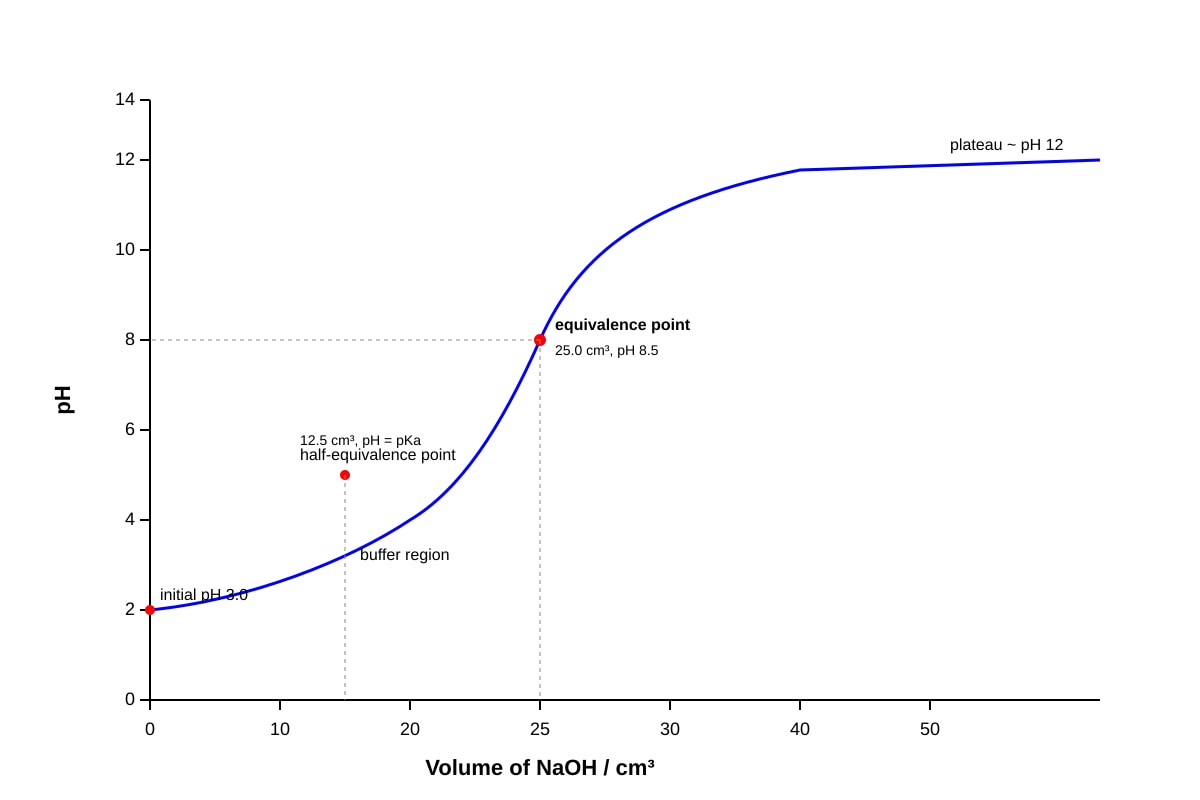
A titration curve for a weak acid vs strong base is shown below.
Image pending generation: graph for Q12.
(a) From the graph, state the volume at the equivalence point. [1]
(b) Deduce the pKa of the acid. [1]
(c) Explain why the pH at equivalence is greater than 7. [2]
13. [3 marks]
0.200 g of an impure sample of CaCO3 was dissolved in excess HCl and the solution titrated with 0.0500 mol dm−3 NaOH. 28.6 cm3 NaOH was required. If the HCl added initially was 50.0 cm3 of 0.100 mol dm−3, calculate the percentage purity of CaCO3. (Mr of CaCO3=100.1)
14. [3 marks]
State and explain the effect on the pH of a CH3COOH/CH3COO− buffer when a small amount of HCl is added.
Section C: Extended Response (15–20)
15. [3 marks]
Compare the Lewis and Brønsted–Lowry definitions of a base, giving one example of a species that acts as a base under each definition.
16. [3 marks]
Explain, with equations, how a buffer resists changes in pH when a small amount of NaOH is added.
17. [3 marks]
A student adds NH3(aq) dropwise then in excess to Cu2+(aq). Describe the observations and write the formula of the complex formed in excess.
18. [3 marks]
Describe how you would test for the presence of SO42− ions in a solution, and state the observation for a positive test.
19. [3 marks]
Calculate the pH of a solution formed by mixing 50.0 cm3 of 0.100 mol dm−3 HCl with 50.0 cm3 of 0.100 mol dm−3 Ba(OH)2. Show all steps.
20. [3 marks]
Explain why Al(OH)3 is described as amphoteric, with reference to its reactions with acid and base.
Answers
A-Level Chemistry H2 Quiz - Acids Bases Salts: Answer Key
Total Marks: 40
Question count: 20 (exactly)
Section A
1. [2 marks]
- Acid: A proton (H+) donor. [1]
- Base: A proton (H+) acceptor. [1]
Teaching note: Brønsted–Lowry theory extends Arrhenius by not requiring water. A conjugate pair differs by one H+.
2. [1 mark]
CO32−
Teaching note: Remove one H+ from HCO3−: HCO3−→CO32−+H+.
3. [2 marks]
- Reject trial 1 (rough). Concordant: 24.35, 24.40, 24.38 (range 0.05 ≤ 0.10). [1]
- Mean = (24.35+24.40+24.38)/3=24.376...≈24.38 cm3 to 2 d.p. [1]
Common mistake: Including rough titre or averaging non-concordant values.
4. [2 marks]
- NH3: Turns damp red litmus paper blue. [1]
- CO2: Gives a white precipitate with limewater (ppt. dissolves in excess CO2). [1]
Marking: Must specify "damp red litmus" and "white ppt." for full credit.
5. [2 marks]
- Dropwise: White precipitate of Al(OH)3. [1]
- Excess: Precipitate dissolves to form colourless [Al(OH)4]− solution. [1]
Note: Al3+ is amphoteric; dissolves in excess NaOH.
6. [1 mark]
pH = 3.0
Working: [H+]=1.0×10⁻³; pH=−log10(1.0×10⁻³)=3.00.
7. [2 marks]
Ka=[CH3COOH][CH3COO−][H+] [2]
Note: State (aq) optional; exclude water.
8. [2 marks]
pH=pKa+log([CH3COOH][CH3COO−])
pKa=−log(1.8×10⁻⁵)=4.74
pH=4.74+log(0.20/0.10)=4.74+0.301=5.04 [2]
Common mistake: Reversing ratio.
Section B
9. [3 marks]
(a) H2SO4+2KOH→K2SO4+2H2O [1]
(b) Moles H2SO4=0.0250×0.0800=2.00×10⁻³ mol
Moles KOH needed = 2×2.00×10−3=4.00×10⁻³ mol
Vol KOH = 4.00×10⁻³/0.100=0.0400 dm3=40.0 cm3 [2]
10. [3 marks]
HA⇌H++A−, Ka=0.050−xx2≈0.050x2
x2=6.3×10−5×0.050=3.15×10⁻⁶
x=1.775×10⁻³
pH=−log(1.775×10⁻³)=2.75 [3]
11. [3 marks]
(a) pH=−log(3.2×10⁻⁴)=3.49 [1]
(b) Acidic (pH < 7) [1]
(c) [OH−]=Kw/[H+]=1.0×10−14/3.2×10−4=3.1×10−11 mol dm−3 [1]
12. [4 marks]
(a) 25.0 cm³ [1]
(b) At half-equivalence (12.5 cm³), pH = pKa = approx 4.5 (read from graph) [1]
(c) Salt of weak acid + strong base hydrolyses: A−+H2O⇌HA+OH−, producing OH− so pH > 7. [2]
13. [3 marks]
Moles HCl initial = 0.0500×0.100=5.00×10⁻³
Moles NaOH used = 0.0286×0.0500=1.43×10⁻³
Moles HCl reacted with CaCO3 = 5.00×10⁻³−1.43×10−3=3.57×10⁻³
CaCO3+2HCl→CaCl2+CO2+H2O
Moles CaCO3 = 3.57×10⁻³/2=1.785×10−3
Mass pure = 1.785×10−3×100.1=0.1787 g
% purity = (0.1787/0.200)×100=89.4% [3]
14. [3 marks]
HCl reacts with CH3COO−: CH3COO−+H+→CH3COOH. [1]
[CH3COO−] decreases slightly, [CH3COOH] increases; ratio changes little. [1]
Henderson–Hasselbalch shows pH drop is small. [1]
Section C
15. [3 marks]
Lewis base: electron-pair donor (e.g. NH3). [1]
Brønsted–Lowry base: proton acceptor (e.g. OH−). [1]
Difference: Lewis broader, not requiring H+. [1]
16. [3 marks]
CH3COOH⇌CH3COO−+H+
Added OH− consumes H+: H++OH−→H2O. [1]
Equilibrium shifts right, CH3COOH dissociates to replace H+. [1]
[H+] remains near constant, pH stable. [1]
17. [3 marks]
Dropwise: pale blue precipitate Cu(OH)2. [1]
Excess: precipitate dissolves to deep blue solution. [1]
Complex: [Cu(NH3)4]2+. [1]
18. [3 marks]
Add BaCl2(aq) (or Ba(NO3)2) acidified with HCl. [1]
Positive: white precipitate of BaSO4. [1]
Equation: Ba2++SO42−→BaSO4(s). [1]
19. [3 marks]
Moles H+ = 0.0500×0.100=5.00×10⁻³
Moles OH− = 0.0500×0.100×2=1.00×10⁻²
Excess OH− = 5.00×10⁻³; total vol = 100 cm³ = 0.100 dm³
[OH−]=5.00×10⁻³/0.100=0.0500 mol dm−3
pOH=1.30, pH=12.70 [3]
20. [3 marks]
Amphoteric: reacts with acid and base. [1]
With acid: Al(OH)3+3H+→Al3++3H2O. [1]
With base: Al(OH)3+OH−→[Al(OH)4]−. [1]
Free quiz and exam paper access
Enter your details to view this paper
Your access is remembered on this device.