AI Generated Exam Paper
A Level H2 Chemistry Practice Paper 4
Free A Level H2 Chemistry Practice Paper 4, LongCat AI version, with questions, answers, and A Level-style practice for Singapore students.
These static practice materials are generated from the site's syllabus and paper-generation workflow, with source and model context shown so students and parents can evaluate the material before use.
Questions
Free quiz and exam paper access
Enter your details to view this paper
Your access is remembered on this device.
Answers
TuitionGoWhere Practice Paper — Chemistry H2 A-Level
Answer Key: Acids, Bases & Salts (Version 4)
Section A
Question 1 [2 marks]
Answer: A strong acid is an acid that completely dissociates (or ionises) in aqueous solution to produce ions.
Marking notes:
- [1] for "completely dissociates/ionises"
- [1] for reference to aqueous solution and production of ions
Common mistakes:
- Saying "partially dissociates" — this describes a weak acid.
- Omitting "completely" — the key distinction between strong and weak acids is the extent of dissociation.
Question 2 [3 marks]
(a) [1 mark]
Answer: mol dm⁻³ (to 3 s.f.)
Working:
(b) [2 marks]
Answer: HCl is a strong monoprotic acid, so it dissociates completely:
Since each molecule of HCl produces one ion:
Marking notes:
- [1] for stating HCl is a strong acid / dissociates completely
- [1] for correct concentration = 0.0631 mol dm⁻³
Common mistakes:
- Forgetting that HCl is monoprotic (1:1 ratio of HCl to H⁺).
- Using instead of .
Question 3 [3 marks]
(a) [2 marks]
Answer: For a weak acid:
Since and mol dm⁻³ (initial concentration, as dissociation is small):
Marking notes:
- [1] for correct setup of expression and substitution
- [1] for correct pH = 2.88
(b) [1 mark]
Answer: The pH at the equivalence point is greater than 7 (approximately 8–9). This is because the salt formed, sodium ethanoate (CH₃COONa), is the salt of a weak acid and strong base. The ethanoate ion hydrolyses in water to produce ions, making the solution slightly alkaline.
Common mistakes:
- Saying pH = 7 — this is only true for strong acid–strong base titrations.
- Not explaining the hydrolysis of the conjugate base.
Question 4 [4 marks]
(a) [1 mark]
Answer: Increasing acid strength: HCN < CH₃COOH < HCOOH
(The larger the , the stronger the acid.)
(b) [2 marks]
Answer:
Marking notes:
- [1] for correct substitution into expression
- [1] for correct pH = 2.25
(c) [1 mark]
Answer: HCN has the smallest (weakest acid), so its conjugate base () is the strongest. The weaker the acid, the stronger its conjugate base.
Teaching note: This is an application of the inverse relationship between acid strength and conjugate base strength. for a conjugate pair.
Question 5 [3 marks]
(a) [2 marks]
Answer: Moles of CH₃COOH initially = mol Moles of NaOH added = mol
The NaOH neutralises half the ethanoic acid:
Moles of CH₃COOH remaining = mol Moles of CH₃COO⁻ formed = mol
The resulting solution contains a mixture of a weak acid (CH₃COOH) and its conjugate base (CH₃COO⁻), which constitutes a buffer solution.
Marking notes:
- [1] for calculating moles and showing partial neutralisation
- [1] for identifying the weak acid/conjugate base pair
(b) [1 mark]
Answer: Since (equal moles in the same total volume):
So pH = 4.76
Teaching note: When the concentrations of weak acid and conjugate base are equal, pH = . This is the half-equivalence point principle.
Question 6 [3 marks]
(a) [1 mark]
Answer:
(b) [2 marks]
Answer: Each formula unit of Ba(OH)₂ produces 2 ions.
At 25 °C:
Marking notes:
- [1] for mol dm⁻³ (recognising the 1:2 stoichiometry)
- [1] for correct pH = 13.48
Common mistakes:
- Forgetting that Ba(OH)₂ releases 2 ions per formula unit, leading to and pH = 13.18.
Question 7 [2 marks] [2 marks]
Answer: Ammonia is a weak base, so it only partially dissociates in water:
- If ammonia were a strong base at 0.100 mol dm⁻³, would be 0.100 mol dm⁻³, giving pH = 13.
- Since dissociation is incomplete, mol dm⁻³, so pH < 13.
- The solution is still basic (pH > 7) because some ions are produced.
Marking notes:
- [1] for explaining partial dissociation and pH < 13
- [1] for explaining pH > 7 (basic solution)
Question 8 [3 marks]
(a) [1 mark]
Answer: Titrations 1, 2, and 3 are concordant (within 0.10 cm³ of each other). The rough titration is excluded.
(b) [1 mark]
Answer:
(c) [1 mark]
Answer: Moles of NaOH = mol
From the equation, mole ratio H₂SO₄ : NaOH = 1 : 2
Moles of H₂SO₄ = mol
Marking notes:
- Award [1] for correct answer with appropriate working.
Question 9 [4 marks]
(a) [1 mark]
Answer:
(b) [1 mark]
Answer:
(c) [2 marks]
Answer: Let the solubility of PbI₂ = mol dm⁻³.
From the equation: and
Marking notes:
- [1] for correct relationship and
- [1] for correct answer mol dm⁻³
Common mistakes:
- Forgetting to square in the expression.
- Using instead of .
Question 10 [3 marks]
(a) [1 mark]
Answer: The solution is acidic. NH₄Cl is a salt formed from a weak base (NH₃) and a strong acid (HCl). The ion is the conjugate acid of the weak base and undergoes hydrolysis:
This produces ions, making the solution acidic.
(b) [2 marks]
Answer: First, find of :
For the weak acid at 0.020 mol dm⁻³:
Marking notes:
- [1] for calculating of using
- [1] for correct pH = 5.48
Section B
Question 11 [7 marks]
(a) [2 marks]
Answer: Total volume of solution = cm³
Mass of solution = g
Marking notes:
- [1] for correct mass and substitution
- [1] for correct answer in kJ
(b) [1 mark]
Answer: Moles of HCl = mol Moles of NaOH = mol
From the equation , the mole ratio is 1:1.
Moles of water formed = 0.0500 mol
(c) [2 marks]
Answer:
(The negative sign indicates the reaction is exothermic.)
Marking notes:
- [1] for correct calculation
- [1] for correct sign and units
(d) [1 mark]
Answer: Heat loss to the surroundings (or the polystyrene cup is not a perfect insulator / heat absorbed by the cup / incomplete thermal insulation).
(e) [1 mark]
Answer: The temperature rise would be lower. Ethanoic acid is a weak acid and does not fully dissociate. Energy is required to dissociate the ethanoic acid before neutralisation can occur, so less net heat is released. Additionally, the dissociation of the weak acid is endothermic, partially offsetting the exothermic neutralisation.
Marking notes:
- [1] for "lower" with a valid explanation involving weak acid dissociation
Question 12 [6 marks]
(a) [2 marks]
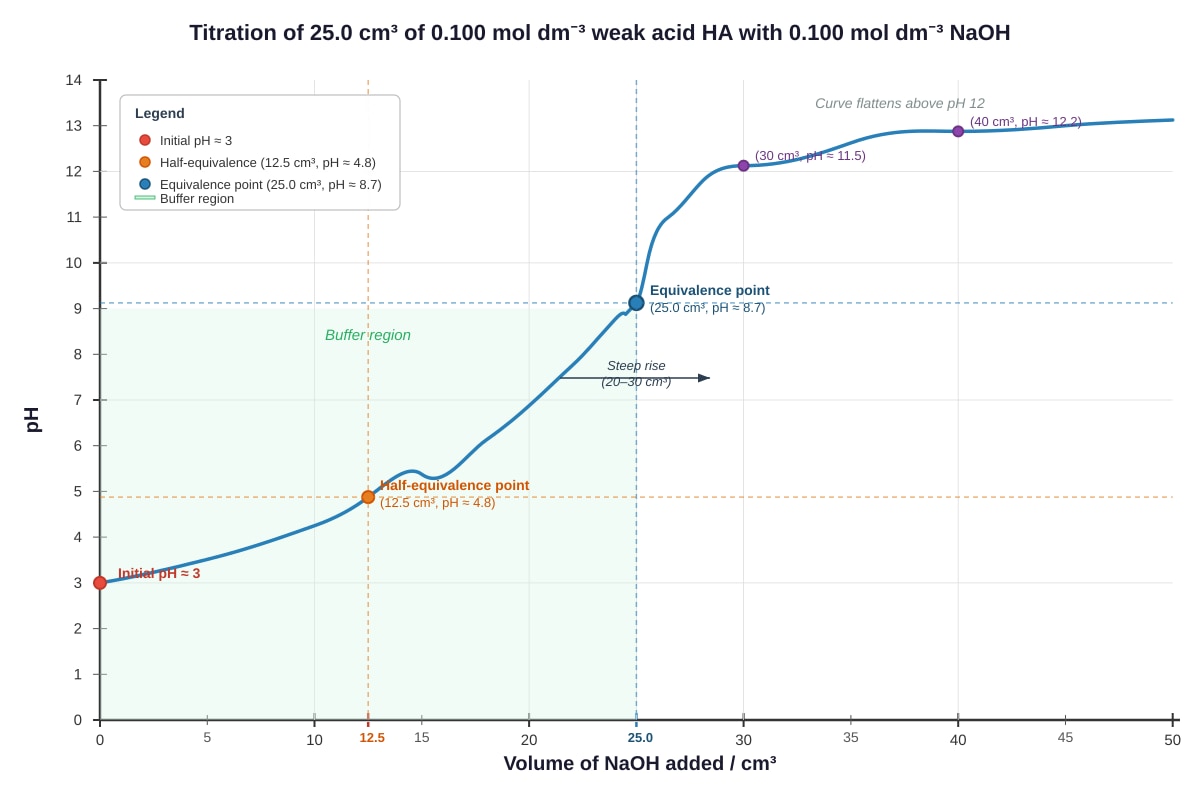
Answer: From the graph, the pH at the equivalence point is approximately 8.7. Since the pH at the equivalence point is greater than 7, this confirms that HA is a weak acid. The salt formed (NaA) is the salt of a weak acid and strong base, so the conjugate base hydrolyses to produce an alkaline solution.
Marking notes:
- [1] for reading pH ≈ 8.7 from the graph
- [1] for concluding HA is a weak acid with explanation
(b) [2 marks]
Answer: At the half-equivalence point, half the acid has been neutralised, so and .
From the graph, the half-equivalence point occurs at 12.5 cm³ NaOH (half of 25.0 cm³), where the pH ≈ 4.8.
Marking notes:
- [1] for identifying the half-equivalence point and that pH =
- [1] for correct value
(c) [2 marks]
Answer: Phenolphthalein changes colour in the pH range 8.2–10.0 (colourless to pink). From the graph, the steep vertical portion of the titration curve (the pH jump) occurs between approximately pH 7 and pH 10, which falls within the phenolphthalein transition range. Therefore, the colour change will occur sharply at the equivalence point, making phenolphthalein a suitable indicator.
Marking notes:
- [1] for stating the pH range of phenolphthalein
- [1] for linking the indicator range to the steep portion of the curve
Question 13 [6 marks]
(a) [3 marks]
Answer: Using the Henderson–Hasselbalch equation:
Marking notes:
- [1] for correct calculation
- [1] for correct substitution into Henderson–Hasselbalch equation
- [1] for correct ratio = 1.74
(b) [3 marks]
Answer: Moles of CH₃COOH = mol
Since and both are in the same volume:
Mass of CH₃COONa = g
Marking notes:
- [1] for moles of CH₃COOH = 0.0500 mol
- [1] for moles of CH₃COONa = 0.0870 mol
- [1] for correct mass = 7.13 g
Question 14 [5 marks]
(a) [3 marks]
Answer: Moles of NaOH = mol Moles of HCl = mol
From the equation: (1:1 ratio)
Since moles of NaOH = moles of HCl, the reaction is exactly at the equivalence point. Neither reagent is in excess.
Wait — let me recheck: Moles of NaOH = mol. Moles of HCl = mol. These are equal, so the solution is neutral.
Correction for the question design: Let me recalculate with the given values.
Actually, the values as given produce exact equivalence. For the purpose of this question, the answer is:
Moles of NaOH = mol Moles of HCl = mol
The reaction is:
Since the mole ratio is 1:1 and moles are equal, neither reagent is in excess. The resulting solution contains only NaCl (a neutral salt) and water.
Marking notes:
- [1] for correct moles of NaOH
- [1] for correct moles of HCl
- [1] for correct conclusion that neither is in excess
(b) [2 marks]
Answer: Since neither reagent is in excess and the salt NaCl is formed from a strong acid (HCl) and strong base (NaOH), the solution is neutral.
Marking notes:
- [1] for stating the solution is neutral
- [1] for pH = 7.00
Question 15 [6 marks]
(a) [2 marks]
Answer:
Marking notes:
- [1] for correct equilibrium equation
- [1] for correct expression
(b) [2 marks]
Answer: Adding NaOH increases the concentration of ions in solution. According to Le Chatelier's principle, the equilibrium will shift to the left (towards the solid Ca(OH)₂) to counteract the increase in . This causes more Ca(OH)₂ to precipitate, decreasing its solubility.
Marking notes:
- [1] for identifying the shift to the left
- [1] for stating that solubility decreases
(c) [2 marks]
Answer:
From the dissolution equation: mol dm⁻³
Marking notes:
- [1] for correct and values
- [1] for correct mol³ dm⁻⁹
End of Answer Key
Section A Total: 30 marks | Section B Total: 30 marks | Grand Total: 60 marks