AI Generated Exam Paper
A Level H2 Chemistry Practice Paper 4
Free A Level H2 Chemistry Practice Paper 4, HY3 AI version, with questions, answers, and A Level-style practice for Singapore students.
These static practice materials are generated from the site's syllabus and paper-generation workflow, with source and model context shown so students and parents can evaluate the material before use.
Questions
Free quiz and exam paper access
Enter your details to view this paper
Your access is remembered on this device.
Answers
TuitionGoWhere Practice Paper — Answer Key (Version 4)
Subject: Chemistry H2
Level: A-Level
Total Marks: 60
Section A Answers (21 marks)
1. [2 marks]
- Acid: proton (H⁺) donor. [1]
- Base: proton (H⁺) acceptor. [1]
Teaching note: Brønsted–Lowry broadens Arrhenius by focusing on H⁺ transfer, not just aqueous OH⁻.
2. [2 marks]
Equation: CO₂(g) + Ca²⁺(aq) + 2OH⁻(aq) → CaCO₃(s) + H₂O(l) or CO₂ + Ca(OH)₂ → CaCO₃ + H₂O. [1]
Observation: limewater turns milky/white precipitate forms. [1]
Common mistake: forgetting ppt dissolves in excess CO₂.
3. [2 marks]
White precipitate of Al(OH)₃ forms initially. [1]
Precipitate dissolves in excess NaOH to form colourless [Al(OH)₄]⁻(aq). [1]
4. [3 marks]
NH₄Cl → NH₄⁺ + Cl⁻. Cl⁻ from strong acid HCl is neutral. [1]
NH₄⁺ + H₂O ⇌ NH₃ + H₃O⁺. [1]
Production of H₃O⁺ makes solution acidic. [1]
5. [3 marks]
Rough (24.80) rejected. [1]
24.30 and 24.35 concordant (diff < 0.10). 24.90 rejected as outlier. [1]
Mean = (24.30 + 24.35)/2 = 24.33 cm³. [1]
6. [2 marks]
K_w = [H⁺][OH⁻]. [1]
Value = 1.0 × 10⁻¹⁴ mol² dm⁻⁶ at 25 °C. [1]
7. [2 marks]
Salt: sodium ethanoate (CH₃COONa). [1]
CH₃COOH + NaOH → CH₃COONa + H₂O. [1]
Section B Answers (24 marks)
8. [3 marks]
Molar solubility = 0.00143 / 143.5 = 9.97 × 10⁻⁶ mol dm⁻³. [1]
AgCl ⇌ Ag⁺ + Cl⁻, so [Ag⁺] = [Cl⁻] = 9.97 × 10⁻⁶. [1]
K_sp = (9.97 × 10⁻⁶)² = 9.94 × 10⁻¹¹ mol² dm⁻⁶. [1]
9. [3 marks]
pH = pK_a + log([A⁻]/[HA]). [1]
pK_a = –log(1.8 × 10⁻⁵) = 4.74. [1]
pH = 4.74 + log(0.40/0.25) = 4.74 + 0.204 = 4.94. [1]
10. [2 marks]
[H⁺] = 0.020 mol dm⁻³. [1]
pH = –log(0.020) = 1.70. [1]
11. [3 marks]
Moles NaOH = 0.0250 × 0.100 = 2.50 × 10⁻³ mol. [1]
2NaOH + H₂SO₄ → Na₂SO₄ + 2H₂O, so mol H₂SO₄ = 1.25 × 10⁻³. [1]
Conc H₂SO₄ = 1.25 × 10⁻³ / 0.0200 = 0.0625 mol dm⁻³. [1]
12. [3 marks]
Mg(OH)₂ ⇌ Mg²⁺ + 2OH⁻. Let s = solubility, [OH⁻] = 2s. [1]
K_sp = s(2s)² = 4s³ = 5.61 × 10⁻¹². [1]
s = ∛(1.40 × 10⁻¹²) = 1.12 × 10⁻⁴ mol dm⁻³. [1]
13. [3 marks]
[H⁺] = 10⁻³·⁰⁰ = 1.00 × 10⁻³. [1]
[A⁻] = [H⁺] = 1.00 × 10⁻³, [HA] = 0.050 – 0.001 = 0.049. [1]
K_a = (1.00 × 10⁻³)² / 0.049 = 2.04 × 10⁻⁵ mol dm⁻³. [1]
14. [4 marks]
After mixing: [Ca²⁺] = 0.010×50/100 = 5.0×10⁻³, [F⁻] = 0.020×50/100 = 1.0×10⁻². [1]
Q = [Ca²⁺][F⁻]² = (5.0×10⁻³)(1.0×10⁻²)² = 5.0×10⁻⁷. [1]
Q > K_sp (3.45×10⁻¹¹). [1]
Therefore precipitate forms. [1]
Section C Answers (15 marks)
15. [2 marks]
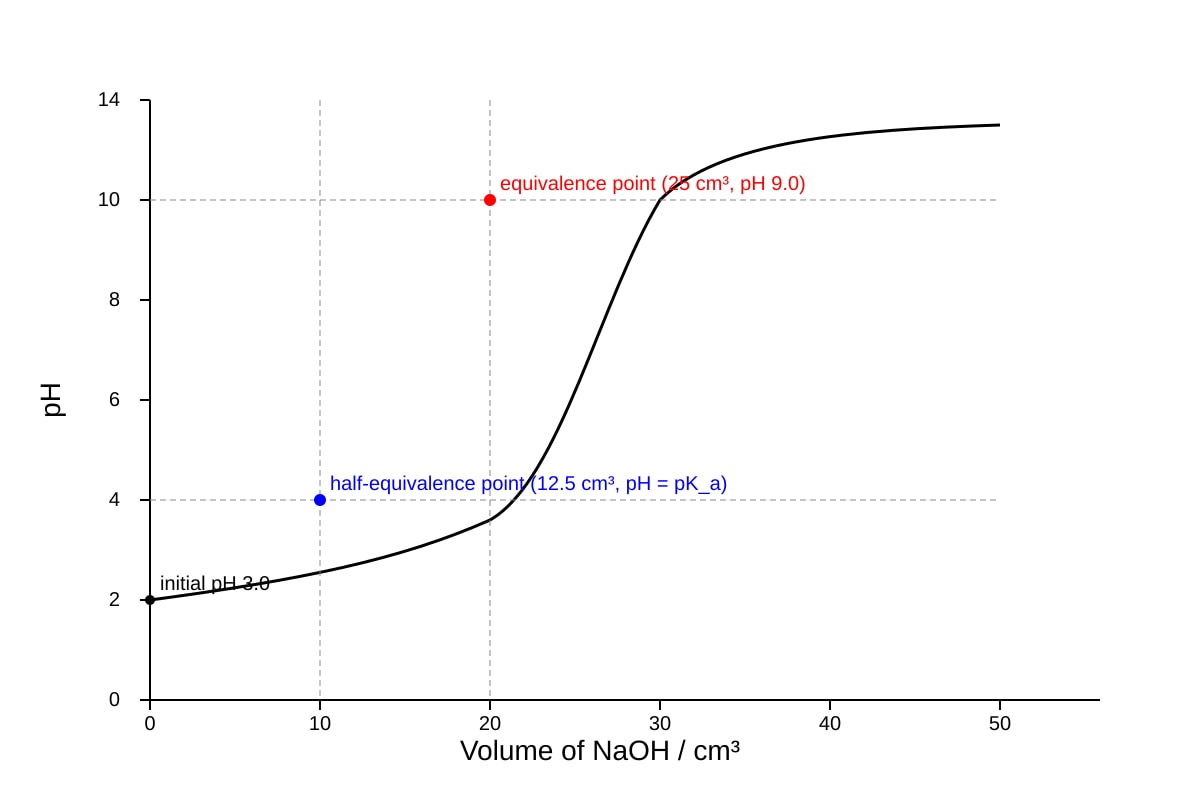
pH at half-equivalence = pK_a of acid. [1]
Significance: at this point [HA] = [A⁻], buffer capacity maximal, pH = pK_a. [1]
16. [1 mark]
From graph half-equivalence pH ≈ pK_a; if pH = 3.0 at half-eq, pK_a = 3.0. (based on placeholder values)
17. [3 marks]
Cu²⁺ + excess NH₃: deep blue solution [Cu(NH₃)₄]²⁺. [1]
Zn²⁺ + NaOH: white ppt. soluble in excess → [Zn(OH)₄]²⁻. [1]
Zn²⁺ + NH₃: white ppt. soluble in excess. [1]
18. [3 marks]
Initial pH = pK_a = 4.74. [1]
Add 0.010 mol H⁺: CH₃COO⁻ decreases to 0.19, CH₃COOH increases to 0.21. [1]
pH = 4.74 + log(0.19/0.21) = 4.69 (small change). [1]
19. [2 marks]
Rinse pH probe with distilled water before use. [1]
Stir solution uniformly and calibrate pH meter. [1]
20. [3 marks]
Both consume added OH⁻ via HA + OH⁻ → A⁻ + H₂O or NH₄⁺ + OH⁻ → NH₃ + H₂O. [1]
CH₃COOH buffer effective near pH 4.7, NH₄⁺/NH₃ near pH 9.2. [1]
Choice depends on required pH range; both resist change via equilibrium shift. [1]