AI Generated Exam Paper
A Level H2 Chemistry Practice Paper 3
Free A Level H2 Chemistry Practice Paper 3, LongCat AI version, with questions, answers, and A Level-style practice for Singapore students.
These static practice materials are generated from the site's syllabus and paper-generation workflow, with source and model context shown so students and parents can evaluate the material before use.
Questions
Free quiz and exam paper access
Enter your details to view this paper
Your access is remembered on this device.
Answers
TuitionGoWhere Practice Paper — Chemistry H2 A-Level
Answer Key: Acids, Bases & Salts
Section A: Multiple Choice
1. B —
Explanation: A conjugate base is formed when an acid donates a proton (). loses one to become . Option A () is the conjugate acid (gaining a proton), not the conjugate base. This tests understanding of conjugate acid-base pairs: acid → conjugate base + .
2. B — mol dm
Explanation:
- , so mol dm
- At 25 °C:
- mol dm
Wait — let me recalculate: . Then mol dm.
Hmm, that gives , which is option C. Let me re-examine.
Actually:
mol dm
This rounds to mol dm, which is C.
Corrected Answer: C — mol dm
Common mistake: Students may confuse with and select option A, or miscalculate the antilog.
3. C —
Explanation: is a salt formed from a weak base () and a strong acid (). The ion undergoes hydrolysis: , producing ions and making the solution acidic. and produce basic solutions (salts of strong base + weak acid). is neutral (strong acid + strong base).
4. A — 3.20
Explanation:
- For a weak acid: mol dm
Common mistake: Students may incorrectly calculate and get pH = 2.70 (option B), forgetting to multiply by the concentration first.
5. D — The resulting solution is not a buffer because only is present.
Explanation: Moles of mol. Moles of mol. The acid and base react in a 1:1 ratio, so all the is completely neutralised to form . The resulting solution contains only (a salt), with no remaining weak acid to act as a buffer component. A buffer requires a weak acid and its conjugate base in comparable amounts.
6. B — 7.0
Explanation: is a strong base and is a strong acid. At the equivalence point, the salt formed is , which is neutral (from strong acid + strong base). The pH at the equivalence point is 7.0. This contrasts with weak acid–strong base titrations where the equivalence point pH > 7 due to hydrolysis of the conjugate base.
7. A — mol dm
Explanation:
- If solubility = , then and
- mol dm
Common mistake: Forgetting the stoichiometric coefficient of and writing instead of .
8. C — Phenolphthalein
Explanation: In a weak acid–strong base titration, the equivalence point occurs at pH > 7 (basic) because the conjugate base of the weak acid hydrolyses. The pH change around the equivalence point falls in the range of approximately 7–10. Phenolphthalein has a pH range of 8.2–10.0, which falls within this steep pH change region. Methyl orange (3.1–4.4) would change colour too early, well before the equivalence point.
9. B — ions react with water to produce .
Explanation: is a salt of a strong base () and a weak acid (). The ion is the conjugate base of and undergoes hydrolysis: . This produces ions, making the solution alkaline. does not hydrolyse (it is the conjugate acid of a strong base).
10. A — mol dm
Explanation:
- , so mol dm
- For : mol dm
- Remaining mol dm (approximation valid since dissociation is small)
- mol dm
11. C — The pH remains almost unchanged.
Explanation: This is a buffer solution containing a weak acid () and its conjugate base (). When a small amount of is added, the ions are consumed by the conjugate base: . This shifts the equilibrium but the ratio changes only slightly, so the pH remains almost unchanged. This is the defining property of a buffer.
12. A — mol dm
Explanation: The ionic product of water is defined as . At 25 °C, mol dm. Option B has the wrong value. Option C incorrectly uses a ratio. Option D incorrectly uses a sum.
13. C — 40.0 cm³
Explanation:
- is diprotic:
- Moles of mol
- Moles of needed mol
- Volume of dm cm³
Common mistake: Forgetting that provides 2 moles of per mole of acid and using a 1:1 ratio, giving 20.0 cm³ (option B).
14. B — 10.52
Explanation:
- mol dm
- mol dm
15. C —
Explanation: The extent of hydrolysis depends on the strength of the parent acid and base. is neutral (strong acid + strong base, no hydrolysis). undergoes cationic hydrolysis (weak base cation). undergoes anionic hydrolysis with , which is the conjugate base of the weak acid — since is weak, is relatively strongly basic and undergoes extensive hydrolysis. has both ions hydrolysing but the effects partially cancel ( for the parent acid and base). is the strongest base among the anions listed because it is the conjugate base of a weak acid () which itself comes from a weak acid ().
Section B: Structured Questions
16. Buffer Solutions and pH Calculations [8 marks]
(a) [2 marks]
A buffer solution is a solution that resists changes in pH when small amounts of acid or base are added, or when it is diluted. It typically consists of a weak acid and its conjugate base (or a weak base and its conjugate acid).
Marking:
- [1] for mentioning resistance to pH change
- [1] for identifying the components (weak acid + conjugate base, or weak base + conjugate acid)
(b)(i) [3 marks]
Step 1: Calculate moles of each component after mixing.
- Moles of mol
- Moles of mol
- Total volume cm³ dm³
Step 2: Calculate concentrations in the mixture.
- mol dm
- mol dm
Step 3: Apply the Henderson-Hasselbalch equation.
Marking:
- [1] for correct moles/concentrations
- [1] for correct and correct substitution into Henderson-Hasselbalch
- [1] for correct final answer (pH = 3.52)
(b)(ii) [3 marks]
When a small amount of dilute is added, the ions from react with the methanoate ions () in the buffer:
This removes the added ions by converting them into un-ionised . The equilibrium:
shifts to the left (Le Chatelier's principle) as is consumed. Since the buffer contains relatively large reservoirs of both and , the ratio changes only slightly, and hence the pH remains nearly constant.
Marking:
- [1] for stating that added reacts with
- [1] for the equation showing the reaction
- [1] for explaining that the ratio changes little / reference to Le Chatelier's principle
17. Solubility Product and Precipitation [8 marks]
(a) [1 mark]
Marking:
- [1] for correct expression (no state symbols needed, no solids included)
(b) [2 marks]
Let solubility mol dm
and
Marking:
- [1] for correct setup ()
- [1] for correct answer ( or mol dm)
(c) [3 marks]
In 0.10 mol dm , mol dm (from the dissolved salt, assuming the contribution from dissolved is negligible).
The solubility is mol dm, which is much lower than in pure water. This is due to the common ion effect: the presence of from shifts the equilibrium to the left (Le Chatelier's principle), suppressing the dissolution of .
Marking:
- [1] for correct calculation
- [1] for identifying the common ion effect
- [1] for explaining the shift in equilibrium
(d) [2 marks]
After mixing equal volumes, the concentrations are halved:
- mol dm
- mol dm
Ionic product
Since ionic product () (), a precipitate of will form.
Marking:
- [1] for correct calculation of ionic product
- [1] for correct comparison with and conclusion
18. Acid-Base Titrations and Indicators [8 marks]
(a) [3 marks]
| Titration | Rough | 1 | 2 | 3 |
|---|---|---|---|---|
| Final reading / cm³ | 24.80 | 24.35 | 24.30 | 24.40 |
| Initial reading / cm³ | 0.00 | 0.00 | 0.00 | 0.00 |
| Titre / cm³ | 24.80 | 24.35 | 24.30 | 24.40 |
Titrations 2 and 3 are concordant (within 0.10 cm³ of each other: cm³ ✓; cm³ ✓).
All three accurate titrations (1, 2, 3) are within 0.10 cm³ of each other, so all three can be used.
Marking:
- [1] for correct table format with all readings
- [1] for identifying concordant titres and excluding the rough titration
- [1] for correct mean titre calculation (24.35 cm³)
(b) [2 marks]
Moles of mol
Moles of mol (1:1 ratio)
Marking:
- [1] for correct moles calculation
- [1] for correct concentration (0.0974 mol dm)
(c) [3 marks]
This is a weak acid () – strong base () titration. At the equivalence point, the solution contains , which hydrolyses to give a solution with pH > 7 (approximately pH 8.7–9.0). The steep portion of the titration curve around the equivalence point spans approximately pH 7 to pH 10.
Phenolphthalein changes colour in the pH range 8.2–10.0, which falls within the steep pH change region around the equivalence point. Therefore, the colour change from colourless to pink will occur sharply at the equivalence point, giving an accurate result.
Marking:
- [1] for identifying this as a weak acid–strong base titration with equivalence point pH > 7
- [1] for stating the pH range of phenolphthalein (8.2–10.0)
- [1] for explaining that this range falls within the steep region of the curve
19. Salt Hydrolysis and pH [6 marks]
(a) [1 mark]
Salt hydrolysis is the reaction of the ions of a salt with water to produce or ions, resulting in a solution that is not neutral (i.e., pH ≠ 7).
Marking:
- [1] for a clear definition involving reaction of salt ions with water producing or
(b)(i) — Acidic [2 marks]
is a salt of a strong acid () and a weak base (). The ion undergoes hydrolysis:
Or more precisely (stepwise):
The highly charged ion polarises the coordinated water molecules, making it easier for a proton to be released. This produces ions, making the solution acidic.
Marking:
- [1] for correct prediction (acidic)
- [1] for correct hydrolysis equation
(b)(ii) — Basic [2 marks]
is a salt of a strong base () and a weak acid (). The ion undergoes hydrolysis:
This produces ions, making the solution basic.
Marking:
- [1] for correct prediction (basic)
- [1] for correct hydrolysis equation
(b)(iii) — Neutral [1 mark]
is a salt of a strong acid () and a strong base (). Neither nor undergoes hydrolysis, so the solution is neutral (pH = 7).
Marking:
- [1] for correct prediction (neutral) with valid reasoning
Section C: Data Interpretation and Application
20. Polyprotic Acids and Titration Curves [15 marks]
(a) [3 marks]
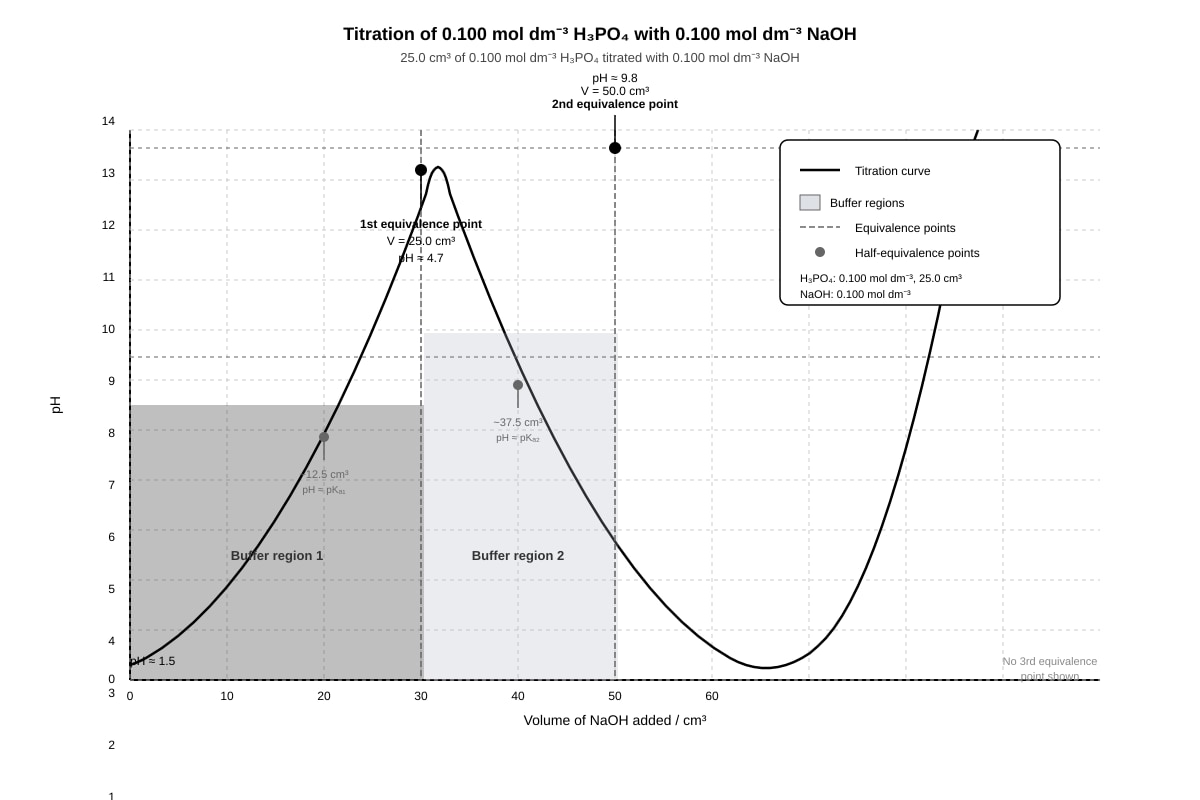
The first equivalence point occurs when all has been converted to :
At this point, the solution contains (the amphoteric species ). The pH is determined by the amphoteric behaviour of , which can act as both an acid and a base. For an amphoteric species, the pH is approximately:
The pH is not 7 because is not a neutral salt — it is an amphoteric ion whose pH depends on the average of and .
Marking:
- [1] for identifying the species present at the first equivalence point ()
- [1] for recognising it is amphoteric
- [1] for the calculation using
(b) [3 marks]
The third ionisation constant is extremely small, meaning is an extremely weak acid. The third equivalence point would require:
At the third equivalence point, the solution would contain , which is a relatively strong conjugate base (since is very small, for is large). The pH at the third equivalence point would be very high (>12), and the pH change would be very gradual because the very weak third dissociation provides very little buffering capacity. Additionally, at such high pH, the effect of atmospheric dissolution becomes significant, making the endpoint indistinct. The very small means the third buffer region has very low capacity, and the steep pH rise is not sharp enough to detect with an indicator.
Marking:
- [1] for noting that is extremely small
- [1] for explaining that the third equivalence point pH would be very high / indistinct
- [1] for explaining the lack of a sharp pH change / buffer capacity issue
(c) [2 marks]
At the first half-equivalence point, exactly half of the has been neutralised:
Using the Henderson-Hasselbalch equation:
Since , the ratio , and .
Therefore:
Marking:
- [1] for stating that at the half-equivalence point
- [1] for applying Henderson-Hasselbalch and showing
(d) [2 marks]
At the second equivalence point, all has been converted to . The pH at this point is approximately:
Phenolphthalein changes colour in the range pH 8.2–10.0. Since the equivalence point pH (~9.77) falls within this range, and the steep portion of the titration curve around the second equivalence point also falls within this range, phenolphthalein is a suitable indicator for the second equivalence point.
Marking:
- [1] for calculating or estimating the pH at the second equivalence point
- [1] for concluding that phenolphthalein is suitable because its range overlaps with the equivalence point pH
(e) [3 marks]
At the second equivalence point, all the original has been converted to .
Moles of initially mol
From the stoichiometry:
- First equivalence: (1:1)
- Second equivalence: (1:1)
At the second equivalence point, moles of mol
Total volume cm³ dm³
Marking:
- [1] for correct moles of
- [1] for correct total volume
- [1] for correct concentration (0.0333 mol dm)
(f) [2 marks]
For the solution containing 0.10 mol dm and 0.10 mol dm :
Using the Henderson-Hasselbalch equation:
Since mol dm:
Marking:
- [1] for correct expression and value
- [1] for correct pH calculation (7.21)
Mark Summary:
| Section | Marks |
|---|---|
| A: Q1–15 (MCQ) | 15 |
| B: Q16 | 8 |
| B: Q17 | 8 |
| B: Q18 | 8 |
| B: Q19 | 6 |
| C: Q20 | 15 |
| Total | 60 |