AI Generated Exam Paper
A Level H2 Chemistry Practice Paper 3
Free A Level H2 Chemistry Practice Paper 3, HY3 AI version, with questions, answers, and A Level-style practice for Singapore students.
These static practice materials are generated from the site's syllabus and paper-generation workflow, with source and model context shown so students and parents can evaluate the material before use.
Questions
TuitionGoWhere Practice Paper - Chemistry H2 A-Level
TuitionGoWhere Practice Paper (AI) — Version 3
Subject: Chemistry H2
Level: A-Level
Paper: Practice Paper (Topic: Acids Bases Salts)
Duration: 1 hour 15 minutes
Total Marks: 60
Name: ________________________
Class: ________________________
Date: ________________________
Instructions:
- This practice paper contains 20 questions on Acids, Bases & Salts.
- Section A: Multiple-choice style short items (1–5). Section B: Structured calculations and explanations (6–14). Section C: Data-based and extended response (15–20).
- Show all working clearly. Use appropriate units and chemical notation.
- The total marks for this paper are 60. Section marks: A = 10, B = 27, C = 23.
Section A (10 marks)
Answer all questions. Each question carries 2 marks.
1. Define a Brønsted–Lowry acid and a Brønsted–Lowry base.
2. Write the conjugate base of HCO3− and the conjugate acid of NH3.
3. State the colour change of methyl orange in acid and in alkali.
4. A solution has pH = 3. What is the [H+] in mol dm⁻³?
5. Name the salt formed from the reaction of nitric acid and potassium hydroxide.
Section B (27 marks)
Answer all questions. Show your working.
6. (3 marks) Calculate the pH of a 0.050 mol dm−3 solution of HCl at 25 °C.
7. (3 marks) The Ka of ethanoic acid, CH3COOH, is 1.8×10⁻⁵ mol dm−3. Calculate the pH of a 0.10 mol dm−3 solution of ethanoic acid.
8. (4 marks) A buffer solution contains 0.20 mol dm−3 CH3COOH and 0.30 mol dm−3 CH3COONa. Calculate its pH. (Ka of CH3COOH=1.8×10⁻⁵ mol dm−3)
9. (3 marks) Explain, using equations, how the above buffer (Q8) resists a change in pH when a small amount of NaOH is added.
10. (3 marks) The solubility of AgCl in water at 25 °C is 1.43×10⁻³ g dm−3. Calculate the Ksp of AgCl. (Molar mass AgCl = 143.5 g mol−1)
11. (3 marks) State and explain the effect on the solubility of AgCl when NaCl is added to the solution.
12. (2 marks) A student titrated 25.0 cm3 of 0.100 mol dm−3 NaOH with HCl and recorded: 24.6, 24.8, 24.7, 25.9 cm³. Identify the concordant titres and give the mean titre to 2 d.p.
13. (3 marks) Write the ionic equation for the reaction of aqueous Al3+ with excess NaOH, and state the observation.
14. (3 marks) A solution gives a white precipitate with BaCl2 solution that is insoluble in dilute HCl. Identify the anion and give the test confirmation.
Section C (23 marks)
Answer all questions. Data interpretation and extended response.
15. The table below shows titration results from a practical session.
| Titration | Volume of FA used / cm³ |
|---|---|
| Rough | 26.40 |
| 1 | 25.85 |
| 2 | 25.90 |
| 3 | 25.80 |
(a) (2 marks) Select a suitable volume of FA for calculations and show your working.
(b) (1 mark) State why the rough titration is excluded.
16. (4 marks) A buffer is made by mixing 0.025 mol of NH3 (Kb=1.8×10⁻⁵) and 0.040 mol of NH4Cl in 250 cm3 solution. Calculate the pH.
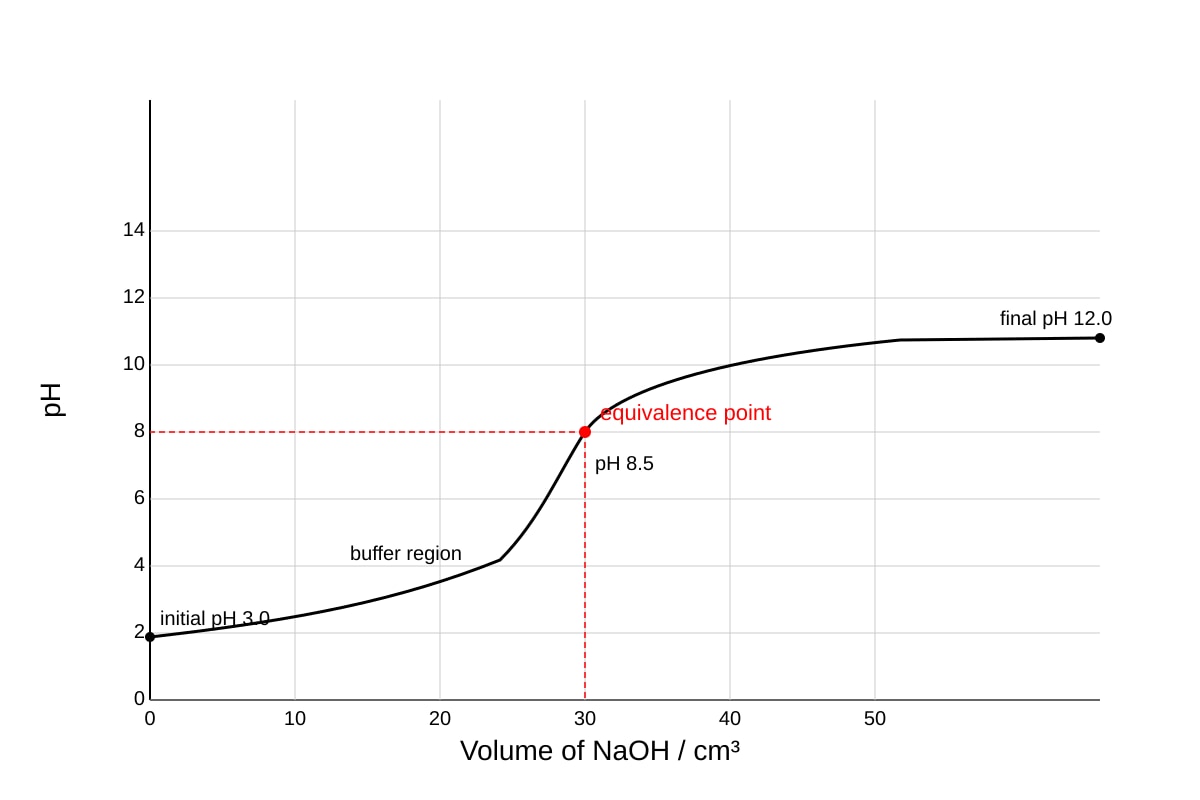
17. The graph below shows the titration curve of a weak acid with a strong base.
Image pending generation: graph for 17.
(a) (2 marks) State the pH at the equivalence point and explain why it is >7.
(b) (2 marks) Suggest an appropriate indicator for this titration.
18. (4 marks) Compare the acid strengths of HCl and CH3COOH of equal concentration using Brønsted–Lowry theory and degree of dissociation.
19. (4 marks) A sample of chalk (CaCO₃) is reacted with excess HCl. The CO₂ evolved is collected. Write equations and explain how you would determine the purity of the chalk by back titration.
20. (4 marks) The Ksp of Mg(OH)2 is 1.8×10⁻¹¹ mol3 dm−9. Calculate the molar solubility and the pH of a saturated solution.
Answers
TuitionGoWhere Practice Paper — Answer Key (Version 3)
Subject: Chemistry H2 A-Level
Topic: Acids Bases Salts
Total Marks: 60
Section A (10 marks)
1. (2 marks)
- Brønsted–Lowry acid: proton (H+) donor. [1]
- Brønsted–Lowry base: proton (H+) acceptor. [1]
Teaching note: This definition extends Arrhenius by not requiring water. E.g. NH3+H+→NH4+ shows NH3 as base.
2. (2 marks)
- Conjugate base of HCO3−: CO32− (loss of H+). [1]
- Conjugate acid of NH3: NH4+ (gain of H+). [1]
3. (2 marks)
- Acid: red. [1]
- Alkali: yellow. [1]
Common mistake: confusing with phenolphthalein (colourless→pink).
4. (2 marks)
[H+]=10−pH=10−3=1.0×10⁻³ mol dm−3. [2]
Method: pH = -log[H⁺] so [H⁺] = 10⁻ᵖᴴ.
5. (2 marks)
Potassium nitrate, KNO3. [2] (acid + base → salt + water; HNO3+KOH→KNO3+H2O)
Section B (27 marks)
6. (3 marks)
HCl is strong monoprotic: [H+]=0.050 mol dm−3.
pH = −log(0.050)=1.30. [3] (1 for [H⁺], 2 for log calc)
7. (3 marks)
CH3COOH⇌H++CH3COO−
Ka=[CH3COOH][H+][CH3COO−]≈0.10x2
x=1.8×10−5×0.10=1.34×10⁻³
pH = −log(1.34×10⁻³)=2.87. [3]
8. (4 marks)
Henderson–Hasselbalch: pH=pKa+log[HA][A−]
pKa=−log(1.8×10⁻⁵)=4.74
pH=4.74+log(0.30/0.20)=4.74+0.18=4.92. [4] (1 pKa, 1 ratio, 1 log, 1 final)
9. (3 marks)
OH−+CH3COOH→CH3COO−+H2O. [2]
The added OH− is consumed by weak acid, so [H+] changes little. [1]
10. (3 marks)
Molar solubility = 1.43×10⁻³/143.5=9.97×10−6 mol dm−3.
AgCl⇌Ag++Cl−, so Ksp=s2=(9.97×10⁻⁶)2=9.94×10⁻¹¹ mol2 dm−6. [3]
11. (3 marks)
Solubility decreases (common ion effect). [1]
Cl− from NaCl shifts equilibrium AgCl(s)⇌Ag++Cl− left. [2]
12. (2 marks)
Concordant: 25.85, 25.90, 25.80 (differ <0.1). [1]
Mean = (25.85+25.90+25.80)/3=25.85 cm3. [1]
13. (3 marks)
Al3++4OH−→[Al(OH)4]−. [2]
Observation: white ppt. dissolves in excess NaOH. [1]
14. (3 marks)
Anion: SO42−. [1]
Test: white ppt. with BaCl2, insoluble in dilute HCl confirms sulphate. [2]
Section C (23 marks)
15. (a) (2 marks)
Use 25.85, 25.90, 25.80 (concordant). Mean = 25.85 cm³. [2]
(b) (1 mark) Rough is not precise, used to find approx endpoint. [1]
16. (4 marks)
[NH3]=0.025/0.250=0.10 M; [NH4+]=0.040/0.250=0.16 M
pOH=pKb+log([NH4+]/[NH3])=4.74+log(0.16/0.10)=4.74+0.20=4.94
pH = 14 – 4.94 = 9.06. [4]
17. (a) (2 marks)
pH ≈ 8.5. [1] Salt of weak acid + strong base is alkaline. [1]
(b) (2 marks) Phenolphthalein (range 8.2–10.0). [2]
18. (4 marks)
HCl is strong: fully dissociated, high [H+]. [2]
CH3COOH weak: partial dissociation (small Ka), lower [H+]. [2]
19. (4 marks)
CaCO3+2HCl→CaCl2+CO2+H2O. [1]
Excess HCl titrated with std NaOH. [1]
Moles HCl reacted = total – leftover. [1]
From stoich, moles CaCO3 = ½ moles HCl; compare to sample mass for purity. [1]
20. (4 marks)
Mg(OH)2⇌Mg2++2OH−; Ksp=s(2s)2=4s3=1.8×10⁻¹¹
s=(4.5×10⁻¹²)1/3=1.65×10−4 M. [2]
[OH−]=2s=3.30×10⁻⁴; pOH = 3.48; pH = 10.52. [2]
Free quiz and exam paper access
Enter your details to view this paper
Your access is remembered on this device.