AI Generated Exam Paper

A Level H2 Chemistry Practice Paper 2

Free AI-Generated Owl Alpha A Level H2 Chemistry Practice Paper 2 practice paper with questions and answers for Singapore students. This page is rendered as a direct URL so the questions and answers can be discovered without pressing in-page buttons.

These static practice materials are generated from the site's syllabus and paper-generation workflow, with source and model context shown so students and parents can evaluate the material before use.

A Level H2 Chemistry AI Generated Generated by Owl Alpha Updated 2026-06-07

Questions

<!-- TuitionGoWhere generation metadata: stage=5-2; model=openrouter/owl-alpha; model_label=Owl Alpha; generated=2026-06-06; Sources: Stage 4-0 LLM templates, syllabus context, and Stage 2 evidence where available. -->

TuitionGoWhere Practice Paper - Chemistry H2 A-Level

TuitionGoWhere Practice Paper (AI)

Subject: Chemistry Level: A-Level H2 Paper: Practice Paper — Acids, Bases & Salts Duration: 1 hour 30 minutes Total Marks: 50 Name: ___________________________ Class: ___________________________ Date: ___________________________


Instructions

  • Answer all questions in the spaces provided.
  • The number of marks for each question or part-question is shown in brackets [ ].
  • All numerical answers should be given to an appropriate number of significant figures unless otherwise stated.
  • The use of a Data Booklet is permitted.
  • A periodic table and relevant constants are provided on the last page.
  • Electronic calculators may be used.

Section A: Multiple Choice [10 marks]

Questions 1–10: Choose the one correct answer for each question. Write your answer in the space provided.


1. Which of the following is the conjugate base of HSO4HSO_4^-?

A. H2SO4H_2SO_4 B. SO42SO_4^{2-} C. H3O+H_3O^+ D. H2SO3H_2SO_3

Answer: ________ [1]


2. A solution has a pH of 3.40. What is the concentration of OHOH^- ions in this solution at 25 °C?

A. 2.51×1042.51 \times 10^{-4} mol dm3^{-3} B. 3.98×10113.98 \times 10^{-11} mol dm3^{-3} C. 2.51×10112.51 \times 10^{-11} mol dm3^{-3} D. 3.98×1043.98 \times 10^{-4} mol dm3^{-3}

Answer: ________ [1]


3. Which of the following salts will produce an aqueous solution with pH > 7?

A. NH4ClNH_4Cl B. NaNO3NaNO_3 C. K2CO3K_2CO_3 D. AlCl3AlCl_3

Answer: ________ [1]


4. The KaK_a of a weak acid HAHA is 4.0×1064.0 \times 10^{-6} mol dm3^{-3}. What is the pH of a 0.050 mol dm3^{-3} solution of HAHA?

A. 2.70 B. 3.35 C. 3.85 D. 5.35

Answer: ________ [1]


5. A buffer solution is prepared by mixing 50.0 cm3^3 of 0.200 mol dm3^{-3} CH3COOHCH_3COOH with 50.0 cm3^3 of 0.200 mol dm3^{-3} NaOHNaOH. Which statement about this mixture is correct?

A. The solution is a buffer because it contains a weak acid and its conjugate base. B. The solution is not a buffer because all the CH3COOHCH_3COOH has been neutralised. C. The solution is not a buffer because it contains only CH3COOCH_3COO^- and excess NaOHNaOH. D. The solution is a buffer because it contains CH3COOHCH_3COOH and CH3COOCH_3COO^- in equal amounts.

Answer: ________ [1]


6. During the titration of a weak acid with a strong base, at the half-equivalence point, which relationship holds?

A. pH=pKapH = pK_a B. pH=12pKapH = \frac{1}{2} pK_a C. pH=pKwpH = pK_w D. pH=pKa+1pH = pK_a + 1

Answer: ________ [1]


7. The solubility product, KspK_{sp}, of Mg(OH)2Mg(OH)_2 is 5.6×10125.6 \times 10^{-12} mol3^3 dm9^{-9} at 25 °C. What is the solubility of Mg(OH)2Mg(OH)_2 in water at 25 °C?

A. 1.1×1041.1 \times 10^{-4} mol dm3^{-3} B. 1.8×1041.8 \times 10^{-4} mol dm3^{-3} C. 2.2×1042.2 \times 10^{-4} mol dm3^{-3} D. 1.1×1061.1 \times 10^{-6} mol dm3^{-3}

Answer: ________ [1]


8. Which indicator is most suitable for a titration of 0.10 mol dm3^{-3} NH3NH_3 (Kb=1.8×10⁵K_b = 1.8 \times 10^{-5}) with 0.10 mol dm3^{-3} HClHCl?

IndicatorpH range of colour change
Methyl orange3.1 – 4.4
Bromothymol blue6.0 – 7.6
Phenolphthalein8.2 – 10.0
Thymol blue8.0 – 9.6

A. Methyl orange B. Bromothymol blue C. Phenolphthalein D. Thymol blue

Answer: ________ [1]


9. A solution contains 0.10 mol dm3^{-3} HCOOHHCOOH (Ka=1.8×10⁴K_a = 1.8 \times 10^{-4}) and 0.15 mol dm3^{-3} HCOONaHCOONa. What is the pH of this solution?

A. 3.57 B. 3.92 C. 4.12 D. 4.74

Answer: ________ [1]


10. Which of the following best explains why the pH at the equivalence point of a titration between CH3COOHCH_3COOH and NaOHNaOH is greater than 7?

A. Excess NaOHNaOH is present at the equivalence point. B. CH3COOCH_3COO^- is the conjugate base of a weak acid and undergoes hydrolysis to produce OHOH^-. C. Na+Na^+ ions react with water to produce OHOH^-. D. CH3COOHCH_3COOH is only partially neutralised.

Answer: ________ [1]


Section B: Structured Questions [25 marks]


11. [4 marks]

(a) Define the term Brønsted–Lowry acid. [1]


(b) In the following reaction, identify the two conjugate acid–base pairs:

NH3+H2ONH4++OHNH_3 + H_2O \rightleftharpoons NH_4^+ + OH^-

Pair 1: acid ________ / conjugate base ________ [1] Pair 2: acid ________ / conjugate base ________ [1]

(c) Explain why NH3NH_3 can act as a Brønsted–Lowry base. [1]


12. [5 marks]

A student titrates 25.0 cm3^3 of 0.120 mol dm3^{-3} NaOHNaOH solution with 0.100 mol dm3^{-3} H2SO4H_2SO_4.

(a) Write the balanced equation for the reaction. [1]


(b) Calculate the volume of H2SO4H_2SO_4 required to reach the equivalence point. [3]


(c) Suggest a suitable indicator for this titration and state the colour change observed. [1]

Indicator: _______________________ Colour change: _______________________


13. [6 marks]

The following data were obtained from a titration of 25.0 cm3^3 of a solution of a weak monoprotic acid HAHA with 0.100 mol dm3^{-3} NaOHNaOH:

TitrationRough123
Final reading / cm3^324.8024.3524.3024.30
Initial reading / cm3^30.000.000.000.00
Volume used / cm3^324.8024.3524.3024.30

(a) Calculate a suitable average titre to be used in your calculations. Show clearly how you obtained this value. [2]


(b) Calculate the concentration of the acid HAHA in mol dm3^{-3}. [2]


(c) The pH of the solution at the equivalence point was found to be 8.72. Explain why the pH is not 7. [2]


14. [5 marks]

A buffer solution is prepared by mixing 100 cm3^3 of 0.300 mol dm3^{-3} HCOOHHCOOH with 100 cm3^3 of 0.150 mol dm3^{-3} NaOHNaOH.

(KaK_a for HCOOH=1.8×10⁴HCOOH = 1.8 \times 10^{-4} mol dm3^{-3})

(a) Calculate the number of moles of HCOOHHCOOH and HCOOHCOO^- present in the buffer after the reaction. [2]


(b) Calculate the pH of the resulting buffer solution. [2]


(c) State and explain what happens to the pH when a small amount of dilute HClHCl is added to this buffer. [1]


15. [5 marks]

The solubility product, KspK_{sp}, of CaF2CaF_2 is 3.9×10113.9 \times 10^{-11} mol3^3 dm9^{-9} at 25 °C.

(a) Write an expression for the solubility product, KspK_{sp}, of CaF2CaF_2. [1]


(b) Calculate the solubility of CaF2CaF_2 in water at 25 °C, in mol dm3^{-3}. [3]


(c) Predict and explain whether the solubility of CaF2CaF_2 would increase, decrease, or remain the same if dissolved in 0.10 mol dm3^{-3} NaFNaF solution instead of pure water. [1]


Section C: Free Response [15 marks]


16. [8 marks]

A student performs a titration to determine the concentration of a solution of ethanoic acid, CH3COOHCH_3COOH, using 0.100 mol dm3^{-3} NaOHNaOH.

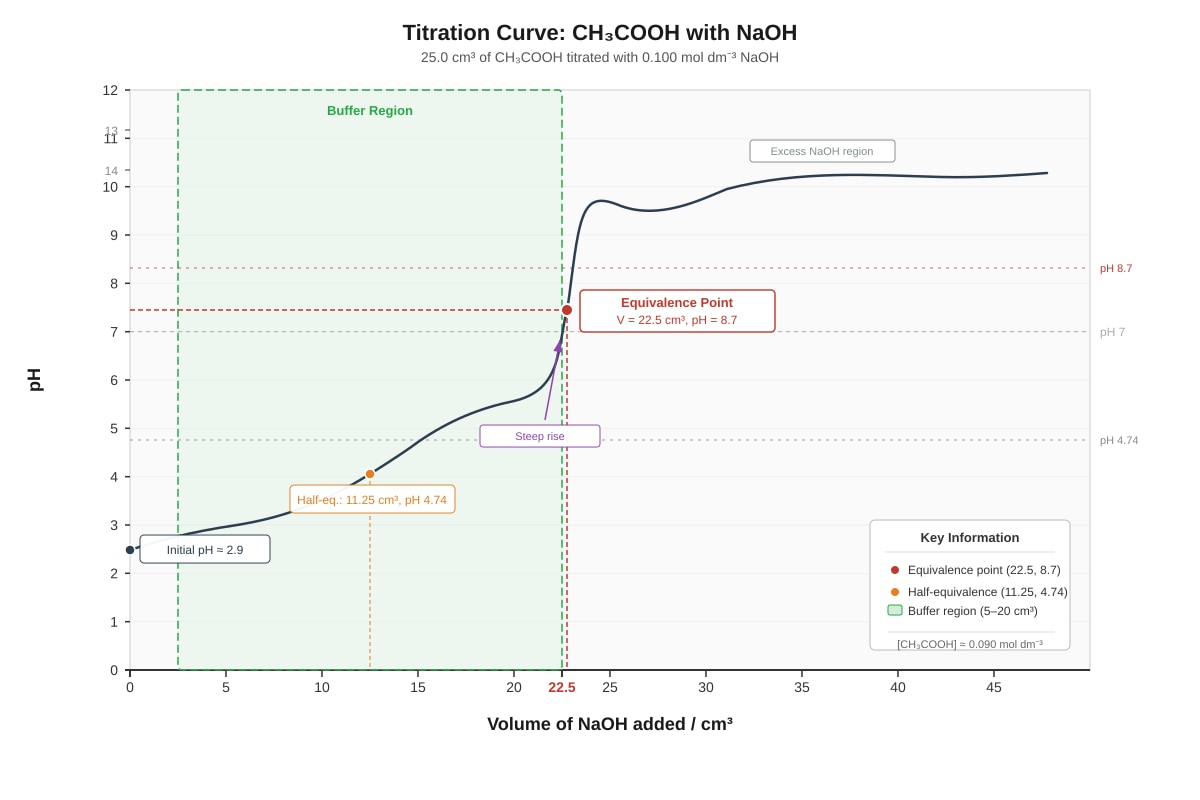
25.0 cm3^3 of CH3COOHCH_3COOH solution is titrated with 0.100 mol dm3^{-3} NaOHNaOH. The following pH curve was obtained:

<image_placeholder> id: Q16-fig1 type: graph linked_question: Q16 description: pH titration curve for 25.0 cm³ of CH₃COOH titrated with 0.100 mol dm⁻³ NaOH. The curve starts at approximately pH 2.9, rises gradually through the buffer region, then steeply rises through the equivalence point at approximately pH 8.7, and levels off around pH 12. The equivalence point volume is approximately 22.5 cm³. labels: x-axis: "Volume of NaOH added / cm³" (0 to 45), y-axis: "pH" (0 to 14), equivalence point marked at ~22.5 cm³, pH at equivalence point ~8.7, buffer region highlighted between ~5 cm³ and ~20 cm³ values: equivalence volume ≈ 22.5 cm³, initial pH ≈ 2.9, pH at equivalence ≈ 8.7, half-equivalence volume ≈ 11.25 cm³, pH at half-equivalence ≈ 4.74 must_show: axes with labels and units, equivalence point clearly marked, buffer region indicated, initial pH, pH at equivalence point, steep rise region </image_placeholder>

(a) From the graph, determine the volume of NaOHNaOH added at the equivalence point. [1]


(b) Calculate the concentration of the CH3COOHCH_3COOH solution. [2]


(c) Using the graph, estimate the KaK_a of CH3COOHCH_3COOH. Show your reasoning. [2]


(d) Explain why phenolphthalein is a suitable indicator for this titration. Refer to the graph in your answer. [2]


(e) The student repeats the titration using methyl orange as the indicator. Explain whether this would give an accurate result. [1]


17. [7 marks]

A solution is prepared by dissolving ammonium chloride, NH4ClNH_4Cl, in water.

(KbK_b for NH3=1.8×10⁵NH_3 = 1.8 \times 10^{-5} mol dm3^{-3}; Kw=1.0×10¹⁴K_w = 1.0 \times 10^{-14} mol2^2 dm6^{-6} at 25 °C)

(a) Write an equation to show the hydrolysis of the ammonium ion in water. [1]


(b) Derive an expression for the acid dissociation constant, KaK_a, of NH4+NH_4^+ in terms of KwK_w and KbK_b. [2]


(c) Calculate the pH of a 0.200 mol dm3^{-3} solution of NH4ClNH_4Cl. [3]


(d) A student claims that adding solid NH4ClNH_4Cl to a solution of NH3NH_3 would decrease the pH of the solution. Evaluate this claim. [1]


Data and Constants

ConstantValue
KwK_w at 25 °C1.0×10141.0 \times 10^{-14} mol2^2 dm6^{-6}
Avogadro constant, LL6.02×10236.02 \times 10^{23} mol1^{-1}

End of Paper


Marking note: Section A = 10 marks, Section B = 25 marks, Section C = 15 marks. Total = 50 marks.

Answers

<!-- TuitionGoWhere generation metadata: stage=5-2; model=openrouter/owl-alpha; model_label=Owl Alpha; generated=2026-06-06; Sources: Stage 4-0 LLM templates, syllabus context, and Stage 2 evidence where available. -->

TuitionGoWhere Practice Paper — Chemistry H2 A-Level

Answer Key: Acids, Bases & Salts (Version 2)


Section A: Multiple Choice

1. B [1]

  • Explanation: A conjugate base is formed when a Brønsted–Lowry acid donates a proton (H+H^+). HSO4HSO_4^- loses one H+H^+ to become SO42SO_4^{2-}. Option A (H2SO4H_2SO_4) is the conjugate acid (gains a proton), not the conjugate base. Option C is the conjugate acid of water. Option D is unrelated.
  • Common mistake: Students confuse conjugate acid with conjugate base. Remember: acid loses H+H^+ → conjugate base; base gains H+H^+ → conjugate acid.

2. B [1]

  • Explanation: pH = 3.40, so [H+]=103.40=3.98×10⁴[H^+] = 10^{-3.40} = 3.98 \times 10^{-4} mol dm3^{-3}. Using Kw=[H+][OH]=1.0×10¹⁴K_w = [H^+][OH^-] = 1.0 \times 10^{-14}: [OH]=1.0×10143.98×104=2.51×10¹¹ mol dm3[OH^-] = \frac{1.0 \times 10^{-14}}{3.98 \times 10^{-4}} = 2.51 \times 10^{-11} \text{ mol dm}^{-3}
  • Common mistake: Students may select A, which is [H+][H^+] not [OH][OH^-], or C, which is a calculation error.

3. C [1]

  • Explanation: K2CO3K_2CO_3 is a salt of a strong base (KOHKOH) and a weak acid (H2CO3H_2CO_3). The CO32CO_3^{2-} ion hydrolyses in water to produce OHOH^-, making the solution alkaline (pH > 7). NH4ClNH_4Cl and AlCl3AlCl_3 produce acidic solutions (cations of weak bases). NaNO3NaNO_3 is a salt of a strong acid and strong base, giving pH ≈ 7.
  • Teaching note: Salts of strong acid + weak base → acidic; weak acid + strong base → alkaline; strong + strong → neutral.

4. C [1]

  • Explanation: For a weak acid, [H+]=Ka×c=4.0×106×0.050=2.0×107=4.47×10⁴[H^+] = \sqrt{K_a \times c} = \sqrt{4.0 \times 10^{-6} \times 0.050} = \sqrt{2.0 \times 10^{-7}} = 4.47 \times 10^{-4} mol dm3^{-3}. pH=log(4.47×10⁴)=3.35pH = -\log(4.47 \times 10^{-4}) = 3.35
  • Wait — recalculating: 4.0×106×0.050=2.0×107=4.472×10⁴\sqrt{4.0 \times 10^{-6} \times 0.050} = \sqrt{2.0 \times 10^{-7}} = 4.472 \times 10^{-4}. pH=log(4.472×10⁴)=3.35pH = -\log(4.472 \times 10^{-4}) = 3.35. Answer is B.
  • Correction: The answer is B (3.35).
  • Common mistake: Students may forget to take the square root or use the wrong formula.

5. B [1]

  • Explanation: Moles of CH3COOHCH_3COOH = 0.050×0.200=0.0100.050 \times 0.200 = 0.010 mol. Moles of NaOHNaOH = 0.050×0.200=0.0100.050 \times 0.200 = 0.010 mol. The acid and base react in a 1:1 ratio, so all the CH3COOHCH_3COOH is completely neutralised to form CH3COONaCH_3COONa. The resulting solution contains only the salt CH3COONaCH_3COONa (and water), with no remaining weak acid to form a buffer pair. A buffer requires significant amounts of both a weak acid and its conjugate base.
  • Common mistake: Students assume any mixture of acid and base forms a buffer. A buffer requires excess weak acid remaining alongside its conjugate base.

6. A [1]

  • Explanation: At the half-equivalence point, exactly half the weak acid has been neutralised, so [HA]=[A][HA] = [A^-]. Substituting into the Henderson–Hasselbalch equation: pH=pKa+log[A][HA]=pKa+log(1)=pKa+0=pKapH = pK_a + log\frac{[A^-]}{[HA]} = pK_a + log(1) = pK_a + 0 = pK_a
  • Teaching note: This is a key concept — at half-equivalence, pH = pKapK_a, which allows experimental determination of KaK_a from a titration curve.

7. A [1]

  • Explanation: Let the solubility of Mg(OH)2Mg(OH)_2 = ss mol dm3^{-3}. Mg(OH)2(s)Mg2+(aq)+2OH(aq)Mg(OH)_2(s) \rightleftharpoons Mg^{2+}(aq) + 2OH^-(aq) Ksp=[Mg2+][OH]2=s×(2s)2=4s3K_{sp} = [Mg^{2+}][OH^-]^2 = s \times (2s)^2 = 4s^3 4s3=5.6×10124s^3 = 5.6 \times 10^{-12} s3=1.4×10¹²s^3 = 1.4 \times 10^{-12} s=1.4×10123=1.12×1041.1×104 mol dm3s = \sqrt[3]{1.4 \times 10^{-12}} = 1.12 \times 10^{-4} \approx 1.1 \times 10^{-4} \text{ mol dm}^{-3}
  • Common mistake: Forgetting the coefficient 2 for [OH][OH^-] when setting up the KspK_{sp} expression, leading to s3s^3 instead of 4s34s^3.

8. A [1]

  • Explanation: This is a weak base (NH3NH_3) titrated with a strong acid (HClHCl). The equivalence point pH is acidic (below 7) because the salt NH4ClNH_4Cl hydrolyses to produce an acidic solution. The equivalence point pH is approximately: [NH4+]0.050 mol dm3(after dilution)[NH_4^+] \approx 0.050 \text{ mol dm}^{-3} \quad (\text{after dilution}) Ka(NH4+)=KwKb=1.0×10141.8×105=5.56×10¹⁰K_a(NH_4^+) = \frac{K_w}{K_b} = \frac{1.0 \times 10^{-14}}{1.8 \times 10^{-5}} = 5.56 \times 10^{-10} [H+]=Ka×c=5.56×1010×0.050=5.27×10⁶[H^+] = \sqrt{K_a \times c} = \sqrt{5.56 \times 10^{-10} \times 0.050} = 5.27 \times 10^{-6} pH5.28pH \approx 5.28 Methyl orange (pH range 3.1–4.4) is the closest match. The steep portion of the curve passes through the methyl orange range.
  • Teaching note: For weak base–strong acid titrations, the equivalence point is acidic, so an indicator with an acidic pH range is needed.

9. B [1]

  • Explanation: Using the Henderson–Hasselbalch equation: pH=pKa+log[A][HA]pH = pK_a + log\frac{[A^-]}{[HA]} pKa=log(1.8×10⁴)=3.74pK_a = -\log(1.8 \times 10^{-4}) = 3.74 pH=3.74+log0.150.10=3.74+log(1.5)=3.74+0.18=3.92pH = 3.74 + log\frac{0.15}{0.10} = 3.74 + log(1.5) = 3.74 + 0.18 = 3.92
  • Common mistake: Swapping [A][A^-] and [HA][HA] in the log term, giving pH = 3.57 (option A).

10. B [1]

  • Explanation: At the equivalence point, all CH3COOHCH_3COOH has been converted to CH3COONaCH_3COONa. The CH3COOCH_3COO^- ion is the conjugate base of a weak acid and undergoes hydrolysis: CH3COO+H2OCH3COOH+OHCH_3COO^- + H_2O \rightleftharpoons CH_3COOH + OH^- This produces OHOH^- ions, making the solution slightly alkaline (pH > 7).
  • Common mistake: Choosing A (excess NaOH) — at the equivalence point, there is no excess reagent.

Section B: Structured Questions


11. [4 marks]

(a) [1] A Brønsted–Lowry acid is a proton (H+H^+) donor.

  • Marking: Must mention "proton" and "donor" (or "donates").

(b) [2]

  • Pair 1: acid = H2OH_2O / conjugate base = OHOH^- [1]
  • Pair 2: acid = NH4+NH_4^+ / conjugate base = NH3NH_3 [1]
  • Explanation: H2OH_2O donates H+H^+ to become OHOH^-. NH3NH_3 accepts H+H^+ to become NH4+NH_4^+. The conjugate acid–base pairs are: H2OH_2O/OHOH^- and NH4+NH_4^+/NH3NH_3.

(c) [1] NH3NH_3 can act as a Brønsted–Lowry base because it has a lone pair of electrons on the nitrogen atom that can accept a proton (H+H^+).

  • Marking: Must mention lone pair and ability to accept H+H^+.

12. [5 marks]

(a) [1] H2SO4+2NaOHNa2SO4+2H2OH_2SO_4 + 2NaOH \rightarrow Na_2SO_4 + 2H_2O

  • Marking: Correct formula of all species and balanced equation. Award 1 mark.

(b) [3]

  • Moles of NaOHNaOH = 25.01000×0.120=3.00×10³\frac{25.0}{1000} \times 0.120 = 3.00 \times 10^{-3} mol [1]
  • From the equation, mole ratio H2SO4:NaOH=1:2H_2SO_4 : NaOH = 1 : 2
  • Moles of H2SO4H_2SO_4 = 3.00×1032=1.50×10³\frac{3.00 \times 10^{-3}}{2} = 1.50 \times 10^{-3} mol [1]
  • Volume of H2SO4H_2SO_4 = 1.50×1030.100=1.50×10²\frac{1.50 \times 10^{-3}}{0.100} = 1.50 \times 10^{-2} dm3^3 = 15.0 cm3^3 [1]
  • Marking: 1 mark for moles of NaOH, 1 mark for correct mole ratio application, 1 mark for final answer with unit.

(c) [1] Indicator: phenolphthalein [½] Colour change: pink to colourless [½] (or colourless to pink, depending on direction — here acid in burette, alkali in flask, so pink → colourless)

  • Note: Since H2SO4H_2SO_4 (strong acid) is added to NaOHNaOH (strong base), the equivalence point is at pH 7. Either phenolphthalein or methyl orange is acceptable. However, phenolphthalein is more commonly used for strong acid–strong base titrations in school labs.

13. [6 marks]

(a) [2]

  • Titrations 2 and 3 are concordant (within 0.10 cm3^3 of each other). [1]
  • Average titre = 24.30+24.302=24.30\frac{24.30 + 24.30}{2} = 24.30 cm3^3 [1]
  • Marking: 1 mark for identifying concordant values, 1 mark for correct average. Titration 1 (24.35) is also close but the two identical values (24.30, 24.30) should be used. If student uses all three concordant values: 24.35+24.30+24.303=24.32\frac{24.35 + 24.30 + 24.30}{3} = 24.32 cm3^3, this is also acceptable.

(b) [2]

  • Moles of NaOHNaOH = 24.301000×0.100=2.43×10³\frac{24.30}{1000} \times 0.100 = 2.43 \times 10^{-3} mol [1]
  • Since HAHA is monoprotic, mole ratio HA:NaOH=1:1HA : NaOH = 1 : 1
  • Concentration of HAHA = 2.43×10325.0/1000=2.43×1030.0250=0.0972\frac{2.43 \times 10^{-3}}{25.0/1000} = \frac{2.43 \times 10^{-3}}{0.0250} = 0.0972 mol dm3^{-3} [1]

(c) [2] The pH at the equivalence point is 8.72 (greater than 7) because the salt formed (sodium salt of the weak acid, NaANaA) undergoes hydrolysis. The conjugate base AA^- reacts with water: A+H2OHA+OHA^- + H_2O \rightleftharpoons HA + OH^- This produces OHOH^- ions, making the solution slightly alkaline. [2]

  • Marking: 1 mark for identifying hydrolysis of the conjugate base, 1 mark for the explanation/equation showing production of OHOH^-.

14. [5 marks]

(a) [2]

  • Initial moles of HCOOHHCOOH = 1001000×0.300=0.0300\frac{100}{1000} \times 0.300 = 0.0300 mol
  • Moles of NaOHNaOH = 1001000×0.150=0.0150\frac{100}{1000} \times 0.150 = 0.0150 mol [1]
  • NaOHNaOH reacts with HCOOHHCOOH in 1:1 ratio:
    • Moles of HCOOHHCOOH remaining = 0.03000.0150=0.01500.0300 - 0.0150 = 0.0150 mol
    • Moles of HCOOHCOO^- formed = 0.01500.0150 mol [1]
  • Marking: 1 mark for moles of NaOH, 1 mark for both remaining HCOOH and HCOO⁻ moles.

(b) [2]

  • Total volume = 100+100=200100 + 100 = 200 cm3^3 = 0.200 dm3^3
  • [HCOOH]=0.01500.200=0.0750[HCOOH] = \frac{0.0150}{0.200} = 0.0750 mol dm3^{-3}
  • [HCOO]=0.01500.200=0.0750[HCOO^-] = \frac{0.0150}{0.200} = 0.0750 mol dm3^{-3}
  • pKa=log(1.8×10⁴)=3.74pK_a = -\log(1.8 \times 10^{-4}) = 3.74 [1]
  • pH=3.74+log0.07500.0750=3.74+0=3.74pH = 3.74 + log\frac{0.0750}{0.0750} = 3.74 + 0 = 3.74 [1]
  • Alternative (using KaK_a expression): pH=pKapH = pK_a when [HA]=[A][HA] = [A^-], so pH=3.74pH = 3.74.

(c) [1] The pH will decrease only very slightly (remain almost unchanged). The added H+H^+ ions react with the HCOOHCOO^- in the buffer: HCOO+H+HCOOHHCOO^- + H^+ \rightarrow HCOOH This removes the added H+H^+ ions, minimising the pH change. The buffer resists changes in pH.

  • Marking: Award 1 mark for stating pH remains almost unchanged with correct explanation involving the buffer action.

15. [5 marks]

(a) [1] Ksp=[Ca2+][F]2K_{sp} = [Ca^{2+}][F^-]^2

  • Marking: Must include the squared term for FF^-. No mark for KspK_{sp} without the square.

(b) [3]

  • Let solubility of CaF2CaF_2 = ss mol dm3^{-3} CaF2(s)Ca2+(aq)+2F(aq)CaF_2(s) \rightleftharpoons Ca^{2+}(aq) + 2F^-(aq) [Ca2+]=s,[F]=2s[Ca^{2+}] = s, \quad [F^-] = 2s Ksp=s×(2s)2=4s3K_{sp} = s \times (2s)^2 = 4s^3 [1] 4s3=3.9×10114s^3 = 3.9 \times 10^{-11} s3=9.75×10¹²s^3 = 9.75 \times 10^{-12} [1] s=9.75×10123=2.14×10⁴ mol dm3s = \sqrt[3]{9.75 \times 10^{-12}} = 2.14 \times 10^{-4} \text{ mol dm}^{-3} [1]
  • Answer: 2.1×1042.1 \times 10^{-4} mol dm3^{-3} (to 2 s.f.)
  • Marking: 1 mark for correct KspK_{sp} expression in terms of ss, 1 mark for correct substitution, 1 mark for final answer.

(c) [1] The solubility of CaF2CaF_2 would decrease. The NaFNaF solution provides FF^- ions (common ion effect). According to Le Chatelier's principle, the increased [F][F^-] shifts the equilibrium to the left (towards the solid), reducing the solubility of CaF2CaF_2.

  • Marking: 1 mark for "decrease" with correct explanation referencing common ion effect or Le Chatelier's principle.

Section C: Free Response


16. [8 marks]

(a) [1] Volume of NaOHNaOH at equivalence point = 22.5 cm3^3 (read from the graph at the steepest point of the curve).

  • Marking: Accept 22.4–22.6 cm3^3 depending on reading precision from the graph.

(b) [2]

  • Moles of NaOHNaOH at equivalence = 22.51000×0.100=2.25×10³\frac{22.5}{1000} \times 0.100 = 2.25 \times 10^{-3} mol [1]
  • Mole ratio CH3COOH:NaOH=1:1CH_3COOH : NaOH = 1 : 1
  • Concentration of CH3COOHCH_3COOH = 2.25×10325.0/1000=2.25×1030.0250=0.0900\frac{2.25 \times 10^{-3}}{25.0/1000} = \frac{2.25 \times 10^{-3}}{0.0250} = 0.0900 mol dm3^{-3} [1]

(c) [2]

  • At the half-equivalence point, volume of NaOHNaOH = 22.52=11.25\frac{22.5}{2} = 11.25 cm3^3
  • From the graph, at 11.25 cm3^3, pH ≈ 4.74 [1]
  • At half-equivalence: pH=pKapH = pK_a, so pKa=4.74pK_a = 4.74
  • Ka=104.74=1.8×10⁵K_a = 10^{-4.74} = 1.8 \times 10^{-5} mol dm3^{-3} [1]
  • Marking: 1 mark for identifying half-equivalence point and reading pH, 1 mark for calculating KaK_a.

(d) [2] Phenolphthalein changes colour in the pH range 8.2–10.0. From the graph, the equivalence point occurs at pH ≈ 8.7, which falls within the phenolphthalein colour-change range. The steep portion of the titration curve passes through the phenolphthalein range, so a sharp colour change (colourless to pink) is observed at the equivalence point, giving an accurate endpoint. [2]

  • Marking: 1 mark for stating the pH range of phenolphthalein, 1 mark for linking it to the equivalence point pH from the graph.

(e) [1] Methyl orange changes colour in the pH range 3.1–4.4, which is well below the equivalence point pH of 8.7. The colour change would occur before the true equivalence point (in the buffer region), leading to an underestimate of the volume of NaOHNaOH required and therefore an underestimate of the concentration of CH3COOHCH_3COOH. This would not give an accurate result.

  • Marking: 1 mark for explaining that methyl orange changes colour too early, leading to inaccurate results.

17. [7 marks]

(a) [1] NH4+(aq)+H2O(l)NH3(aq)+H3O+(aq)NH_4^+(aq) + H_2O(l) \rightleftharpoons NH_3(aq) + H_3O^+(aq)

  • Accept: NH4+NH3+H+NH_4^+ \rightleftharpoons NH_3 + H^+ (simplified form)
  • Marking: 1 mark for correct equation showing NH4+NH_4^+ acting as an acid.

(b) [2]

  • For the conjugate acid–base pair: Ka(NH4+)×Kb(NH3)=KwK_a(NH_4^+) \times K_b(NH_3) = K_w [1]
  • Therefore: Ka(NH4+)=KwKb(NH3)K_a(NH_4^+) = \frac{K_w}{K_b(NH_3)} [1]
  • Explanation: NH4+NH_4^+ and NH3NH_3 are a conjugate acid–base pair. The product of KaK_a of the conjugate acid and KbK_b of the base equals KwK_w.
  • Marking: 1 mark for the relationship Ka×Kb=KwK_a \times K_b = K_w, 1 mark for rearranging to Ka=Kw/KbK_a = K_w / K_b.

(c) [3]

  • Ka(NH4+)=KwKb=1.0×10141.8×105=5.56×10¹⁰K_a(NH_4^+) = \frac{K_w}{K_b} = \frac{1.0 \times 10^{-14}}{1.8 \times 10^{-5}} = 5.56 \times 10^{-10} mol dm3^{-3} [1]
  • For the weak acid NH4+NH_4^+ at concentration 0.200 mol dm3^{-3}: [H+]=Ka×c=5.56×1010×0.200=1.11×1010=1.05×10⁵ mol dm3[H^+] = \sqrt{K_a \times c} = \sqrt{5.56 \times 10^{-10} \times 0.200} = \sqrt{1.11 \times 10^{-10}} = 1.05 \times 10^{-5} \text{ mol dm}^{-3} [1] pH=log(1.05×10⁵)=4.98pH = -\log(1.05 \times 10^{-5}) = 4.98 [1]
  • Answer: pH = 4.98 (or 5.0 to 2 s.f.)
  • Marking: 1 mark for calculating KaK_a, 1 mark for correct [H+][H^+] calculation, 1 mark for pH.

(d) [1] The student's claim is correct. Adding NH4ClNH_4Cl to NH3NH_3 solution increases the concentration of NH4+NH_4^+ (the conjugate acid). According to Le Chatelier's principle, this shifts the equilibrium: NH3+H2ONH4++OHNH_3 + H_2O \rightleftharpoons NH_4^+ + OH^- to the left, reducing [OH][OH^-] and therefore decreasing the pH. This is consistent with the buffer equation: increasing [NH4+][NH_4^+] decreases pH.

  • Marking: 1 mark for agreeing with the claim and providing a correct explanation using Le Chatelier's principle or the Henderson–Hasselbalch equation.

Mark Summary

SectionMarks
A: Q1–10 (Multiple Choice)10
B: Q114
B: Q125
B: Q136
B: Q145
B: Q155
C: Q168
C: Q177
Total50