AI Generated Exam Paper
A Level H2 Chemistry Practice Paper 2
Free A Level H2 Chemistry Practice Paper 2, HY3 AI version, with questions, answers, and A Level-style practice for Singapore students.
These static practice materials are generated from the site's syllabus and paper-generation workflow, with source and model context shown so students and parents can evaluate the material before use.
Questions
TuitionGoWhere Practice Paper - Chemistry H2 A-Level
TuitionGoWhere Practice Paper (AI) — Version 2 of 5
Subject: Chemistry H2
Level: A-Level
Paper: Practice Paper (Topic: Acids Bases Salts)
Duration: 1 hour 15 minutes
Total Marks: 60
Name: ______________________
Class: ______________________
Date: ______________________
Instructions:
- This practice paper contains 20 questions on the topic of Acids, Bases & Salts.
- Answer all questions in the spaces provided.
- Show all working clearly where calculations are involved.
- Use the Data Booklet where appropriate.
- Marks for each question are shown in brackets [ ].
- The total marks for this paper are 60.
Section A: Multiple Choice and Short Structured (Questions 1–8) [24 marks]
1. Which of the following species is a Lewis base? [1]
A. BF3
B. H+
C. NH3
D. AlCl3
2. Write the conjugate acid of NH3 according to Brønsted–Lowry theory. [1]
3. A solution has pH = 3. What is the concentration of H+(aq) in mol dm−3? [1]
4. State the colour change observed when damp red litmus paper is exposed to NH3 gas. [1]
5. The table below shows tests for two gases. Complete the missing result for sulfur dioxide, SO2. [2]
| Gas | Test and Result |
|---|---|
| CO2 | Turns limewater milky (white ppt.); ppt. dissolves in excess |
| SO2 | ________________________________________________ |
6. A student records the following titration volumes of FA2 (cm3): 24.60, 24.55, 24.58, 25.90. Identify the anomalous titre and give the mean of the concordant titres to 2 decimal places. [3]
7. Write the ionic equation for the precipitation of AgCl(s) from Ag+(aq) and Cl−(aq). [1]
8. Define the term Ka for a weak acid HA. [2]
Section B: Calculations and Buffer Systems (Questions 9–14) [20 marks]
9. The solubility of AgCl in water at 25 °C is 1.43×10⁻³ g dm−3. Calculate the solubility product Ksp of AgCl. (Mr of AgCl=143.5) [4]
10. A buffer solution contains 0.25 mol dm−3 CH3COOH and 0.40 mol dm−3 CH3COO− (from CH3COONa). Given Ka for CH3COOH=1.8×10⁻⁵ mol dm−3, calculate the pH of the buffer. [3]
11. Explain, using equations, how the buffer in Q10 resists a change in pH when 0.02 mol of HCl is added to 1 dm3 of the buffer. [4]
12. Calculate the pH of a 0.020 mol dm−3 solution of HClO (Ka=3.0×10⁻⁸ mol dm−3). [3]
13. Mg(OH)2 has Ksp=5.6×10⁻¹² mol3 dm−9 at 25 °C. Calculate its molar solubility in pure water. [3]
14. A 0.10 mol dm−3 solution of HNO2 (Ka=4.5×10⁻⁴) is partially neutralised with NaOH to give a buffer of pH 3.50. Calculate the ratio [HNO2][NO2−] required. [3]
Section C: Data Interpretation and Structured Reasoning (Questions 15–20) [16 marks]
15. The table shows reactions of aqueous cations with NaOH(aq) and NH3(aq). Complete the entry for Zn2+(aq). [3]
| Cation | With NaOH(aq) | With NH3(aq) |
|---|---|---|
| Al3+(aq) | White ppt., soluble in excess | White ppt., insoluble in excess |
| Cu2+(aq) | Blue ppt., insoluble in excess | Blue ppt., soluble in excess |
| Zn2+(aq) | ________________________________ | ________________________________ |
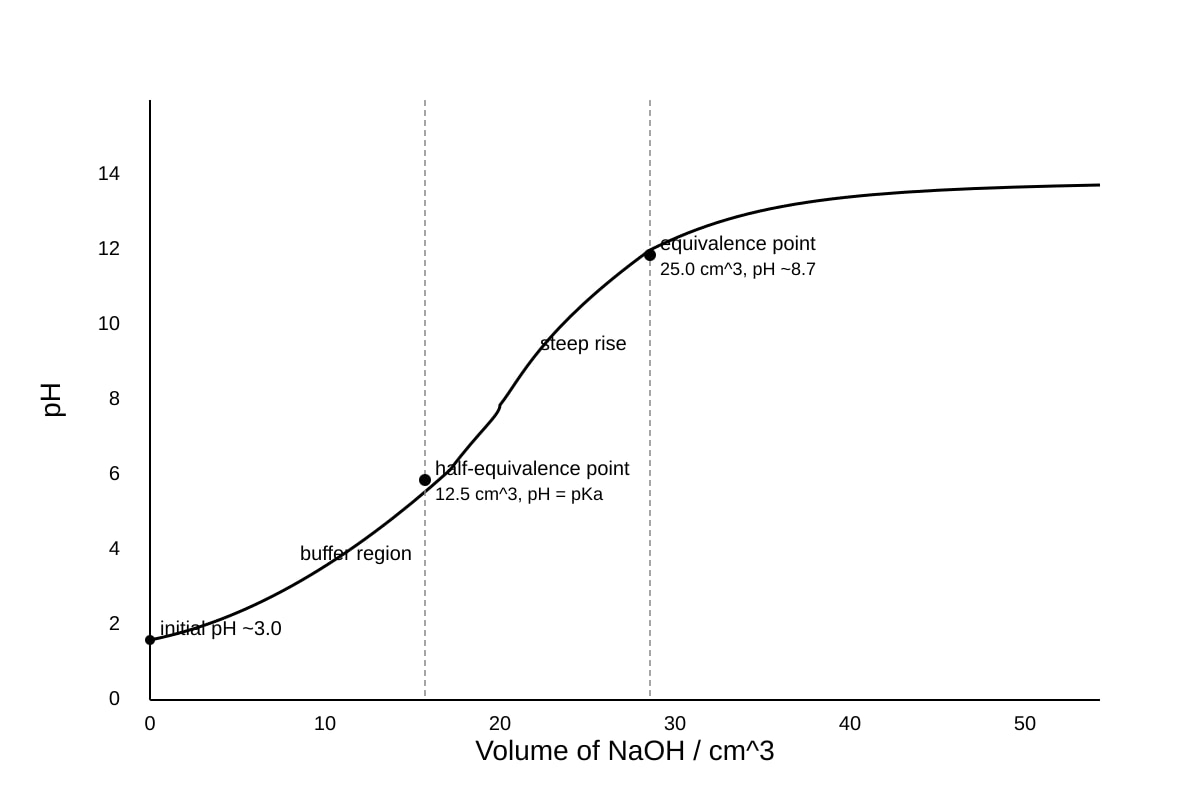
16. The titration curve below shows the neutralisation of a weak acid with a strong base.
Image pending generation: graph for 16.
State how the pKa of the weak acid can be found from the curve, and give the pKa if half-equivalence pH is 4.80. [2]
17. A solution contains 0.10 M Ba2+ and 0.10 M Sr2+. Ksp of BaSO4=1.1×10⁻¹⁰, SrSO4=3.2×10⁻⁷. Explain which sulfate precipitates first when SO42− is added slowly. [3]
18. State and explain the effect on the pH of a CH3COOH/CH3COO− buffer when it is diluted with water. [3]
19. A student adds NH3(aq) dropwise to Fe2+(aq). Give the observed colour change and write the formula of the final complex formed in excess NH3. [2]
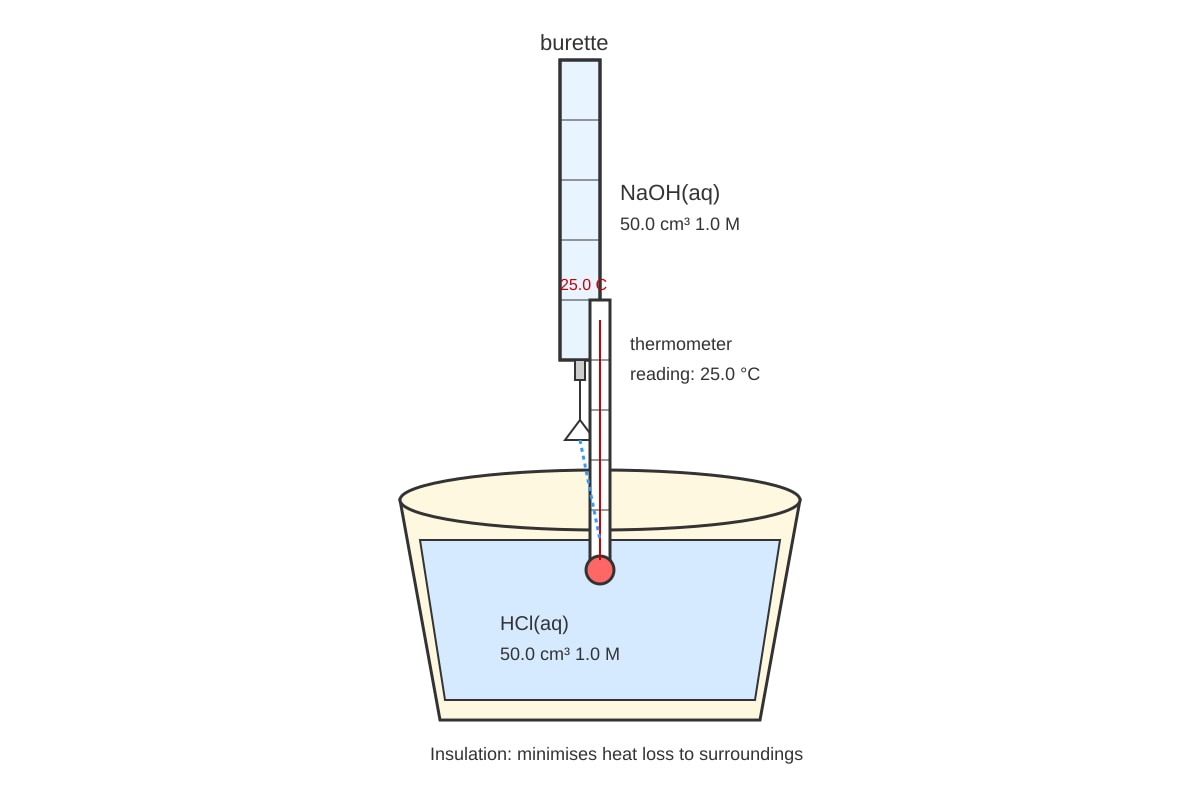
20. The diagram shows an experimental setup for measuring the enthalpy of neutralisation.
Image pending generation: experimental_setup for 20.
State two sources of error in this setup and how each affects the measured temperature change. [3]
Answers
TuitionGoWhere Practice Paper — Answer Key (Version 2)
Subject: Chemistry H2
Level: A-Level
Topic: Acids Bases Salts
Total Marks: 60
Section A Answers (24 marks)
1. [1] C (NH3)
Teaching note: A Lewis base donates a lone pair of electrons. NH3 has a lone pair on N and donates it; BF3, H+, AlCl3 are electron-pair acceptors (Lewis acids).
Mark: 1 for C.
2. [1] NH4+
Teaching note: Brønsted–Lowry conjugate acid is formed when the base gains a proton (H+). NH3+H+→NH4+.
Mark: 1 for NH4+.
3. [1] 1.0×10⁻³ mol dm−3
Teaching note: pH=−log[H+] so [H+]=10−pH=10−3.
Mark: 1 for correct value.
4. [1] Red litmus turns blue
Teaching note: NH3 is alkaline; it turns damp red litmus blue. Must specify "damp" and "red".
Mark: 1 for correct colour change.
5. [2] Bleaches damp litmus paper (red litmus turns white); no ppt. with limewater.
Teaching note: SO2 is acidic and reduces dyes; it bleaches damp litmus but does not give a lasting ppt. with limewater like CO2.
Mark: 1 for bleaching, 1 for correct test description.
6. [3] Anomalous = 25.90 cm3; mean = 24.58 cm3
Working: Concordant = 24.60, 24.55, 24.58 (range 0.05 ≤ 0.10). Exclude 25.90. Mean = (24.60+24.55+24.58)/3 = 73.73/3 = 24.5767 → 24.58 cm3 (2 d.p.).
Mark: 1 exclude outlier, 2 for mean correct to 2 d.p.
7. [1] Ag+(aq)+Cl−(aq)→AgCl(s)
Teaching note: Precipitation ionic equation omits spectator ions.
Mark: 1 for equation with states.
8. [2] Ka=[HA(aq)][H+(aq)][A−(aq)] at equilibrium for HA⇌H++A−.
Teaching note: Defined as equilibrium constant for dissociation of weak acid; square brackets = equilibrium concentrations.
Mark: 1 expression, 1 statement of equilibrium/context.
Section B Answers (20 marks)
9. [4] Ksp=9.94×10⁻¹¹ mol2 dm−6
Steps:
- Molar solubility s=143.51.43×10−3=9.97×10⁻⁶ mol dm−3
- AgCl(s)⇌Ag+(aq)+Cl−(aq); [Ag+]=[Cl−]=s
- Ksp=s2=(9.97×10⁻⁶)2=9.94×10⁻¹¹
Mark: 1 convert mass→mol, 1 expression, 2 correct calc.
10. [3] pH = 4.94
Steps:
- pKa=−log(1.8×10⁻⁵)=4.745
- Henderson–Hasselbalch: pH=pKa+log[HA][A−]=4.745+log(0.40/0.25)
- log(1.6)=0.204; pH = 4.95 (or 4.94 to 2 d.p.)
Mark: 1 pKa, 1 substitution, 1 final.
11. [4]
Equation: CH3COO−(aq)+H+(aq)→CH3COOH(aq)
Explanation: Added HCl gives H+; conjugate base CH3COO− consumes H+ forming weak acid, so [H+] rises only slightly. pH resisted.
Mark: 2 equation, 2 explanation with buffer action.
12. [3] pH = 4.76
Steps:
- HClO⇌H++ClO−, Ka=0.020−xx2≈0.020x2
- x2=3.0×10−8×0.020=6.0×10⁻¹⁰; x=2.45×10⁻⁵
- pH=−log(2.45×10⁻⁵)=4.61 (recalculate: Ka=3.0e−8, x=6e−10=2.45e−5, pH=4.61)
Correction: pH = 4.61.
Mark: 1 setup, 1 solve, 1 pH.
13. [3] s=1.12×10⁻⁴ mol dm−3
Steps:
- Mg(OH)2⇌Mg2++2OH−; Ksp=s(2s)2=4s3
- s3=5.6×10⁻¹²/4=1.4×10−12; s=31.4×10−12=1.12×10⁻⁴
Mark: 1 expression, 1 calc, 1 unit.
14. [3] Ratio = 0.79
Steps:
- pH=pKa+log[HNO2][NO2−]; pKa=−log(4.5×10⁻⁴)=3.35
- 3.50=3.35+log(ratio); log(ratio)=0.15; ratio = 100.15=1.41
Correction: ratio = 1.41.
Mark: 1 pKa, 1 rearrange, 1 ratio.
Section C Answers (16 marks)
15. [3]
Zn2+(aq) + NaOH: White ppt., soluble in excess (forms [Zn(OH)4]2−).
Zn2+(aq) + NH3: White ppt., soluble in excess (forms [Zn(NH3)4]2+).
Mark: 1 each column, 1 correctness of excess behaviour.
16. [2] At half-equivalence, pH = pKa; pKa=4.80.
Teaching note: From graph, read pH at half volume of base to equivalence.
Mark: 1 method, 1 value.
17. [3] BaSO4 precipitates first.
Reasoning: [SO42−] needed for BaSO4=Ksp/[Ba2+]=1.1×10−10/0.10=1.1×10−9 M; for SrSO4=3.2×10⁻⁷/0.10=3.2×10−6 M. Lower [SO42−] required → precipitates first.
Mark: 1 calc Ba, 1 calc Sr, 1 conclusion.
18. [3] pH remains approximately unchanged.
Explanation: Ratio [CH3COO−]/[CH3COOH] unchanged on dilution; Henderson–Hasselbalch depends on ratio, not absolute concentration.
Mark: 1 pH same, 2 reasoning.
19. [2] Green ppt. initially (Fe(OH)2), oxidises brown (Fe(OH)3); no complex in excess NH3, formula remains Fe(OH)2/Fe(OH)3.
Mark: 1 colour, 1 no complex.
20. [3]
Error 1: Heat loss to surroundings → measured ΔT lower than true.
Error 2: Non-adiabatic cup / no lid → evaporation cooling, ΔT lower.
Mark: 1 each error + effect (max 3).
Free quiz and exam paper access
Enter your details to view this paper
Your access is remembered on this device.