AI Generated Exam Paper
A Level H2 Chemistry Practice Paper 1
Free A Level H2 Chemistry Practice Paper 1, HY3 AI version, with questions, answers, and A Level-style practice for Singapore students.
These static practice materials are generated from the site's syllabus and paper-generation workflow, with source and model context shown so students and parents can evaluate the material before use.
Questions
Free quiz and exam paper access
Enter your details to view this paper
Your access is remembered on this device.
Answers
TuitionGoWhere Practice Paper — Answer Key (Version 1)
Subject: Chemistry H2 A-Level
Topic: Acids Bases Salts
Total Marks: 60
Section A Answers
1. [1 mark] B. proton donor
Teaching note: Brønsted–Lowry defines acid as proton (H⁺) donor, base as proton acceptor. Lewis theory uses electron pairs. Common mistake: confusing with Lewis acid (electron pair acceptor).
2. [1 mark] C. BF₃
Teaching note: BF₃ has an incomplete octet and accepts an electron pair → Lewis acid. NH₃ and OH⁻ are Lewis bases; H₂O can act as both but is not the best example here.
3. [2 marks] Conjugate base of HCOOH = HCOO⁻ (1 mark); conjugate acid of NH₃ = NH₄⁺ (1 mark).
Teaching note: Remove H⁺ from acid → conjugate base; add H⁺ to base → conjugate acid.
4. [2 marks] Rough titration = 23.10 cm³ (1 mark). Concordant: 22.85, 22.90, 22.88 (all within 0.05 cm³). Mean = (22.85 + 22.90 + 22.88)/3 = 22.876… ≈ 22.88 cm³ (1 mark, to 2 d.p.).
Marking: 1 for identifying rough, 1 for correct mean. Common trap: including rough in mean.
5. [2 marks] CO₂: turns limewater milky/white ppt, ppt dissolves in excess CO₂ (1 mark). NH₃: turns damp red litmus paper blue (1 mark).
Teaching note: Must specify damp red litmus for NH₃; for CO₂ use limewater.
6. [2 marks] White ppt initially, soluble in excess NaOH (1 mark); species = [Al(OH)₄]⁻ (1 mark).
Teaching note: Al³⁺ is amphoteric; in excess OH⁻ forms tetrahydroxoaluminate.
7. [3 marks]
Molar solubility = 1.43×10⁻³ / 143.5 = 9.97×10⁻⁶ mol dm⁻³ (1 mark)
AgCl(s) ⇌ Ag⁺ + Cl⁻, so [Ag⁺] = [Cl⁻] = 9.97×10⁻⁶ (1 mark)
Kₛₚ = (9.97×10⁻⁶)² = 9.94×10⁻¹¹ mol² dm⁻⁶ (1 mark)
Marking: 1 each for conversion, substitution, final Kₛₚ.
8. [3 marks]
pKₐ = –log(1.8×10⁻⁵) = 4.74 (1 mark)
pH = pKₐ + log([A⁻]/[HA]) = 4.74 + log(0.40/0.25) = 4.74 + 0.204 = 4.94 (2 marks: 1 for formula, 1 for correct value)
Teaching note: Henderson–Hasselbalch for buffer.
Section B Answers
9. [4 marks]
HCl added: CH₃COO⁻ + H⁺ → CH₃COOH (2 marks: eq + explanation that H⁺ consumed by base)
NaOH added: CH₃COOH + OH⁻ → CH₃COO⁻ + H₂O (2 marks: eq + explanation that OH⁻ consumed by acid)
Teaching note: Buffer resists pH change by neutralising added acid/base using its components.
10. [4 marks]
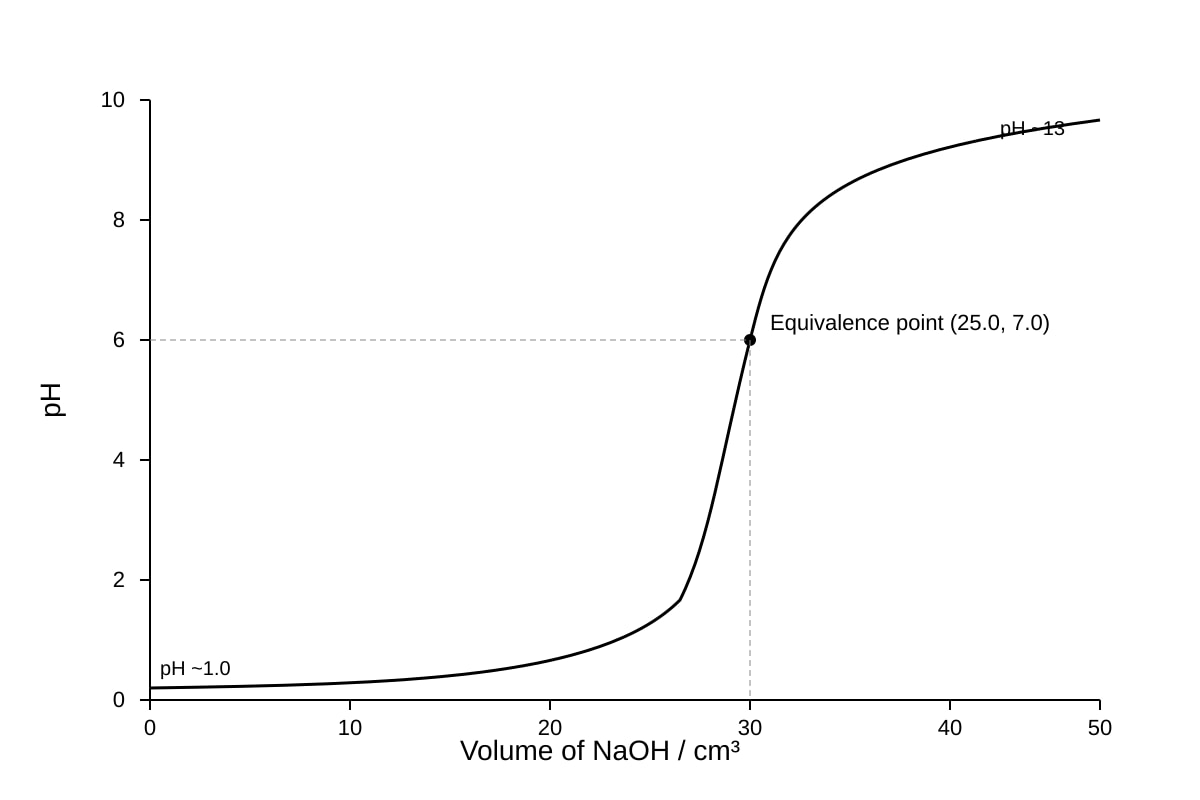
Curve: starts pH ~1, gradual rise, steep at 25 cm³, pH 7 at eq, then to ~13 (2 marks for shape). Equivalence point labelled at (25.0, 7.0) (1 mark). Strong acid–strong base → pH 7 (1 mark).
Image requirement: Graph must show x-axis Volume NaOH, y-axis pH, point (25,7) marked.
11. [4 marks]
Kₐ = [H⁺][HCOO⁻]/[HCOOH] ≈ x²/0.050 (1 mark, assumption x << 0.050)
x² = 1.7×10⁻⁴ × 0.050 = 8.5×10⁻⁶ (1 mark)
x = 2.92×10⁻³ mol dm⁻³ (1 mark)
pH = –log(2.92×10⁻³) = 2.53 (1 mark)
Assumption: dissociation small (valid as 2.92e-3 << 0.050).
12. [4 marks]
Mg(OH)₂(s) ⇌ Mg²⁺ + 2OH⁻ (1 mark). Ionic lattice broken by hydration (1 mark). Low Kₛₚ means equilibrium lies left (1 mark); sparingly soluble due to strong lattice energy vs hydration (1 mark).
13. [4 marks]
H₂SO₄ + 2NaOH → Na₂SO₄ + 2H₂O (1 mark)
Moles H₂SO₄ = 0.0250 × 0.0800 = 2.00×10⁻³ mol (1 mark)
Moles NaOH needed = 2 × 2.00×10⁻³ = 4.00×10⁻³ mol (1 mark)
Vol NaOH = 4.00×10⁻³ / 0.200 = 0.0200 dm³ = 20.0 cm³ (1 mark)
14. [4 marks]
Observation: brown precipitate forms, insoluble in excess NH₃ (2 marks).
Equation: Fe³⁺ + 3NH₃ + 3H₂O → Fe(OH)₃(s) + 3NH₄⁺ (2 marks)
Teaching note: Fe³⁺ does not form ammine complex.
Section C Answers
15. [3 marks]
Order: B (4.5e-5) < A (1.0e-4) < C (3.2e-3) (2 marks). Larger Kₐ = stronger acid (1 mark).
16. [4 marks]
At half-neutralisation (12.5 cm³), pH = pKₐ = 4.45 (2 marks for value, 2 marks for justification using buffer region / half-equivalence).
Teaching note: At V = ½ Veq, [HA]=[A⁻], pH = pKₐ.
17. [3 marks]
Kₛₚ = [Mg²⁺][OH⁻]² → [OH⁻]² = Kₛₚ/[Mg²⁺] = 5.6e-12 / 0.010 = 5.6e-10 (1 mark)
[OH⁻] = √(5.6e-10) = 2.37×10⁻⁵ mol dm⁻³ (2 marks)
Minimum to start precipitation.
18. [3 marks]
Adding NH₄Cl increases [NH₄⁺] (1 mark). Buffer pH = pKₐ + log([NH₃]/[NH₄⁺]) decreases slightly (1 mark). Resists large change (1 mark).
19. [4 marks]
Moles NH₃ = 0.0500×0.200 = 0.0100 mol (1 mark)
Moles HCl = 0.0500×0.100 = 0.00500 mol (1 mark)
After reaction: NH₃ left = 0.00500 mol, NH₄⁺ formed = 0.00500 mol (1 mark)
pH = pKₐ + log(0.005/0.005) = 9.25 + 0 = 9.25 (1 mark) [pKₐ = –log(5.6e-10)=9.25]
20. [3 marks]
At equivalence, salt of weak acid (A⁻) hydrolyses: A⁻ + H₂O ⇌ HA + OH⁻ (2 marks). Produces OH⁻ → pH > 7 (1 mark).
End of Answer Key