From Real Exams Exam Paper

A Level H2 Chemistry Practice Paper 5

Free Exam-Derived Owl Alpha A Level H2 Chemistry Practice Paper 5 practice paper with questions and answers for Singapore students. This page is rendered as a direct URL so the questions and answers can be discovered without pressing in-page buttons.

These static practice materials are generated from the site's syllabus and paper-generation workflow, with source and model context shown so students and parents can evaluate the material before use.

A Level H2 Chemistry From Real Exams Generated by Owl Alpha Updated 2026-06-07

Questions

<!-- TuitionGoWhere generation metadata: stage=3-1; model=openrouter/owl-alpha; model_label=Owl Alpha; generated=2026-06-06; Sources: Stage 2-1 real exam-derived templates and Stage 2-2 exam-enriched syllabus. -->

TuitionGoWhere Practice Paper - Chemistry H2 A-Level

TuitionGoWhere Secondary School (AI)


Subject:Chemistry H2
Level:A-Level
Paper:Practice Paper — Acids, Bases & Salts
Version:5 of 5
Duration:1 hour 30 minutes
Total Marks:60
Name:________________________
Class:________________________
Date:________________________

Instructions

  • Answer all questions in the spaces provided.
  • Write your answers in dark blue or black pen.
  • You may use a pencil for any diagrams or graphs.
  • Show all working for calculation questions. Credit is given for correct working even if the final answer is incorrect.
  • The use of an approved scientific calculator is expected where appropriate.
  • The Data Booklet is not provided for this practice paper.
  • The number of marks is shown in brackets [ ] at the end of each question or part-question.

Section A: Short-Answer and Structured Questions (30 marks)

Questions 1–10


1. Define the term Brønsted–Lowry acid. Give one example of a species that acts as a Brønsted–Lowry acid in aqueous solution, and write an equation to show its behaviour.


[2]


2. A solution of hydrochloric acid has a concentration of 0.150 mol dm30.150 \text{ mol dm}^{-3}. Calculate the pH of this solution. Show your working.


[2]


3. Ethanoic acid (CH3COOHCH_3COOH) is a weak acid.

(a) Write an expression for the acid dissociation constant, KaK_a, of ethanoic acid.

[1]

(b) The KaK_a of ethanoic acid at 25 °C is 1.74×10⁵ mol dm31.74 \times 10^{-5} \text{ mol dm}^{-3}. Calculate the pH of a 0.100 mol dm30.100 \text{ mol dm}^{-3} solution of ethanoic acid. Assume [H+]=Ka×c[H^+] = \sqrt{K_a \times c}.


[2]


4. Explain why a solution of sodium chloride (NaClNaCl) in water has a pH of approximately 7, while a solution of sodium ethanoate (CH3COONaCH_3COONa) in water has a pH greater than 7. Reference the nature of the parent acid and base in each case.


[3]


5. A student carries out a titration to determine the concentration of a solution of sulfuric acid (H2SO4H_2SO_4) using 0.100 mol dm30.100 \text{ mol dm}^{-3} sodium hydroxide (NaOHNaOH).

(a) Write the balanced equation for the reaction.

[1]

(b) The student finds that 24.80 cm324.80 \text{ cm}^3 of NaOHNaOH is required to neutralise 25.0 cm325.0 \text{ cm}^3 of the sulfuric acid solution. Calculate the concentration of the sulfuric acid in mol dm3\text{mol dm}^{-3}.


[2]


6. State and explain the effect on the pH of the following additions to a solution of 0.100 mol dm30.100 \text{ mol dm}^{-3} ethanoic acid:

(a) Adding solid sodium ethanoate (CH3COONaCH_3COONa).


[2]

(b) Diluting the solution with an equal volume of distilled water.


[2]


7. A buffer solution is prepared by mixing 50.0 cm350.0 \text{ cm}^3 of 0.200 mol dm30.200 \text{ mol dm}^{-3} ethanoic acid with 50.0 cm350.0 \text{ cm}^3 of 0.100 mol dm30.100 \text{ mol dm}^{-3} sodium hydroxide.

(a) Calculate the number of moles of ethanoic acid and sodium hydroxide before reaction.

[1]

(b) Calculate the number of moles of ethanoic acid and sodium ethanoate present in the buffer after reaction.


[2]

(c) Using your answer to (b) and the KaK_a value of 1.74×10⁵ mol dm31.74 \times 10^{-5} \text{ mol dm}^{-3}, calculate the pH of the resulting buffer.


[2]


8. Distinguish between a strong acid and a weak acid. In your answer, refer to the degree of dissociation and the species present in aqueous solution.


[2]


9. A solution of ammonia (NH3NH_3) has a concentration of 0.050 mol dm30.050 \text{ mol dm}^{-3}. The KbK_b of ammonia is 1.78×10⁵ mol dm31.78 \times 10^{-5} \text{ mol dm}^{-3}.

(a) Write an expression for KbK_b for ammonia.

[1]

(b) Calculate the pH of this ammonia solution. Assume [OH]=Kb×c[OH^-] = \sqrt{K_b \times c}.


[3]


10. Explain the term equivalence point in the context of an acid–base titration. How does the choice of indicator depend on the strength of the acid and base used?


[3]


Section B: Data Interpretation and Applied Questions (30 marks)

Questions 11–20


11. The following data were obtained from a titration of 25.0 cm325.0 \text{ cm}^3 of a solution of a monoprotic weak acid, HA, with 0.100 mol dm30.100 \text{ mol dm}^{-3} NaOHNaOH.

TitrationRough123
Final burette reading / cm3\text{cm}^326.5025.9025.8527.10
Initial burette reading / cm3\text{cm}^31.001.001.002.00
Volume used / cm3\text{cm}^325.5024.9024.8525.10

(a) Complete the table by calculating the volume of NaOHNaOH used in each titration.

[1]

(b) Identify any anomalous result and calculate a suitable mean titre to be used in your calculations. Show clearly how you obtained this value.


[2]

(c) Calculate the concentration of the weak acid HA in mol dm3\text{mol dm}^{-3}.


[2]


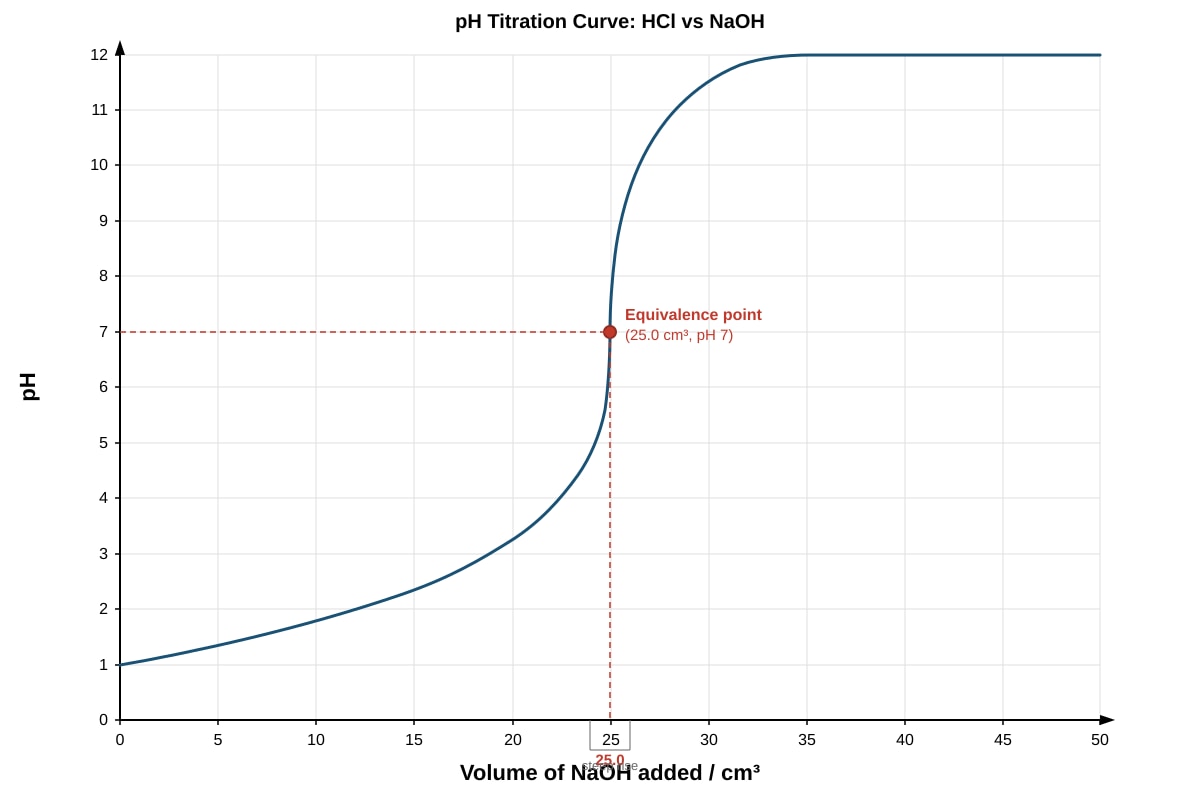
12. The graph below shows the pH curve obtained when 0.100 mol dm30.100 \text{ mol dm}^{-3} NaOHNaOH is added to 25.0 cm325.0 \text{ cm}^3 of 0.100 mol dm30.100 \text{ mol dm}^{-3} hydrochloric acid.

<image_placeholder> id: Q12-fig1 type: graph linked_question: Q12 description: pH titration curve showing pH (y-axis, range 0–14) versus volume of 0.100 mol dm⁻³ NaOH added in cm³ (x-axis, range 0–50). The curve starts at pH ≈ 1 at 0 cm³, rises gradually, then has a steep vertical rise between approximately 24–26 cm³, passing through pH 7 at 25.0 cm³ (the equivalence point), and levels off at pH ≈ 12 beyond 30 cm³. The equivalence point is clearly at 25.0 cm³. labels: y-axis: "pH", x-axis: "Volume of NaOH added / cm³", equivalence point marked at (25.0, 7), steep rise region between 24–26 cm³ values: initial pH ≈ 1, equivalence point at 25.0 cm³, pH at equivalence = 7, final pH ≈ 12 must_show: y-axis labelled "pH" with scale 0–14, x-axis labelled "Volume of NaOH added / cm³" with scale 0–50, curve shape showing steep rise near equivalence point, equivalence point clearly at 25.0 cm³ and pH 7

</image_placeholder>

(a) Use the graph to determine the volume of NaOHNaOH required to reach the equivalence point.

[1]

(b) Explain why the pH at the equivalence point is 7 for this titration.


[2]

(c) Sketch on the same axes the pH curve you would expect if 0.100 mol dm30.100 \text{ mol dm}^{-3} ethanoic acid (a weak acid) of the same volume and concentration were titrated with the same NaOHNaOH solution. Label your sketch clearly and state two key differences from the original curve.


[3]


13. A student wishes to prepare a buffer solution with a pH of 4.75 using ethanoic acid (CH3COOHCH_3COOH, Ka=1.74×10⁵K_a = 1.74 \times 10^{-5}) and sodium ethanoate (CH3COONaCH_3COONa).

(a) Calculate the required ratio [CH3COO][CH3COOH]\frac{[CH_3COO^-]}{[CH_3COOH]} in the buffer.


[2]

(b) The student has 100 cm3100 \text{ cm}^3 of 0.500 mol dm30.500 \text{ mol dm}^{-3} ethanoic acid. Calculate the mass of sodium ethanoate (Mr=82.0M_r = 82.0) that must be dissolved in this solution to achieve the required ratio.


[2]


14. The solubility product, KspK_{sp}, of magnesium hydroxide, Mg(OH)2Mg(OH)_2, at 25 °C is 5.61×10¹² mol3dm95.61 \times 10^{-12} \text{ mol}^3 \text{dm}^{-9}.

(a) Write an expression for KspK_{sp} of Mg(OH)2Mg(OH)_2.

[1]

(b) Calculate the solubility of Mg(OH)2Mg(OH)_2 in water at 25 °C, in mol dm3\text{mol dm}^{-3}.


[2]

(c) Calculate the pH of a saturated solution of Mg(OH)2Mg(OH)_2 at 25 °C.


[2]


15. A solution contains a mixture of 0.100 mol dm30.100 \text{ mol dm}^{-3} HClHCl and 0.200 mol dm30.200 \text{ mol dm}^{-3} CH3COOHCH_3COOH (Ka=1.74×10⁵K_a = 1.74 \times 10^{-5}).

(a) Calculate the pH of this solution. Assume that the contribution of H+H^+ from ethanoic acid is negligible compared to that from HClHCl.


[2]

(b) Explain why the contribution of H+H^+ from ethanoic acid can be considered negligible.


[2]


16. The indicator methyl orange has a pKInpK_{In} of 3.7. It changes colour over the pH range 3.1–4.4 (red in acid, yellow in base).

(a) Explain whether methyl orange would be a suitable indicator for the titration of 0.100 mol dm30.100 \text{ mol dm}^{-3} NaOHNaOH with 0.100 mol dm30.100 \text{ mol dm}^{-3} ethanoic acid. The pH change at the equivalence point for this titration occurs over approximately pH 7–10.


[2]

(b) Suggest a more suitable indicator for this titration and explain your choice.


[2]


17. A solution of sodium carbonate (Na2CO3Na_2CO_3) in water is alkaline.

(a) Write an equation for the hydrolysis reaction of the carbonate ion (CO32CO_3^{2-}) with water.

[1]

(b) Explain, with reference to the parent acid and base, why a solution of Na2CO3Na_2CO_3 is alkaline.


[2]

(c) A solution of ammonium chloride (NH4ClNH_4Cl) in water is acidic. Write an equation to show the hydrolysis of the ammonium ion and explain why the solution is acidic.


[2]


18. The following question relates to the thermal decomposition of calcium carbonate and its relevance to salt formation.

Calcium carbonate decomposes on heating to form calcium oxide and carbon dioxide. Calcium oxide reacts with water to form calcium hydroxide, which is used in agriculture to neutralise acidic soils.

(a) Write a balanced equation for the thermal decomposition of calcium carbonate.

[1]

(b) Write a balanced equation for the reaction of calcium oxide with water.

[1]

(c) A farmer needs to neutralise an acidic soil sample containing 0.025 mol0.025 \text{ mol} of H2SO4H_2SO_4. Calculate the minimum mass of calcium hydroxide (Mr=74.1M_r = 74.1) required for complete neutralisation.


[2]


19. A student investigates the enthalpy change of neutralisation of hydrochloric acid with sodium hydroxide.

50.0 cm350.0 \text{ cm}^3 of 1.00 mol dm31.00 \text{ mol dm}^{-3} HClHCl is mixed with 50.0 cm350.0 \text{ cm}^3 of 1.00 mol dm31.00 \text{ mol dm}^{-3} NaOHNaOH in a polystyrene cup. The temperature rise is 6.8°C6.8 °C.

(a) Calculate the heat change, qq, in the reaction. Assume the density of the solution is 1.00 g cm31.00 \text{ g cm}^{-3} and the specific heat capacity is 4.18 J g1°C14.18 \text{ J g}^{-1} \text{°C}^{-1}.


[2]

(b) Calculate the enthalpy change of neutralisation in kJ mol1\text{kJ mol}^{-1}. Include the correct sign and units.


[2]

(c) The literature value for the standard enthalpy change of neutralisation of a strong acid with a strong base is 57.1 kJ mol1-57.1 \text{ kJ mol}^{-1}. Suggest one reason why the student's value differs from the literature value.

[1]


20. A solution of a diprotic acid H2AH_2A has a concentration of 0.050 mol dm30.050 \text{ mol dm}^{-3}. The acid dissociates in two steps:

H2AH++HAKa1=4.50×10³H_2A \rightleftharpoons H^+ + HA^- \quad K_{a1} = 4.50 \times 10^{-3} HAH++A2Ka2=6.20×10⁸HA^- \rightleftharpoons H^+ + A^{2-} \quad K_{a2} = 6.20 \times 10^{-8}

(a) Explain why Ka1Ka2K_{a1} \gg K_{a2} for this acid.


[2]

(b) Calculate the pH of the 0.050 mol dm30.050 \text{ mol dm}^{-3} H2AH_2A solution. Assume that the second dissociation contributes negligibly to [H+][H^+].


[3]

(c) Calculate the concentration of A2A^{2-} ions in the solution.


[2]


End of Paper

Total: 60 marks

Answers

<!-- TuitionGoWhere generation metadata: stage=3-1; model=openrouter/owl-alpha; model_label=Owl Alpha; generated=2026-06-06; Sources: Stage 2-1 real exam-derived templates and Stage 2-2 exam-enriched syllabus. -->

TuitionGoWhere Practice Paper - Chemistry H2 A-Level

Answer Key — Acids, Bases & Salts (Version 5 of 5)


Question 1 [2]

Definition: A Brønsted–Lowry acid is a proton (H+H^+) donor.

Example: HClHCl (or any valid acid such as H2SO4H_2SO_4, CH3COOHCH_3COOH, NH4+NH_4^+)

Equation: HCl(aq)H+(aq)+Cl(aq)HCl(aq) \rightarrow H^+(aq) + Cl^-(aq)

or HCl(aq)+H2O(l)H3O+(aq)+Cl(aq)HCl(aq) + H_2O(l) \rightarrow H_3O^+(aq) + Cl^-(aq)

Marking:

  • 1 mark for correct definition (proton donor)
  • 1 mark for a valid example with a correct equation showing proton donation

Teaching note: A Brønsted–Lowry acid donates a proton to another species (the base). The key idea is proton transfer. Students sometimes confuse this with the Lewis acid definition (electron pair acceptor).


Question 2 [2]

HClHCl is a strong acid and dissociates completely:

HClH++ClHCl \rightarrow H^+ + Cl^-

[H+]=0.150 mol dm3[H^+] = 0.150 \text{ mol dm}^{-3}

pH=log10[H+]=log10(0.150)pH = -\log_{10}[H^+] = -\log_{10}(0.150)

pH=0.82 (2 d.p.)pH = 0.82 \text{ (2 d.p.)}

Marking:

  • 1 mark for correct [H+]=0.150 mol dm3[H^+] = 0.150 \text{ mol dm}^{-3} (complete dissociation)
  • 1 mark for correct pH = 0.82

Common mistake: Students may forget that HClHCl is monoprotic and strong, so [H+]=[HCl][H^+] = [HCl]. For diprotic strong acids like H2SO4H_2SO_4, [H+]=2×[H2SO4][H^+] = 2 \times [H_2SO_4] (for the first complete dissociation).


Question 3

(a) [1]

Ka=[H+][CH3COO][CH3COOH]K_a = \frac{[H^+][CH_3COO^-]}{[CH_3COOH]}

Marking: 1 mark for correct expression.

(b) [2]

[H+]=Ka×c=1.74×105×0.100[H^+] = \sqrt{K_a \times c} = \sqrt{1.74 \times 10^{-5} \times 0.100}

[H+]=1.74×106=1.32×10³ mol dm3[H^+] = \sqrt{1.74 \times 10^{-6}} = 1.32 \times 10^{-3} \text{ mol dm}^{-3}

pH=log10(1.32×10³)=2.88 (2 d.p.)pH = -\log_{10}(1.32 \times 10^{-3}) = 2.88 \text{ (2 d.p.)}

Marking:

  • 1 mark for correct substitution
  • 1 mark for correct pH = 2.88

Teaching note: For weak acids, we use the approximation [H+]=Kac[H^+] = \sqrt{K_a \cdot c} because the degree of dissociation is small. This is derived from Ka=x2cxx2cK_a = \frac{x^2}{c-x} \approx \frac{x^2}{c} when xcx \ll c.


Question 4 [3]

NaClNaCl: Formed from a strong acid (HClHCl) and a strong base (NaOHNaOH). Neither ion hydrolyses in water, so the solution is neutral, pH ≈ 7.

CH3COONaCH_3COONa: Formed from a weak acid (CH3COOHCH_3COOH) and a strong base (NaOHNaOH). The ethanoate ion (CH3COOCH_3COO^-) is the conjugate base of a weak acid and undergoes hydrolysis:

CH3COO+H2OCH3COOH+OHCH_3COO^- + H_2O \rightleftharpoons CH_3COOH + OH^-

This produces OHOH^- ions, making the solution alkaline (pH > 7).

Marking:

  • 1 mark: NaClNaCl from strong acid + strong base → neutral
  • 1 mark: CH3COONaCH_3COONa from weak acid + strong base → alkaline
  • 1 mark: Correct explanation involving hydrolysis of CH3COOCH_3COO^- producing OHOH^-

Question 5

(a) [1]

H2SO4+2NaOHNa2SO4+2H2OH_2SO_4 + 2NaOH \rightarrow Na_2SO_4 + 2H_2O

Marking: 1 mark for correct balanced equation.

(b) [2]

Moles of NaOHNaOH used:

n(NaOH)=0.100×24.801000=2.48×10³ moln(NaOH) = 0.100 \times \frac{24.80}{1000} = 2.48 \times 10^{-3} \text{ mol}

From the equation, mole ratio H2SO4:NaOH=1:2H_2SO_4 : NaOH = 1 : 2

n(H2SO4)=2.48×1032=1.24×10³ moln(H_2SO_4) = \frac{2.48 \times 10^{-3}}{2} = 1.24 \times 10^{-3} \text{ mol}

c(H2SO4)=1.24×10325.0/1000=0.0496 mol dm3c(H_2SO_4) = \frac{1.24 \times 10^{-3}}{25.0/1000} = 0.0496 \text{ mol dm}^{-3}

Marking:

  • 1 mark for correct moles of NaOH and use of 1:2 ratio
  • 1 mark for correct concentration = 0.0496 mol dm⁻³

Question 6

(a) [2]

Adding sodium ethanoate increases the concentration of the common ion CH3COOCH_3COO^-. By Le Chatelier's principle, the equilibrium:

CH3COOHH++CH3COOCH_3COOH \rightleftharpoons H^+ + CH_3COO^-

shifts to the left, reducing [H+][H^+]. Therefore, the pH increases.

Marking:

  • 1 mark: Common ion effect / equilibrium shifts left
  • 1 mark: pH increases

(b) [2]

Dilution reduces the concentration of all species. For a weak acid, dilution increases the degree of dissociation (more molecules dissociate), but the overall [H+][H^+] decreases because the solution is more dilute. Therefore, the pH increases (moves closer to 7).

Marking:

  • 1 mark: Degree of dissociation increases on dilution
  • 1 mark: pH increases (but remains below 7)

Common mistake: Students may think dilution of a weak acid decreases pH. While more molecules dissociate, the total [H+][H^+] still decreases because the volume increase dominates.


Question 7

(a) [1]

n(CH3COOH)=0.200×50.01000=0.0100 moln(CH_3COOH) = 0.200 \times \frac{50.0}{1000} = 0.0100 \text{ mol}

n(NaOH)=0.100×50.01000=0.00500 moln(NaOH) = 0.100 \times \frac{50.0}{1000} = 0.00500 \text{ mol}

Marking: 1 mark for both correct values.

(b) [2]

The reaction: CH3COOH+NaOHCH3COONa+H2OCH_3COOH + NaOH \rightarrow CH_3COONa + H_2O

NaOHNaOH is the limiting reagent.

n(CH3COOH)remaining=0.01000.00500=0.00500 moln(CH_3COOH)_{\text{remaining}} = 0.0100 - 0.00500 = 0.00500 \text{ mol}

n(CH3COONa)formed=0.00500 moln(CH_3COONa)_{\text{formed}} = 0.00500 \text{ mol}

Marking:

  • 1 mark for identifying NaOH as limiting reagent and calculating remaining acid
  • 1 mark for moles of sodium ethanoate formed

(c) [2]

Total volume = 50.0+50.0=100.0 cm3=0.100 dm350.0 + 50.0 = 100.0 \text{ cm}^3 = 0.100 \text{ dm}^3

[CH3COOH]=0.005000.100=0.0500 mol dm3[CH_3COOH] = \frac{0.00500}{0.100} = 0.0500 \text{ mol dm}^{-3}

[CH3COO]=0.005000.100=0.0500 mol dm3[CH_3COO^-] = \frac{0.00500}{0.100} = 0.0500 \text{ mol dm}^{-3}

Using the Henderson–Hasselbalch equation:

pH=pKa+log10[CH3COO][CH3COOH]pH = pK_a + \log_{10}\frac{[CH_3COO^-]}{[CH_3COOH]}

pKa=log10(1.74×10⁵)=4.76pK_a = -\log_{10}(1.74 \times 10^{-5}) = 4.76

pH=4.76+log100.05000.0500=4.76+log10(1)=4.76+0=4.76pH = 4.76 + \log_{10}\frac{0.0500}{0.0500} = 4.76 + \log_{10}(1) = 4.76 + 0 = 4.76

Marking:

  • 1 mark for correct concentrations or correct use of Henderson–Hasselbalch
  • 1 mark for correct pH = 4.76

Teaching note: When [acid]=[salt][acid] = [salt], pH=pKapH = pK_a. This is a useful shortcut for buffer problems.


Question 8 [2]

A strong acid dissociates completely in aqueous solution (e.g., HClHCl, H2SO4H_2SO_4, HNO3HNO_3). The degree of dissociation is essentially 100%. The solution contains only H+H^+ ions and the conjugate base anions — no undissociated acid molecules remain.

A weak acid only partially dissociates in aqueous solution (e.g., CH3COOHCH_3COOH, H2CO3H_2CO_3). The degree of dissociation is small (typically < 5%). The solution contains H+H^+ ions, conjugate base anions, and undissociated acid molecules in equilibrium.

Marking:

  • 1 mark: Strong acid = complete dissociation; weak acid = partial dissociation
  • 1 mark: Reference to species present (undissociated molecules exist in weak acid solution)

Question 9

(a) [1]

Kb=[NH4+][OH][NH3]K_b = \frac{[NH_4^+][OH^-]}{[NH_3]}

Marking: 1 mark for correct expression.

(b) [3]

[OH]=Kb×c=1.78×105×0.050[OH^-] = \sqrt{K_b \times c} = \sqrt{1.78 \times 10^{-5} \times 0.050}

[OH]=8.90×107=9.43×10⁴ mol dm3[OH^-] = \sqrt{8.90 \times 10^{-7}} = 9.43 \times 10^{-4} \text{ mol dm}^{-3}

pOH=log10(9.43×10⁴)=3.03pOH = -\log_{10}(9.43 \times 10^{-4}) = 3.03

pH=14.003.03=10.97pH = 14.00 - 3.03 = 10.97

Marking:

  • 1 mark for correct [OH][OH^-] calculation
  • 1 mark for correct pOH
  • 1 mark for correct pH = 10.97

Teaching note: For weak bases, we use the same approximation method as weak acids but calculate [OH][OH^-] first, then convert to pH using pH=14pOHpH = 14 - pOH.


Question 10 [3]

The equivalence point is the point in an acid–base titration at which the amount (in moles) of acid is exactly neutralised by the amount of base, according to the stoichiometric ratio in the balanced equation. At this point, neither reactant is in excess.

Indicator choice: The indicator must have a colour-change range (transition range) that falls within the steep portion of the titration curve near the equivalence point.

  • For a strong acid–strong base titration, the equivalence point is at pH 7 and the pH change is very steep. Many indicators work (e.g., phenolphthalein, methyl orange).
  • For a weak acid–strong base titration, the equivalence point is above pH 7 (due to hydrolysis of the conjugate base). Phenolphthalein (range 8.2–10.0) is suitable.
  • For a strong acid–weak base titration, the equivalence point is below pH 7. Methyl orange (range 3.1–4.4) is suitable.

Marking:

  • 1 mark: Correct definition of equivalence point
  • 1 mark: Indicator range must fall within the steep pH change region
  • 1 mark: Specific example linking acid/base strength to indicator choice

Question 11

(a) [1]

TitrationRough123
Volume used / cm3\text{cm}^325.5024.9024.8525.10

Marking: 1 mark for all three values correctly calculated.

(b) [2]

Titrations 1, 2, and 3 are concordant (within 0.10 cm³ of each other). The rough titration is not used in the mean.

Mean titre=24.90+24.85+25.103=74.853=24.95 cm3\text{Mean titre} = \frac{24.90 + 24.85 + 25.10}{3} = \frac{74.85}{3} = 24.95 \text{ cm}^3

Marking:

  • 1 mark for identifying concordant titres (1, 2, 3) and excluding the rough
  • 1 mark for correct mean = 24.95 cm³

(c) [2]

n(NaOH)=0.100×24.951000=2.495×10³ moln(NaOH) = 0.100 \times \frac{24.95}{1000} = 2.495 \times 10^{-3} \text{ mol}

HA is monoprotic, so mole ratio HA : NaOH = 1 : 1

n(HA)=2.495×10³ moln(HA) = 2.495 \times 10^{-3} \text{ mol}

c(HA)=2.495×10325.0/1000=0.0998 mol dm3c(HA) = \frac{2.495 \times 10^{-3}}{25.0/1000} = 0.0998 \text{ mol dm}^{-3}

Marking:

  • 1 mark for correct moles of NaOH and 1:1 ratio
  • 1 mark for correct concentration = 0.0999 mol dm⁻³ (accept 0.0998–0.100)

Question 12

(a) [1]

Equivalence point at 25.0 cm³ NaOH (read from the graph where the steep rise passes through pH 7).

Marking: 1 mark for reading 25.0 cm³ from the graph.

(b) [2]

HClHCl is a strong acid and NaOHNaOH is a strong base. At the equivalence point, the salt formed is NaClNaCl, which is derived from a strong acid and a strong base. Neither Na+Na^+ nor ClCl^- undergoes hydrolysis, so the solution is neutral and the pH is 7.

Marking:

  • 1 mark: NaCl formed from strong acid + strong base
  • 1 mark: No hydrolysis → pH = 7

(c) [3]

Key differences for ethanoic acid (weak acid) vs. NaOH titration:

  1. Starting pH is higher (around 2.9, not 1) because ethanoic acid is weak and only partially dissociates.
  2. Equivalence point pH is above 7 (approximately 8.7–9) because the salt CH3COONaCH_3COONa is formed from a weak acid and strong base; the ethanoate ion hydrolyses to produce an alkaline solution.
  3. The curve has a buffer region before the equivalence point where the pH rises gradually (the "S" shape is less steep initially).
  4. The steep rise is shorter in vertical extent compared to the strong acid titration.

Marking:

  • 1 mark: Starting pH is higher
  • 1 mark: Equivalence point pH > 7
  • 1 mark: Any other valid difference (buffer region, shorter steep section, etc.)

Image note: The graph should show a curve starting at pH ≈ 2.9, with a buffer region from about 0–20 cm³, a steep rise between approximately 23–26 cm³ passing through pH ≈ 8.7 at 25.0 cm³, and levelling off at pH ≈ 11–12.


Question 13

(a) [2]

Using the Henderson–Hasselbalch equation:

pH=pKa+log10[CH3COO][CH3COOH]pH = pK_a + \log_{10}\frac{[CH_3COO^-]}{[CH_3COOH]}

pKa=log10(1.74×10⁵)=4.76pK_a = -\log_{10}(1.74 \times 10^{-5}) = 4.76

4.75=4.76+log10[CH3COO][CH3COOH]4.75 = 4.76 + \log_{10}\frac{[CH_3COO^-]}{[CH_3COOH]}

log10[CH3COO][CH3COOH]=4.754.76=0.01\log_{10}\frac{[CH_3COO^-]}{[CH_3COOH]} = 4.75 - 4.76 = -0.01

[CH3COO][CH3COOH]=100.01=0.977\frac{[CH_3COO^-]}{[CH_3COOH]} = 10^{-0.01} = 0.977

Marking:

  • 1 mark for correct pKa calculation and substitution
  • 1 mark for correct ratio = 0.977 (or 0.98 to 2 s.f.)

(b) [2]

Moles of CH3COOHCH_3COOH in 100 cm³ of 0.500 mol dm⁻³:

n(CH3COOH)=0.500×1001000=0.0500 moln(CH_3COOH) = 0.500 \times \frac{100}{1000} = 0.0500 \text{ mol}

From the ratio:

n(CH3COO)n(CH3COOH)=0.977\frac{n(CH_3COO^-)}{n(CH_3COOH)} = 0.977

n(CH3COO)=0.977×0.0500=0.04885 moln(CH_3COO^-) = 0.977 \times 0.0500 = 0.04885 \text{ mol}

Mass of CH3COONaCH_3COONa:

m=n×Mr=0.04885×82.0=4.01 gm = n \times M_r = 0.04885 \times 82.0 = 4.01 \text{ g}

Marking:

  • 1 mark for correct moles of ethanoic acid and use of ratio
  • 1 mark for correct mass = 4.01 g

Question 14

(a) [1]

Ksp=[Mg2+][OH]2K_{sp} = [Mg^{2+}][OH^-]^2

Marking: 1 mark for correct expression.

(b) [2]

Let the solubility of Mg(OH)2Mg(OH)_2 = s mol dm3s \text{ mol dm}^{-3}

Mg(OH)2(s)Mg2+(aq)+2OH(aq)Mg(OH)_2(s) \rightleftharpoons Mg^{2+}(aq) + 2OH^-(aq)

[Mg2+]=s,[OH]=2s[Mg^{2+}] = s, \quad [OH^-] = 2s

Ksp=s×(2s)2=4s3K_{sp} = s \times (2s)^2 = 4s^3

4s3=5.61×10124s^3 = 5.61 \times 10^{-12}

s3=1.4025×10¹²s^3 = 1.4025 \times 10^{-12}

s=1.4025×10123=1.12×10⁴ mol dm3s = \sqrt[3]{1.4025 \times 10^{-12}} = 1.12 \times 10^{-4} \text{ mol dm}^{-3}

Marking:

  • 1 mark for correct relationship [OH]=2s[OH^-] = 2s and Ksp=4s3K_{sp} = 4s^3
  • 1 mark for correct solubility = 1.12×1041.12 \times 10^{-4} mol dm⁻³

(c) [2]

[OH]=2s=2×1.12×104=2.24×10⁴ mol dm3[OH^-] = 2s = 2 \times 1.12 \times 10^{-4} = 2.24 \times 10^{-4} \text{ mol dm}^{-3}

pOH=log10(2.24×10⁴)=3.65pOH = -\log_{10}(2.24 \times 10^{-4}) = 3.65

pH=14.003.65=10.35pH = 14.00 - 3.65 = 10.35

Marking:

  • 1 mark for correct [OH]=2.24×10⁴[OH^-] = 2.24 \times 10^{-4}
  • 1 mark for correct pH = 10.35

Question 15

(a) [2]

HClHCl is a strong acid and dissociates completely:

[H+]=0.100 mol dm3[H^+] = 0.100 \text{ mol dm}^{-3}

pH=log10(0.100)=1.00pH = -\log_{10}(0.100) = 1.00

Marking:

  • 1 mark for [H+]=0.100[H^+] = 0.100 from HCl
  • 1 mark for pH = 1.00

(b) [2]

The H+H^+ from HClHCl suppresses the dissociation of ethanoic acid due to the common ion effect. The equilibrium:

CH3COOHH++CH3COOCH_3COOH \rightleftharpoons H^+ + CH_3COO^-

is shifted far to the left by the high [H+][H^+] from HClHCl. The additional [H+][H^+] from ethanoic acid is negligible compared to 0.100 mol dm⁻³ from HClHCl.

Marking:

  • 1 mark: Common ion effect suppresses ethanoic acid dissociation
  • 1 mark: [H+][H^+] from ethanoic acid is negligible compared to 0.100 mol dm⁻³

Question 16

(a) [2]

Methyl orange changes colour over pH 3.1–4.4. For a weak acid–strong base titration, the equivalence point occurs at approximately pH 8.7–9, and the steep pH change occurs over approximately pH 7–10. Since the colour change range of methyl orange (3.1–4.4) does not fall within the steep region of the titration curve, methyl orange is not suitable. The colour change would occur long before the equivalence point is reached.

Marking:

  • 1 mark: Methyl orange is not suitable
  • 1 mark: Its range (3.1–4.4) does not fall within the steep pH change region (pH 7–10)

(b) [2]

Phenolphthalein is more suitable. Its colour change range is pH 8.2–10.0, which falls within the steep portion of the titration curve for a weak acid–strong base titration (pH 7–10). The colour change (colourless to pink) would occur very close to the equivalence point.

Marking:

  • 1 mark: Phenolphthalein
  • 1 mark: Its range (8.2–10.0) falls within the steep region near the equivalence point

Question 17

(a) [1]

CO32(aq)+H2O(l)HCO3(aq)+OH(aq)CO_3^{2-}(aq) + H_2O(l) \rightleftharpoons HCO_3^-(aq) + OH^-(aq)

Marking: 1 mark for correct equation.

(b) [2]

Na2CO3Na_2CO_3 is formed from a strong base (NaOHNaOH) and a weak acid (H2CO3H_2CO_3). The carbonate ion (CO32CO_3^{2-}) is the conjugate base of the weak acid HCO3HCO_3^-. It hydrolyses with water to produce OHOH^- ions, making the solution alkaline.

Marking:

  • 1 mark: Strong base + weak acid
  • 1 mark: CO32CO_3^{2-} hydrolyses to produce OHOH^-

(c) [2]

NH4+(aq)+H2O(l)NH3(aq)+H3O+(aq)NH_4^+(aq) + H_2O(l) \rightleftharpoons NH_3(aq) + H_3O^+(aq)

NH4ClNH_4Cl is formed from a weak base (NH3NH_3) and a strong acid (HClHCl). The ammonium ion (NH4+NH_4^+) is the conjugate acid of the weak base NH3NH_3. It hydrolyses with water to produce H3O+H_3O^+ (or H+H^+) ions, making the solution acidic.

Marking:

  • 1 mark: Correct hydrolysis equation
  • 1 mark: NH4+NH_4^+ is the conjugate acid of a weak base; produces H+H^+ → acidic

Question 18

(a) [1]

CaCO3(s)CaO(s)+CO2(g)CaCO_3(s) \rightarrow CaO(s) + CO_2(g)

Marking: 1 mark for correct balanced equation.

(b) [1]

CaO(s)+H2O(l)Ca(OH)2(aq)CaO(s) + H_2O(l) \rightarrow Ca(OH)_2(aq)

Marking: 1 mark for correct balanced equation.

(c) [2]

Ca(OH)2+H2SO4CaSO4+2H2OCa(OH)_2 + H_2SO_4 \rightarrow CaSO_4 + 2H_2O

Mole ratio: Ca(OH)2:H2SO4=1:1Ca(OH)_2 : H_2SO_4 = 1 : 1

n(Ca(OH)2)=n(H2SO4)=0.025 moln(Ca(OH)_2) = n(H_2SO_4) = 0.025 \text{ mol}

m(Ca(OH)2)=0.025×74.1=1.85 gm(Ca(OH)_2) = 0.025 \times 74.1 = 1.85 \text{ g}

Marking:

  • 1 mark for correct 1:1 mole ratio and moles of Ca(OH)₂
  • 1 mark for correct mass = 1.85 g

Question 19

(a) [2]

Total volume = 50.0+50.0=100.0 cm350.0 + 50.0 = 100.0 \text{ cm}^3

Mass of solution = 100.0×1.00=100.0 g100.0 \times 1.00 = 100.0 \text{ g}

q=mcΔT=100.0×4.18×6.8=2842.4 J=2.84 kJq = mc\Delta T = 100.0 \times 4.18 \times 6.8 = 2842.4 \text{ J} = 2.84 \text{ kJ}

Marking:

  • 1 mark for correct mass and substitution
  • 1 mark for correct q = 2.84 kJ

(b) [2]

n(HCl)=1.00×50.01000=0.0500 moln(HCl) = 1.00 \times \frac{50.0}{1000} = 0.0500 \text{ mol}

n(NaOH)=1.00×50.01000=0.0500 moln(NaOH) = 1.00 \times \frac{50.0}{1000} = 0.0500 \text{ mol}

The reaction is 1:1, so 0.0500 mol of water is formed.

ΔH=qn=2.840.0500=56.8 kJ mol1\Delta H = \frac{-q}{n} = \frac{-2.84}{0.0500} = -56.8 \text{ kJ mol}^{-1}

Marking:

  • 1 mark for correct moles of reaction
  • 1 mark for correct ΔH=56.8 kJ mol1\Delta H = -56.8 \text{ kJ mol}^{-1} (negative sign required)

(c) [1]

Any one of:

  • Heat loss to the surroundings (polystyrene cup is not a perfect insulator)
  • Heat absorbed by the calorimeter/cup
  • Assumption that the specific heat capacity and density of the solution are the same as water

Marking: 1 mark for any valid reason.


Question 20

(a) [2]

Ka1Ka2K_{a1} \gg K_{a2} because:

The first proton is removed from the neutral molecule H2AH_2A, which is relatively easy. The second proton must be removed from the already negatively charged species HAHA^-. Removing a positively charged proton (H+H^+) from a negatively charged ion is energetically more difficult because of the stronger electrostatic attraction between the negative ion and the proton. Additionally, the negative charge on HAHA^- makes it harder to lose another proton.

Marking:

  • 1 mark: Second dissociation is from a negatively charged species
  • 1 mark: Electrostatic attraction makes removal of H⁺ harder / energetically less favourable

(b) [3]

Considering only the first dissociation:

H2AH++HAKa1=4.50×10³H_2A \rightleftharpoons H^+ + HA^- \quad K_{a1} = 4.50 \times 10^{-3}

Ka1=[H+][HA][H2A]=x20.050x=4.50×10³K_{a1} = \frac{[H^+][HA^-]}{[H_2A]} = \frac{x^2}{0.050 - x} = 4.50 \times 10^{-3}

Since Ka1K_{a1} is not very small compared to cc, we should solve the quadratic:

x2=4.50×10³(0.050x)x^2 = 4.50 \times 10^{-3}(0.050 - x)

x2=2.25×1044.50×103xx^2 = 2.25 \times 10^{-4} - 4.50 \times 10^{-3}x

x2+4.50×103x2.25×104=0x^2 + 4.50 \times 10^{-3}x - 2.25 \times 10^{-4} = 0

Using the quadratic formula:

x=4.50×10³+(4.50×10³)2+4×2.25×1042x = \frac{-4.50 \times 10^{-3} + \sqrt{(4.50 \times 10^{-3})^2 + 4 \times 2.25 \times 10^{-4}}}{2}

x=4.50×10³+2.025×10⁵+9.00×1042x = \frac{-4.50 \times 10^{-3} + \sqrt{2.025 \times 10^{-5} + 9.00 \times 10^{-4}}}{2}

x=4.50×10³+9.2025×1042x = \frac{-4.50 \times 10^{-3} + \sqrt{9.2025 \times 10^{-4}}}{2}

x=4.50×10³+3.034×1022=2.584×1022=1.29×10²x = \frac{-4.50 \times 10^{-3} + 3.034 \times 10^{-2}}{2} = \frac{2.584 \times 10^{-2}}{2} = 1.29 \times 10^{-2}

[H+]=1.29×10² mol dm3[H^+] = 1.29 \times 10^{-2} \text{ mol dm}^{-3}

pH=log10(1.29×10²)=1.89pH = -\log_{10}(1.29 \times 10^{-2}) = 1.89

Marking:

  • 1 mark for setting up the Ka1K_{a1} expression correctly
  • 1 mark for solving the quadratic (or valid attempt)
  • 1 mark for correct pH = 1.89

(c) [2]

For the second dissociation:

HAH++A2Ka2=6.20×10⁸HA^- \rightleftharpoons H^+ + A^{2-} \quad K_{a2} = 6.20 \times 10^{-8}

Since Ka2Ka1K_{a2} \ll K_{a1}, the second dissociation contributes negligibly to [H+][H^+], so:

[H+][HA]1.29×10² mol dm3[H^+] \approx [HA^-] \approx 1.29 \times 10^{-2} \text{ mol dm}^{-3}

Ka2=[H+][A2][HA]K_{a2} = \frac{[H^+][A^{2-}]}{[HA^-]}

6.20×108=(1.29×10²)[A2]1.29×1026.20 \times 10^{-8} = \frac{(1.29 \times 10^{-2})[A^{2-}]}{1.29 \times 10^{-2}}

[A2]=Ka2=6.20×10⁸ mol dm3[A^{2-}] = K_{a2} = 6.20 \times 10^{-8} \text{ mol dm}^{-3}

Marking:

  • 1 mark for recognising that [H+][HA][H^+] \approx [HA^-] from first dissociation
  • 1 mark for [A2]=Ka2=6.20×10⁸[A^{2-}] = K_{a2} = 6.20 \times 10^{-8} mol dm⁻³

Teaching note: For diprotic acids where Ka1Ka2K_{a1} \gg K_{a2}, the concentration of the dianion A2A^{2-} is approximately equal to Ka2K_{a2}. This is a useful result that students should remember.


End of Answer Key

Total: 60 marks