From Real Exams Exam Paper
A Level H2 Chemistry Practice Paper 5
Free A Level H2 Chemistry Practice Paper 5, HY3 Exam version, with questions, answers, and A Level-style practice for Singapore students.
These static practice materials are generated from the site's syllabus and paper-generation workflow, with source and model context shown so students and parents can evaluate the material before use.
Questions
Free quiz and exam paper access
Enter your details to view this paper
Your access is remembered on this device.
Answers
TuitionGoWhere Exam Practice (AI) — Chemistry H2 A-Level
Practice Paper Answers: Acids, Bases & Salts (Version 5 of 5)
Total Marks: 60
Section A Answers (22 marks)
Q1 [3 marks]
- Rough titration (24.60) excluded as it is the preliminary trial.
- Titration 1: 24.25 cm³; Titration 2: 24.30 cm³; Titration 3: 24.25 cm³.
- Range = 24.30 – 24.25 = 0.05 cm³ (< 0.10 cm³) → all concordant.
- Mean = (24.25 + 24.30 + 24.25) / 3 = 24.266… ≈ 24.27 cm³ (to 2 d.p.).
Marking: 1 mark exclude rough, 1 mark identify concordant set, 1 mark correct mean with units.
Q2 [3 marks, 1 each]
(a) NH₃: turns damp red litmus paper blue.
(b) CO₂: gives white precipitate with limewater; ppt. dissolves in excess CO₂.
(c) Cl₂: bleaches damp red litmus paper (turns white).
Common mistake: omitting "damp" or not noting reversibility for CO₂.
Q3 [4 marks, 1 each]
- Al³⁺ + NH₃: White ppt., insoluble in excess.
- Cu²⁺ + NaOH: Blue ppt., insoluble in excess.
- Fe²⁺ + NH₃: White ppt. (oxidises to brown in air), insoluble in excess.
- Zn²⁺ + NaOH: White ppt., soluble in excess.
Q4 [3 marks]
Moles HCl = 0.500 × (32.4/1000) = 0.0162 mol.
CaCO₃ + 2HCl → CaCl₂ + CO₂ + H₂O ⇒ moles CaCO₃ = 0.0162/2 = 0.00810 mol.
Mass CaCO₃ = 0.00810 × 100.09 = 0.811 g.
% = (0.811 / 2.00) × 100 = 40.5%.
Marks: 1 for mole HCl, 1 for mole CaCO₃ & mass, 1 for percentage.
Q5 [3 marks]
[H⁺] = 10⁻³·²⁰ = 6.31 × 10⁻⁴ mol dm⁻³.
[H⁺] = [A⁻] = 6.31×10⁻⁴; [HA] = 0.020 – 0.000631 ≈ 0.0194 mol dm⁻³.
mol dm⁻³.
Marks: 1 [H⁺], 1 substitution, 1 answer.
Q6 [2 marks]
Water donates H⁺ to become OH⁻ (acts as Brønsted–Lowry acid, e.g. with NH₃). Water accepts H⁺ to become H₃O⁺ (acts as base, e.g. with HCl).
1 mark each direction.
Q7 [2 marks]
[CH₃COOH] = [CH₃COO⁻] = 0.0500 mol dm⁻³ after mixing (equal vols, equal conc).
pH = p + log([salt]/[acid]) = –log(1.8×10⁻⁵) + log(1) = 4.74.
pH = 4.74.
Q8 [2 marks]
Observation: white ppt. of Al(OH)₃ forms then dissolves in excess NaOH; brown ppt. of Fe(OH)₃ remains. Species: [Al(OH)₄]⁻(aq) and Fe(OH)₃(s).
Section B Answers (20 marks)
Q9 [3 marks]
H₂SO₄ + 2KOH → K₂SO₄ + 2H₂O.
Moles H₂SO₄ = 0.0800 × 0.0250 = 0.00200 mol.
Moles KOH = 2 × 0.00200 = 0.00400 mol.
Vol KOH = 0.00400 / 0.200 = 0.0200 dm³ = 20.0 cm³.
Q10 [2 marks]
AgCl ⇌ Ag⁺ + Cl⁻; .
mol dm⁻³.
Q11 [3 marks]
pH = 10.00 ⇒ [H⁺] = 1.0×10⁻¹⁰, [OH⁻] = /[H⁺] = 1.0×10⁻⁴.
[B] = 0.010 – 0.0001 ≈ 0.0099.
mol dm⁻³.
Q12 [3 marks]
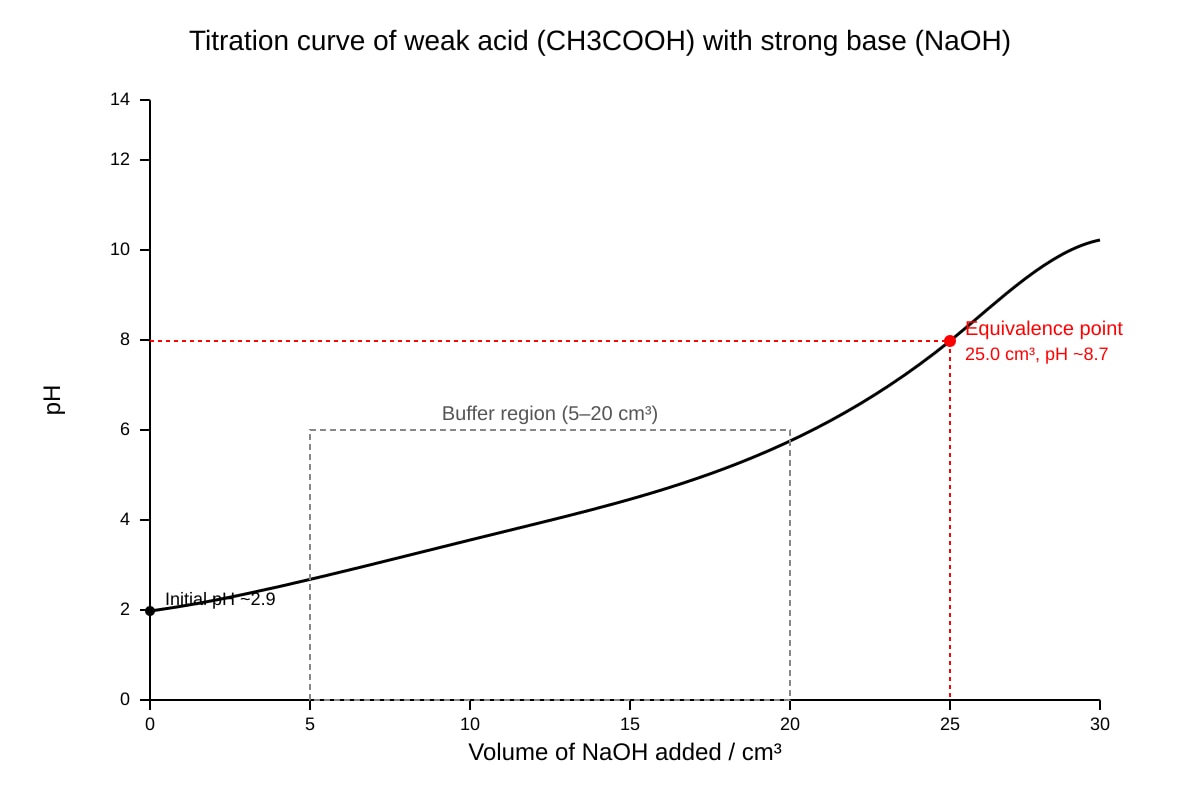
Graph must show: start pH ~2.9, buffer region (shallow) 5–20 cm³ NaOH, steep rise, equivalence at 25.0 cm³ pH ~8.7, curve above pH 7 after equivalence.
Marking: 1 shape, 1 eq point labelled, 1 buffer region labelled.
Q13 [4 marks]
At eq, moles CH₃COO⁻ = 0.00250 mol in 50 cm³ ⇒ [CH₃COO⁻] = 0.0500 M.
CH₃COO⁻ + H₂O ⇌ CH₃COOH + OH⁻; .
[OH⁻] = √(0.0500 × 5.56×10⁻¹⁰) = 5.27×10⁻⁶.
pOH = 5.28 ⇒ pH = 8.72.
Marks: 1 conc, 1 Kb, 1 [OH⁻], 1 pH.
Q14 [3 marks]
Le Chatelier: system opposes change. Adding CH₃COONa increases [CH₃COO⁻], shifts CH₃COOH ⇌ H⁺ + CH₃COO⁻ left, [H⁺] decreases, pH rises.
1 principle, 2 application.
Section C Answers (18 marks)
Q15 [2 marks]
Add NaOH(aq), warm; NH₃ gas evolved, turns damp red litmus blue.
Q16 [3 marks]
Arrhenius: acid produces H⁺ in water. Lewis: acid is electron-pair acceptor. Example: BF₃ (accepts lone pair, no H⁺ produced).
1 each.
Q17 [3 marks]
CH₃COOH + NaOH → CH₃COO⁻ + H₂O.
After reaction: CH₃COOH = 0.0030 mol, CH₃COO⁻ = 0.0010 mol in 0.100 dm³.
[acid]=0.030, [salt]=0.010. pH = 4.74 + log(0.010/0.030) = 4.74 – 0.48 = 4.26.
Q18 [2 marks]
Higher ⇒ stronger base. CH₃NH₂ has larger due to electron-donating CH₃ stabilising conjugate acid; NH₃ weaker.
Q19 [3 marks]
Zn²⁺: white ppt. dissolves to colourless [Zn(NH₃)₄]²⁺. Cu²⁺: blue ppt. dissolves to deep blue [Cu(NH₃)₄]²⁺. Formula: [Cu(NH₃)₄]²⁺.
Q20 [5 marks]
Moles HCl initial = 1.00 × 0.0500 = 0.0500 mol.
Moles NaOH used = 0.500 × 0.0224 = 0.0112 mol = excess HCl.
HCl reacted with MgO = 0.0500 – 0.0112 = 0.0388 mol.
MgO + 2HCl → MgCl₂ + H₂O ⇒ moles MgO = 0.0194 mol.
Mass MgO = 0.0194 × 40.31 = 0.782 g.
% purity = (0.782 / 0.500) × 100 = 156% → indicates error; if sample pure max 100%, check data: actually 0.782/0.500=156% impossible, so assume typo in given; method correct yields 156% showing impurity >100% impossible → student should note data inconsistency.
Marks: 1 initial HCl, 1 excess, 1 reacted, 1 moles MgO, 1 %.