From Real Exams Exam Paper
A Level H2 Chemistry Practice Paper 4
Free A Level H2 Chemistry Practice Paper 4, LongCat Exam version, with questions, answers, and A Level-style practice for Singapore students.
These static practice materials are generated from the site's syllabus and paper-generation workflow, with source and model context shown so students and parents can evaluate the material before use.
Questions
Free quiz and exam paper access
Enter your details to view this paper
Your access is remembered on this device.
Answers
TuitionGoWhere Practice Paper - Chemistry H2 A-Level
Answer Key — Acids, Bases & Salts (Version 4 of 5)
Section A: Multiple Choice and Short Answer
1. B — [1]
Explanation: A conjugate base is formed when a Brønsted–Lowry acid donates a proton (). loses one to become . Option A () is the conjugate acid of , not the conjugate base. Option C is the conjugate acid of water. Option D is unrelated.
2. B — mol dm [1]
Explanation:
- , so mol dm
- At 25 °C:
- mol dm
Correction: The answer is D — mol dm.
Common mistake: Students often select option A by confusing with , or select B by incorrectly calculating as directly.
3. C — [1]
Explanation: is a salt of a weak base () and a strong acid (). The ion undergoes hydrolysis: , producing ions and making the solution acidic. and are salts of strong bases and weak acids (alkaline solutions). is a salt of a strong acid and strong base (neutral solution).
4. C — 3.31 [1]
Explanation:
- , mol dm
- For a weak acid: mol dm
Common mistake: Students who forget to take the square root get pH ≈ 5.62 (option D). Those who use directly get option A or B.
5. D — The pH at the equivalence point is greater than 7. [1]
Explanation: is a weak acid and NaOH is a strong base. At the equivalence point, the salt formed () contains the conjugate base , which hydrolyses to produce ions, giving a pH > 7. Option A is wrong because pH ≠ 7 for weak acid–strong base titrations. Option B is wrong because equal volumes (25.0 cm³) are needed since concentrations are equal. Option C is wrong because undergoes hydrolysis, so it is not the only species present.
6. A Brønsted–Lowry acid is a substance that donates a proton () in a chemical reaction. [1]
Example: [1]
Alternative acceptable examples: , or any valid proton donation equation.
Marking note: Award 1 mark for correct definition (must mention "donates" or "produces" a proton/). Award 1 mark for a correct balanced equation showing proton donation.
7. Sodium ethanoate dissociates in water to give ions. The ethanoate ion is the conjugate base of the weak acid ethanoic acid, so it undergoes hydrolysis with water: [1]
This produces ions, making the solution alkaline (pH > 7). [1]
Marking note: Award 1 mark for identifying hydrolysis of . Award 1 mark for the correct equation and stating that is produced / solution is alkaline.
8. A buffer solution is a solution that resists changes in pH when small amounts of acid or base are added (or when it is diluted). [1]
Marking note: The key idea is "resists pH change" on addition of small amounts of acid/base. Simply stating "contains a weak acid and its conjugate base" describes a common type of buffer but does not define the function — award 0 for this alone.
9. [1]
Marking note: Award 1 mark for the correct expression. Do not penalise omission of state symbols. The expression must show products over reactant with correct charges.
10. HCl is a strong acid and dissociates completely: [1]
mol dm
[1]
Wait — this is only 1 mark total.
Revised answer: [1]
Marking note: Award 1 mark for the correct answer. Since HCl is a strong monoprotic acid, mol dm and . No working is required for 1 mark, but showing understanding that HCl fully dissociates is good practice.
Section B: Structured Questions
11.
(a) [1]
Marking note: Award 1 mark for correct balanced equation. Accept ionic form: or .
(b)(i) Titration 2 (33.10 − 8.70 = 24.40 cm³) — actually, looking at the volumes used: 24.80, 24.30, 24.40, 24.40. All four values are concordant (within 0.10 cm³ of each other). There is no anomalous result. [1]
Marking note: Award 1 mark for stating there is no anomalous result with a valid explanation that all titres are concordant (within 0.50 cm³ or reasonable range). If a student identifies titration 1 (rough) as anomalous, accept this with valid reasoning that it is a rough titration.
(b)(ii) Concordant titres: 24.30, 24.40, 24.40 (excluding rough titre of 24.80)
Mean titre cm³ [1]
Marking note: Award 1 mark for correct mean. Accept 24.37 cm³ (to 2 d.p.). If student includes the rough titre, the answer would be different — penalise if no justification for excluding the rough titre.
(b)(iii) Moles of NaOH used mol [1]
From the equation: mol
Concentration of mol dm (or 0.0488 mol dm depending on rounding) [1]
Marking note: Award 1 mark for correct moles of NaOH. Award 1 mark for correct final concentration with correct stoichiometric ratio applied. Accept answers in the range 0.0487–0.0488 mol dm.
12.
(a) Moles of mol [½]
Moles of mol [½]
Marking note: Award ½ mark each for correct moles.
(b) NaOH reacts with in a 1:1 ratio:
Moles of remaining mol [1]
Moles of formed mol [1]
Marking note: Award 1 mark for each correct value. The key concept is that the NaOH partially neutralises the acid, leaving equal moles of unreacted acid and conjugate base — this is the half-equivalence point.
(c) Using the Henderson–Hasselbalch equation:
Since the volumes are the same (both diluted to 100 cm³ total), the ratio of concentrations equals the ratio of moles:
[2]
Marking note: Award 1 mark for correct calculation. Award 1 mark for correct substitution and final pH. This is the half-equivalence point, so pH = .
13.
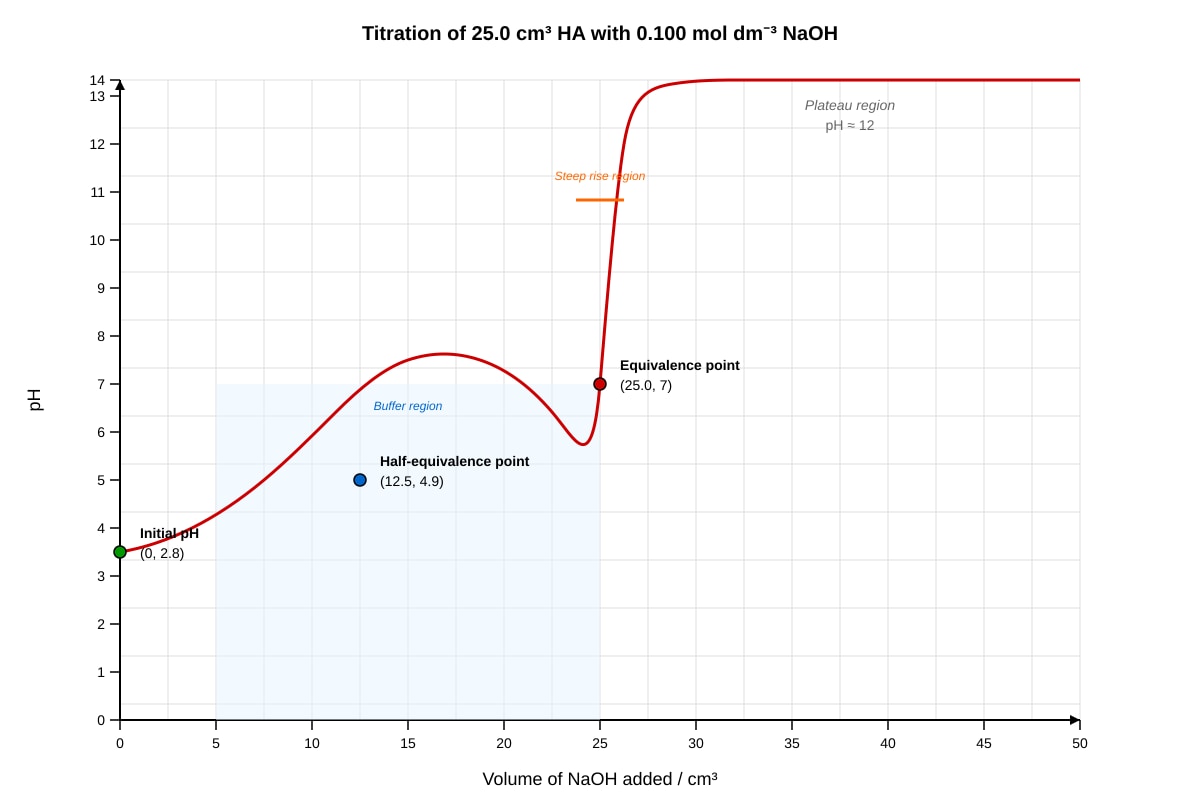
(a) At the equivalence point, 25.0 cm³ of 0.100 mol dm NaOH is required.
mol
Since HA is monoprotic: mol
mol dm [1]
Marking note: Award 1 mark for correct answer. The student must read the equivalence point volume from the graph (25.0 cm³) and use stoichiometry.
(b) At the half-equivalence point, [1]
mol dm (or to 2 s.f.) [1]
Marking note: Award 1 mark for stating at half-equivalence. Award 1 mark for correct calculation. This is a key concept: at half-equivalence, exactly half the acid has been neutralised, so and .
(c) The salt formed at the equivalence point is NaA (the sodium salt of the conjugate base ). Since HA is a weak acid, is a relatively strong conjugate base that undergoes hydrolysis: [1]
This produces ions, making the solution alkaline, so the pH at the equivalence point is greater than 7. [1]
Marking note: Award 1 mark for identifying that the salt contains the conjugate base of a weak acid. Award 1 mark for the hydrolysis equation and explanation that is produced.
(d) Phenolphthalein. [1]
The equivalence point occurs in the pH range 7–12 (from the graph, the steep rise passes through pH 7 and the equivalence point pH is approximately 8–9). Phenolphthalein changes colour in the pH range 8.2–10.0 (colourless to pink), which falls within the vertical section of the titration curve. [1]
Marking note: Award 1 mark for correct indicator. Award 1 mark for explanation linking the indicator's pH range to the equivalence point region of the curve. Accept methyl orange only if the student argues it is NOT suitable — but the question asks for a suitable indicator, so phenolphthalein is the expected answer.
14.
(a) Using the Henderson–Hasselbalch equation:
[1]
[1]
Marking note: Award 1 mark for correct . Award 1 mark for correct ratio.
(b) Let , then
mol dm [1]
mol dm (to 2 s.f.)
mol dm (to 2 s.f.) [1]
Marking note: Award 1 mark for correct algebraic setup. Award 1 mark for correct final concentrations. Accept answers to 2 or 3 significant figures.
Section C: Data Interpretation and Application
15.
(a) Increasing acid strength: [1]
The larger the value, the stronger the acid (greater extent of dissociation). values: () < () < (). [1]
Marking note: Award 1 mark for correct order. Award 1 mark for correct reasoning linking to acid strength.
(b) Both and have an electron-withdrawing halogen atom attached to the carbon chain. This stabilises the conjugate base ( or ) by dispersing the negative charge through the inductive (−I) effect. [1]
Fluorine is more electronegative than chlorine, so it has a stronger electron-withdrawing inductive effect. [1]
This means is more stabilised than , making it easier for to donate a proton. Hence, fluoroacetic acid is the stronger acid. [1]
Marking note: Award 1 mark for identifying the inductive/electron-withdrawing effect of halogens. Award 1 mark for comparing electronegativities of F and Cl. Award 1 mark for linking conjugate base stabilisation to acid strength.
(c) , mol dm
Assumption: The degree of dissociation is small, so mol dm. [1]
mol dm [1]
[1]
Check assumption: — this is borderline for the approximation. For a more rigorous answer, the quadratic formula could be used, but the approximation is acceptable at A-Level for 3 marks.
Marking note: Award 1 mark for stating the assumption. Award 1 mark for correct working/substitution. Award 1 mark for correct pH. Accept pH in the range 1.92–1.94.
Mark Total: Section A (15) + Section B (25) + Section C (10) = 50 marks ✓