From Real Exams Exam Paper
A Level H2 Chemistry Practice Paper 4
Free A Level H2 Chemistry Practice Paper 4, HY3 Exam version, with questions, answers, and A Level-style practice for Singapore students.
These static practice materials are generated from the site's syllabus and paper-generation workflow, with source and model context shown so students and parents can evaluate the material before use.
Questions
TuitionGoWhere Practice Paper - Chemistry H2 A-Level
TuitionGoWhere Exam Practice (AI)
Subject: Chemistry H2
Level: A-Level
Paper: Practice Paper (Version 4 of 5)
Duration: 75 minutes
Total Marks: 60
Name: ______________________
Class: ______________________
Date: ______________________
Instructions:
- Answer all questions in the spaces provided.
- Show all working clearly. Use appropriate units and significant figures.
- Useful data: Kw=1.0×10⁻¹⁴ mol2 dm−6 at 298 K; R=8.31 J K−1 mol−1.
- This paper tests the topic Acids, Bases & Salts only.
Section A: Titration and Data Interpretation (Questions 1–5) [12 marks]
1. A student performed a titration of hydrochloric acid (FA1) against sodium hydroxide. The raw burette readings (cm³) were:
| Trial | Initial | Final | Volume |
|---|---|---|---|
| 1 (rough) | 0.00 | 24.80 | 24.80 |
| 2 | 0.20 | 24.95 | 24.75 |
| 3 | 1.10 | 25.90 | 24.80 |
| 4 | 0.50 | 25.20 | 24.70 |
From your titrations, obtain a suitable volume of FA1 to be used in your calculations. Show clearly how you obtained this volume. [2]
2. State the colour change observed at the endpoint when phenolphthalein is used as indicator in the titration of weak acid CH₃COOH with strong base NaOH. [1]
3. The table below shows gas tests. Complete the missing entries. [3]
| Gas | Test | Observation |
|---|---|---|
| NH₃ | Damp red litmus paper | _________________ |
| CO₂ | Limewater | _________________ |
| Cl₂ | Damp litmus paper | _________________ |
4. A sample of cation solution gives a white precipitate with NaOH(aq) which is soluble in excess NaOH. With NH₃(aq), a white precipitate forms and is insoluble in excess. Identify the cation. [1]
5. Record the titration results from Q1 in a properly presented results table showing concordant titres only, to 2 decimal places. [5]
Section B: Calculations and Acid–Base Theory (Questions 6–12) [24 marks]
6. Calculate the pH of a 0.020 mol dm−3 solution of HCl at 298 K. [2]
7. A 0.10 mol dm−3 solution of ethanoic acid (CH₃COOH) has Ka=1.8×10⁻⁵ mol dm−3. Calculate its pH. [3]
8. Define a Brønsted–Lowry acid and a Brønsted–Lowry base. Give one example of a conjugate acid–base pair. [3]
9. Calculate the volume of 0.100 mol dm−3 NaOH required to neutralise 25.0 cm3 of 0.080 mol dm−3 H₂SO₄. [3]
10. Explain, using an equation, why a solution of NH₄Cl is acidic. [2]
11. A buffer solution contains 0.20 mol dm−3 CH₃COOH and 0.30 mol dm−3 CH₃COO⁻ (from sodium ethanoate). Given Ka=1.8×10⁻⁵, calculate the pH. [3]
12. State the Lewis definition of a base and identify the Lewis base in the reaction: BF₃ + NH₃ → F₃B←NH₃. [2]
Section C: Structured and Extended Response (Questions 13–20) [24 marks]
13. A student adds NaOH(aq) dropwise to a solution containing Al³⁺(aq).
(a) State the observation initially. [1]
(b) State what is observed on adding excess NaOH(aq). [1]
(c) Write the equation for the dissolution in excess NaOH. [2]
14. Describe and explain the result of adding aqueous ammonia to a solution of Cu²⁺(aq). Include the formula of the final complex. [3]
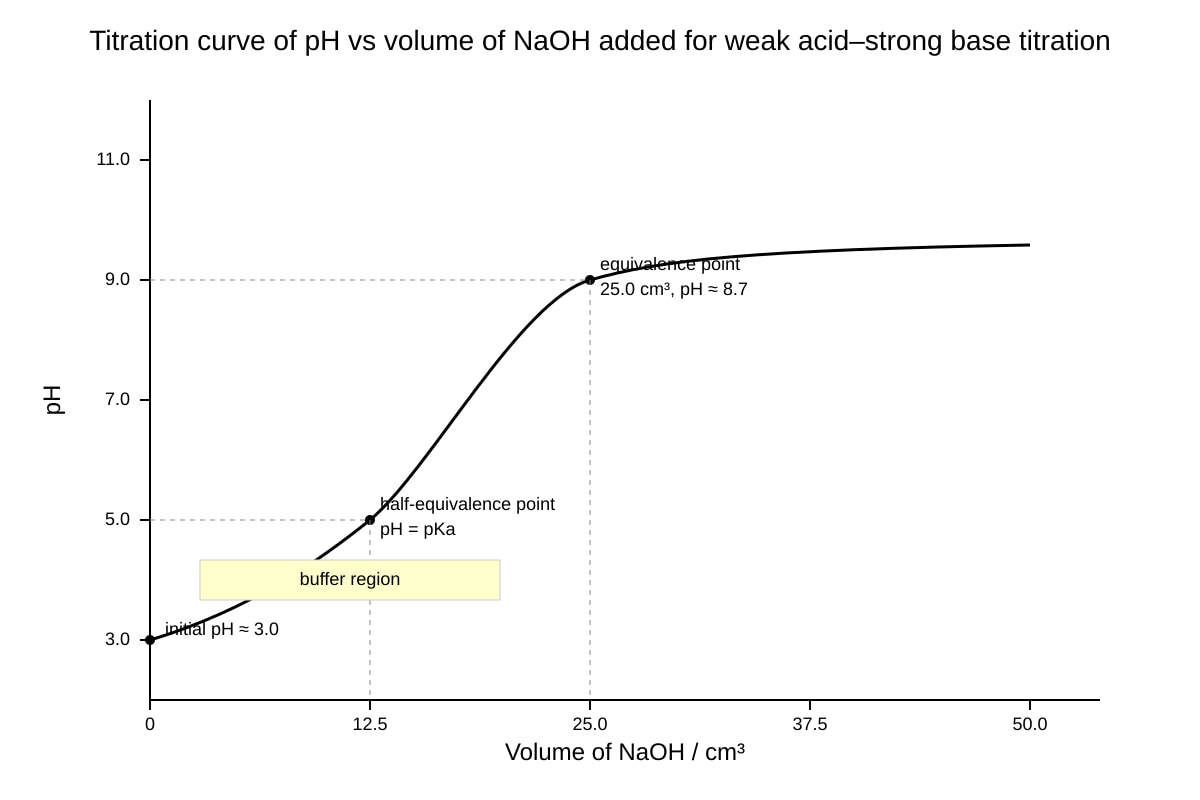
15. The following titration curve was obtained by adding NaOH to a weak monoprotic acid.
Image pending generation: graph for 15.
Using the graph, estimate the pKa of the acid and explain your method. [2]
16. Compare the actions of a buffer solution and a strong acid when small amounts of NaOH are added. [3]
17. A solution contains Pb²⁺(aq). State the observation when NH₃(aq) is added dropwise and in excess. [2]
18. Calculate the mass of anhydrous sodium carbonate required to prepare 250 cm3 of 0.100 mol dm−3 Na₂CO₃. (Mᵣ Na₂CO₃ = 106) [3]
19. Explain why CO₂ turns limewater milky but the milkiness disappears in excess CO₂. Include equations. [3]
20. A salt X is dissolved in water and gives a solution of pH 9. Suggest a possible identity for X based on hydrolysis of ions, and explain. [3]
Answers
Answer Key: TuitionGoWhere Practice Paper - Chemistry H2 A-Level (Version 4)
Topic: Acids, Bases & Salts
Section A
1. [2 marks]
- Reject trial 1 (rough): 24.80 cm³.
- Trials 2–4: 24.75, 24.80, 24.70 cm³. Range = 0.10 cm³ (≤0.10 acceptable). All concordant.
- Mean = (24.75 + 24.80 + 24.70) / 3 = 24.75 cm³.
- Award 1 mark for correct exclusion of rough, 1 mark for mean to 2 d.p. with units.
Answer: 24.75 cm³
2. [1 mark]
Colourless → pink (or faint pink).
Teaching: Phenolphthalein is colourless in acid, pink in alkali; endpoint at pH ~8.3.
3. [3 marks, 1 each]
- NH₃: turns damp red litmus paper blue
- CO₂: white precipitate (ppt) formed, dissolves in excess CO₂
- Cl₂: bleaches damp litmus paper (turns white)
4. [1 mark]
Al³⁺(aq). (White ppt soluble in excess NaOH, insoluble in excess NH₃.)
5. [5 marks]
Present table with concordant titres only:
| Titration | Volume / cm³ |
|---|---|
| 2 | 24.75 |
| 3 | 24.80 |
| 4 | 24.70 |
| Mean | 24.75 |
Mark: 1 for heading/units, 1 each for 3 values (2 d.p.), 1 for mean. Common error: including rough titre.
Section B
6. [2 marks]
HCl → H⁺ + Cl⁻, strong acid fully dissociated.
[H⁺] = 0.020 mol dm⁻³.
pH = –log(0.020) = 1.70.
1 mark concentration, 1 mark pH.
7. [3 marks]
CH₃COOH ⇌ H⁺ + CH₃COO⁻
Ka=[CH3COOH][H+][CH3COO−]≈0.10x2
x=1.8×10−5×0.10=1.34×10⁻³
pH = –log(1.34×10⁻³) = 2.87.
Marks: 1 eqn, 1 calc x, 1 pH.
8. [3 marks]
Brønsted–Lowry acid: proton (H⁺) donor. [1]
Base: proton acceptor. [1]
Pair e.g. CH₃COOH / CH₃COO⁻. [1]
9. [3 marks]
H₂SO₄ + 2NaOH → Na₂SO₄ + 2H₂O
n(H₂SO₄) = 0.080 × 25.0/1000 = 2.00×10⁻³ mol
n(NaOH) = 2 × 2.00×10⁻³ = 4.00×10⁻³ mol
V = n / c = 4.00×10⁻³ / 0.100 = 0.0400 dm³ = 40.0 cm³.
Marks: 1 eqn, 1 moles, 1 volume.
10. [2 marks]
NH₄⁺ + H₂O ⇌ NH₃ + H₃O⁺. [1] NH₄⁺ hydrolyses to produce H₃O⁺, lowering pH. [1]
11. [3 marks]
Henderson–Hasselbalch: pH = pKa + log([A⁻]/[HA])
pKa = –log(1.8×10⁻⁵) = 4.74
pH = 4.74 + log(0.30/0.20) = 4.74 + 0.176 = 4.92.
Marks: 1 pKa, 1 ratio, 1 final.
12. [2 marks]
Lewis base: electron-pair donor. [1] NH₃ is Lewis base (donates lone pair to BF₃). [1]
Section C
13. [4 marks]
(a) White precipitate of Al(OH)₃. [1]
(b) Precipitate dissolves to form colourless solution. [1]
(c) Al(OH)₃ + OH⁻ → [Al(OH)₄]⁻. [2]
14. [3 marks]
Light blue ppt of Cu(OH)₂ forms; with excess NH₃ dissolves to deep blue solution of [Cu(NH₃)₄]²⁺. [2] Equation: Cu²⁺ + 4NH₃ → [Cu(NH₃)₄]²⁺. [1]
15. [2 marks]
At half-equivalence (12.5 cm³), pH = pKa. From graph pH ≈ (read value, e.g. 4.7). [1] Method stated. [1]
16. [3 marks]
Buffer resists pH change by consuming OH⁻: CH₃COOH + OH⁻ → CH₃COO⁻ + H₂O. [2] Strong acid would be little affected only if excess H⁺ present, but addition of base raises pH sharply if not buffered. [1]
17. [2 marks]
White ppt Pb(OH)₂ forms; insoluble in excess NH₃. [2]
18. [3 marks]
n = 0.100 × 250/1000 = 0.0250 mol
m = n × Mᵣ = 0.0250 × 106 = 2.65 g.
Marks: 1 moles, 1 mass, 1 units.
19. [3 marks]
CO₂ + Ca(OH)₂ → CaCO₃ (white ppt) + H₂O. [1] Excess CO₂: CaCO₃ + CO₂ + H₂O → Ca(HCO₃)₂ (soluble). [2]
20. [3 marks]
X could be CH₃COONa. [1] CH₃COO⁻ hydrolyses: CH₃COO⁻ + H₂O ⇌ CH₃COOH + OH⁻, raising pH. [2]
Free quiz and exam paper access
Enter your details to view this paper
Your access is remembered on this device.