From Real Exams Exam Paper

A Level H2 Chemistry Practice Paper 3

Free Exam-Derived Owl Alpha A Level H2 Chemistry Practice Paper 3 practice paper with questions and answers for Singapore students. This page is rendered as a direct URL so the questions and answers can be discovered without pressing in-page buttons.

These static practice materials are generated from the site's syllabus and paper-generation workflow, with source and model context shown so students and parents can evaluate the material before use.

A Level H2 Chemistry From Real Exams Generated by Owl Alpha Updated 2026-06-07

Questions

<!-- TuitionGoWhere generation metadata: stage=3-1; model=openrouter/owl-alpha; model_label=Owl Alpha; generated=2026-06-06; Sources: Stage 2-1 real exam-derived templates and Stage 2-2 exam-enriched syllabus. -->

TuitionGoWhere Practice Paper - Chemistry H2 A-Level

TuitionGoWhere Secondary School (AI)


Subject: Chemistry Level: A-Level H2 Paper: Practice Paper — Acids, Bases & Salts Version: 3 of 5 Duration: 60 minutes Total Marks: 50


Name: ________________________ Class: ________________________ Date: ________________________ Score: ________________________


Instructions

  1. Answer all questions in the spaces provided.
  2. Write your answers in dark blue or black pen.
  3. You may use a soft pencil for any diagrams, graphs, or rough working.
  4. Show all working for calculation questions. Answers without working may not receive full credit.
  5. The use of an approved scientific calculator is expected where appropriate.
  6. A Data Booklet is provided.
  7. The number of marks for each question or part question is shown in brackets [ ].

Section A: Multiple Choice and Short Answer (Questions 1–10)

Answer all questions in this section.


Question 1 [1]

Which of the following is the correct expression for the ionic product of water, KwK_w, at 25 °C?

A. Kw=[H2O]K_w = [H_2O] B. Kw=[H+][OH]K_w = [H^+][OH^-] C. Kw=[H+][OH]K_w = \frac{[H^+]}{[OH^-]} D. Kw=[H+]+[OH]K_w = [H^+] + [OH^-]


Question 2 [1]

A solution has a pH of 3.40 at 25 °C. What is the concentration of OHOH^- ions in this solution?

A. 2.51×10¹¹ mol dm32.51 \times 10^{-11} \text{ mol dm}^{-3} B. 3.98×10⁴ mol dm33.98 \times 10^{-4} \text{ mol dm}^{-3} C. 2.51×10⁴ mol dm32.51 \times 10^{-4} \text{ mol dm}^{-3} D. 3.98×10¹¹ mol dm33.98 \times 10^{-11} \text{ mol dm}^{-3}


Question 3 [2]

Define the following terms:

(a) A Brønsted–Lowry acid. [1]

(b) A buffer solution. [1]


Question 4 [2]

Calculate the pH of a 0.025 mol dm30.025 \text{ mol dm}^{-3} solution of sodium hydroxide, NaOHNaOH, at 25 °C. Assume NaOHNaOH dissociates completely.


Question 5 [3]

Ethanoic acid, CH3COOHCH_3COOH, is a weak acid with Ka=1.74×10⁵ mol dm3K_a = 1.74 \times 10^{-5} \text{ mol dm}^{-3} at 25 °C.

(a) Write an expression for the acid dissociation constant, KaK_a, of ethanoic acid. [1]

(b) Calculate the pH of a 0.100 mol dm30.100 \text{ mol dm}^{-3} solution of ethanoic acid. State any assumption you make. [2]


Question 6 [3]

A buffer solution is prepared by mixing 50.0 cm350.0 \text{ cm}^3 of 0.200 mol dm30.200 \text{ mol dm}^{-3} ethanoic acid with 50.0 cm350.0 \text{ cm}^3 of 0.200 mol dm30.200 \text{ mol dm}^{-3} sodium ethanoate.

(a) Calculate the pH of this buffer solution. (KaK_a of ethanoic acid =1.74×10⁵ mol dm3= 1.74 \times 10^{-5} \text{ mol dm}^{-3}) [2]

(b) Explain qualitatively what happens to the pH when a small amount of dilute hydrochloric acid is added to this buffer. [1]


Question 7 [3]

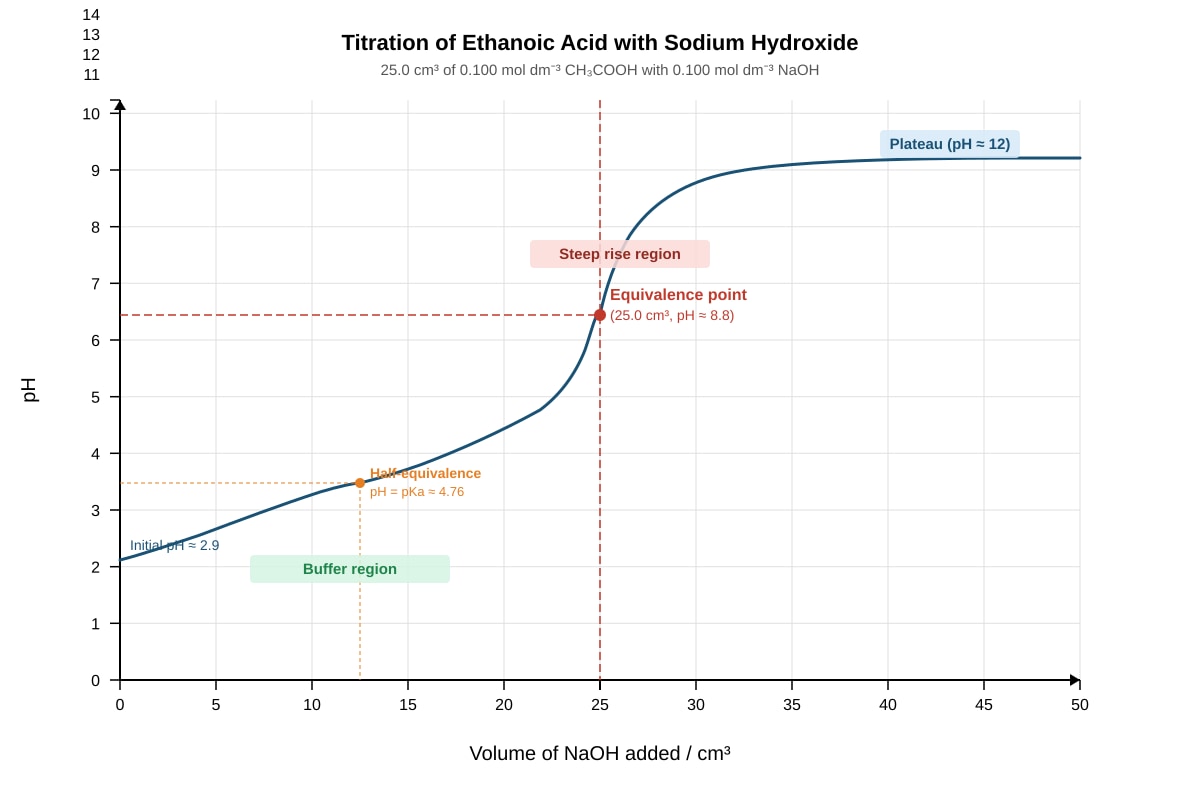
The following question refers to the titration of 25.0 cm325.0 \text{ cm}^3 of 0.100 mol dm30.100 \text{ mol dm}^{-3} ethanoic acid with 0.100 mol dm30.100 \text{ mol dm}^{-3} sodium hydroxide.

<image_placeholder> id: Q7-fig1 type: graph linked_question: Q7 description: A pH titration curve showing the titration of 25.0 cm³ of 0.100 mol dm⁻³ ethanoic acid (weak acid) with 0.100 mol dm⁻³ NaOH (strong base). The curve starts at approximately pH 2.9, rises gradually, has a steep rise between approximately 20–30 cm³, and plateaus at high pH around 12. The equivalence point is at 25.0 cm³. labels: x-axis: "Volume of NaOH added / cm³" (0 to 50), y-axis: "pH" (0 to 14), equivalence point marked at 25.0 cm³, buffer region indicated, initial pH ~2.9 values: equivalence point at 25.0 cm³, initial pH ≈ 2.9, pH at equivalence point ≈ 8.8, half-equivalence point at 12.5 cm³ where pH = pKa ≈ 4.76 must_show: axes with labels and units, equivalence point clearly marked at 25.0 cm³, initial pH, buffer region, steep rise region, plateau at high pH </image_placeholder>

(a) Use the graph to determine the pH at the equivalence point. [1]

(b) Explain why the pH at the equivalence point is greater than 7. [1]

(c) State a suitable indicator for this titration. Give a reason for your choice. [1]


Question 8 [3]

A student carries out a titration to determine the concentration of a solution of hydrochloric acid using 0.100 mol dm30.100 \text{ mol dm}^{-3} sodium hydroxide.

The student records the following results:

TitrationRough123
Final burette reading / cm³24.8024.4048.7024.30
Initial burette reading / cm³0.000.0024.400.00
Volume of NaOH used / cm³24.8024.4024.3024.30

(a) Identify any anomalous result and explain your reasoning. [1]

(b) Calculate the mean titre to be used in your calculation. [1]

(c) The student used 25.0 cm325.0 \text{ cm}^3 of hydrochloric acid. Calculate the concentration of the hydrochloric acid. [1]


Question 9 [3]

The solubility product, KspK_{sp}, of magnesium hydroxide, Mg(OH)2Mg(OH)_2, is 1.8×10¹¹ mol3 dm91.8 \times 10^{-11} \text{ mol}^3 \text{ dm}^{-9} at 25 °C.

(a) Write an expression for KspK_{sp} of Mg(OH)2Mg(OH)_2. [1]

(b) Calculate the solubility of Mg(OH)2Mg(OH)_2 in water at 25 °C, in mol dm3\text{mol dm}^{-3}. [2]


Question 10 [4]

A solution contains a mixture of 0.100 mol dm30.100 \text{ mol dm}^{-3} hydrochloric acid and 0.100 mol dm30.100 \text{ mol dm}^{-3} ethanoic acid (Ka=1.74×10⁵ mol dm3K_a = 1.74 \times 10^{-5} \text{ mol dm}^{-3}).

(a) Explain why the pH of this mixture is approximately 1.0. [2]

(b) Calculate the concentration of ethanoate ions, CH3COOCH_3COO^-, in this mixture. [2]


Section B: Structured and Data-Based Questions (Questions 11–20)

Answer all questions in this section.


Question 11 [4]

The table below shows the KaK_a values for three weak acids at 25 °C.

AcidFormulaKaK_a / mol dm3\text{mol dm}^{-3}
Hydrofluoric acidHFHF6.8×1046.8 \times 10^{-4}
Nitrous acidHNO2HNO_24.5×1044.5 \times 10^{-4}
Methanoic acidHCOOHHCOOH1.8×1041.8 \times 10^{-4}

(a) Arrange the three acids in order of increasing acid strength. [1]

(b) Calculate the pH of a 0.050 mol dm30.050 \text{ mol dm}^{-3} solution of methanoic acid. [2]

(c) Explain which of the three acids would produce the highest pH when each is prepared as a 0.100 mol dm30.100 \text{ mol dm}^{-3} solution. [1]


Question 12 [5]

A student prepares a buffer solution by dissolving 4.10 g4.10 \text{ g} of sodium ethanoate, CH3COONaCH_3COONa, in 250 cm3250 \text{ cm}^3 of 0.100 mol dm30.100 \text{ mol dm}^{-3} ethanoic acid.

(a) Calculate the concentration of sodium ethanoate in the buffer solution. (MrM_r of CH3COONa=82.0CH_3COONa = 82.0) [2]

(b) Calculate the pH of the buffer solution. (KaK_a of ethanoic acid =1.74×10⁵ mol dm3= 1.74 \times 10^{-5} \text{ mol dm}^{-3}) [2]

(c) The student adds 10.0 cm310.0 \text{ cm}^3 of 0.100 mol dm30.100 \text{ mol dm}^{-3} HClHCl to 100 cm3100 \text{ cm}^3 of this buffer. Explain qualitatively whether the pH change will be large or small. [1]


Question 13 [4]

The following question is about the hydrolysis of salts.

(a) Explain why a solution of ammonium chloride, NH4ClNH_4Cl, is acidic. Include an equation in your answer. [2]

(b) Explain why a solution of sodium ethanoate, CH3COONaCH_3COONa, is alkaline. Include an equation in your answer. [2]


Question 14 [5]

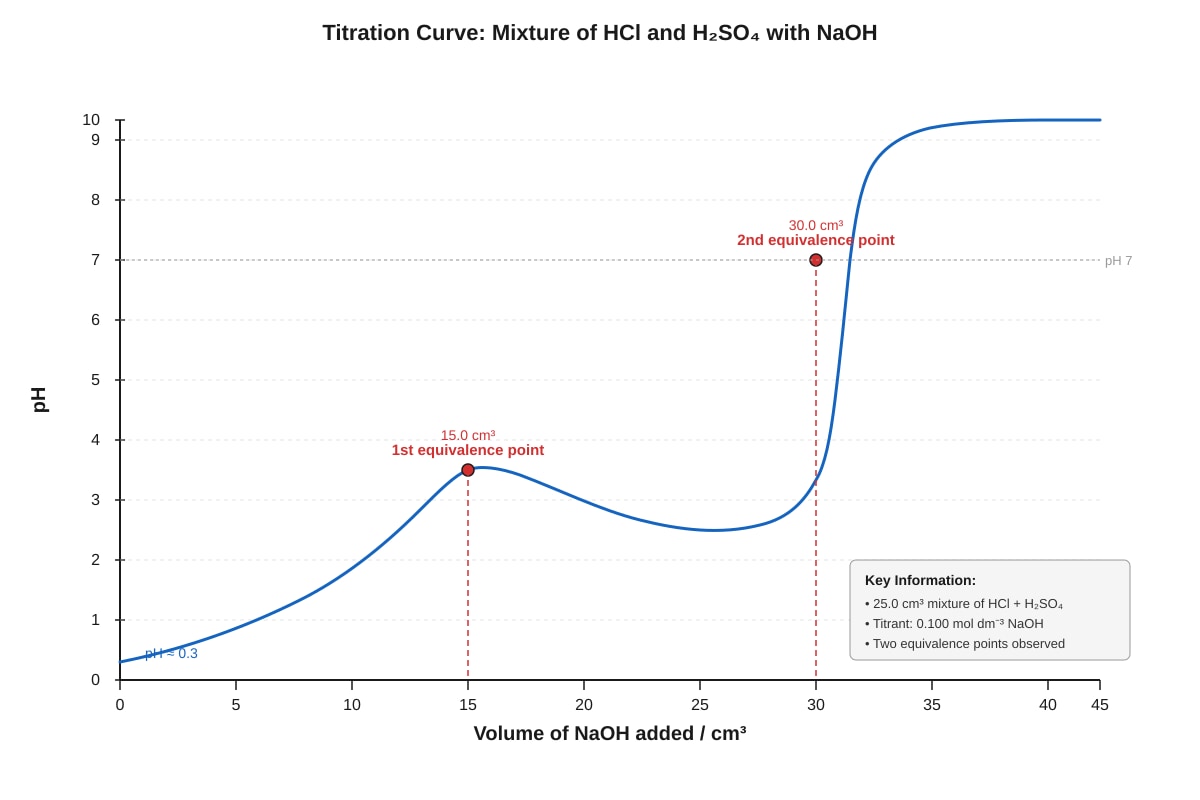
A 25.0 cm325.0 \text{ cm}^3 sample of a solution containing a mixture of HClHCl and H2SO4H_2SO_4 was titrated with 0.100 mol dm30.100 \text{ mol dm}^{-3} NaOHNaOH. The titration curve is shown below.

<image_placeholder> id: Q14-fig1 type: graph linked_question: Q14 description: A pH titration curve for the titration of 25.0 cm³ of a mixture of HCl and H₂SO₄ with 0.100 mol dm⁻³ NaOH. The curve starts at very low pH (~0.3), rises gradually, has a first equivalence point at approximately 15.0 cm³, continues rising, and has a second equivalence point at approximately 30.0 cm³, then rises steeply. labels: x-axis: "Volume of NaOH added / cm³" (0 to 50), y-axis: "pH" (0 to 14), first equivalence point at ~15.0 cm³, second equivalence point at ~30.0 cm³ values: first equivalence point at 15.0 cm³, second equivalence point at 30.0 cm³, initial pH ≈ 0.3 must_show: axes with labels and units, two equivalence points clearly marked, initial low pH, steep rise after second equivalence point </image_placeholder>

(a) Explain why there are two equivalence points in this titration. [2]

(b) From the graph, determine the total volume of NaOHNaOH required to reach the second equivalence point. [1]

(c) Calculate the total concentration of H+H^+ ions in the original acid mixture. [2]


Question 15 [4]

The common ion effect can affect the solubility of sparingly soluble salts.

(a) Define the term common ion effect. [1]

(b) The KspK_{sp} of silver chloride, AgClAgCl, is 1.8×10¹⁰ mol2 dm61.8 \times 10^{-10} \text{ mol}^2 \text{ dm}^{-6} at 25 °C. Calculate the solubility of AgClAgCl in:

    (i) pure water [1]

    (ii) 0.100 mol dm30.100 \text{ mol dm}^{-3} sodium chloride solution [2]


Question 16 [4]

A student investigates the effect of temperature on the ionic product of water, KwK_w.

The following data was collected:

Temperature / °CKwK_w / mol2 dm6\text{mol}^2 \text{ dm}^{-6}
102.92×10152.92 \times 10^{-15}
251.00×10141.00 \times 10^{-14}
402.92×10142.92 \times 10^{-14}
609.61×10149.61 \times 10^{-14}

(a) Explain the trend in KwK_w with increasing temperature in terms of the enthalpy change of the dissociation of water. [2]

(b) Calculate the pH of pure water at 60 °C. [1]

(c) State whether pure water at 60 °C is acidic, alkaline, or neutral. Explain your answer. [1]


Question 17 [3]

A solution of a weak monoprotic acid, HAHA, has a concentration of 0.050 mol dm30.050 \text{ mol dm}^{-3} and a pH of 3.00.

(a) Calculate the KaK_a of the acid HAHA. [2]

(b) Calculate the percentage dissociation of the acid in this solution. [1]


Question 18 [4]

The following question relates to the preparation of a buffer solution of a specific pH.

(a) Describe how you would prepare a buffer solution with a pH of 5.00 using ethanoic acid (Ka=1.74×10⁵ mol dm3K_a = 1.74 \times 10^{-5} \text{ mol dm}^{-3}) and sodium ethanoate. Include the required ratio of concentrations. [3]

(b) Explain why a buffer solution resists changes in pH when small amounts of acid or base are added. [1]


Question 19 [3]

A solution of sodium carbonate, Na2CO3Na_2CO_3, is alkaline.

(a) Write an equation to show the hydrolysis of the carbonate ion, CO32CO_3^{2-}, in water. [1]

(b) Explain why the hydrolysis of CO32CO_3^{2-} makes the solution alkaline. [1]

(c) Predict whether a solution of sodium hydrogencarbonate, NaHCO3NaHCO_3, would be acidic, alkaline, or neutral. Give a reason. [1]


Question 19 [3]

A solution of sodium carbonate, Na2CO3Na_2CO_3, is alkaline.

(a) Write an equation to show the hydrolysis of the carbonate ion, CO32CO_3^{2-}, in water. [1]

(b) Explain why the hydrolysis of CO32CO_3^{2-} makes the solution alkaline. [1]

(c) Predict whether a solution of sodium hydrogencarbonate, NaHCO3NaHCO_3, would be acidic, alkaline, or neutral. Give a reason. [1]


Question 20 [5]

A student wishes to determine the concentration of a solution of sulfuric acid, H2SO4H_2SO_4, by titration with 0.100 mol dm30.100 \text{ mol dm}^{-3} NaOHNaOH.

The student records the following titration results:

TitrationRough123
Final burette reading / cm³26.5025.8525.7525.80
Initial burette reading / cm³0.000.000.000.00
Volume of NaOH used / cm³26.5025.8525.7525.80

(a) From the titrations, obtain a suitable volume of NaOHNaOH to be used in your calculations. Show clearly how you obtained this volume. [2]

(b) The student used 20.0 cm320.0 \text{ cm}^3 of sulfuric acid. Calculate the concentration of the sulfuric acid. [2]

(c) The student used methyl orange as the indicator. Explain why this is a suitable indicator for this titration. [1]


End of Paper


Summary of Marks

SectionQuestionsMarks
A1–1025
B11–2025
Total50

Answers

<!-- TuitionGoWhere generation metadata: stage=3-1; model=openrouter/owl-alpha; model_label=Owl Alpha; generated=2026-06-06; Sources: Stage 2-1 real exam-derived templates and Stage 2-2 exam-enriched syllabus. -->

TuitionGoWhere Practice Paper — Chemistry H2 A-Level

Answer Key — Version 3 of 5


Section A: Multiple Choice and Short Answer (Questions 1–10)


Question 1 [1]

Answer: B

Kw=[H+][OH]K_w = [H^+][OH^-]

Explanation: The ionic product of water is defined as the product of the concentrations of hydrogen ions and hydroxide ions in aqueous solution. At 25 °C, Kw=1.00×10¹⁴ mol2 dm6K_w = 1.00 \times 10^{-14} \text{ mol}^2 \text{ dm}^{-6}. This is a fundamental definition that students must recall. Option A is incorrect because water is a pure liquid and its concentration is not included in the equilibrium expression. Option C is a ratio, not a product. Option D is a sum, not a product.


Question 2 [1]

Answer: A2.51×1011 mol dm32.51 \times 10^{-11} \text{ mol dm}^{-3}

Working:

Given: pH = 3.40

Step 1: Calculate [H+][H^+] [H+]=10pH=103.40=3.98×10⁴ mol dm3[H^+] = 10^{-\text{pH}} = 10^{-3.40} = 3.98 \times 10^{-4} \text{ mol dm}^{-3}

Step 2: Use KwK_w to find [OH][OH^-] Kw=[H+][OH]=1.00×10¹⁴K_w = [H^+][OH^-] = 1.00 \times 10^{-14} [OH]=1.00×10143.98×104=2.51×10¹¹ mol dm3[OH^-] = \frac{1.00 \times 10^{-14}}{3.98 \times 10^{-4}} = 2.51 \times 10^{-11} \text{ mol dm}^{-3}

Explanation: This question tests the relationship between pH, [H+][H^+], and [OH][OH^-] via KwK_w. Students must first convert pH to [H+][H^+] using the antilog, then use the KwK_w expression to find [OH][OH^-]. A common mistake is to calculate 103.4010^{-3.40} incorrectly or to confuse [H+][H^+] with [OH][OH^-].


Question 3 [2]

(a) [1] A Brønsted–Lowry acid is a proton (H+H^+) donor.

Explanation: The Brønsted–Lowry theory defines acids and bases in terms of proton transfer. An acid donates a proton; a base accepts a proton. This is the most commonly used definition in A-Level Chemistry.

(b) [1] A buffer solution is a solution that resists changes in pH when small amounts of acid or base are added (or when it is diluted).

Explanation: A buffer typically consists of a weak acid and its conjugate base (or a weak base and its conjugate acid). The key property is resistance to pH change, not maintenance of a constant pH.


Question 4 [2]

Answer: pH = 12.40

Working:

NaOHNaOH is a strong base and dissociates completely: NaOHNa++OHNaOH \rightarrow Na^+ + OH^-

[OH]=0.025 mol dm3[OH^-] = 0.025 \text{ mol dm}^{-3}

Step 1: Calculate pOH pOH=log10[OH]=log10(0.025)=1.60\text{pOH} = -\log_{10}[OH^-] = -\log_{10}(0.025) = 1.60

Step 2: Calculate pH pH=14.00pOH=14.001.60=12.40\text{pH} = 14.00 - \text{pOH} = 14.00 - 1.60 = 12.40

Alternatively: [H+]=Kw[OH]=1.00×10140.025=4.00×10¹³ mol dm3[H^+] = \frac{K_w}{[OH^-]} = \frac{1.00 \times 10^{-14}}{0.025} = 4.00 \times 10^{-13} \text{ mol dm}^{-3} pH=log10(4.00×10¹³)=12.40\text{pH} = -\log_{10}(4.00 \times 10^{-13}) = 12.40

Explanation: For strong base pH calculations, students can either calculate pOH first and subtract from 14, or calculate [H+][H^+] from KwK_w and then find pH. Both methods are valid. The key is recognising that NaOHNaOH dissociates completely, so [OH]=[NaOH][OH^-] = [NaOH].


Question 5 [3]

(a) [1] Ka=[CH3COO][H+][CH3COOH]K_a = \frac{[CH_3COO^-][H^+]}{[CH_3COOH]}

Explanation: The KaK_a expression is written as the product of the concentrations of the products (dissociated ions) divided by the concentration of the undissociated acid. Water is omitted as it is a pure liquid.

(b) [2] Answer: pH = 2.88

Working:

Assumption: The dissociation of ethanoic acid is small, so [CH3COOH]0.100 mol dm3[CH_3COOH] \approx 0.100 \text{ mol dm}^{-3} at equilibrium.

Ka=[CH3COO][H+][CH3COOH]=[H+]20.100=1.74×10⁵K_a = \frac{[CH_3COO^-][H^+]}{[CH_3COOH]} = \frac{[H^+]^2}{0.100} = 1.74 \times 10^{-5}

Since [CH3COO]=[H+][CH_3COO^-] = [H^+] (1:1 stoichiometry of dissociation):

[H+]2=1.74×105×0.100=1.74×10⁶[H^+]^2 = 1.74 \times 10^{-5} \times 0.100 = 1.74 \times 10^{-6} [H+]=1.74×106=1.32×10³ mol dm3[H^+] = \sqrt{1.74 \times 10^{-6}} = 1.32 \times 10^{-3} \text{ mol dm}^{-3} pH=log10(1.32×10³)=2.88\text{pH} = -\log_{10}(1.32 \times 10^{-3}) = 2.88

Marking notes:

  • 1 mark for correct KaK_a expression or correct method setup
  • 1 mark for correct pH value

Explanation: For weak acid pH calculations, the key assumption is that the degree of dissociation is small, so the equilibrium concentration of the undissociated acid is approximately equal to the initial concentration. This allows the simplification [H+]2=Ka×C[H^+]^2 = K_a \times C. Students should always state this assumption. The assumption is valid if the percentage dissociation is less than 5%.


Question 6 [3]

(a) [2] Answer: pH = 4.76

Working:

After mixing equal volumes, the concentrations are halved: [CH3COOH]=0.2002=0.100 mol dm3[CH_3COOH] = \frac{0.200}{2} = 0.100 \text{ mol dm}^{-3} [CH3COO]=0.2002=0.100 mol dm3[CH_3COO^-] = \frac{0.200}{2} = 0.100 \text{ mol dm}^{-3}

Using the Henderson–Hasselbalch equation: pH=pKa+log10[salt][acid]\text{pH} = \text{p}K_a + \log_{10}\frac{[\text{salt}]}{[\text{acid}]} pKa=log10(1.74×10⁵)=4.76\text{p}K_a = -\log_{10}(1.74 \times 10^{-5}) = 4.76 pH=4.76+log100.1000.100=4.76+log10(1)=4.76+0=4.76\text{pH} = 4.76 + \log_{10}\frac{0.100}{0.100} = 4.76 + \log_{10}(1) = 4.76 + 0 = 4.76

Marking notes:

  • 1 mark for correct pKa calculation or recognition that [salt]/[acid] = 1
  • 1 mark for correct final pH

(b) [1] When a small amount of HClHCl is added, the H+H^+ ions react with the ethanoate ions (CH3COOCH_3COO^-) to form more ethanoic acid (CH3COOHCH_3COOH). The ratio [CH3COO]/[CH3COOH][CH_3COO^-]/[CH_3COOH] changes only slightly, so the pH remains approximately constant.

Explanation: The buffer works because the added H+H^+ is consumed by the conjugate base (CH3COOCH_3COO^-) present in the buffer. This is the fundamental mechanism of buffer action. The pH change is small because the logarithmic relationship means that even significant changes in the ratio produce only small pH changes.


Question 7 [3]

(a) [1] From the graph, the pH at the equivalence point (25.0 cm³) is approximately 8.8 (accept 8.5–9.0).

Explanation: The equivalence point is where the steepest part of the curve occurs, at 25.0 cm³ of NaOH added. Students should read the pH value at this point from the y-axis.

(b) [1] At the equivalence point, all the ethanoic acid has been converted to sodium ethanoate (CH3COONaCH_3COONa). The ethanoate ion is the conjugate base of a weak acid and undergoes hydrolysis in water: CH3COO+H2OCH3COOH+OHCH_3COO^- + H_2O \rightleftharpoons CH_3COOH + OH^- This produces OHOH^- ions, making the solution alkaline (pH > 7).

Explanation: The pH at the equivalence point of a weak acid–strong base titration is always greater than 7 because the salt formed contains the conjugate base of the weak acid, which hydrolyses to produce hydroxide ions.

(c) [1] Phenolphthalein. The equivalence point pH (~8.8) falls within the pH range of phenolphthalein (8.3–10.0), so the colour change (colourless to pink) will occur at the equivalence point.

Explanation: The indicator must have a transition range that includes the equivalence point pH. For weak acid–strong base titrations, the equivalence point is in the alkaline range, so phenolphthalein is suitable. Methyl orange would change colour too early (in the buffer region) and is not suitable.


Question 8 [3]

(a) [1] Titration 1 (24.40 cm³) and Titration 3 (24.30 cm³) are concordant (within 0.10 cm³ of each other). Titration 2 (48.70 cm³) appears to be a cumulative reading (the student did not reset the burette to 0.00 between titrations 1 and 2). The rough titration (24.80 cm³) is not used in the mean calculation. The concordant results are titrations 1 and 3 (or 2 and 3 if titration 2 is read as 24.30 cm³ from the difference 48.70 − 24.40 = 24.30).

Re-evaluation: Looking more carefully:

  • Titration 2: Final = 48.70, Initial = 24.40 → Volume = 48.70 − 24.40 = 24.30 cm³
  • Titration 3: Final = 24.30, Initial = 0.00 → Volume = 24.30 cm³

So titrations 2 and 3 are concordant at 24.30 cm³. Titration 1 (24.40 cm³) is also concordant (within 0.10 cm³).

Answer: All three accurate titrations (1, 2, and 3) are concordant. No anomalous result among the accurate titrations. The rough titration is not included in the mean.

(b) [1] Mean titre =24.40+24.30+24.303=73.003=24.33 cm3= \frac{24.40 + 24.30 + 24.30}{3} = \frac{73.00}{3} = 24.33 \text{ cm}^3

(c) [1] HCl+NaOHNaCl+H2OHCl + NaOH \rightarrow NaCl + H_2O

Moles of NaOH=0.100×24.331000=2.433×10³ molNaOH = 0.100 \times \frac{24.33}{1000} = 2.433 \times 10^{-3} \text{ mol}

From the 1:1 stoichiometry, moles of HCl=2.433×10³ molHCl = 2.433 \times 10^{-3} \text{ mol}

[HCl]=2.433×10325.01000=2.433×1030.0250=0.0973 mol dm3[HCl] = \frac{2.433 \times 10^{-3}}{\frac{25.0}{1000}} = \frac{2.433 \times 10^{-3}}{0.0250} = 0.0973 \text{ mol dm}^{-3}

Explanation: This is a standard acid–titration calculation. Students must identify concordant titres (within 0.10 cm³), calculate the mean, then use the stoichiometry of the reaction to find the unknown concentration.


Question 9 [3]

(a) [1] Ksp=[Mg2+][OH]2K_{sp} = [Mg^{2+}][OH^-]^2

Explanation: The KspK_{sp} expression is written from the dissolution equilibrium: Mg(OH)2(s)Mg2+(aq)+2OH(aq)Mg(OH)_2(s) \rightleftharpoons Mg^{2+}(aq) + 2OH^-(aq) The concentration of the solid is omitted, and the stoichiometric coefficients become exponents.

(b) [2] Answer: 1.65×10⁴ mol dm31.65 \times 10^{-4} \text{ mol dm}^{-3}

Working:

Let the solubility of Mg(OH)2=s mol dm3Mg(OH)_2 = s \text{ mol dm}^{-3}

Then: [Mg2+]=s[Mg^{2+}] = s and [OH]=2s[OH^-] = 2s

Ksp=[Mg2+][OH]2=s×(2s)2=4s3K_{sp} = [Mg^{2+}][OH^-]^2 = s \times (2s)^2 = 4s^3 4s3=1.8×10114s^3 = 1.8 \times 10^{-11} s3=1.8×10114=4.5×10¹²s^3 = \frac{1.8 \times 10^{-11}}{4} = 4.5 \times 10^{-12} s=4.5×10123=1.65×10⁴ mol dm3s = \sqrt[3]{4.5 \times 10^{-12}} = 1.65 \times 10^{-4} \text{ mol dm}^{-3}

Marking notes:

  • 1 mark for correct setup (Ksp=4s3K_{sp} = 4s^3)
  • 1 mark for correct final answer

Explanation: For solubility product calculations, students must relate the molar solubility ss to the ion concentrations using the stoichiometry of the dissolution equation. A common mistake is to forget that [OH]=2s[OH^-] = 2s (not ss), which leads to Ksp=4s3K_{sp} = 4s^3 rather than Ksp=s3K_{sp} = s^3.


Question 10 [4]

(a) [2] Hydrochloric acid is a strong acid and dissociates completely, contributing [H+]=0.100 mol dm3[H^+] = 0.100 \text{ mol dm}^{-3}. Ethanoic acid is a weak acid with Ka=1.74×10⁵K_a = 1.74 \times 10^{-5}, so its contribution to [H+][H^+] is very small compared to HClHCl. Additionally, the high [H+][H^+] from HClsuppressesthedissociationofethanoicacid(commonioneffect).Therefore,thetotalHCl suppresses the dissociation of ethanoic acid (common ion effect). Therefore, the total [H^+] \approx 0.100 \text{ mol dm}^{-3},giving, giving \text{pH} = -\log_{10}(0.100) = 1.0$.

Explanation: In a mixture of a strong acid and a weak acid, the pH is dominated by the strong acid because it dissociates completely. The common ion effect (H+H^+ from HClHCl) further suppresses the dissociation of the weak acid.

(b) [2] Answer: [CH3COO]=1.74×10⁵ mol dm3[CH_3COO^-] = 1.74 \times 10^{-5} \text{ mol dm}^{-3}

Working:

For ethanoic acid: Ka=[CH3COO][H+][CH3COOH]=1.74×10⁵K_a = \frac{[CH_3COO^-][H^+]}{[CH_3COOH]} = 1.74 \times 10^{-5}

In the mixture: [H+]0.100[H^+] \approx 0.100 (from HClHCl) and [CH3COOH]0.100[CH_3COOH] \approx 0.100 (undissociated)

1.74×105=[CH3COO]×0.1000.1001.74 \times 10^{-5} = \frac{[CH_3COO^-] \times 0.100}{0.100} [CH3COO]=1.74×10⁵ mol dm3[CH_3COO^-] = 1.74 \times 10^{-5} \text{ mol dm}^{-3}

Marking notes:

  • 1 mark for correct substitution into KaK_a expression
  • 1 mark for correct final answer

Explanation: This question demonstrates the common ion effect quantitatively. The presence of H+H^+ from the strong acid suppresses the dissociation of the weak acid to such an extent that [CH3COO][CH_3COO^-] is extremely small — equal to KaK_a itself when [H+]=[CH3COOH][H^+] = [CH_3COOH].


Section B: Structured and Data-Based Questions (Questions 11–20)


Question 11 [4]

(a) [1] Increasing acid strength: HCOOH<HNO2<HFHCOOH < HNO_2 < HF

(Acids with larger KaK_a values are stronger acids.)

Explanation: The acid dissociation constant KaK_a is a measure of acid strength. A larger KaK_a means greater dissociation and therefore a stronger acid. HFHF has the largest KaK_a (6.8×1046.8 \times 10^{-4}) and is the strongest; HCOOHHCOOH has the smallest KaK_a (1.8×1041.8 \times 10^{-4}) and is the weakest.

(b) [2] Answer: pH = 2.52

Working:

Ka=[H+]2[HCOOH]=[H+]20.050=1.8×10⁴K_a = \frac{[H^+]^2}{[HCOOH]} = \frac{[H^+]^2}{0.050} = 1.8 \times 10^{-4} [H+]2=1.8×104×0.050=9.0×10⁶[H^+]^2 = 1.8 \times 10^{-4} \times 0.050 = 9.0 \times 10^{-6} [H+]=9.0×106=3.0×10³ mol dm3[H^+] = \sqrt{9.0 \times 10^{-6}} = 3.0 \times 10^{-3} \text{ mol dm}^{-3} pH=log10(3.0×10³)=2.52\text{pH} = -\log_{10}(3.0 \times 10^{-3}) = 2.52

Marking notes:

  • 1 mark for correct method/equation setup
  • 1 mark for correct pH value

(c) [1] Methanoic acid (HCOOHHCOOH) would produce the highest pH. It is the weakest acid (smallest KaK_a), so it dissociates the least, producing the lowest [H+][H^+] and therefore the highest pH.

Explanation: For solutions of equal concentration, the weakest acid produces the fewest H+H^+ ions and therefore has the highest pH. This is the inverse relationship between acid strength and pH.


Question 12 [5]

(a) [2] Answer: [CH3COONa]=0.200 mol dm3[CH_3COONa] = 0.200 \text{ mol dm}^{-3}

Working:

Moles of CH3COONa=4.1082.0=0.0500 molCH_3COONa = \frac{4.10}{82.0} = 0.0500 \text{ mol}

[CH3COONa]=0.05002501000=0.05000.250=0.200 mol dm3[CH_3COONa] = \frac{0.0500}{\frac{250}{1000}} = \frac{0.0500}{0.250} = 0.200 \text{ mol dm}^{-3}

Marking notes:

  • 1 mark for correct moles calculation
  • 1 mark for correct concentration

(b) [2] Answer: pH = 5.06

Working:

pKa=log10(1.74×10⁵)=4.76\text{p}K_a = -\log_{10}(1.74 \times 10^{-5}) = 4.76 pH=pKa+log10[salt][acid]=4.76+log100.2000.100=4.76+log10(2)=4.76+0.30=5.06\text{pH} = \text{p}K_a + \log_{10}\frac{[\text{salt}]}{[\text{acid}]} = 4.76 + \log_{10}\frac{0.200}{0.100} = 4.76 + \log_{10}(2) = 4.76 + 0.30 = 5.06

Marking notes:

  • 1 mark for correct pKa and log ratio calculation
  • 1 mark for correct final pH

(c) [1] The pH change will be small. The buffer contains sufficient CH3COOCH_3COO^- to react with the added H+H^+ ions, converting them to CH3COOHCH_3COOH. The ratio [CH3COO]/[CH3COOH][CH_3COO^-]/[CH_3COOH] changes only slightly, so the pH remains relatively constant.

Explanation: This tests understanding of buffer action. The added acid is neutralised by the conjugate base component of the buffer, minimising the pH change.


Question 13 [4]

(a) [2] Ammonium chloride is a salt of a weak base (NH3NH_3) and a strong acid (HClHCl). The ammonium ion (NH4+NH_4^+) is the conjugate acid of the weak base and undergoes hydrolysis in water: NH4++H2ONH3+H3O+NH_4^+ + H_2O \rightleftharpoons NH_3 + H_3O^+ This produces H3O+H_3O^+ (or H+H^+) ions, making the solution acidic (pH < 7).

Marking notes:

  • 1 mark for identifying the salt as from weak base + strong acid
  • 1 mark for correct hydrolysis equation and explanation

(b) [2] Sodium ethanoate is a salt of a strong base (NaOHNaOH) and a weak acid (CH3COOHCH_3COOH). The ethanoate ion (CH3COOCH_3COO^-) is the conjugate base of the weak acid and undergoes hydrolysis in water: CH3COO+H2OCH3COOH+OHCH_3COO^- + H_2O \rightleftharpoons CH_3COOH + OH^- This produces OHOH^- ions, making the solution alkaline (pH > 7).

Marking notes:

  • 1 mark for identifying the salt as from strong base + weak acid
  • 1 mark for correct hydrolysis equation and explanation

Explanation: The acidity or alkalinity of a salt solution depends on the relative strengths of the parent acid and base. Salts of strong acid + weak base are acidic; salts of weak acid + strong base are alkaline; salts of strong acid + strong base are neutral.


Question 14 [4]

(a) [2] The mixture contains two acids: HClHCl (a strong monoprotic acid) and H2SO4H_2SO_4 (a strong diprotic acid). The first equivalence point corresponds to the neutralisation of the first proton from H2SO4H_2SO_4 plus all the H+H^+ from HClHCl. The second equivalence point corresponds to the neutralisation of the second proton from H2SO4H_2SO_4. Alternatively, the two equivalence points arise because H2SO4H_2SO_4 can donate two protons sequentially.

More precisely: The first equivalence point at ~15.0 cm³ corresponds to neutralisation of all HClHCl and the first proton of H2SO4H_2SO_4. The second equivalence point at ~30.0 cm³ corresponds to neutralisation of the second proton of H2SO4H_2SO_4. The volume between the two equivalence points (15.0 cm³) equals the volume to the first equivalence point, confirming that the second proton of H2SO4H_2SO_4 requires the same amount of base as the first.

Marking notes:

  • 1 mark for identifying the two acids and their nature
  • 1 mark for explaining the two-stage neutralisation

(b) [1] From the graph, the second equivalence point occurs at 30.0 cm³ of NaOHNaOH.

(c) [2] Answer: [H+]total=0.120 mol dm3[H^+]_{\text{total}} = 0.120 \text{ mol dm}^{-3}

Working:

Total moles of NaOHNaOH used to second equivalence point: nNaOH=0.100×30.01000=3.00×10³ moln_{NaOH} = 0.100 \times \frac{30.0}{1000} = 3.00 \times 10^{-3} \text{ mol}

Since each mole of NaOHNaOH neutralises one mole of H+H^+: Total moles of H+=3.00×10³ mol\text{Total moles of } H^+ = 3.00 \times 10^{-3} \text{ mol}

[H+]total=3.00×10325.01000=3.00×1030.0250=0.120 mol dm3[H^+]_{\text{total}} = \frac{3.00 \times 10^{-3}}{\frac{25.0}{1000}} = \frac{3.00 \times 10^{-3}}{0.0250} = 0.120 \text{ mol dm}^{-3}

Marking notes:

  • 1 mark for correct moles of NaOH calculation
  • 1 mark for correct total H+ concentration

Question 15 [4]

(a) [1] The common ion effect is the reduction in the solubility of a sparingly soluble salt when a soluble compound containing a common ion is added to the solution. It is an application of Le Chatelier's principle.

Explanation: The common ion effect occurs because the addition of a common ion shifts the dissolution equilibrium to the left (towards the solid), reducing solubility.

(b)(i) [1] Answer: 1.34×10⁵ mol dm31.34 \times 10^{-5} \text{ mol dm}^{-3}

Working:

AgCl(s)Ag+(aq)+Cl(aq)AgCl(s) \rightleftharpoons Ag^+(aq) + Cl^-(aq) Ksp=[Ag+][Cl]=s2=1.8×10¹⁰K_{sp} = [Ag^+][Cl^-] = s^2 = 1.8 \times 10^{-10} s=1.8×1010=1.34×10⁵ mol dm3s = \sqrt{1.8 \times 10^{-10}} = 1.34 \times 10^{-5} \text{ mol dm}^{-3}

(b)(ii) [2] Answer: 1.8×10⁹ mol dm31.8 \times 10^{-9} \text{ mol dm}^{-3}

Working:

In 0.100 mol dm30.100 \text{ mol dm}^{-3} NaClNaCl, [Cl]=0.100 mol dm3[Cl^-] = 0.100 \text{ mol dm}^{-3} (from the soluble salt).

Let the solubility of AgClAgCl in this solution = ss'

Then: [Ag+]=s[Ag^+] = s' and [Cl]=0.100+s0.100[Cl^-] = 0.100 + s' \approx 0.100 (since s0.100s' \ll 0.100)

Ksp=[Ag+][Cl]=s×0.100=1.8×10¹⁰K_{sp} = [Ag^+][Cl^-] = s' \times 0.100 = 1.8 \times 10^{-10} s=1.8×10100.100=1.8×10⁹ mol dm3s' = \frac{1.8 \times 10^{-10}}{0.100} = 1.8 \times 10^{-9} \text{ mol dm}^{-3}

Marking notes:

  • 1 mark for correct setup with common ion
  • 1 mark for correct final answer

Explanation: The solubility of AgClAgCl is dramatically reduced (by a factor of ~7400) in the presence of the common ion ClCl^-. This is a clear demonstration of the common ion effect. The approximation 0.100+s0.1000.100 + s' \approx 0.100 is valid because ss' is negligible compared to 0.100.


Question 16 [4]

(a) [2] As temperature increases, KwK_w increases. This means the dissociation of water: H2O(l)H+(aq)+OH(aq)H_2O(l) \rightleftharpoons H^+(aq) + OH^-(aq) is favoured at higher temperatures. By Le Chatelier's principle, if the forward reaction is favoured by increasing temperature, the reaction must be endothermic (ΔH>0\Delta H > 0). The dissociation of water absorbs heat, so increasing temperature shifts the equilibrium to the right, producing more H+H^+ and OHOH^- ions and increasing KwK_w.

Marking notes:

  • 1 mark for stating the reaction is endothermic
  • 1 mark for correct application of Le Chatelier's principle

(b) [1] Answer: pH = 6.51

Working:

At 60 °C: Kw=9.61×10¹⁴K_w = 9.61 \times 10^{-14}

In pure water: [H+]=[OH]=Kw=9.61×1014=3.10×10⁷ mol dm3[H^+] = [OH^-] = \sqrt{K_w} = \sqrt{9.61 \times 10^{-14}} = 3.10 \times 10^{-7} \text{ mol dm}^{-3}

pH=log10(3.10×10⁷)=6.51\text{pH} = -\log_{10}(3.10 \times 10^{-7}) = 6.51

(c) [1] Pure water at 60 °C is neutral. In pure water, [H+]=[OH][H^+] = [OH^-] at all temperatures. Although the pH is less than 7, this does not mean the solution is acidic — it simply reflects the higher KwK_w at elevated temperature. Neutrality is defined by [H+]=[OH][H^+] = [OH^-], not by pH = 7.

Explanation: This is a common misconception. pH = 7 is only neutral at 25 °C. At higher temperatures, the neutral pH is lower because KwK_w is larger. Students must understand that neutrality means [H+]=[OH][H^+] = [OH^-], not pH = 7.


Question 17 [3]

(a) [2] Answer: Ka=2.0×10⁵ mol dm3K_a = 2.0 \times 10^{-5} \text{ mol dm}^{-3}

Working:

[H+]=10pH=103.00=1.0×10³ mol dm3[H^+] = 10^{-\text{pH}} = 10^{-3.00} = 1.0 \times 10^{-3} \text{ mol dm}^{-3}

For the dissociation: HAH++AHA \rightleftharpoons H^+ + A^-

At equilibrium: [H+]=[A]=1.0×10³[H^+] = [A^-] = 1.0 \times 10^{-3} and [HA]=0.0501.0×1030.049[HA] = 0.050 - 1.0 \times 10^{-3} \approx 0.049

Ka=[H+][A][HA]=(1.0×10³)20.049=1.0×1060.049=2.04×1052.0×105 mol dm3K_a = \frac{[H^+][A^-]}{[HA]} = \frac{(1.0 \times 10^{-3})^2}{0.049} = \frac{1.0 \times 10^{-6}}{0.049} = 2.04 \times 10^{-5} \approx 2.0 \times 10^{-5} \text{ mol dm}^{-3}

Marking notes:

  • 1 mark for correct [H+][H^+] calculation and equilibrium concentrations
  • 1 mark for correct KaK_a value

(b) [1] Answer: 2.0%

Working:

Percentage dissociation=[H+]equilibrium[HA]initial×100%=1.0×1030.050×100%=2.0%\text{Percentage dissociation} = \frac{[H^+]_{\text{equilibrium}}}{[HA]_{\text{initial}}} \times 100\% = \frac{1.0 \times 10^{-3}}{0.050} \times 100\% = 2.0\%

Explanation: Percentage dissociation indicates what fraction of the acid molecules have dissociated. For weak acids, this is typically small (< 5%), which validates the approximation used in many KaK_a calculations.


Question 18 [4]

(a) [3] To prepare a buffer with pH = 5.00 using ethanoic acid and sodium ethanoate:

Step 1: Calculate the required ratio using the Henderson–Hasselbalch equation. pH=pKa+log10[CH3COO][CH3COOH]\text{pH} = \text{p}K_a + \log_{10}\frac{[CH_3COO^-]}{[CH_3COOH]} 5.00=4.76+log10[CH3COO][CH3COOH]5.00 = 4.76 + \log_{10}\frac{[CH_3COO^-]}{[CH_3COOH]} log10[CH3COO][CH3COOH]=0.24\log_{10}\frac{[CH_3COO^-]}{[CH_3COOH]} = 0.24 [CH3COO][CH3COOH]=100.24=1.74\frac{[CH_3COO^-]}{[CH_3COOH]} = 10^{0.24} = 1.74

Step 2: The ratio of [CH3COO][CH_3COO^-] to [CH3COOH][CH_3COOH] should be 1.74 : 1.

Step 3: To prepare the buffer, mix appropriate volumes/concentrations of ethanoic acid and sodium ethanoate solutions such that this ratio is achieved. For example, mix 100 cm3100 \text{ cm}^3 of 0.100 mol dm30.100 \text{ mol dm}^{-3} ethanoic acid with 174 cm3174 \text{ cm}^3 of 0.100 mol dm30.100 \text{ mol dm}^{-3} sodium ethanoate (or any combination giving the 1.74:1 ratio). Verify the pH with a pH meter and adjust if necessary.

Marking notes:

  • 1 mark for correct pKa calculation
  • 1 mark for correct ratio calculation
  • 1 mark for practical preparation method

(b) [1] A buffer resists pH changes because it contains significant amounts of both a weak acid and its conjugate base. When acid is added, the conjugate base neutralises it; when base is added, the weak acid neutralises it. The ratio of acid to conjugate base changes only slightly, so the pH remains relatively constant.

Explanation: The buffer action relies on the equilibrium between the weak acid and its conjugate base. Both components must be present in sufficient quantities to neutralise added acid or base.


Question 19 [3]

(a) [1] CO32+H2OHCO3+OHCO_3^{2-} + H_2O \rightleftharpoons HCO_3^- + OH^-

Explanation: The carbonate ion is the conjugate base of the weak acid HCO3HCO_3^-. It accepts a proton from water, producing hydroxide ions.

(b) [1] The hydrolysis of CO32CO_3^{2-} produces OHOH^- ions, which increases the [OH][OH^-] in the solution, making it alkaline (pH > 7).

Explanation: Any reaction that produces OHOH^- ions will make the solution alkaline. The carbonate ion is a relatively strong conjugate base (since HCO3HCO_3^- is a weak acid), so the hydrolysis is significant.

(c) [1] A solution of NaHCO3NaHCO_3 would be alkaline (pH > 7). The hydrogencarbonate ion (HCO3HCO_3^-) can act as both an acid (donating H+H^+ to form CO32CO_3^{2-}) and a base (accepting H+H^+ to form H2CO3H_2CO_3). However, the KbK_b of HCO3HCO_3^- (as a base, Kb=Kw/Ka1K_b = K_w/K_{a1}) is greater than the KaK_a of HCO3HCO_3^- (as an acid, Ka2K_{a2}), so the solution is slightly alkaline.

Explanation: HCO3HCO_3^- is amphiprotic. Whether its solution is acidic or alkaline depends on whether its acidic or basic character dominates. Since Kb(HCO3)>Ka(HCO3)K_b(HCO_3^-) > K_a(HCO_3^-), the solution is alkaline (pH ≈ 8.3 for typical concentrations).


Question 20 [5]

(a) [2]

The concordant titres are titrations 1, 2, and 3 (all within 0.10 cm³ of each other: 25.85, 25.75, 25.80).

Mean titre =25.85+25.75+25.803=77.403=25.80 cm3= \frac{25.85 + 25.75 + 25.80}{3} = \frac{77.40}{3} = 25.80 \text{ cm}^3

Marking notes:

  • 1 mark for identifying concordant titres
  • 1 mark for correct mean calculation

(b) [2] Answer: [H2SO4]=0.0645 mol dm3[H_2SO_4] = 0.0645 \text{ mol dm}^{-3}

Working:

H2SO4+2NaOHNa2SO4+2H2OH_2SO_4 + 2NaOH \rightarrow Na_2SO_4 + 2H_2O

Moles of NaOH=0.100×25.801000=2.58×10³ molNaOH = 0.100 \times \frac{25.80}{1000} = 2.58 \times 10^{-3} \text{ mol}

From the 1:2 stoichiometry: Moles of H2SO4=2.58×1032=1.29×10³ mol\text{Moles of } H_2SO_4 = \frac{2.58 \times 10^{-3}}{2} = 1.29 \times 10^{-3} \text{ mol}

[H2SO4]=1.29×10320.01000=1.29×1030.0200=0.0645 mol dm3[H_2SO_4] = \frac{1.29 \times 10^{-3}}{\frac{20.0}{1000}} = \frac{1.29 \times 10^{-3}}{0.0200} = 0.0645 \text{ mol dm}^{-3}

Marking notes:

  • 1 mark for correct stoichiometry (1:2 ratio)
  • 1 mark for correct final concentration

(c) [1] Methyl orange is suitable because the titration of a strong acid (H2SO4H_2SO_4) with a strong base (NaOHNaOH) has an equivalence point at pH 7. Methyl orange changes colour in the pH range 3.1–4.4, which is on the acidic side of the steep portion of the titration curve. The colour change (yellow to orange/red) occurs sharply at the equivalence point for this strong acid–strong base titration.

Note: In practice, either methyl orange or phenolphthalein can be used for strong acid–strong base titrations because the pH change at the equivalence point is very steep (pH 3–11), so both indicators change colour within this range.

Explanation: For strong acid–strong base titrations, the equivalence point is at pH 7 and the pH change is very steep. Both methyl orange and phenolphthalein are suitable because their transition ranges fall within the steep portion of the titration curve.


Summary of Marks

SectionQuestionsMarks
A1–1025
B11–2025
Total50