From Real Exams Exam Paper
A Level H2 Chemistry Practice Paper 3
Free A Level H2 Chemistry Practice Paper 3, HY3 Exam version, with questions, answers, and A Level-style practice for Singapore students.
These static practice materials are generated from the site's syllabus and paper-generation workflow, with source and model context shown so students and parents can evaluate the material before use.
Questions
TuitionGoWhere Exam Practice (AI) — Chemistry H2 A-Level
Practice Paper: Acids, Bases & Salts (Version 3 of 5)
School: TuitionGoWhere Exam Practice (AI)
Subject: Chemistry H2
Level: A-Level
Paper: Practice Paper (Topic: Acids, Bases & Salts) — Version 3
Duration: 75 minutes
Total Marks: 60
Name: ___________________________
Class: ___________________________
Date: ___________________________
Instructions:
- Answer all questions in the spaces provided.
- Show all working clearly. Use appropriate units and significant figures.
- Useful data: Kw=1.0×10⁻¹⁴ mol2 dm−6 at 298 K; R=8.31 J K−1 mol−1.
- Qualitative analysis notes and Data Booklet conventions apply.
Section A: Titration, Data Interpretation & Qualitative Analysis (Questions 1–7) [21 marks]
1. A student performed a titration of 25.0 cm³ of hydrochloric acid (FA 12) with 0.100 mol dm⁻³ sodium hydroxide using phenolphthalein. The burette readings recorded were:
| Titration | Initial reading / cm³ | Final reading / cm³ | Volume used / cm³ |
|---|---|---|---|
| Rough | 0.00 | 24.60 | 24.60 |
| 1 | 0.20 | 24.35 | 24.15 |
| 2 | 0.50 | 24.70 | 24.20 |
| 3 | 0.00 | 24.25 | 24.25 |
From your titrations, obtain a suitable volume of FA 12 to be used in your calculations. Show clearly how you obtained this volume. [3]
Volume of FA 12 = __________ cm³
2. State the test and observable result for the gas sulfur dioxide, SO₂. [2]
Test: ______________________________________________________
Result: ____________________________________________________
3. Complete the table for the reactions of aqueous cations with excess reagents. [4]
| Cation | Reaction with excess NaOH(aq) | Reaction with excess NH₃(aq) |
|---|---|---|
| Al³⁺(aq) | White ppt., soluble in excess | ___________________________________ |
| Cu²⁺(aq) | ___________________________________ | Blue ppt., soluble in excess (deep blue complex) |
| Fe²⁺(aq) | Green ppt., insoluble in excess | ___________________________________ |
| Zn²⁺(aq) | ___________________________________ | White ppt., soluble in excess |
4. A 0.0500 mol dm⁻³ solution of ethanoic acid has pH = 3.00 at 298 K. Calculate the acid dissociation constant, Ka, for ethanoic acid. [3]
Ka = __________ mol dm⁻³
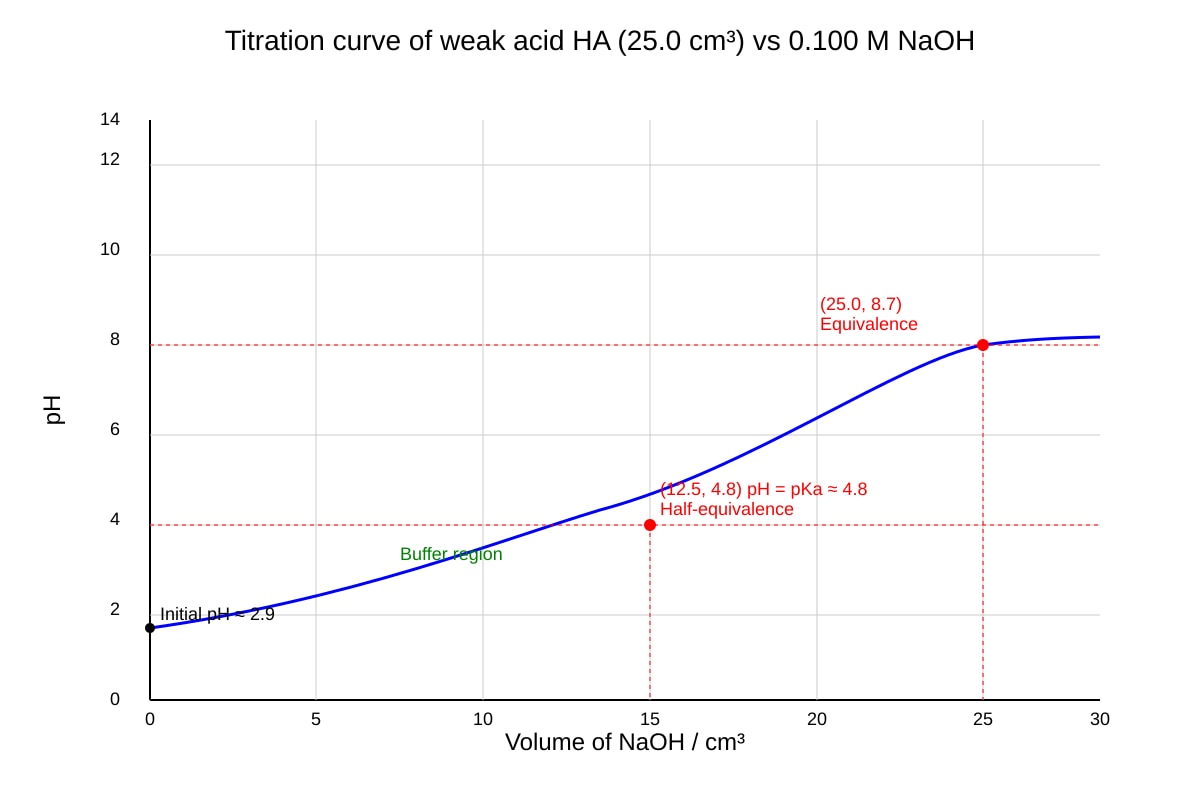
5. The titration curve below shows the addition of 0.100 mol dm⁻³ NaOH to 25.0 cm³ of a weak monoprotic acid HA.
Image pending generation: graph for Q5.
State the pKa of HA from the graph and explain how the half-equivalence point is used. [2]
pKa = __________
Explanation: ________________________________________________________
6. Write the ionic equation for the reaction of aqueous aluminium ions with excess hydroxide ions. [2]
7. Explain, using Brønsted–Lowry theory, why NH₃ acts as a base in water. [2]
Section B: Calculations & Equilibria (Questions 8–14) [24 marks]
8. 25.0 cm³ of 0.0800 mol dm⁻³ H₂SO₄ is neutralised by 0.100 mol dm⁻³ NaOH. Calculate the volume of NaOH required. [3]
Volume = __________ cm³
9. A buffer solution contains 0.200 mol dm⁻³ CH₃COOH and 0.100 mol dm⁻³ CH₃COO⁻ (from sodium ethanoate). Given Ka(CH₃COOH) = 1.8×10⁻⁵ mol dm⁻³, calculate the pH. [3]
pH = __________
10. Calculate the pH of a 0.0100 mol dm⁻³ solution of barium hydroxide, Ba(OH)₂, assuming complete dissociation. [3]
pH = __________
11. The solubility product of AgCl is 1.6×10⁻¹⁰ mol² dm⁻⁶ at 298 K. Calculate the molar solubility of AgCl in pure water. [3]
Solubility = __________ mol dm⁻³
12. A student mixes 50.0 cm³ of 0.100 mol dm⁻³ HCl with 50.0 cm³ of 0.100 mol dm⁻³ NH₃ (Kb = 1.8×10⁻⁵). Determine whether the resulting solution is acidic, basic, or neutral, and calculate the pH. [4]
pH = __________
13. For the weak acid HX, Ka=2.0×10⁻⁴ mol dm⁻³. In a buffer where [HX] = 0.050 mol dm⁻³ and [X⁻] = 0.010 mol dm⁻³, calculate [H⁺] and state if the buffer is effective. [4]
[H⁺] = __________ mol dm⁻³
Effective? __________
14. Explain the difference between the Arrhenius and Lewis definitions of an acid, giving one example of a Lewis acid that is not an Arrhenius acid. [4]
Section C: Structured Reasoning & Synthesis (Questions 15–20) [15 marks]
15. A sample of soil is found to have pH 4.5. Explain the effect of adding slaked lime, Ca(OH)₂, on the soil pH and the equilibrium of H⁺ with OH⁻. [3]
16. Describe how you would prepare a pure sample of magnesium sulfate crystals from magnesium carbonate and dilute sulfuric acid. Include the equation. [3]
17. The table shows Kb values for some amines at 298 K:
| Amine | Kb / mol dm⁻³ |
|---|---|
| methylamine | 4.4×10⁻⁴ |
| ethylamine | 5.6×10⁻⁴ |
| aniline | 4.2×10⁻¹⁰ |
Explain the trend in basicity from the data. [3]
18. A student claims that a strong acid always has a lower pH than a weak acid of the same concentration. State whether this is correct and explain with reference to degree of dissociation. [2]
19. Write the conjugate base of H₂PO₄⁻ and state the Brønsted–Lowry role of H₂PO₄⁻ when it forms that base. [2]
Conjugate base: __________
Role: __________
20. A titration of 25.0 cm³ of Na₂CO₃ with HCl gives two equivalence points. Explain why two equivalence points are observed and identify the species present at the first equivalence point. [2]
Answers
TuitionGoWhere Exam Practice (AI) — Chemistry H2 A-Level
Practice Paper: Acids, Bases & Salts (Version 3) — Answer Key
Total Marks: 60
Section A (21 marks)
Q1 [3 marks]
- Reject rough titration (24.60 cm³).
- Concordant titrations: 24.15, 24.20, 24.25 (range = 0.10 cm³, acceptable).
- Mean = (24.15 + 24.20 + 24.25) / 3 = 24.20 cm³.
- Answer: 24.20 cm³ (1 mark for excluding rough, 1 mark for correct concordant set, 1 mark for mean to 2 d.p.).
Teaching note: Concordant results should differ by ≤0.10 cm³. The rough is for finding approximate endpoint only.
Q2 [2 marks]
- Test: Insert a damp litmus paper into the gas / pass gas over damp litmus. [1]
- Result: Damp red litmus paper is bleached white (or turns white). [1]
Common mistake: Confusing with CO₂ (limewater ppt). SO₂ bleaches but does not give ppt with limewater as primary test.
Q3 [4 marks, 1 each]
- Al³⁺ with NH₃: White ppt., insoluble in excess.
- Cu²⁺ with NaOH: Blue ppt., insoluble in excess.
- Fe²⁺ with NH₃: White ppt., insoluble in excess (oxidises to brown in air).
- Zn²⁺ with NaOH: White ppt., soluble in excess.
Teaching note: Amphoteric hydroxides (Al, Zn) dissolve in excess NaOH; Cu²⁺ forms [Cu(NH₃)₄]²⁺ in excess NH₃.
Q4 [3 marks]
pH = 3.00 → [H⁺] = 10−3.00 = 1.0×10⁻³ mol dm⁻³.
For CH₃COOH ⇌ H⁺ + CH₃COO⁻, at equilibrium [H⁺] = [CH₃COO⁻] = 1.0×10⁻³, [CH₃COOH] ≈ 0.0500 – 0.0010 = 0.0490.
Ka=[CH3COOH][H+][CH3COO−]=0.0490(1.0×10⁻³)2=2.04×10⁻⁵.
Answer: 2.0×10⁻⁵ mol dm⁻³ (1 mark [H⁺], 1 mark substitution, 1 mark final).
Marking: Accept 2.0×10⁻⁵ or 2.04×10⁻⁵.
Q5 [2 marks]
- pKa = 4.8 (from half-equivalence pH). [1]
- Explanation: At half-equivalence, [HA] = [A⁻], so pH = pKa by Henderson–Hasselbalch. [1]
Visual needed: Graph shows half-equivalence at 12.5 cm³, pH 4.8.
Q6 [2 marks]
Al³⁺(aq) + 4OH⁻(aq) → [Al(OH)₄]⁻(aq) [2]
(or Al³⁺ + 3OH⁻ → Al(OH)₃, then + OH⁻ → [Al(OH)₄]⁻; full ionic with complex scores full).
Q7 [2 marks]
NH₃ accepts a proton (H⁺) from H₂O: NH₃ + H₂O ⇌ NH₄⁺ + OH⁻. [1] Brønsted–Lowry base = proton acceptor. [1]
Section B (24 marks)
Q8 [3 marks]
H₂SO₄ + 2NaOH → Na₂SO₄ + 2H₂O.
Moles H₂SO₄ = 0.0250 × 0.0800 = 2.00×10⁻³ mol.
Moles NaOH needed = 2 × 2.00×10⁻³ = 4.00×10⁻³ mol.
Vol NaOH = 4.00×10⁻³ / 0.100 = 0.0400 dm³ = 40.0 cm³. [1+1+1]
Q9 [3 marks]
[H⁺] = Ka×[A−][HA]=1.8×10−5×0.1000.200=3.6×10⁻⁵.
pH = –log(3.6×10⁻⁵) = 4.44. [1 formula, 1 calc, 1 pH]
Q10 [3 marks]
Ba(OH)₂ → Ba²⁺ + 2OH⁻; [OH⁻] = 2 × 0.0100 = 0.0200 M.
pOH = –log(0.0200) = 1.70; pH = 14.00 – 1.70 = 12.30. [1+1+1]
Q11 [3 marks]
AgCl ⇌ Ag⁺ + Cl⁻; Ksp=s2=1.6×10⁻¹⁰; s = 1.6×10−10=1.26×10⁻⁵.
Answer: 1.3×10⁻⁵ mol dm⁻³ (allow 1.26×10⁻⁵). [1+2]
Q12 [4 marks]
Moles HCl = 0.0500×0.100 = 5.00×10⁻³; moles NH₃ = same.
They react: NH₃ + HCl → NH₄Cl, all converted to NH₄⁺ (5×10⁻³ mol in 100 cm³ → 0.0500 M).
NH₄⁺ is weak acid: Ka=Kw/Kb=10−14/1.8×10−5=5.56×10−10.
[H⁺] = √(K_a × c) = √(5.56×10⁻¹⁰ × 0.0500) = 5.27×10⁻⁶; pH = 5.28.
Solution is acidic, pH 5.28. [1 neutralisation, 1 Ka, 1 H+, 1 pH]
Q13 [4 marks]
[H⁺] = Ka×[X−][HX]=2.0×10−4×0.0100.050=1.0×10⁻³ M. [2]
Effective? Ratio [HX]/[X⁻] = 5, within 0.1–10, so yes effective (buffer resists pH change). [2]
Q14 [4 marks]
Arrhenius acid: produces H⁺ in aqueous solution (e.g., HCl → H⁺ + Cl⁻). [1]
Lewis acid: electron-pair acceptor (e.g., BF₃). [1]
Example not Arrhenius: BF₃ (no H, accepts lone pair from NH₃). [2]
Teaching: Lewis broader; includes non-proton species.
Section C (15 marks)
Q15 [3 marks]
Ca(OH)₂ dissociates to OH⁻, neutralising H⁺ (H⁺ + OH⁻ → H₂O). [1] Soil pH rises toward neutral. [1] Equilibrium H₂O ⇌ H⁺ + OH⁻ shifts left as [H⁺] decreases. [1]
Q16 [3 marks]
MgCO₃ + H₂SO₄ → MgSO₄ + CO₂ + H₂O. [1] Add excess MgCO₃ to acid until no more effervescence, filter, evaporate filtrate, cool to crystallise. [2]
Q17 [3 marks]
Higher Kb = stronger base. Ethylamine > methylamine > aniline. [1] Alkyl amines stronger due to +I effect stabilising conjugate acid. [1] Aniline weak as lone pair delocalised into benzene ring. [1]
Q18 [2 marks]
Correct: strong acid dissociates fully, weak partially. [1] Same concentration → strong has higher [H⁺] → lower pH. [1]
Q19 [2 marks]
Conjugate base: HPO₄²⁻. [1] Role: H₂PO₄⁻ acts as acid (donates H⁺). [1]
Q20 [2 marks]
Two equivalence points because CO₃²⁻ is diprotic: CO₃²⁻ → HCO₃⁻ → H₂CO₃. [1] First eq point: HCO₃⁻ present. [1]
Free quiz and exam paper access
Enter your details to view this paper
Your access is remembered on this device.