From Real Exams Exam Paper

A Level H2 Chemistry Practice Paper 2

Free Exam-Derived Owl Alpha A Level H2 Chemistry Practice Paper 2 practice paper with questions and answers for Singapore students. This page is rendered as a direct URL so the questions and answers can be discovered without pressing in-page buttons.

These static practice materials are generated from the site's syllabus and paper-generation workflow, with source and model context shown so students and parents can evaluate the material before use.

A Level H2 Chemistry From Real Exams Generated by Owl Alpha Updated 2026-06-07

Questions

<!-- TuitionGoWhere generation metadata: stage=3-1; model=openrouter/owl-alpha; model_label=Owl Alpha; generated=2026-06-06; Sources: Stage 2-1 real exam-derived templates and Stage 2-2 exam-enriched syllabus. -->

TuitionGoWhere Practice Paper - Chemistry H2 A-Level

TuitionGoWhere Secondary School (AI)


Subject:Chemistry H2
Level:A-Level
Paper:Practice Paper — Acids, Bases & Salts
Version:2 of 5
Duration:1 hour 15 minutes
Total Marks:60
Name:________________________
Class:________________________
Date:________________________

Instructions

  • Answer all questions in the spaces provided.
  • Write your answers in dark blue or black pen.
  • You may use a pencil for any diagrams, graphs, or rough working.
  • The use of an approved scientific calculator is expected.
  • The number of marks is given in brackets [ ] at the end of each question or part question.
  • Show all working in calculations — marks are awarded for correct method even if the final answer is incorrect.
  • Use of the Data Booklet is permitted.

Section A: Multiple Choice and Short Answer (20 marks)

Questions 1–10


1. Which of the following is the conjugate base of HSO4HSO_4^-?

A. H2SO4H_2SO_4 B. SO42SO_4^{2-} C. H3O+H_3O^+ D. H2SO3H_2SO_3

[1]


2. A solution has a pH of 3.40 at 25 °C. What is the concentration of OHOH^- ions in this solution?

A. 2.51×1042.51 \times 10^{-4} mol dm3^{-3} B. 3.98×10113.98 \times 10^{-11} mol dm3^{-3} C. 2.51×10112.51 \times 10^{-11} mol dm3^{-3} D. 3.98×1043.98 \times 10^{-4} mol dm3^{-3}

[1]


3. Which salt, when dissolved in water, produces a solution with pH > 7?

A. Sodium chloride B. Ammonium nitrate C. Potassium sulfate D. Sodium carbonate

[1]


4. Define the term buffer solution.


[2]


5. Calculate the pH of a 0.25 mol dm3^{-3} solution of hydrochloric acid, HCl.


[1]


6. A 0.10 mol dm3^{-3} solution of a weak acid HA has a pH of 2.87. Calculate the acid dissociation constant, KaK_a, for HA. Give your answer to 2 significant figures.


[3]


7. State and explain the effect on the pH of a solution of 0.10 mol dm3^{-3} ethanoic acid when a small amount of solid sodium ethanoate is added.


[2]


8. Write an expression for the ionic product of water, KwK_w. State its value at 25 °C.


[1]


9. Explain why the pH at the equivalence point of a titration between a weak acid and a strong base is greater than 7.


[2]


10. A solution of sodium hydroxide has a concentration of 0.150 mol dm3^{-3}. Calculate the volume of this NaOH solution required to neutralise 25.0 cm3^3 of 0.100 mol dm3^{-3} sulfuric acid, H2SO4H_2SO_4.


[3]


Section B: Structured Questions (25 marks)

Questions 11–15


11. A student carried out a titration to determine the concentration of a solution of ethanoic acid, CH3COOHCH_3COOH, using 0.100 mol dm3^{-3} sodium hydroxide.

The student's titration results are shown below:

TitrationRough123
Final burette reading / cm3^324.5023.9023.8523.95
Initial burette reading / cm3^30.000.000.000.00
Volume used / cm3^324.5023.9023.8523.95

(a) From the titrations, obtain a suitable volume of NaOH to be used in your calculations. Show clearly how you obtained this volume.


[2]

(b) Calculate the concentration of the ethanoic acid solution, given that 25.0 cm3^3 of ethanoic acid was used in each titration.


[3]

(c) The student used phenolphthalein as the indicator. Explain why phenolphthalein is a suitable indicator for this titation, but methyl orange is not.


[2]


12. A buffer solution is prepared by mixing 50.0 cm3^3 of 0.200 mol dm3^{-3} ethanoic acid with 50.0 cm3^3 of 0.100 mol dm3^{-3} sodium hydroxide.

(a) Calculate the pH of this buffer solution. (KaK_a of ethanoic acid =1.74×105= 1.74 \times 10^{-5} mol dm3^{-3})


[4]

(b) Explain, with reference to the equilibrium involved, how this buffer solution resists changes in pH when a small amount of dilute hydrochloric acid is added.


[3]


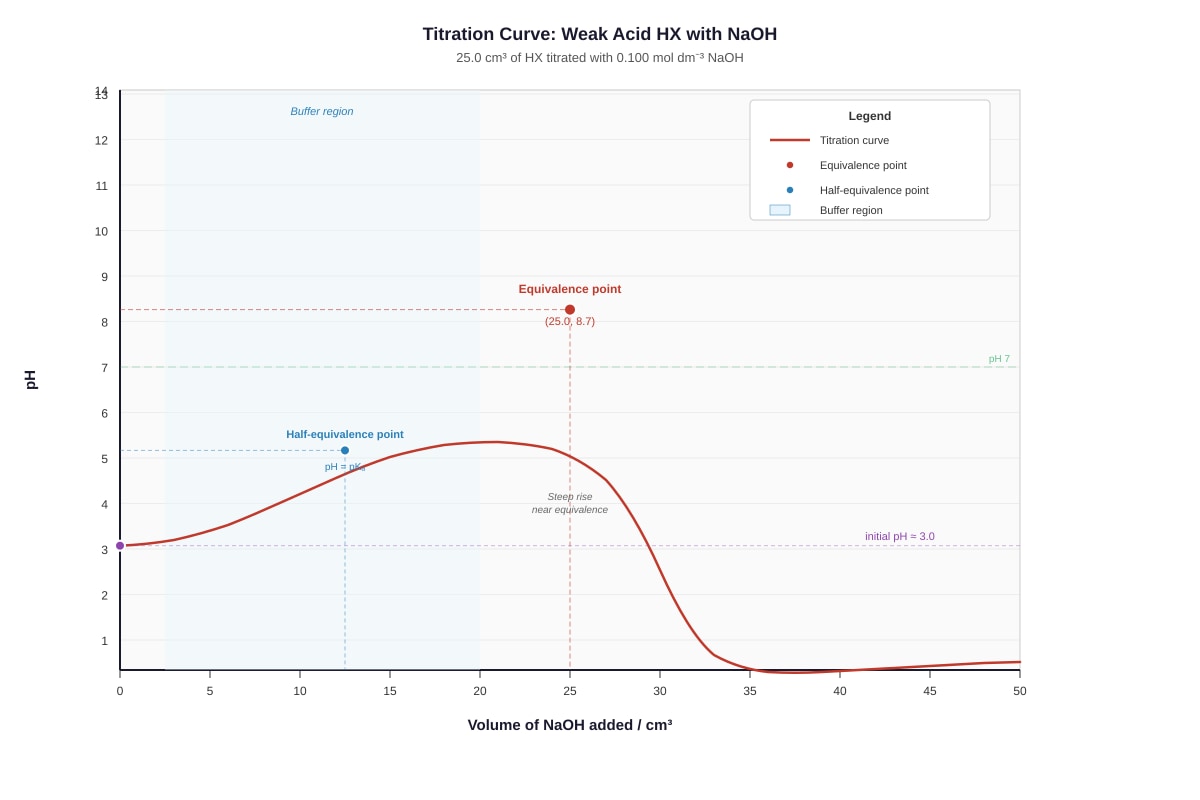
13. The graph below shows the pH curve obtained when 0.100 mol dm3^{-3} NaOH is added to 25.0 cm3^3 of a solution of a weak acid HX.

<image_placeholder> id: Q13-fig1 type: graph linked_question: Q13 description: pH curve for titration of 25.0 cm³ of weak acid HX with 0.100 mol dm⁻³ NaOH. x-axis: Volume of NaOH added / cm³, range 0–50. y-axis: pH, range 0–14. Curve starts at pH ≈ 3.0, rises gradually, has a steep rise between 24 and 26 cm³, and levels off around pH 12. Equivalence point at 25.0 cm³ where pH ≈ 8.7. Buffer region visible between ~5 and 20 cm³. labels: x-axis: Volume of NaOH added / cm³; y-axis: pH; equivalence point marked at (25.0, ~8.7); initial pH ≈ 3.0; half-equivalence point at ~12.5 cm³ where pH = pKa values: Equivalence point volume = 25.0 cm³; initial pH ≈ 3.0; pH at equivalence ≈ 8.7; half-equivalence at 12.5 cm³ must_show: Axes with labels and scales, S-shaped titration curve, equivalence point clearly identifiable, buffer region, initial pH, half-equivalence point where pH = pKa </image_placeholder>

(a) Use the graph to determine the concentration of the weak acid HX.


[2]

(b) Estimate the KaK_a of HX using the graph. Show your reasoning.


[2]

(c) On the graph, sketch the pH curve that would be obtained if 0.100 mol dm3^{-3} NaOH were added to 25.0 cm3^3 of 0.100 mol dm3^{-3} hydrochloric acid instead. Label this curve "HCl".


[2]


14. A solution contains a mixture of 0.10 mol dm3^{-3} CH3COOHCH_3COOH and 0.05 mol dm3^{-3} HClHCl.

(a) Explain why the pH of this mixed solution is approximately equal to the pH of the 0.05 mol dm3^{-3} HCl solution alone.


[2]

(b) Calculate the pH of the mixed solution.


[1]


15. Solid calcium fluoride, CaF2CaF_2, is sparingly soluble in water.

(a) Write an expression for the solubility product, KspK_{sp}, of CaF2CaF_2. State the units.


[2]

(b) The KspK_{sp} of CaF2CaF_2 at 25 °C is 1.46×10101.46 \times 10^{-10} mol3^3 dm9^{-9}. Calculate the solubility of CaF2CaF_2 in water at 25 °C.


[2]


Section C: Data Interpretation and Application (15 marks)

Questions 16–20


16. The table below shows the KaK_a values for three weak acids at 25 °C.

AcidFormulaKaK_a / mol dm3^{-3}
Methanoic acidHCOOHHCOOH1.77×1041.77 \times 10^{-4}
Ethanoic acidCH3COOHCH_3COOH1.74×1051.74 \times 10^{-5}
Carbonic acidH2CO3H_2CO_34.45×1074.45 \times 10^{-7}

(a) Arrange the acids in order of increasing pH for solutions of the same concentration (0.10 mol dm3^{-3}). Explain your reasoning.


[2]

(b) Calculate the pH of a 0.10 mol dm3^{-3} solution of methanoic acid.


[2]

(c) Sodium methanoate, HCOONaHCOONa, is the salt formed when methanoic acid reacts with sodium hydroxide. Predict and explain whether a solution of sodium methanoate is acidic, basic, or neutral.


[2]


17. A student wishes to prepare a buffer solution with a pH of 4.75 using ethanoic acid (Ka=1.74×10⁵K_a = 1.74 \times 10^{-5} mol dm3^{-3}) and sodium ethanoate.

(a) Calculate the ratio [CH3COO][CH3COOH]\frac{[CH_3COO^-]}{[CH_3COOH]} required to achieve pH 4.75.


[3]

(b) Describe how the student could prepare 500 cm3^3 of this buffer using 0.50 mol dm3^{-3} ethanoic acid and 0.50 mol dm3^{-3} sodium ethanoate solutions. Calculate the volume of each solution required.


[3]


18. A solution of ammonia, NH3NH_3, has a concentration of 0.100 mol dm3^{-3}. The base dissociation constant, KbK_b, for ammonia is 1.78×1051.78 \times 10^{-5} mol dm3^{-3}.

(a) Write an expression for KbK_b for ammonia.


[1]

(b) Calculate the pH of the 0.100 mol dm3^{-3} ammonia solution.


[3]


19. A 25.0 cm3^3 sample of a solution containing a mixture of H2SO4H_2SO_4 and HClHCl was titrated with 0.200 mol dm3^{-3} NaOH using methyl orange as indicator. 32.50 cm3^3 of NaOH was required to reach the end-point.

In a separate experiment, a 25.0 cm3^3 sample of the same mixture was treated with excess barium chloride solution. The precipitate of barium sulfate was filtered, washed, dried, and found to have a mass of 0.466 g.

(a) Calculate the concentration of H2SO4H_2SO_4 in the mixture.


[2]

(b) Calculate the concentration of HClHCl in the mixture.


[3]


20. Explain the following observations:

(a) The pH of 0.10 mol dm3^{-3} Na2CO3Na_2CO_3 solution is higher than the pH of 0.10 mol dm3^{-3} NaHCO3NaHCO_3 solution.


[3]

(b) When a few drops of concentrated hydrochloric acid are added to a saturated solution of calcium hydroxide, the solution becomes clear. Explain this observation.


[2]


End of Paper

Total: 60 marks

Answers

<!-- TuitionGoWhere generation metadata: stage=3-1; model=openrouter/owl-alpha; model_label=Owl Alpha; generated=2026-06-06; Sources: Stage 2-1 real exam-derived templates and Stage 2-2 exam-enriched syllabus. -->

TuitionGoWhere Practice Paper - Chemistry H2 A-Level

Answer Key — Acids, Bases & Salts (Version 2 of 5)


Section A: Multiple Choice and Short Answer


1. BSO42SO_4^{2-} [1]

Explanation: A conjugate base is formed when an acid donates a proton (H+H^+). HSO4HSO_4^- loses one H+H^+ to become SO42SO_4^{2-}. Option A (H2SO4H_2SO_4) is the conjugate acid (gaining a proton), not the conjugate base. This tests understanding of the Brønsted-Lowry acid-base conjugate pair concept.


2. C2.51×10112.51 \times 10^{-11} mol dm3^{-3} [1]

Explanation:

  • pH = 3.40, so [H+]=103.40=3.98×10⁴[H^+] = 10^{-3.40} = 3.98 \times 10^{-4} mol dm3^{-3}
  • At 25 °C: Kw=[H+][OH]=1.00×10¹⁴K_w = [H^+][OH^-] = 1.00 \times 10^{-14}
  • [OH]=Kw[H+]=1.00×10143.98×104=2.51×10¹¹[OH^-] = \frac{K_w}{[H^+]} = \frac{1.00 \times 10^{-14}}{3.98 \times 10^{-4}} = 2.51 \times 10^{-11} mol dm3^{-3}

Common mistake: Students often select B, which is the [H+][H^+] value, forgetting to divide KwK_w by [H+][H^+].


3. D — Sodium carbonate [1]

Explanation: Sodium carbonate (Na2CO3Na_2CO_3) is a salt of a strong base (NaOH) and a weak acid (H2CO3H_2CO_3). The CO32CO_3^{2-} ion hydrolyses in water: CO32+H2OHCO3+OHCO_3^{2-} + H_2O \rightleftharpoons HCO_3^- + OH^-, producing OHOH^- ions and giving pH > 7. NaCl and K2SO4K_2SO_4 are salts of strong acids and strong bases (neutral, pH = 7). NH4NO3NH_4NO_3 is a salt of a weak base and strong acid (acidic, pH < 7).


4. A buffer solution is a solution that resists changes in pH when small amounts of acid or base are added (or when it is diluted). [2]

Marking:

  • [1] for "resists changes in pH"
  • [1] for "when small amounts of acid or base are added"

Explanation: A buffer typically consists of a weak acid and its conjugate base (or weak base and its conjugate acid). The weak acid neutralises added base, and the conjugate base neutralises added acid, keeping pH approximately constant.


5. pH = 0.60 [1]

Explanation:

  • HCl is a strong acid, so it dissociates completely: [H+]=0.25[H^+] = 0.25 mol dm3^{-3}
  • pH=log10[H+]=log10(0.25)=0.60pH = -\log_{10}[H^+] = -\log_{10}(0.25) = 0.60

Common mistake: Students sometimes forget that strong acids fully dissociate and try to use KaK_a expressions.


6. Ka=1.8×10⁵K_a = 1.8 \times 10^{-5} mol dm3^{-3} [3]

Step-by-step:

  • pH = 2.87, so [H+]=102.87=1.349×10³[H^+] = 10^{-2.87} = 1.349 \times 10^{-3} mol dm3^{-3}
  • For the dissociation: HAH++AHA \rightleftharpoons H^+ + A^-
  • At equilibrium: [H+]=[A]=1.349×10³[H^+] = [A^-] = 1.349 \times 10^{-3} mol dm3^{-3}
  • [HA]=0.101.349×1030.0987[HA] = 0.10 - 1.349 \times 10^{-3} \approx 0.0987 mol dm3^{-3} (or ≈ 0.10 if approximation used)
  • Ka=[H+][A][HA]=(1.349×10³)20.0987=1.84×10⁵K_a = \frac{[H^+][A^-]}{[HA]} = \frac{(1.349 \times 10^{-3})^2}{0.0987} = 1.84 \times 10^{-5}
  • To 2 s.f.: Ka=1.8×10⁵K_a = 1.8 \times 10^{-5} mol dm3^{-3}

Marking:

  • [1] for correct [H+][H^+] calculation
  • [1] for correct KaK_a expression and substitution
  • [1] for correct final answer to 2 s.f. with units

7. The pH increases. [1]

Explanation: Adding sodium ethanoate increases the concentration of CH3COOCH_3COO^- ions. By Le Chatelier's principle, the equilibrium CH3COOHCH3COO+H+CH_3COOH \rightleftharpoons CH_3COO^- + H^+ shifts to the left, reducing [H+][H^+], so the pH increases. [1]

Explanation: This is a common ion effect. The added conjugate base suppresses the dissociation of the weak acid, reducing the hydrogen ion concentration and raising the pH. This is the principle behind buffer action.


8. Kw=[H+][OH]K_w = [H^+][OH^-] [1]

Value at 25 °C: Kw=1.00×10¹⁴K_w = 1.00 \times 10^{-14} mol2^2 dm6^{-6} [1]

Explanation: The ionic product of water arises from the autoionisation of water: H2OH++OHH_2O \rightleftharpoons H^+ + OH^-. At 25 °C, [H+]=[OH]=1.00×10⁷[H^+] = [OH^-] = 1.00 \times 10^{-7} mol dm3^{-3} in pure water, so Kw=(1.00×10⁷)2=1.00×10¹⁴K_w = (1.00 \times 10^{-7})^2 = 1.00 \times 10^{-14} mol2^2 dm6^{-6}.


9. At the equivalence point, all the weak acid has been neutralised to form its conjugate base (e.g., CH3COOCH_3COO^-). [1] The conjugate base hydrolyses with water: CH3COO+H2OCH3COOH+OHCH_3COO^- + H_2O \rightleftharpoons CH_3COOH + OH^-, producing OHOH^- ions. [1] This makes the solution slightly alkaline, so pH > 7. [1]

Explanation: For a strong acid–strong base titration, the salt formed is neutral and pH = 7 at equivalence. For a weak acid–strong base titration, the salt contains the conjugate base of the weak acid, which is basic in solution, giving pH > 7.


10. 33.3 cm3^3 [3]

Step-by-step:

  • Moles of H2SO4=25.01000×0.100=2.50×10³H_2SO_4 = \frac{25.0}{1000} \times 0.100 = 2.50 \times 10^{-3} mol
  • H2SO4H_2SO_4 is diprotic: H2SO4+2NaOHNa2SO4+2H2OH_2SO_4 + 2NaOH \rightarrow Na_2SO_4 + 2H_2O
  • Moles of NaOH required =2×2.50×103=5.00×103= 2 \times 2.50 \times 10^{-3} = 5.00 \times 10^{-3} mol
  • Volume of NaOH =5.00×1030.150=0.0333= \frac{5.00 \times 10^{-3}}{0.150} = 0.0333 dm3=33.3^3 = 33.3 cm3^3

Marking:

  • [1] for correct moles of H2SO4H_2SO_4
  • [1] for correct stoichiometric ratio (×2)
  • [1] for correct final volume

Section B: Structured Questions


11.

(a) Mean volume of NaOH = 23.90+23.85+23.953=23.90\frac{23.90 + 23.85 + 23.95}{3} = 23.90 cm3^3 [2]

Marking:

  • [1] for identifying concordant titres (all three are within 0.10 cm³ of each other; the rough titration is excluded)
  • [1] for correct mean calculation

Note: The rough titration (24.50 cm³) is not used in the mean. Titrations 1, 2, and 3 are concordant (within ±0.10 cm³).

(b) Concentration of ethanoic acid = 0.0956 mol dm3^{-3} [3]

Step-by-step:

  • Moles of NaOH used =23.901000×0.100=2.39×103= \frac{23.90}{1000} \times 0.100 = 2.39 \times 10^{-3} mol
  • CH3COOH+NaOHCH3COONa+H2OCH_3COOH + NaOH \rightarrow CH_3COONa + H_2O (1:1 ratio)
  • Moles of CH3COOH=2.39×10³CH_3COOH = 2.39 \times 10^{-3} mol
  • Concentration of CH3COOH=2.39×10325.0/1000=0.0956CH_3COOH = \frac{2.39 \times 10^{-3}}{25.0/1000} = 0.0956 mol dm3^{-3}

Marking:

  • [1] for moles of NaOH
  • [1] for 1:1 stoichiometry and moles of acid
  • [1] for correct concentration

(c) Phenolphthalein changes colour in the pH range 8.2–10.0, which falls within the steep vertical section of the weak acid–strong base titration curve (equivalence point pH ≈ 8.7). [1] Methyl orange changes colour in the pH range 3.1–4.4, which is far below the equivalence point pH for this titration, so it would change colour too early, leading to a large titration error. [1]

Explanation: The indicator's colour-change range must fall within the steep portion of the titration curve. For weak acid–strong base, the steep rise occurs around pH 7–10, so phenolphthalein is appropriate but methyl orange is not.


12.

(a) pH = 4.76 [4]

Step-by-step:

  • Moles of CH3COOH=50.01000×0.200=0.0100CH_3COOH = \frac{50.0}{1000} \times 0.200 = 0.0100 mol
  • Moles of NaOH=50.01000×0.100=0.0050NaOH = \frac{50.0}{1000} \times 0.100 = 0.0050 mol
  • Reaction: CH3COOH+NaOHCH3COONa+H2OCH_3COOH + NaOH \rightarrow CH_3COONa + H_2O
  • After reaction:
    • Moles of CH3COOHCH_3COOH remaining =0.01000.0050=0.0050= 0.0100 - 0.0050 = 0.0050 mol
    • Moles of CH3COOCH_3COO^- formed =0.0050= 0.0050 mol
  • Total volume =50.0+50.0=100.0= 50.0 + 50.0 = 100.0 cm3=0.100^3 = 0.100 dm3^3
  • Using Henderson-Hasselbalch equation:
    • pH=pKa+log10[CH3COO][CH3COOH]pH = pK_a + \log_{10}\frac{[CH_3COO^-]}{[CH_3COOH]}
    • pKa=log10(1.74×10⁵)=4.76pK_a = -\log_{10}(1.74 \times 10^{-5}) = 4.76
    • Since [CH3COO]=[CH3COOH][CH_3COO^-] = [CH_3COOH], log10(1)=0\log_{10}(1) = 0
    • pH=4.76+0=4.76pH = 4.76 + 0 = 4.76

Marking:

  • [1] for correct moles of acid and base
  • [1] for correct moles after reaction
  • [1] for correct Henderson-Hasselbalch substitution
  • [1] for correct pH

(b) When HCl is added, the H+H^+ ions react with the CH3COOCH_3COO^- ions in the buffer: CH3COO+H+CH3COOHCH_3COO^- + H^+ \rightarrow CH_3COOH. [1] This removes the added H+H^+ ions, converting them into undissociated ethanoic acid. [1] The equilibrium CH3COOHCH3COO+H+CH_3COOH \rightleftharpoons CH_3COO^- + H^+ shifts to the left (Le Chatelier's principle), so the change in [H+][H^+] is very small and the pH remains approximately constant. [1]

Explanation: The buffer works because the conjugate base (CH3COOCH_3COO^-) acts as a "reservoir" to neutralise added acid, while the weak acid (CH3COOHCH_3COOH) acts as a reservoir to neutralise added base.


13.

(a) From the graph, the equivalence point occurs at 25.0 cm3^3 of NaOH. [1]

  • Moles of NaOH =25.01000×0.100=2.50×103= \frac{25.0}{1000} \times 0.100 = 2.50 \times 10^{-3} mol
  • Since HX is monoprotic: moles of HX =2.50×103= 2.50 \times 10^{-3} mol
  • Concentration of HX =2.50×10325.0/1000=0.100= \frac{2.50 \times 10^{-3}}{25.0/1000} = 0.100 mol dm3^{-3} [1]

(b) At the half-equivalence point (12.5 cm³ of NaOH added), half the acid has been neutralised, so [HX]=[X][HX] = [X^-]. [1] At this point, pH=pKapH = pK_a. From the graph, at 12.5 cm³, pH ≈ 4.75. Therefore, pKa=4.75pK_a = 4.75 and Ka=104.75=1.78×10⁵K_a = 10^{-4.75} = 1.78 \times 10^{-5} mol dm3^{-3}. [1]

Note: The exact value read from the graph may vary slightly; accept KaK_a in the range 1.5×1051.5 \times 10^{-5} to 2.0×1052.0 \times 10^{-5} mol dm3^{-3}.

(c) The HCl curve should show:

  • A starting pH of 1.0 (strong acid, 0.100 mol dm⁻³)
  • A steeper vertical rise centred at pH 7 (equivalence point)
  • The same equivalence point volume (25.0 cm³)
  • Levelling off at a lower pH than the weak acid curve (around pH 11–12)

[2] — [1] for correct shape (steeper, starting lower), [1] for correct equivalence point and labelling

Image placeholder note: The graph should show a clear S-shaped curve for the weak acid HX titration with NaOH, with axes labelled, equivalence point at 25.0 cm³, initial pH ~3, and half-equivalence point identifiable. The HCl curve should be sketched on the same axes for comparison.


14.

(a) HCl is a strong acid and dissociates completely, providing 0.05 mol dm3^{-3} H+H^+. Ethanoic acid is a weak acid with Ka=1.74×10⁵K_a = 1.74 \times 10^{-5}, so it dissociates only very slightly. [1] The H+H^+ from the strong acid also suppresses the dissociation of ethanoic acid (common ion effect), making the contribution from ethanoic acid negligible. [1] Therefore, the pH is determined almost entirely by the HCl.

(b) pH = 1.30 [1]

Explanation:

  • Total [H+]0.05[H^+] \approx 0.05 mol dm3^{-3} (from HCl; contribution from CH3COOHCH_3COOH is negligible)
  • pH=log10(0.05)=1.30pH = -\log_{10}(0.05) = 1.30

15.

(a) Ksp=[Ca2+][F]2K_{sp} = [Ca^{2+}][F^-]^2 [1]

Units: (mol dm3)(mol dm3)2=mol3 dm9(mol\ dm^{-3})(mol\ dm^{-3})^2 = mol^3\ dm^{-9} [1]

Explanation: For the equilibrium CaF2(s)Ca2+(aq)+2F(aq)CaF_2(s) \rightleftharpoons Ca^{2+}(aq) + 2F^-(aq), the solubility product expression is written as the product of the ion concentrations raised to their stoichiometric coefficients.

(b) Solubility =3.30×104= 3.30 \times 10^{-4} mol dm3^{-3} [2]

Step-by-step:

  • Let the solubility of CaF2=sCaF_2 = s mol dm3^{-3}
  • Then [Ca2+]=s[Ca^{2+}] = s and [F]=2s[F^-] = 2s
  • Ksp=(s)(2s)2=4s3K_{sp} = (s)(2s)^2 = 4s^3
  • 4s3=1.46×10104s^3 = 1.46 \times 10^{-10}
  • s3=3.65×10¹¹s^3 = 3.65 \times 10^{-11}
  • s=3.65×10113=3.30×10⁴s = \sqrt[3]{3.65 \times 10^{-11}} = 3.30 \times 10^{-4} mol dm3^{-3}

Marking:

  • [1] for correct substitution into KspK_{sp} expression
  • [1] for correct final answer

Section C: Data Interpretation and Application


16.

(a) Increasing pH: HCOOH<CH3COOH<H2CO3HCOOH < CH_3COOH < H_2CO_3 [1]

Explanation: For solutions of the same concentration, the weaker the acid (smaller KaK_a), the less it dissociates, so the lower the [H+][H^+] and the higher the pH. H2CO3H_2CO_3 has the smallest KaK_a so it has the highest pH; HCOOHHCOOH has the largest KaK_a so it has the lowest pH. [1]

(b) pH = 2.38 [2]

Step-by-step:

  • Ka=[H+][A][HA]x20.10K_a = \frac{[H^+][A^-]}{[HA]} \approx \frac{x^2}{0.10} (assuming x0.10x \ll 0.10)
  • x2=1.77×104×0.10=1.77×10⁵x^2 = 1.77 \times 10^{-4} \times 0.10 = 1.77 \times 10^{-5}
  • x=[H+]=4.21×10³x = [H^+] = 4.21 \times 10^{-3} mol dm3^{-3}
  • pH=log10(4.21×10³)=2.38pH = -\log_{10}(4.21 \times 10^{-3}) = 2.38

Marking:

  • [1] for correct setup and [H+][H^+] calculation
  • [1] for correct pH

Check: 4.21×1030.10×100%=4.2%\frac{4.21 \times 10^{-3}}{0.10} \times 100\% = 4.2\% dissociation, which is < 5%, so the approximation is valid.

(c) Basic. [1] Sodium methanoate is the salt of a strong base (NaOH) and a weak acid (HCOOHHCOOH). The methanoate ion, HCOOHCOO^-, is the conjugate base of a weak acid and undergoes hydrolysis: HCOO+H2OHCOOH+OHHCOO^- + H_2O \rightleftharpoons HCOOH + OH^-, producing OHOH^- ions and making the solution basic (pH > 7). [1]


17.

(a) [CH3COO][CH3COOH]=1.02\frac{[CH_3COO^-]}{[CH_3COOH]} = 1.02 [3]

Step-by-step:

  • pH=pKa+log10[CH3COO][CH3COOH]pH = pK_a + \log_{10}\frac{[CH_3COO^-]}{[CH_3COOH]}
  • pKa=log10(1.74×10⁵)=4.76pK_a = -\log_{10}(1.74 \times 10^{-5}) = 4.76
  • 4.75=4.76+log10[CH3COO][CH3COOH]4.75 = 4.76 + \log_{10}\frac{[CH_3COO^-]}{[CH_3COOH]}
  • log10[CH3COO][CH3COOH]=4.754.76=0.01\log_{10}\frac{[CH_3COO^-]}{[CH_3COOH]} = 4.75 - 4.76 = -0.01
  • [CH3COO][CH3COOH]=100.01=0.9770.98\frac{[CH_3COO^-]}{[CH_3COOH]} = 10^{-0.01} = 0.977 \approx 0.98

Marking:

  • [1] for correct pKapK_a calculation
  • [1] for correct substitution into Henderson-Hasselbalch
  • [1] for correct ratio

Note: Accept answers in the range 0.97–1.02 depending on rounding.

(b) Since both solutions have the same concentration (0.50 mol dm3^{-3}), the ratio of volumes needed equals the ratio of concentrations. [1]

  • VCH3COOVCH3COOH=0.98\frac{V_{CH_3COO^-}}{V_{CH_3COOH}} = 0.98
  • Let VCH3COO=0.98xV_{CH_3COO^-} = 0.98x and VCH3COOH=xV_{CH_3COOH} = x
  • Total volume: 0.98x+x=5000.98x + x = 500 cm3^3
  • 1.98x=5001.98x = 500
  • x=252.5x = 252.5 cm3^3
  • Volume of 0.50 mol dm3^{-3} CH3COOHCH_3COOH ≈ 253 cm3^3 [1]
  • Volume of 0.50 mol dm3^{-3} CH3COONaCH_3COONa ≈ 247 cm3^3 [1]

Marking:

  • [1] for correct method linking volume ratio to concentration ratio
  • [1] for each correct volume

18.

(a) Kb=[NH4+][OH][NH3]K_b = \frac{[NH_4^+][OH^-]}{[NH_3]} [1]

Explanation: For the equilibrium NH3+H2ONH4++OHNH_3 + H_2O \rightleftharpoons NH_4^+ + OH^-, the base dissociation constant expression follows the standard format of products over reactant (excluding water as it is the solvent).

(b) pH = 11.13 [3]

Step-by-step:

  • Kb=x20.100=1.78×10⁵K_b = \frac{x^2}{0.100} = 1.78 \times 10^{-5}
  • x2=1.78×10⁶x^2 = 1.78 \times 10^{-6}
  • x=[OH]=1.33×10³x = [OH^-] = 1.33 \times 10^{-3} mol dm3^{-3}
  • pOH=log10(1.33×10³)=2.88pOH = -\log_{10}(1.33 \times 10^{-3}) = 2.88
  • pH=14.002.88=11.12pH = 14.00 - 2.88 = 11.12 (or 11.13)

Marking:

  • [1] for correct [OH][OH^-] calculation
  • [1] for correct pOHpOH
  • [1] for correct pHpH

19.

(a) [H2SO4]=0.0800[H_2SO_4] = 0.0800 mol dm3^{-3} [2]

Step-by-step:

  • BaCl2+H2SO4BaSO4+2HClBaCl_2 + H_2SO_4 \rightarrow BaSO_4 + 2HCl
  • Moles of BaSO4=0.466233.4=1.997×10³BaSO_4 = \frac{0.466}{233.4} = 1.997 \times 10^{-3} mol ≈ 2.00×1032.00 \times 10^{-3} mol
  • Moles of H2SO4H_2SO_4 in 25.0 cm3=2.00×10³^3 = 2.00 \times 10^{-3} mol
  • Concentration of H2SO4=2.00×10325.0/1000=0.0800H_2SO_4 = \frac{2.00 \times 10^{-3}}{25.0/1000} = 0.0800 mol dm3^{-3}

Marking:

  • [1] for correct moles of BaSO4BaSO_4
  • [1] for correct concentration of H2SO4H_2SO_4

(b) [HCl]=0.100[HCl] = 0.100 mol dm3^{-3} [3]

Step-by-step:

  • Total moles of NaOH used =32.501000×0.200=6.50×103= \frac{32.50}{1000} \times 0.200 = 6.50 \times 10^{-3} mol
  • Moles of H+H^+ from H2SO4=2×2.00×103=4.00×10³H_2SO_4 = 2 \times 2.00 \times 10^{-3} = 4.00 \times 10^{-3} mol
  • Moles of H+H^+ from HCl=6.50×1034.00×103=2.50×10³HCl = 6.50 \times 10^{-3} - 4.00 \times 10^{-3} = 2.50 \times 10^{-3} mol
  • Concentration of HCl=2.50×10325.0/1000=0.100HCl = \frac{2.50 \times 10^{-3}}{25.0/1000} = 0.100 mol dm3^{-3}

Marking:

  • [1] for total moles of NaOH
  • [1] for subtracting H2SO4H_2SO_4 contribution
  • [1] for correct HCl concentration

20.

(a) CO32CO_3^{2-} is the conjugate base of HCO3HCO_3^- and has a greater charge density than HCO3HCO_3^-. [1] CO32CO_3^{2-} undergoes hydrolysis to a greater extent: CO32+H2OHCO3+OHCO_3^{2-} + H_2O \rightleftharpoons HCO_3^- + OH^-, producing more OHOH^- ions than the hydrolysis of HCO3HCO_3^-: HCO3+H2OH2CO3+OHHCO_3^- + H_2O \rightleftharpoons H_2CO_3 + OH^-. [1] Since CO32CO_3^{2-} is a stronger base (it is the conjugate base of a weaker acid, HCO3HCO_3^-), the Na2CO3Na_2CO_3 solution has a higher pH. [1]

Explanation: The key concept is that the conjugate base of a weaker acid is stronger. HCO3HCO_3^- is a weaker acid than H2CO3H_2CO_3, so CO32CO_3^{2-} is a stronger base than HCO3HCO_3^-, leading to more extensive hydrolysis and a higher pH.

(b) Calcium hydroxide is sparingly soluble: Ca(OH)2(s)Ca2+(aq)+2OH(aq)Ca(OH)_2(s) \rightleftharpoons Ca^{2+}(aq) + 2OH^-(aq). [1] Adding HCl neutralises the OHOH^- ions: H++OHH2OH^+ + OH^- \rightarrow H_2O. By Le Chatelier's principle, the equilibrium shifts to the right, dissolving more Ca(OH)2Ca(OH)_2. As sufficient acid is added, all the solid dissolves, making the solution clear. [1]

Explanation: The saturated limewater initially appears slightly cloudy due to undissolved Ca(OH)2Ca(OH)_2. The acid removes OHOH^- ions, causing more solid to dissolve until it is completely consumed.


End of Answer Key

Total: 60 marks