From Real Exams Exam Paper
A Level H2 Chemistry Practice Paper 2
Free A Level H2 Chemistry Practice Paper 2, HY3 Exam version, with questions, answers, and A Level-style practice for Singapore students.
These static practice materials are generated from the site's syllabus and paper-generation workflow, with source and model context shown so students and parents can evaluate the material before use.
Questions
TuitionGoWhere Exam Practice (AI) — Chemistry H2 A-Level
Practice Paper: Acids Bases Salts (Version 2 of 5)
School: TuitionGoWhere Exam Practice (AI)
Subject: Chemistry H2
Level: A-Level
Paper: Practice Paper 2 (Topic: Acids Bases Salts)
Version: 2
Duration: 75 minutes
Total Marks: 80
Name: _______________________
Class: _______________________
Date: _______________________
Instructions:
- Answer all questions in the spaces provided.
- Show all working clearly. Use appropriate units and significant figures.
- Useful data: Kw=1.0×10⁻¹⁴ mol2 dm−6 at 298 K, R=8.31 J K−1 mol−1.
- Qualitative analysis notes and Data Booklet conventions apply.
Section A: Titration, Data Interpretation and Qualitative Analysis (Questions 1–7) [28 marks]
1. A student carried out a titration of 25.0 cm³ of ethanoic acid (FA 2) of unknown concentration with 0.100 mol dm⁻³ sodium hydroxide using phenolphthalein. The burette readings recorded were:
| Titration | Initial reading / cm³ | Final reading / cm³ | Volume added / cm³ |
|---|---|---|---|
| Rough | 0.00 | 24.60 | 24.60 |
| 1 | 0.20 | 24.40 | 24.20 |
| 2 | 1.10 | 25.30 | 24.20 |
| 3 | 0.50 | 24.80 | 24.30 |
From your titrations, obtain a suitable volume of FA 2 to be used in your calculations. Show clearly how you obtained this volume. [3]
2. Complete the table of gas tests below. [4]
| Gas | Test and Result |
|---|---|
| Ammonia, NH₃ | ___________________________________________________ |
| Carbon dioxide, CO₂ | ________________________________________________ |
| Chlorine, Cl₂ | __________________________________________________ |
| Oxygen, O₂ | ___________________________________________________ |
3. A solution contains Al³⁺(aq) and Cu²⁺(aq). Complete the table for their reactions with aqueous reagents. [4]
| Cation | Reaction with excess NaOH(aq) | Reaction with excess NH₃(aq) |
|---|---|---|
| Al³⁺ | ________________________________________________ | ________________________________________________ |
| Cu²⁺ | ________________________________________________ | ________________________________________________ |
4. In a redox titration, 0.0250 mol dm⁻³ potassium manganate(VII) was used to titrate 20.0 cm³ of Fe²⁺ solution. 22.40 cm³ of MnO₄⁻ was required. Write the balanced ionic equation for the reaction and calculate the concentration of Fe²⁺. [4]
5. The pH of a 0.020 mol dm⁻³ solution of a weak monoprotic acid HA is 3.20 at 298 K. Determine the acid dissociation constant Ka and the percentage dissociation. [4]
6. A buffer solution is prepared by mixing 0.100 mol dm⁻³ CH₃COOH (30.0 cm³) with 0.100 mol dm⁻³ CH₃COONa (20.0 cm³). Given Ka(CH₃COOH) = 1.8×10⁻⁵ mol dm⁻³, calculate the pH of the buffer. [4]
7. State and explain the change, if any, to the pH of the buffer in Q6 when 1.0 cm³ of 0.100 mol dm⁻³ HCl is added. [5]
Section B: Structured Calculation and Equilibrium (Questions 8–14) [30 marks]
8. Calculate the volume of 0.200 mol dm⁻³ HCl required to exactly neutralise 25.0 cm³ of 0.150 mol dm⁻³ Ba(OH)₂. [3]
9. The solubility product of AgCl at 298 K is 1.6×10⁻¹⁰ mol² dm⁻⁶. Calculate the molar solubility of AgCl in pure water and in a solution containing 0.010 mol dm⁻³ NaCl. [5]
10. A 0.010 mol dm⁻³ solution of NH₃ has pH 10.60 at 298 K. Given Kw=1.0×10⁻¹⁴, find Kb for NH₃. [4]
11. Using the Brønsted–Lowry theory, identify the conjugate acid–base pairs in the reaction: HCO3−+H2O⇌CO32−+H3O+ [3]
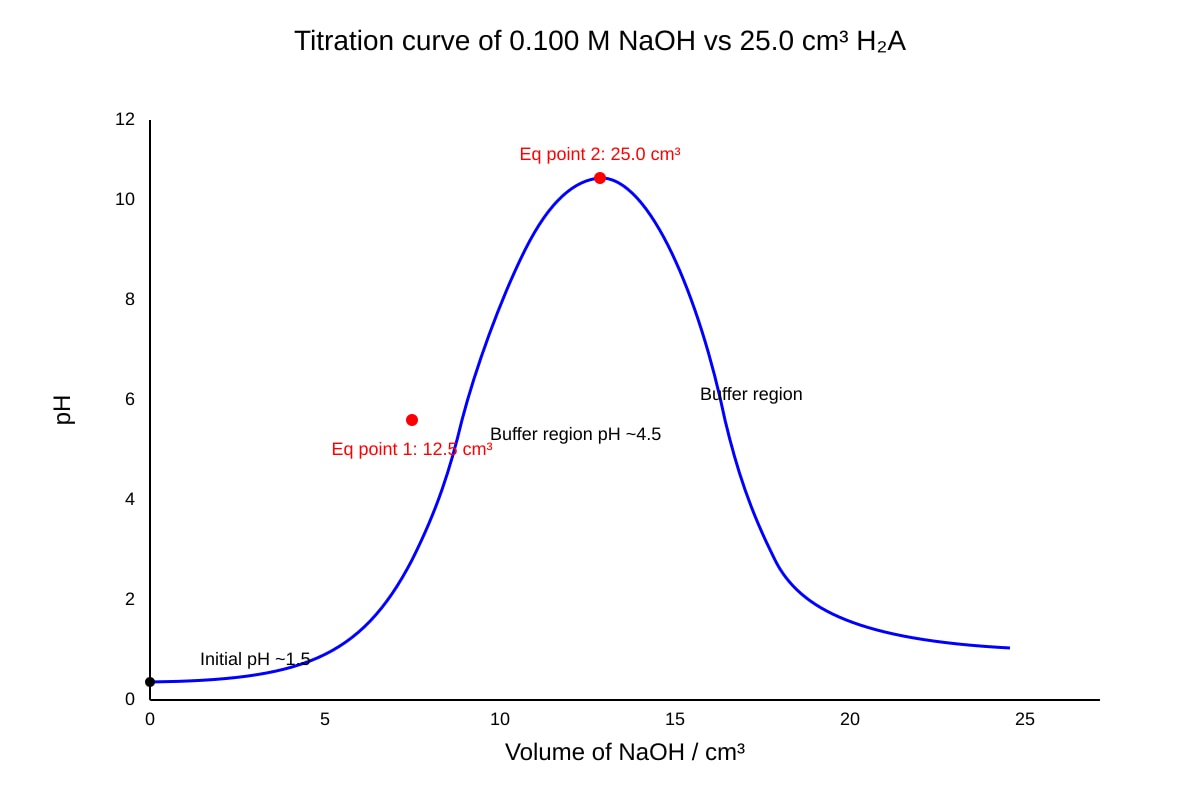
12. The titration curve below shows the addition of 0.100 mol dm⁻³ NaOH to 25.0 cm³ of a diprotic acid H₂A.
Image pending generation: graph for Q12.
(a) Deduce the volumes of NaOH at the two equivalence points and the molarity of H₂A. [3]
(b) Sketch the expected curve if H₂A were replaced by an equally concentrated monoprotic strong acid. [2]
13. Explain, using Le Chatelier’s principle and equilibrium expressions, why the pH of a NH₃/NH₄⁺ buffer decreases when a small amount of solid NH₄Cl is added. [4]
14. A sample of 0.500 g of impure CaCO₃ is dissolved in excess HCl and the unreacted acid back-titrated with 0.100 mol dm⁻³ NaOH (18.0 cm³ used). If initially 50.0 cm³ of 0.200 mol dm⁻³ HCl was added, calculate the percentage purity of CaCO₃. [6]
Section C: Synthesis, Extended Reasoning and Applications (Questions 15–20) [22 marks]
15. Compare the Arrhenius, Brønsted–Lowry, and Lewis definitions of an acid. Give one example species for each that illustrates its unique scope. [5]
16. A salt X is known to produce a green precipitate with NaOH that turns brown on standing, and a white precipitate with NH₃ that does not dissolve in excess. Identify the cation and explain your reasoning. [4]
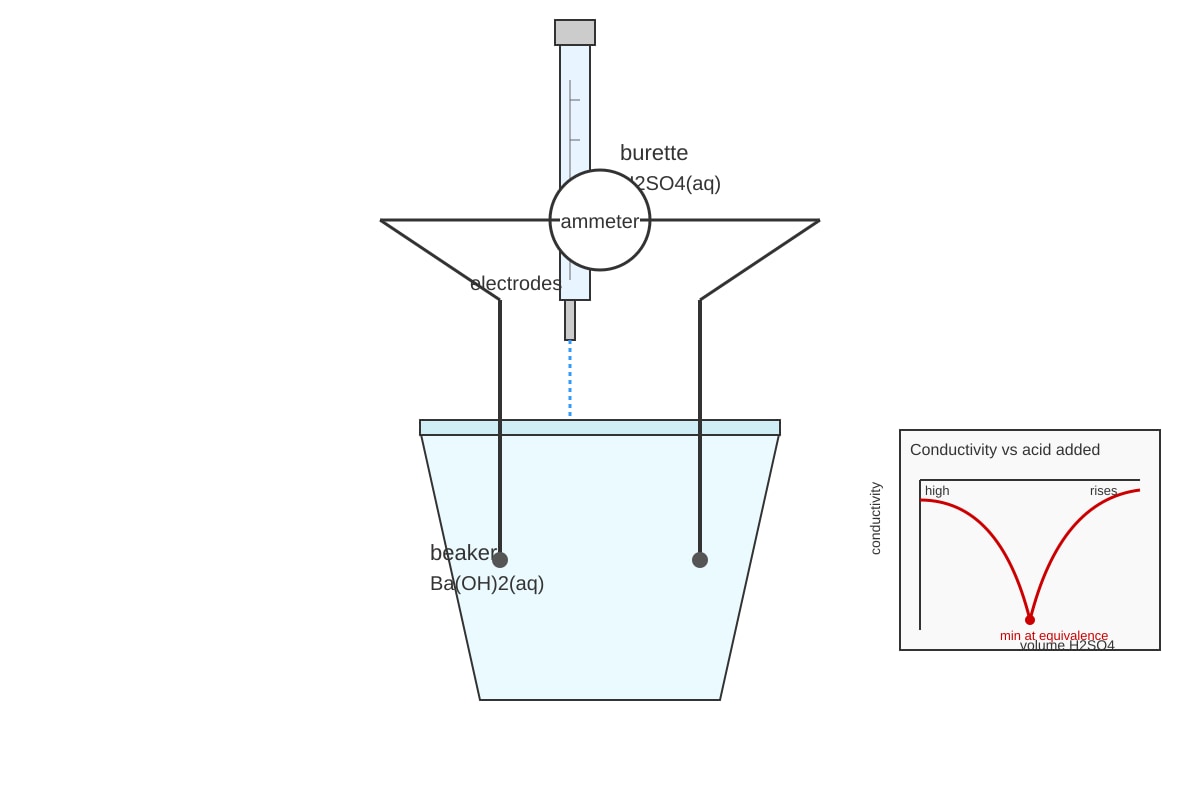
17. The diagram shows a conductivity cell used to monitor the neutralisation of Ba(OH)₂ with H₂SO₄.
Image pending generation: experimental_setup for Q17.
Explain the change in conductivity during the titration and why it does not return to zero. [4]
18. Calculate the mass of anhydrous sodium carbonate required to prepare 250 cm³ of a standard solution that would require 20.0 cm³ of 0.0500 mol dm⁻³ H₂SO₄ for neutralisation in a 25.0 cm³ aliquot. [4]
19. A student claims that adding a strong acid to a weak acid solution will increase its pH. Using equilibrium principles, evaluate this claim. [3]
20. The table gives Ka values for three acids at 298 K:
| Acid | Ka / mol dm⁻³ |
|---|---|
| HX | 2.0×10⁻⁴ |
| HY | 1.5×10⁻⁶ |
| HZ | 4.0×10⁻¹⁰ |
(a) Rank the acids in order of decreasing strength. [1]
(b) For a 0.010 M solution of HY, calculate [H⁺] and pH. [3]
(c) State which acid would be most suitable to prepare a buffer of pH ~ 5.5 with its sodium salt and justify. [2]
Answers
TuitionGoWhere Exam Practice (AI) — Chemistry H2 A-Level
Practice Paper: Acids Bases Salts (Version 2) — Answer Key
Total Marks: 80
Section A Answers (28 marks)
Q1 [3 marks]
- Rough titration (24.60) excluded as it is the initial trial.
- Titration 1: 24.20 cm³, Titration 2: 24.20 cm³, Titration 3: 24.30 cm³.
- Range of 1 and 2 = 0.00; 3 differs by 0.10 cm³ (acceptable ≤0.10). All three concordant.
- Mean = (24.20 + 24.20 + 24.30) / 3 = 24.23 cm³.
- Answer: 24.23 cm³ (1 mark for excluding rough, 1 mark for correct concordant set, 1 mark for mean to 2 d.p.)
- Teaching note: Concordant titres should agree within 0.10 cm³. Burette reading precision is ±0.05 cm³ so mean to 2 d.p. is appropriate.
Q2 [4 marks – 1 each]
- NH₃: Turns damp red litmus paper blue.
- CO₂: Gives white ppt. with limewater; ppt. dissolves in excess CO₂.
- Cl₂: Bleaches damp red litmus paper (turns white).
- O₂: Rekindles a glowing splint.
- Common mistake: writing “turns litmus blue” without “damp red”.
Q3 [4 marks – 1 each]
- Al³⁺ + excess NaOH: White ppt. of Al(OH)₃ dissolves to form [Al(OH)₄]⁻ (colourless solution).
- Al³⁺ + excess NH₃: White ppt. of Al(OH)₃, insoluble in excess.
- Cu²⁺ + excess NaOH: Blue ppt. of Cu(OH)₂, insoluble in excess.
- Cu²⁺ + excess NH₃: Blue ppt. dissolves to form deep blue [Cu(NH₃)₄]²⁺ solution.
- Teaching note: Al³⁺ is amphoteric; Cu²⁺ forms ammine complex.
Q4 [4 marks]
- Equation: MnO4−+5Fe2++8H+→Mn2++5Fe3++4H2O (1 mark)
- Moles MnO₄⁻ = 0.0250 × (22.40/1000) = 5.60×10⁻⁴ mol (1 mark)
- Moles Fe²⁺ = 5 × 5.60×10⁻⁴ = 2.80×10⁻³ mol (1 mark)
- [Fe²⁺] = 2.80×10⁻³ / 0.0200 = 0.140 mol dm⁻³ (1 mark)
Q5 [4 marks]
- [H⁺] = 10⁻³·²⁰ = 6.31×10⁻⁴ mol dm⁻³ (1)
- Ka=[HA][H+][A−]=0.020−6.31×10⁻⁴(6.31×10⁻⁴)2≈2.0×10⁻⁵ mol dm⁻³ (2)
- % dissoc = (6.31×10⁻⁴ / 0.020)×100 = 3.16% (1)
Q6 [4 marks]
- Moles CH₃COOH = 0.100×30/1000 = 3.0×10⁻³; moles CH₃COO⁻ = 0.100×20/1000 = 2.0×10⁻³
- pH = pKa + log([salt]/[acid]) = –log(1.8×10⁻⁵) + log(2.0/3.0) = 4.74 – 0.176 = 4.56 (4)
Q7 [5 marks]
- HCl adds H⁺: reacts with CH₃COO⁻ → CH₃COOH.
- New moles CH₃COO⁻ = 2.0×10⁻³ – 1.0×10⁻⁴ = 1.9×10⁻³; CH₃COOH = 3.0×10⁻³ + 1.0×10⁻⁴ = 3.1×10⁻³
- pH = 4.74 + log(1.9/3.1) = 4.53 (drop of 0.03) (3 marks for calc, 2 for explanation of buffer action resisting large change)
Section B Answers (30 marks)
Q8 [3 marks]
- 2HCl + Ba(OH)₂ → BaCl₂ + 2H₂O; mol Ba(OH)₂ = 0.150×25/1000 = 3.75×10⁻³
- mol HCl = 2×3.75×10⁻³ = 7.50×10⁻³; V = 7.50×10⁻³/0.200 = 0.0375 dm³ = 37.5 cm³ (3)
Q9 [5 marks]
- Pure water: s2=1.6×10⁻¹⁰ → s = 1.26×10⁻⁵ M (2)
- With 0.010 M Cl⁻: [Ag+]=Ksp/[Cl−]=1.6×10−10/0.010=1.6×10−8 M (3)
Q10 [4 marks]
- pOH = 14 – 10.60 = 3.40; [OH⁻] = 10⁻³·⁴ = 3.98×10⁻⁴
- Kb=(3.98×10⁻⁴)2/(0.010–3.98×10−4)=1.6×10−5 (4)
Q11 [3 marks]
- Pair 1: HCO₃⁻ (acid) / CO₃²⁻ (base) (1.5)
- Pair 2: H₂O (base) / H₃O⁺ (acid) (1.5)
Q12 [5 marks]
- (a) Eq pts at 12.5 and 25.0 cm³; mol H₂A = 0.100×0.0125 = 1.25×10⁻³ in 25 cm³ → 0.0500 M (3)
- (b) Monoprotic strong: one steep rise at 12.5 cm³, initial pH ~1, final pH ~13 (2)
Q13 [4 marks]
- NH₄Cl adds NH₄⁺ (common ion); equilibrium NH₃ + H₂O ⇌ NH₄⁺ + OH⁻ shifts left, [OH⁻] decreases, pH decreases (4)
Q14 [6 marks]
- Initial HCl mol = 0.200×0.050 = 0.0100
- Back-titrated NaOH mol = 0.100×0.018 = 0.00180 → excess HCl = 0.00180
- HCl reacted with CaCO₃ = 0.00820; CaCO₃ + 2HCl → mol CaCO₃ = 0.00410
- Mass = 0.00410 × 100.1 = 0.410 g; purity = 0.410/0.500×100 = 82.0% (6)
Section C Answers (22 marks)
Q15 [5 marks]
- Arrhenius: produces H⁺ in aq; e.g. HCl (1+1)
- Brønsted–Lowry: proton donor; e.g. NH₄⁺ (1+1)
- Lewis: electron-pair acceptor; e.g. BF₃ (1+1)
- Clear comparison (1)
Q16 [4 marks]
- Fe²⁺: green ppt. with NaOH, oxidises to brown Fe³⁺; white ppt. with NH₃ not dissolving = Fe²⁺ (4)
Q17 [4 marks]
- Initial: Ba²⁺ and OH⁻ conduct; adding H₂SO₄ forms BaSO₄(s) and H₂O, ions removed, conductivity falls to min at eq (2). After eq, excess H⁺ and SO₄²⁻ increase conductivity (2).
Q18 [4 marks]
- H₂SO₄ mol in 20 cm³ = 0.0500×0.020 = 1.0×10⁻³; total in 250 = 1.25×10⁻²
- Na₂CO₃ + H₂SO₄ → mol Na₂CO₃ = 1.25×10⁻²; mass = 1.25×10⁻²×106 = 1.33 g (4)
Q19 [3 marks]
- False; strong acid adds H⁺, suppresses weak acid dissociation, [H⁺] increases, pH decreases (3)
Q20 [6 marks]
- (a) HX > HY > HZ (1)
- (b) [H⁺] = √(1.5×10⁻⁶×0.010) = 3.87×10⁻⁴; pH = 3.41 (3)
- (c) HY (pKa 5.82) closest to 5.5 (2)
Free quiz and exam paper access
Enter your details to view this paper
Your access is remembered on this device.