From Real Exams Exam Paper
A Level H2 Chemistry Practice Paper 1
Free A Level H2 Chemistry Practice Paper 1, LongCat Exam version, with questions, answers, and A Level-style practice for Singapore students.
These static practice materials are generated from the site's syllabus and paper-generation workflow, with source and model context shown so students and parents can evaluate the material before use.
Questions
Free quiz and exam paper access
Enter your details to view this paper
Your access is remembered on this device.
Answers
TuitionGoWhere Practice Paper - Chemistry H2 A-Level
Answer Key — Acids, Bases & Salts (Version 1 of 5)
Section A: Short-Answer Questions
1. [2 marks]
Answer: A Brønsted–Lowry acid is a proton () donor. [1]
Example: (or , , , etc.) [1]
Teaching note: The Brønsted–Lowry definition focuses on the transfer of a proton from the acid to a base. Any species that can donate qualifies. This is broader than the Arrhenius definition, which requires the acid to produce in aqueous solution specifically.
2. [3 marks total]
(a) [1 mark]
Teaching note: The relationship is fundamental. Students should be able to use this directly from their calculators. The answer should be given to 2 significant figures (matching the 2 decimal places in the pH value).
(b) [2 marks]
Teaching note: At 25 °C, is always mol dm. Students must rearrange correctly. Common mistake: using without sufficient precision, which introduces rounding errors. Using directly is more accurate.
3. [3 marks]
Answer: Hydrochloric acid is a strong acid and dissociates completely in water, producing a high concentration of ions. [1]
Ethanoic acid is a weak acid and only partially dissociates in water, so the concentration of ions is much lower than the nominal concentration of the acid. [1]
Since pH = , the lower in ethanoic acid gives a higher pH. [1]
Teaching note: Key terms required: "strong/weak acid," "complete/partial dissociation," and the link between and pH. Students often state that weak acids have "fewer ions" without explaining why (partial dissociation), which would not earn full marks.
4. [2 marks]
[1]
Units: [1]
Teaching note: expressions always have products (right-hand side of equilibrium) over reactants (left-hand side). Pure solids and solvents are omitted. For a monobasic acid, the units of are always mol dm.
5. [5 marks total]
(a) [3 marks]
For the equilibrium:
At equilibrium: mol dm
Marking: 1 mark for calculation, 1 mark for correct substitution, 1 mark for final answer.
Teaching note: Since the acid is weak and the degree of dissociation is small (~3.2%), the approximation initial concentration is valid. However, showing the subtraction demonstrates understanding. Students should check that dissociation is <5% to justify the approximation.
(b) [2 marks]
NaX is the salt of a weak acid and strong base, so undergoes hydrolysis:
The solution will be alkaline (pH > 7). [1]
Using
Since is very small, the pH will be only slightly above 7, approximately pH ≈ 8–9. [1]
Teaching note: The conjugate base of a weak acid is itself a weak base, so the salt solution is alkaline. Students should recognise the pattern: weak acid + strong base → alkaline salt solution.
6. [3 marks]
Answer: The pH of the ethanoic acid solution increases. [1]
dissociates completely to provide ions, which is the common ion. [1]
By Le Chatelier's principle, the increased shifts the equilibrium to the left, reducing and hence increasing the pH. [1]
Teaching note: This is a classic buffer/common ion effect question. Students must identify the common ion (), state the direction of equilibrium shift, and link this to a change in and therefore pH. Simply stating "pH increases" without explanation earns only 1 mark.
7. [5 marks total]
(a) [3 marks]
Moles of = mol
Moles of = mol
Since moles of acid = moles of base, all the is converted to . [1]
Total volume = 50.0 + 50.0 = 100.0 cm = 0.100 dm
Using
Marking: 1 mark for identifying complete neutralisation to salt, 1 mark for correct and calculation, 1 mark for final pH.
(b) [2 marks]
The resulting solution is not a buffer. [1]
A buffer requires significant amounts of both a weak acid and its conjugate base. Here, all the has been converted to , so there is no remaining weak acid to act as the buffer component. [1]
Teaching note: This is a common exam trap. Students often assume that mixing a weak acid and strong base always produces a buffer. A buffer is only formed when the acid is in excess so that both the weak acid and its salt coexist in significant amounts.
8. [3 marks]
Answer: Add a small piece of magnesium ribbon (or zinc, or ) to equal volumes of each acid at the same concentration. [1]
With the strong acid, the reaction is vigorous/faster, producing hydrogen gas (effervescence) rapidly. [1]
With the weak acid, the reaction is slower/less vigorous because the is lower (the acid is only partially dissociated). [1]
Alternative acceptable answers:
- Measure the pH of each solution: the strong acid has a lower pH.
- Measure electrical conductivity: the strong acid has higher conductivity due to greater .
- Measure initial rate of reaction with a carbonate: strong acid produces faster.
Teaching note: The key principle is that at the same concentration, a strong acid has a higher than a weak acid, leading to faster reaction rates. Any experiment that exploits this difference is acceptable.
9. [4 marks total]
(a) [1 mark]
(b) [3 marks]
Let the solubility of = mol dm
Marking: 1 mark for correct relationship between ion concentrations and , 1 mark for correct substitution into expression, 1 mark for final answer.
Teaching note: The stoichiometry of dissolution is critical. For every 1 mole of that dissolves, 2 moles of are produced, hence . This is the most common source of error — students often write .
10. [3 marks]
Answer: The common ion effect is the reduction in solubility of a sparingly soluble salt when a solution already contains an ion that is common to the salt. [1]
dissolves according to:
dissociates completely: , providing ions. [1]
By Le Chatelier's principle, the increased shifts the equilibrium to the left, reducing the solubility of . [1]
Teaching note: Students must define the term, write relevant equations, and apply Le Chatelier's principle. The common ion () suppresses dissolution. This is a direct application of equilibrium principles to solubility.
Section B: Structured Questions
11. [9 marks total]
(a) [1 mark]
The rough titration (24.80 cm) is anomalous. [1]
It differs significantly from the other three results (24.35, 24.30, 24.40), which are all within 0.10 cm of each other.
(b) [2 marks]
The rough titration is excluded. Titrations 1, 2, and 3 are concordant (within 0.10 cm).
Marking: 1 mark for excluding the rough/anomalous result, 1 mark for correct mean.
(c) [1 mark]
(d) [3 marks]
Moles of used = mol [1]
From the equation, mole ratio
Moles of mol [1]
(e) [2 marks]
There is no effect on the calculated concentration. [1]
The conical flask contains a known volume of . Rinsing with distilled water adds more water but does not change the number of moles of in the flask. The same amount of is still required for neutralisation, so the titre volume and calculated concentration remain unchanged. [1]
Teaching note: This is a classic conceptual question. Students often confuse rinsing the conical flask (no effect) with rinsing the burette (would cause error). The burette must be rinsed with the titrant, not water.
12. [8 marks total]
(a) [2 marks]
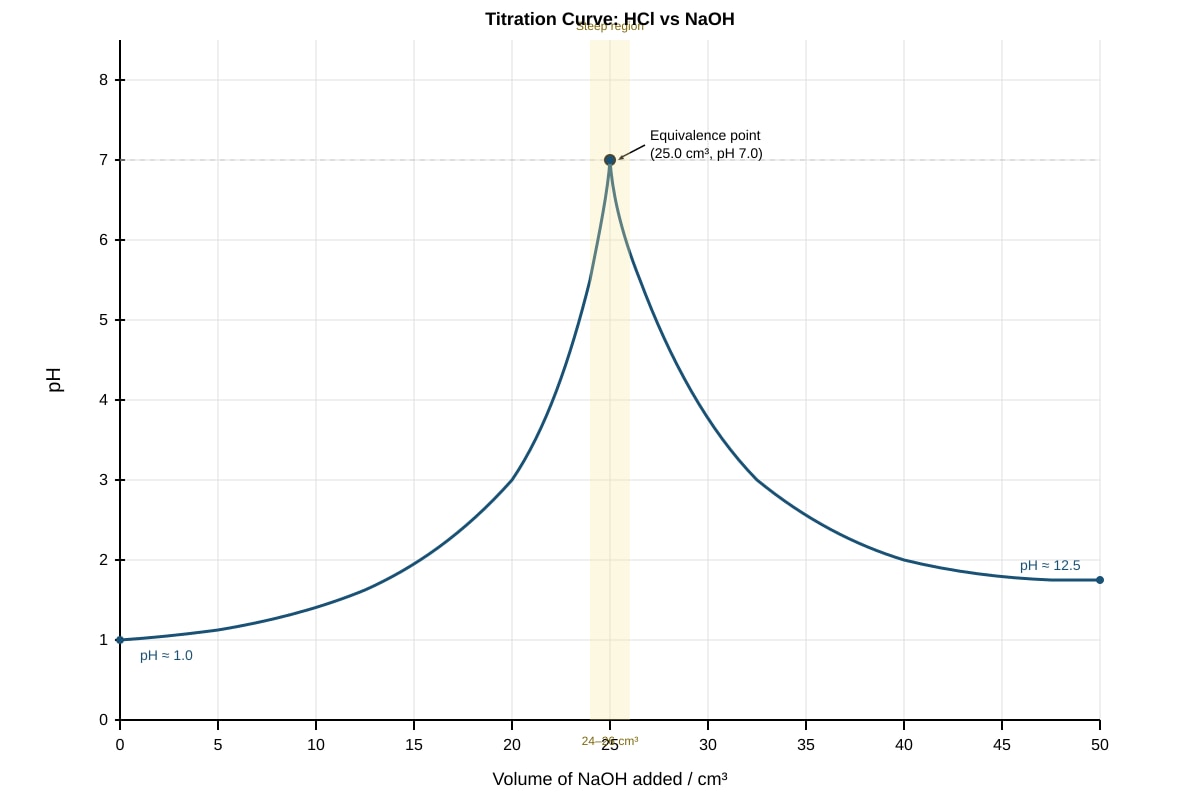
From the graph, initial pH ≈ 1.0 (at 0 cm NaOH added). [1]
Since is a strong monoprotic acid, [1]
(b) [1 mark]
is a strong acid and is a strong base. The salt formed does not hydrolyse, so the solution is neutral at pH 7.0. [1]
(c) [3 marks]
The sketch should show:
- Starting pH higher than 1.0 (approximately pH ≈ 2–3 for 0.10 mol dm weak acid) [1]
- A buffer region before the equivalence point (gentle rise) [1]
- Equivalence point at 25.0 cm NaOH but at pH > 7 (approximately pH ≈ 8–9), with a less steep vertical rise compared to the strong acid curve [1]
Teaching note: Key differences for weak acid vs. strong base titration: (1) higher initial pH, (2) buffer region with gradual pH change, (3) equivalence point above pH 7 due to hydrolysis of the conjugate base, (4) less steep pH jump at equivalence.
(d) [2 marks]
At the equivalence point, all the ethanoic acid has been converted to sodium ethanoate (). [1]
The ion is the conjugate base of a weak acid and undergoes hydrolysis: , producing ions and making the solution alkaline (pH > 7). [1]
13. [10 marks total]
(a) [3 marks]
Using the Henderson–Hasselbalch equation:
Marking: 1 mark for calculation, 1 mark for correct substitution, 1 mark for final ratio.
(b) [4 marks]
To form a buffer, some must react with to produce , with excess remaining.
Let volume of = dm, volume of = dm
Moles of = → produces mol
Moles of remaining =
Volume of 0.50 mol dm = [1]
Volume of 0.50 mol dm = [1]
Marking: 1 mark for correct setup of ratio equation, 1 mark for each volume.
(c) [3 marks]
In 1.00 dm of the buffer:
Moles of = mol
Moles of = mol
Adding 0.005 mol :
- reacts with : moles of = mol [1]
- Moles of = mol [1]
Teaching note: Adding a small amount of strong base to a buffer causes only a small pH change — this is the key property of buffers. The pH changes from 5.00 to 5.03, demonstrating buffer action.
14. [5 marks total]
(a) [2 marks]
is a strong acid and dissociates completely, providing mol dm. [1]
The high from suppresses the dissociation of (common ion effect), so the additional contributed by is negligible. [1]
(b) [1 mark]
(c) [2 marks]
From the equilibrium:
Teaching note: In a mixture of strong and weak acids, the strong acid dominates the pH. The weak acid's dissociation is suppressed, and is determined solely by with fixed by the strong acid.
15. [4 marks total]
(a) [2 marks]
An indicator changes colour over the approximate range . [1]
Colour change range: pH 2.46 to 4.46 (approximately pH 2.5–4.5). [1]
(b) [2 marks]
For a strong acid–strong base titration, the equivalence point is at pH 7.0, and the pH jump spans approximately pH 4–10. [1]
Either indicator is suitable since the steep portion of the titration curve spans both their colour-change ranges. However, phenolphthalein (pH 8.2–10.0) is more commonly used because its colour change (colourless → pink) is easier to detect than methyl orange's (red → yellow). [1]
Teaching note: For strong acid–strong base titrations, both indicators work because the vertical portion of the pH curve covers a wide range. The choice is often based on ease of observing the colour change.
Section C: Data Interpretation & Application
16. [7 marks total]
(a) [2 marks]
Order of increasing acid strength: [1]
A larger value indicates a greater degree of dissociation and therefore a stronger acid. [1]
(b) [3 marks]
[1]
[1]
Marking: 1 mark for correct setup, 1 mark for , 1 mark for pH. Check: dissociation = 5.97 × 10⁻³/0.20 = 3.0% < 5%, so approximation is valid.
(c) [2 marks]
would produce the most alkaline solution. [1]
has the smallest , meaning is the strongest conjugate base (of the three). A stronger conjugate base undergoes more hydrolysis, producing more and hence a higher pH. [1]
Teaching note: The weaker the acid, the stronger its conjugate base. This inverse relationship is key: smallest → strongest conjugate base → most alkaline salt solution.
17. [7 marks total]
(a) [2 marks]
Bubble the gas through limewater (calcium hydroxide solution). [1]
The limewater turns milky/cloudy due to the formation of white precipitate . [1]
(b) [2 marks]
The solution is calcium hydroxide solution (limewater). [1]
(c) (i) [1 mark]
(ii) [2 marks]
Moles of = mol [1]
From the equation, mole ratio
Moles of mol
18. [6 marks total]
(a) [1 mark]
(b) [1 mark]
From the stoichiometry,
(c) [2 marks]
Marking: 1 mark for correct substitution, 1 mark for final answer with units.
(d) [2 marks]
The solubility of would decrease. [1]
Adding increases (common ion effect). By Le Chatelier's principle, the equilibrium shifts to the left, reducing the dissolution of . [1]
19. [5 marks total]
(a) [3 marks]
Moles of = mol
Moles of = mol
Reaction:
Moles of needed to neutralise all = mol
Since only mol is available, is the limiting reagent. [1]
Moles of reacted = mol
Moles of excess = [1]
Marking: 1 mark for identifying limiting reagent, 1 mark for moles of excess reagent, 1 mark for correct calculation.
(b) [2 marks]
Total volume = cm = 0.050 dm
Excess : Each mole of provides 2 moles of :
Teaching note: is diprotic, so each mole produces 2 moles of . This is a common source of error — students sometimes forget the factor of 2.
20. [6 marks total]
(a) [2 marks]
[1]
[1]
(b) [3 marks]
Moles of mol [1]
From the equation, mole ratio
Moles of neutralised = mol [1]
(c) [1 mark]
is preferred because it is milder/less corrosive (or: it reacts more gently / produces less gas per mole / has a lower alkalinity so is less likely to cause alkalosis). [1]
Alternative acceptable answers:
- is more soluble and acts faster.
- produces less per mole of acid neutralised (1:1 vs 1:2 ratio with ).
Total: 60 marks
Mark Distribution Summary:
| Section | Marks |
|---|---|
| A: Questions 1–10 | 20 |
| B: Questions 11–15 | 25 |
| C: Questions 16–20 | 15 |
| Total | 60 |