From Real Exams Exam Paper
A Level H2 Chemistry Practice Paper 1
Free A Level H2 Chemistry Practice Paper 1, HY3 Exam version, with questions, answers, and A Level-style practice for Singapore students.
These static practice materials are generated from the site's syllabus and paper-generation workflow, with source and model context shown so students and parents can evaluate the material before use.
Questions
TuitionGoWhere Exam Practice (AI) — Chemistry H2 A-Level
Subject: Chemistry H2
Level: A-Level
Paper: Practice Paper (Version 1 of 5)
Duration: 75 minutes
Total Marks: 60
Name: ___________________________
Class: ___________________________
Date: ___________________________
Instructions:
- Answer all questions.
- Show all working clearly where calculations are involved.
- Use the Data Booklet where appropriate.
- Marks for each question are shown in brackets.
- Section totals are shown at the end of each section.
Section A: Titration and Data Interpretation (Questions 1–5)
(Total: 14 marks)
1. A student performed a titration of 25.0 cm³ of hydrochloric acid with 0.100 mol dm⁻³ sodium hydroxide solution using phenolphthalein indicator. The burette readings recorded were:
| Titration | Initial reading / cm³ | Final reading / cm³ | Volume used / cm³ |
|---|---|---|---|
| Rough | 0.00 | 26.40 | 26.40 |
| 1 | 0.20 | 25.90 | 25.70 |
| 2 | 1.10 | 26.80 | 25.70 |
| 3 | 0.50 | 26.10 | 25.60 |
From your titrations, obtain a suitable volume of NaOH to be used in your calculations. Show clearly how you obtained this volume. [3]
2. State the colour change observed at the end point of the titration in Question 1. [1]
3. A sample of ethanoic acid (CH₃COOH) was titrated with 0.0500 mol dm⁻³ NaOH. The concordant titre volumes were 22.45 cm³, 22.50 cm³, and 22.40 cm³. Calculate the concentration of the ethanoic acid solution in mol dm⁻³, assuming 25.0 cm³ of acid was used. [3]
4. The table below shows gas tests. Complete the missing entries.
| Gas | Test | Observation |
|---|---|---|
| NH₃ | Damp red litmus paper | ____________________ [1] |
| CO₂ | Limewater | ____________________ [1] |
| Cl₂ | Damp litmus paper | ____________________ [1] |
5. A solution contains Al³⁺(aq). Describe what is observed when excess NaOH(aq) is added dropwise. Include the equation for the final species. [2]
Section B: Acid–Base Theory and Calculations (Questions 6–10)
(Total: 16 marks)
6. Define a Brønsted–Lowry acid and a Brønsted–Lowry base. [2]
7. The Kₐ of methanoic acid (HCOOH) at 298 K is 1.8 × 10⁻⁴ mol dm⁻³. Calculate the pH of a 0.0200 mol dm⁻³ solution of methanoic acid. [3]
8. Explain, using an equation, why a solution of sodium ethanoate (CH₃COONa) is basic. [2]
9. A buffer solution is made by mixing 0.100 mol dm⁻³ CH₃COOH (50.0 cm³) with 0.100 mol dm⁻³ CH₃COONa (50.0 cm³). Given pKₐ of CH₃COOH = 4.76, calculate the pH of the buffer. [3]
10. State and explain the effect on the pH of the buffer in Q9 if 5.0 cm³ of 0.100 mol dm⁻³ HCl is added. [3]
Section C: Salts, Precipitation and Structured Reasoning (Questions 11–15)
(Total: 15 marks)
11. Complete the table for cation tests with aqueous reagents.
| Cation | NaOH(aq) (limited) | NH₃(aq) (excess) |
|---|---|---|
| Cu²⁺ | Blue ppt., insol. in excess [1] | ____________________ [1] |
| Fe³⁺ | ____________________ [1] | Brown ppt., insol. [1] |
12. Write the ionic equation for the precipitation of BaSO₄ from Ba²⁺(aq) and SO₄²⁻(aq). [1]
13. The Ksp of AgCl at 298 K is 1.8 × 10⁻¹⁰ mol² dm⁻⁶. Calculate the molar solubility of AgCl in pure water. [3]
14. A student adds NH₃(aq) to a solution containing Zn²⁺(aq). Describe the observations with limited and excess NH₃(aq), and give the formula of the complex formed in excess. [3]
15. Explain why PbCl₂ is more soluble in hot water than in cold, using Le Chatelier’s principle and lattice/ hydration concepts. [3]
Section D: Integrated Application (Questions 16–20)
(Total: 15 marks)
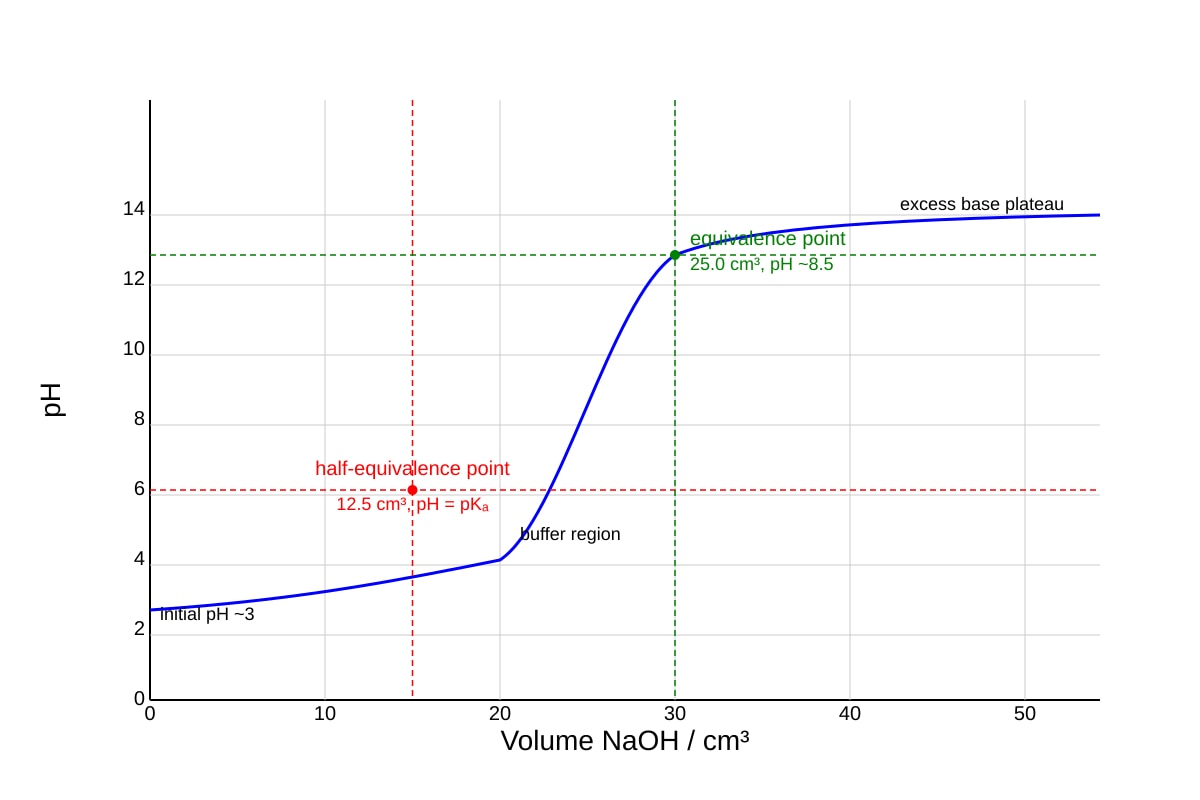
16. A titration curve for a weak acid–strong base titration is shown below.
Image pending generation: graph for 16.
(a) State the pH at the equivalence point and explain why it is not 7. [2]
(b) From the half-equivalence point, deduce the pKₐ of HA. [1]
17. Calculate the mass of anhydrous sodium carbonate (Na₂CO₃, Mᵣ = 106.0) required to prepare 250 cm³ of 0.0500 mol dm⁻³ solution. [3]
18. A salt X is soluble in water and gives a white precipitate with BaCl₂ solution that is insoluble in dilute HCl. Identify the anion present and give the confirmatory test. [2]
19. Compare the Lewis and Brønsted–Lowry definitions of a base, giving one example of a species that is a base under both and one that is a base only under Lewis. [3]
20. A mixture of Na₂CO₃ and NaHCO₃ is analysed by double indicator titration. Explain how phenolphthalein and methyl orange endpoints allow determination of the two components. [4]
Answers
TuitionGoWhere Exam Practice (AI) — Chemistry H2 A-Level
Answer Key (Version 1 of 5) — Acids Bases Salts
Section A
1. [3 marks]
- Reject rough titration (26.40 cm³).
- Titration 1: 25.70, Titration 2: 25.70, Titration 3: 25.60.
- Range = 25.70 – 25.60 = 0.10 cm³ (acceptable, ≤0.10).
- Mean = (25.70 + 25.70 + 25.60) / 3 = 25.666… ≈ 25.67 cm³ (to 2 d.p.).
Marking: 1 for excluding rough, 1 for correct concordant set, 1 for mean to correct precision.
2. [1 mark] Colourless to pink (or faint pink).
3. [3 marks]
- Mean titre = (22.45 + 22.50 + 22.40)/3 = 22.45 cm³.
- n(NaOH) = 0.0500 × (22.45/1000) = 1.1225 × 10⁻³ mol.
- CH₃COOH + NaOH → CH₃COONa + H₂O, 1:1 ⇒ n(acid) = 1.1225 × 10⁻³ mol.
- Conc. acid = n / V = 1.1225 × 10⁻³ / 0.0250 = 0.0449 mol dm⁻³.
Marks: 1 mean, 1 moles, 1 concentration.
4. [3 marks]
- NH₃: turns damp red litmus paper blue
- CO₂: white precipitate (ppt) formed, dissolves in excess CO₂
- Cl₂: bleaches damp litmus paper (red turns white)
1 mark each.
5. [2 marks]
- White precipitate first forms: Al³⁺ + 3OH⁻ → Al(OH)₃(s).
- With excess NaOH, ppt. dissolves: Al(OH)₃ + OH⁻ → [Al(OH)₄]⁻(aq).
1 for observation, 1 for equation/complex.
Section B
6. [2 marks] Brønsted–Lowry acid = proton (H⁺) donor; base = proton (H⁺) acceptor. (1 each)
7. [3 marks]
- HCOOH ⇌ H⁺ + HCOO⁻, Kₐ = [H⁺][HCOO⁻]/[HCOOH] ≈ x²/0.0200.
- x² = 1.8×10⁻⁴ × 0.0200 = 3.6×10⁻⁶ ⇒ x = 1.897×10⁻³ mol dm⁻³.
- pH = –log(1.897×10⁻³) = 2.72.
Marks: 1 setup, 1 solve, 1 pH.
8. [2 marks]
- CH₃COO⁻ + H₂O ⇌ CH₃COOH + OH⁻, produces OH⁻ ⇒ basic. (1 equation, 1 explanation)
9. [3 marks]
- [acid] = [salt] = 0.100 × 50/100 = 0.0500 mol dm⁻³ each.
- pH = pKₐ + log([salt]/[acid]) = 4.76 + log(1) = 4.76.
Marks: 1 ratio, 1 substitution, 1 answer.
10. [3 marks]
- HCl adds H⁺: CH₃COO⁻ + H⁺ → CH₃COOH.
- n(HCl) = 0.100 × 0.005 = 5.0×10⁻⁴ mol reduces salt, increases acid.
- New [salt] = (0.005 – 0.0005)/0.105 = 0.0429; [acid] = 0.0476.
- pH = 4.76 + log(0.0429/0.0476) = 4.76 – 0.045 = 4.71 (slightly lower).
Marks: 1 reaction, 1 recalc, 1 pH.
Section C
11. [4 marks]
- Cu²⁺ + excess NH₃: blue ppt. dissolves to deep blue solution [Cu(NH₃)₄]²⁺ (1).
- Fe³⁺ + NaOH: brown ppt. Fe(OH)₃ (1). Others given.
12. [1 mark] Ba²⁺(aq) + SO₄²⁻(aq) → BaSO₄(s).
13. [3 marks]
- AgCl ⇌ Ag⁺ + Cl⁻, Ksp = s² = 1.8×10⁻¹⁰.
- s = √(1.8×10⁻¹⁰) = 1.34×10⁻⁵ mol dm⁻³.
Marks: 1 equation, 1 root, 1 unit.
14. [3 marks]
- Limited NH₃: white ppt. Zn(OH)₂.
- Excess NH₃: ppt. dissolves to colourless solution of [Zn(NH₃)₄]²⁺.
1 + 1 + 1 for formula.
15. [3 marks]
- Dissolution endothermic (lattice breaks, hydration forms); heating favours dissolution (Le Chatelier).
- Higher T reduces attractive lattice dominance, increases ion solvation kinetic energy.
1 principle, 1 explanation, 1 conclusion.
Section D
16. [3 marks]
(a) Equivalence pH ≈ 8.5; not 7 because conjugate base A⁻ hydrolyses to give OH⁻. [2]
(b) pKₐ = pH at half-equivalence = value from graph (~3–5 depending on curve). [1]
17. [3 marks]
- n = 0.0500 × 0.250 = 0.0125 mol.
- m = 0.0125 × 106.0 = 1.325 g.
1 moles, 1 mass, 1 units.
18. [2 marks] Anion = SO₄²⁻; confirmatory: white BaSO₄ ppt. insoluble in dilute HNO₃/HCl. (1 + 1)
19. [3 marks]
- Lewis base = electron pair donor; Brønsted = proton acceptor.
- Both: NH₃ (donates pair / accepts H⁺).
- Lewis only: BF₃ (accepts pair, not proton).
1 + 1 + 1.
20. [4 marks]
- Phenolphthalein endpoint (pH~8.3) measures Na₂CO₃ → NaHCO₃ only.
- Methyl orange endpoint (pH~3.7) measures total to H₂CO₃.
- Difference gives NaHCO₃ originally present.
1 each stage.
Free quiz and exam paper access
Enter your details to view this paper
Your access is remembered on this device.