AI Generated Quiz
A Level H1 Chemistry Periodic Table Quiz
Free A Level H1 Chemistry Periodic Table quiz, LongCat AI version, with questions, answers, and A Level-style practice for Singapore students.
These static practice materials are generated from the site's syllabus and paper-generation workflow, with source and model context shown so students and parents can evaluate the material before use.
Questions
Free quiz and exam paper access
Enter your details to view this paper
Your access is remembered on this device.
Answers
A-Level Chemistry H1 Quiz - Periodic Table
Answer Key & Teaching Notes
Section A: Multiple Choice
Question 1
Answer: B [2]
Explanation: Across Period 3, electrons are added to the same principal energy level (n = 3) while protons are added to the nucleus. The shielding effect from inner electrons remains approximately constant, so the effective nuclear charge increases. This pulls the electron cloud closer to the nucleus, decreasing atomic radius.
Common Mistakes:
- Choosing A: The number of electron shells stays the same across a period; it increases down a group.
- Choosing C: Shielding does not increase significantly across a period since inner-shell electrons remain constant.
Question 2
Answer: D [2]
Explanation: The configuration has 16 electrons, so the element is sulfur (S), in Group 16. It gains 2 electrons to form . Option A is incorrect because sulfur is a non-metal. Option B is incorrect because is an acidic oxide. Option C is incorrect because chlorine () has a more negative electron affinity than sulfur due to its higher effective nuclear charge and the stability of achieving a full configuration.
Common Mistakes:
- Choosing A: Students may confuse Group 16 with metallic character. All Period 3 elements from Na to Al are metals; Si is a metalloid; P onwards are non-metals.
Question 3
Answer: B [2]
Explanation: is amphoteric, meaning it reacts with both acids and bases. and are basic oxides. and are acidic oxides. Amphoteric oxides are typically found at the metal–non-metal boundary in the Periodic Table.
Common Mistakes:
- Choosing A or C: Students may not recall that amphoteric oxides are associated with elements near the metalloid boundary.
Question 4
Answer: B [2]
Explanation: There is a very large jump between the 2nd ionisation energy (1145) and the 3rd ionisation energy (4912). This indicates that the first two electrons are relatively easy to remove (from the same outer shell), but the third electron must be removed from an inner, more stable shell. This is characteristic of a Group 2 element with two valence electrons.
Common Mistakes:
- Choosing A: A Group 1 element would show a large jump between the 1st and 2nd ionisation energies.
- Choosing D: A Group 14 element would show a large jump between the 4th and 5th ionisation energies.
Question 5
Answer: B [2]
Explanation: Halogens exist as diatomic molecules (, , , ). Down the group, the number of electrons increases, leading to stronger van der Waals (London dispersion) forces between molecules. More energy is needed to overcome these forces, so the melting and boiling points increase.
Common Mistakes:
- Choosing A: The covalent bond strength within the molecule does not determine melting point; intermolecular forces do.
- Choosing C: Electronegativity actually decreases down the group.
Section B: Short Answer & Structured Response
Question 6
(a) [2 marks]
Answer: The first ionisation energy is the energy required to remove one mole of electrons from one mole of gaseous atoms to form one mole of gaseous 1+ ions.
Marking: 1 mark for "remove electron from gaseous atom"; 1 mark for correct specification of "one mole of electrons from one mole of atoms forming one mole of unipositive gaseous ions."
(b) [1 mark]
Answer:
Marking: Correct species and state symbols. Must show gaseous state and the electron as a product.
(c) [2 marks]
Explanation:
- Mg has a higher nuclear charge (12 protons) than Na (11 protons). [1]
- Both have the same shielding from inner electrons (core electrons: ), so the effective nuclear charge experienced by the outer electron is greater in Mg. [1]
- The outer electron in Mg is held more tightly, requiring more energy to remove.
Common Mistakes: Students may say "more electron shells" or "more electrons" without specifying effective nuclear charge and shielding.
Question 7
(a) [1 mark]
Answer: The first ionisation energy generally increases across Period 3 from Na to Ar.
(b) [2 marks]
Explanation:
- In Mg, the outermost electron is in the 3s orbital. [1]
- In Al, the outermost electron is in the 3p orbital, which is at a higher energy level (slightly further from the nucleus) and is shielded by the 3s electrons. [1]
- Therefore, the 3p electron in Al is easier to remove, giving a lower ionisation energy.
(c) [2 marks]
Explanation:
- In P, the 3p orbitals contain three unpaired electrons (one in each orbital). [1]
- In S, one of the 3p orbitals contains a pair of electrons. The electron-electron repulsion within the paired orbital makes it easier to remove one of the paired electrons. [1]
Common Mistakes: Students may confuse the explanation for Al vs Mg with that of S vs P. The Al vs Mg drop is due to subshell energy; the S vs P drop is due to electron pairing.
Question 8
(a) [3 marks]
Answer:
- Electronegativity increases across Period 3 from Na to Cl. [1]
- This is because the nuclear charge increases while the number of inner electron shells remains the same. [1]
- The effective nuclear charge increases, so the bonding electrons are attracted more strongly by the atom. [1]
(b) [2 marks]
Explanation:
- The electronegativity difference is . [1]
- Since the difference is relatively small and aluminium is a metal near the metal–non-metal boundary, is covalent (or predominantly covalent). It exists as a simple molecular compound (dimer in vapour state) rather than an ionic lattice. [1]
Common Mistakes: Students may assume all metal–non-metal compounds are ionic. The electronegativity difference and the position of Al near the metalloid boundary must be considered.
Question 9
(a) [3 marks]
Answer:
- has a giant ionic lattice structure. [1]
- It consists of and ions held together by strong electrostatic forces of attraction. [1]
- A large amount of energy is needed to overcome these strong ionic bonds, resulting in a very high melting point. [1]
(b) [3 marks]
Answer:
- has a giant covalent (macromolecular) structure where each Si atom is bonded to four O atoms in a tetrahedral arrangement, forming a 3D network. [1]
- exists as simple covalent molecules ( molecules) held together by weak van der Waals forces. [1]
- The strong covalent bonds throughout the lattice require much more energy to break than the weak intermolecular forces between molecules. [1]
Common Mistakes: Students may say "ionic bonds" for ; it is covalent. Also, students may not distinguish between breaking covalent bonds (in ) and overcoming intermolecular forces (in ).
Question 10
(a) [1 mark]
Answer: Atomic radius increases down a group.
(b) [3 marks]
Explanation:
- Going down a group, the number of electron shells increases. [1]
- The outermost electrons are further from the nucleus. [1]
- Although the nuclear charge increases, the additional inner electron shells provide more shielding, so the effective nuclear charge does not increase enough to compensate for the greater distance. [1]
Question 11
(a) [1 mark]
Answer: Acidic oxide.
(b) [1 mark]
Answer:
(Or a specific equation if Z is identified as Si: )
(c) [2 marks]
Answer: Z is silicon (Si). [1] Silicon is a metalloid in Period 3, Group 14, and its oxide is weakly acidic, reacting with NaOH to form sodium silicate and water. [1]
Alternative acceptable answer: Z could be sulfur (S), but is the more common oxide of sulfur that reacts with NaOH. Given the formula , silicon is the best fit.
Question 12
(a) [1 mark]
Answer: An amphoteric substance is one that can react with both acids and bases.
(b) [2 marks]
With acid: [1]
With base: [1]
(Alternative for base: )
Question 13
(a) [3 marks]
Explanation:
- and are ionic compounds. In the molten state, the ions are free to move and carry charge, so they conduct electricity. [1]
- is a covalent (simple molecular) compound. It consists of neutral molecules with no mobile ions or electrons. [1]
- Therefore, does not conduct electricity in any state. [1]
(b) [1 mark]
Answer: This suggests that is predominantly covalent (or a poor ionic conductor), existing as molecules rather than as a fully ionic lattice. In the molten state, it exists as dimers with few free ions.
Question 14
(a) [2 marks]
Answer: For main group elements, the charge of the ion formed is related to the group number. Group 1 elements form 1+ ions, Group 2 elements form 2+ ions, Group 13 elements form 3+ ions, Group 16 elements form 2− ions, and Group 17 elements form 1− ions. [1]
Example: Sodium (Group 1) forms ; oxygen (Group 16) forms . [1]
(b) [2 marks]
Explanation:
- has lost its outer 3s electron, so it has one fewer electron shell (now only n = 2). [1]
- The remaining electrons experience a greater effective nuclear charge per electron and are pulled closer to the nucleus, making the ionic radius smaller than the atomic radius. [1]
Question 15
(a) [3 marks]
Explanation:
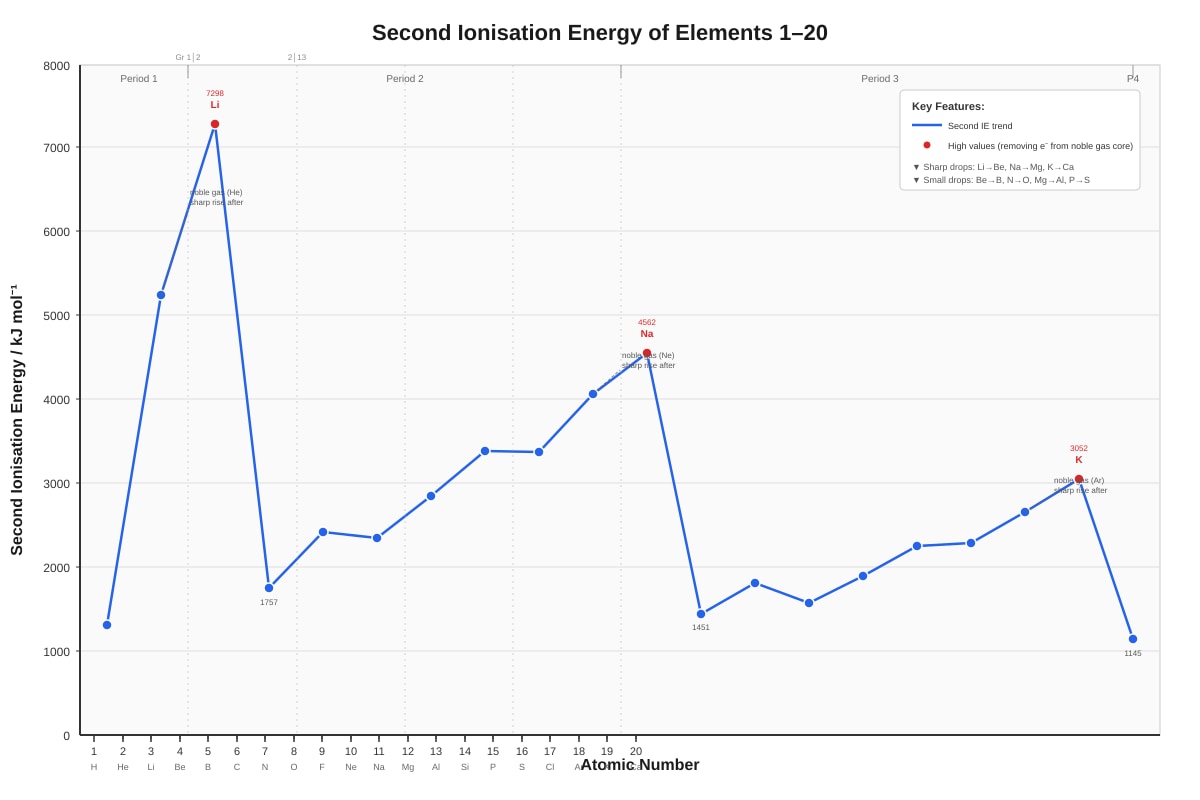
- Li has the configuration . After losing one electron, has the configuration (a stable noble gas configuration). [1]
- The second ionisation energy of lithium involves removing an electron from the 1s orbital, which is much closer to the nucleus and experiences very little shielding. [1]
- Be has the configuration . The second ionisation removes a 2s electron, which is in a higher energy level and is shielded by the 1s electrons. [1]
- Therefore, the second IE of Li is much higher than that of Be.
(b) [2 marks]
Explanation:
- Nitrogen has the configuration , with one electron in each 2p orbital (all unpaired). [1]
- Oxygen has the configuration , with one paired set of electrons in a 2p orbital. The electron-electron repulsion in the paired orbital makes it easier to remove an electron, so the second IE of O is lower than that of N. [1]
Note on graph: The graph should show very high second IE values for Li, Na, and K (removing an electron from a noble gas core), and drops from Group 2→13 and Group 15→16.
Section C: Extended Response & Data Analysis
Question 16
(a) [3 marks]
Answer:
- Atomic radius decreases across Period 3. [1]
- The number of protons (nuclear charge) increases while electrons are added to the same principal energy level (n = 3). [1]
- The shielding effect from inner electrons remains approximately constant, so the effective nuclear charge increases, pulling the electron cloud closer to the nucleus. [1]
(b) [2 marks]
Answer:
- Silicon has a giant covalent (diamond-like) structure where each Si atom is covalently bonded to four other Si atoms in a tetrahedral arrangement. [1]
- At low temperatures, electrons are held in covalent bonds and cannot conduct. At higher temperatures, some electrons gain enough energy to move into the conduction band, allowing limited conductivity. This intermediate behaviour makes it a semiconductor. [1]
(c) [2 marks]
Answer:
- Both electronegativity and first ionisation energy generally increase across Period 3. [1]
- This is because both properties depend on the effective nuclear charge: a higher effective nuclear charge means the atom attracts bonding electrons more strongly (higher electronegativity) and holds its own electrons more tightly (higher ionisation energy). [1]
Question 17
(a) [4 marks]
Answer:
- The boiling point increases down Group 17 (from to ). [1]
- Halogens exist as diatomic molecules (, , , ) held together by weak van der Waals (London dispersion) forces between molecules. [1]
- Going down the group, the number of electrons in the molecule increases. [1]
- More electrons mean stronger temporary dipoles and hence stronger van der Waals forces, requiring more energy to overcome, so the boiling point increases. [1]
(b) [3 marks]
Answer:
- is a simple covalent molecule with weak van der Waals forces between molecules. Little energy is needed to separate the molecules, so it is a gas at room temperature. [1]
- has a giant ionic lattice structure with strong electrostatic forces of attraction between and ions. [1]
- A large amount of energy is needed to overcome these strong ionic bonds, so is a solid at room temperature. [1]
Question 18
(a) [3 marks]
Answer:
- Element Q is in Group 1. [1]
- There is a very large jump between the 1st IE (496) and the 2nd IE (4562). [1]
- This indicates that the first electron is easy to remove (from the outer shell), but the second electron must be removed from a stable, inner noble gas configuration. This is characteristic of Group 1 elements with one valence electron. [1]
(b) [1 mark]
Answer: (sodium, Na)
(c) [1 mark]
Answer:
Note: The third ionisation energy involves removing an electron from , which has the configuration . This requires removing an electron from the inner 2p subshell, which is why the 3rd IE is very high.
Question 19
(a) [3 marks]
Answers:
- : Basic [0.5]
- : Basic [0.5]
- : Amphoteric [0.5]
- : Acidic (weakly acidic) [0.5]
- : Acidic [0.5]
- : Acidic [0.5]
Marking: 0.5 marks each. Award 0.5 for each correct classification.
(b) [2 marks]
with water: [1]
with water: [1]
(c) [3 marks]
Answer:
- has a giant covalent (macromolecular) structure where each Si atom is bonded to four O atoms in a tetrahedral network. [1]
- exists as simple covalent molecules held together by weak van der Waals forces. [1]
- Melting requires breaking strong covalent bonds throughout the lattice, while melting only requires overcoming weak intermolecular forces. Hence has a much higher melting point. [1]
Question 20
(a) [1 mark]
Answer: (calcium, Ca)
(b) [4 marks]
(i) Atomic radius increases down Group 2. [1] This is because each successive element has an additional electron shell, placing the outermost electrons further from the nucleus. The increased shielding from inner shells outweighs the increased nuclear charge. [1]
(ii) First ionisation energy decreases down Group 2. [1] The outermost electrons are further from the nucleus and experience more shielding from inner electrons, so the effective nuclear charge experienced by the outer electrons is less. Less energy is required to remove the outer electron. [1]
(c) [1 mark]
Answer:
(d) [2 marks]
Answer:
- Calcium hydroxide, , is a base that dissociates in water to produce hydroxide ions: [1]
- The presence of ions makes the solution alkaline, giving a pH greater than 7. [1]
Mark Summary
| Section | Questions | Marks |
|---|---|---|
| A: MCQ | 1–5 | 10 |
| B: Short Answer/Structured | 6–15 | 24 |
| C: Extended Response | 16–20 | 16 |
| Total | 20 questions | 50 |