AI Generated Quiz
A Level H1 Chemistry Organic Chemistry Quiz
Free A Level H1 Chemistry Organic Chemistry quiz, LongCat AI version, with questions, answers, and A Level-style practice for Singapore students.
These static practice materials are generated from the site's syllabus and paper-generation workflow, with source and model context shown so students and parents can evaluate the material before use.
Questions
Free quiz and exam paper access
Enter your details to view this paper
Your access is remembered on this device.
Answers
A-Level Chemistry H1 Quiz - Organic Chemistry
Answer Key & Teaching Notes
Section A: Multiple Choice
1. A — 2-methylbutan-1-ol [2 marks]
Teaching Notes: The longest carbon chain containing the –OH group has 4 carbons (butane). Numbering from the end nearest the –OH group gives the –OH at position 1. There is a methyl substituent at position 2. Hence: 2-methylbutan-1-ol.
- Why not B? 3-methylbutan-1-ol would require numbering from the wrong end; the –OH takes priority for lowest locant.
- Why not C? 2-methylpropan-1-ol has only 3 carbons in the main chain (C₃), but the compound has 4 carbons in its longest chain.
- Why not D? 3-methylpropan-1-ol is not a valid IUPAC name — propane only has 3 carbons, so position 3 is equivalent to position 1, and the correct name would be a butanol isomer.
Common mistake: Students often choose the wrong longest chain or number from the wrong end.
2. C — 1,2-dibromopropane [2 marks]
Teaching Notes: Propene () undergoes electrophilic addition with bromine (). The molecule adds across the C=C double bond. One bromine attaches to C-1 and the other to C-2, giving 1,2-dibromopropane ().
- Why not A or B? These would be substitution products (replacing H with Br), not addition products. Addition across the double bond is the characteristic reaction of alkenes with halogens.
- Why not D? 1,3-dibromopropane would require bromines on C-1 and C-3, which is not how addition across the C=C bond works.
Common mistake: Confusing addition with substitution reactions.
3. C — Bromine water [2 marks]
Teaching Notes: Alkenes decolourise bromine water (from orange/brown to colourless) due to electrophilic addition across the C=C double bond. Alkanes do not react with bromine water under normal conditions (no reaction; bromine water remains orange).
- Why not A? Dilute HCl does not react with either alkanes or alkenes under standard conditions.
- Why not B? Aqueous NaOH does not react with either.
- Why not D? Aqueous ammonia does not react with either.
Common mistake: Students may confuse this test with the reaction of alkanes with bromine in UV light (free radical substitution), which is not a simple test-tube distinction.
4. C — Carboxyl group (–COOH) [2 marks]
Teaching Notes: Ethanoic acid () is a carboxylic acid. Its functional group is the carboxyl group (–COOH), which consists of a carbonyl group (>C=O) and a hydroxyl group (–OH) bonded to the same carbon atom.
- Why not A? The hydroxyl group alone (–OH) is the functional group of alcohols, not carboxylic acids.
- Why not B? The carbonyl group alone (>C=O) is the functional group of aldehydes and ketones.
- Why not D? The ester group (–COO–) is the functional group of esters.
Common mistake: Students confuse the –OH in carboxylic acids with the alcohol –OH group. The key distinction is that in carboxylic acids, the –OH is part of the –COOH group.
5. C — Dehydration [2 marks]
Teaching Notes: Concentrated sulfuric acid acts as a dehydrating agent, removing a molecule of water () from ethanol to form ethene. This is an elimination reaction (specifically, dehydration — loss of water).
- Why not A? Hydration is the reverse — adding water to ethene to form ethanol.
- Why not B? Oxidation of ethanol would produce ethanal or ethanoic acid, not ethene.
- Why not B? Hydrolysis involves breaking bonds using water, which is the opposite of what occurs here.
Common mistake: Students confuse dehydration (loss of water) with hydration (addition of water).
Section B: Structured Questions
6. [3 marks]
(a) A homologous series is a family of organic compounds that:
- have the same functional group
- can be represented by the same general formula
- show a gradation in physical properties (e.g., boiling point increases with chain length)
- differ from the next member by a unit (14 atomic mass units)
- show similar chemical properties [2 marks]
(b) The general formula for alkanes is: [1 mark]
Teaching Notes: Students often forget that members of a homologous series share the same functional group AND general formula. Both points are needed for a full definition. The increment is a key distinguishing feature.
7. [3 marks]
(a) Propan-2-ol: [1 mark]
Structural formula:
(The –OH group is on carbon 2 of a 3-carbon chain)
(b) Butanoic acid: [1 mark]
Structural formula:
(A 4-carbon chain with a –COOH group at the end)
(c) Ethyl ethanoate: [1 mark]
Structural formula:
(An ester formed from ethanoic acid and ethanol; the alkyl group from ethanol comes first in the name, then the acid portion with the -oate suffix)
Teaching Notes: Students should practise drawing full structural formulae showing all atoms and bonds. Abbreviated formulae (e.g., ) are acceptable but must clearly show the functional group.
8. [3 marks]
Reagent: Sodium carbonate solution () [or sodium hydrogencarbonate / litmus paper — any valid distinguishing reagent] [1 mark for reagent + observations]
Observation with propan-1-ol: No visible reaction / no effervescence. [½ mark]
Observation with propanoic acid: Effervescence / bubbles of gas produced (carbon dioxide). [½ mark]
Chemical equation:
[1 mark]
Alternative valid reagent: Blue litmus paper — propanoic acid turns it red; propan-1-ol has no effect.
Teaching Notes: Carboxylic acids react with carbonates to produce gas. Alcohols do not react with carbonates. This is a standard distinguishing test. Students must include state symbols and balance the equation for full marks.
Common mistake: Writing the formula of the acid incorrectly, or forgetting to balance the equation.
9. [4 marks]
(a) The functional group is the carboxyl group (–COOH). The compound is a carboxylic acid. [1 mark]
Reasoning: The reaction with producing a gas that turns limewater milky confirms is evolved, which is characteristic of carboxylic acids reacting with carbonates.
(b) TWO possible structural formulae for containing –COOH: [2 marks — 1 mark each]
- Butanoic acid:
- 2-methylpropanoic acid:
(c) IUPAC name of ONE structure: [1 mark]
Either: butanoic acid or 2-methylpropanoic acid
Teaching Notes: For with a –COOH group, the remaining portion is –. This can be a straight-chain propyl group (butanoic acid) or a branched isopropyl group (2-methylpropanoic acid). Students should check that the molecular formula matches.
10. [3 marks]
(a) Balanced equation for fermentation of glucose: [1 mark]
(b) TWO conditions required: [2 marks — 1 mark each]
- Temperature of approximately 30–40°C (warm conditions; too high a temperature denatures the enzyme)
- Absence of oxygen / anaerobic conditions (fermentation is an anaerobic process; in the presence of oxygen, aerobic respiration occurs instead)
Also acceptable: Presence of yeast (enzyme zymase), aqueous solution.
Teaching Notes: Students often write "room temperature" which is vague. The optimal temperature range (30–40°C) should be specified. The anaerobic condition is crucial — many students forget this.
11. [4 marks]
(a) Reagent A: Hydrogen bromide () [1 mark]
Reaction type: Electrophilic addition [1 mark]
Note: The question shows propene → 1-bromopropane. While addition to propene predominantly gives 2-bromopropane (Markovnikov), the question specifies 1-bromopropane as the product. This could be achieved using in the presence of peroxides (anti-Markovnikov addition). Accept either answer with appropriate explanation.
Alternative acceptable answer: would give a dibromide, not the desired product. The most likely intended reagent is .
(b) Reagent B: Aqueous sodium hydroxide () or potassium hydroxide () [1 mark]
Conditions: Heat under reflux (or warm) [1 mark]
This is a nucleophilic substitution reaction.
Teaching Notes: Students should recognise the conversion of a halogenoalkane to an alcohol as a substitution reaction using aqueous . Reflux ensures the reaction goes to completion without losing volatile reagents.
12. [4 marks]
(a) Structural isomerism is the phenomenon where compounds have the same molecular formula but different structural formulae (different arrangements of atoms). [1 mark]
(b) The two structural isomers of : [3 marks]
-
Butane (straight chain): [1 mark for structure + ½ mark for name]
-
2-methylpropane (branched): or [1 mark for structure + ½ mark for name]
Teaching Notes: has only TWO structural isomers. Students sometimes try to draw more by rearranging the same structure. Emphasise that the longest chain determines the parent name, and branching must create a genuinely different connectivity.
Common mistake: Drawing the same isomer twice with different orientations on the page.
13. [4 marks]
(a) Colour change: From orange to green [1 mark]
Reasoning: Orange (dichromate(VI) ions) is reduced to green (chromium(III) ions) during oxidation of the alcohol.
(b) The organic product is ethanoic acid () [1 mark]
Reasoning: Ethanol (a primary alcohol) is first oxidised to ethanal, then further to ethanoic acid under reflux conditions with excess oxidising agent.
(c) Reflux is used because: [2 marks]
- Ethanal () is volatile (boiling point ≈ 20°C) and would escape as vapour during heating if simple distillation were used. [1 mark]
- Reflux ensures that any volatile products condense and return to the reaction flask, allowing the oxidation to go to completion (primary alcohol → aldehyde → carboxylic acid). [1 mark]
Alternative valid point: Reflux allows the reaction to be carried out at a high temperature (to increase rate) without loss of reactants or products.
Teaching Notes: This is a classic exam question. Students must understand the difference between reflux (condensation and return) and distillation (collection of volatile product). For complete oxidation of a primary alcohol to a carboxylic acid, reflux is essential.
14. [4 marks]
(a) Compound Y contains an aldehyde functional group (–CHO). [1 mark]
Reasoning: A positive Tollens' test (silver mirror) indicates an aldehyde. The molecular formula is consistent with propanal ().
Note on Fehling's test: The question states that Fehling's test is negative. This is unusual for a simple aliphatic aldehyde (which would normally give a positive Fehling's test). This detail may indicate the compound is an aromatic aldehyde (e.g., benzaldehyde), but this is beyond H1 syllabus. At H1 level, students should identify the functional group as an aldehyde based on the Tollens' test result.
(b) Structural formula of Y: (propanal) [1 mark]
(c) Equation for Tollens' reaction: [2 marks]
Simplified form (also acceptable):
Marking: 1 mark for correct reactants and products; 1 mark for correct state symbols and balanced equation.
Teaching Notes: Tollens' reagent is a solution of silver nitrate in aqueous ammonia. The silver ion () is reduced to metallic silver (), which forms a mirror on the test tube. The aldehyde is oxidised to a carboxylate ion.
15. [4 marks]
(a) Repeating unit of poly(propene): [2 marks]
Drawn as: A chain where every other carbon has a methyl group attached.
Marking: 1 mark for correct backbone; 1 mark for correct methyl substituent.
(b) Type of polymerisation: Addition polymerisation [1 mark]
(c) Environmental concern: [1 mark — any ONE of:]
- Poly(propene) is non-biodegradable and persists in the environment for a very long time.
- Burning poly(propene) can release toxic fumes (e.g., carbon monoxide, unburned hydrocarbons).
- It contributes to landfill waste as it does not decompose naturally.
- Microplastic pollution in oceans and waterways.
Teaching Notes: Addition polymers like poly(propene) are formed by the repeated addition of monomer units without the loss of any atoms or small molecules. This contrasts with condensation polymers (e.g., polyesters, polyamides) which release small molecules like water during polymerisation.
Section C: Free Response
16. [6 marks]
(a) Showing empirical formula is : [2 marks]
| Element | % by mass | Atomic mass | Moles (÷ Aᵣ) | Ratio |
|---|---|---|---|---|
| C | 40.0 | 12 | 40.0 ÷ 12 = 3.33 | 1 |
| H | 6.7 | 1 | 6.7 ÷ 1 = 6.7 | 2 |
| O | 53.3 | 16 | 53.3 ÷ 16 = 3.33 | 1 |
Simplest whole number ratio: C : H : O = 1 : 2 : 1
∴ Empirical formula = ✓
Marking: 1 mark for correct mole calculations; 1 mark for correct ratio and empirical formula.
(b) Molecular formula: [1 mark]
Empirical formula mass of = 12 + 2(1) + 16 = 30
∴ Molecular formula =
(c) Since Z reacts with sodium carbonate to produce a gas (), it must be a carboxylic acid. [1 mark for identification]
With molecular formula , the compound is ethanoic acid: [1 mark for structure]
Reasoning: The only carboxylic acid with formula is ethanoic acid. The –COOH group reacts with to produce gas. [1 mark for explanation]
Teaching Notes: This is a standard empirical formula calculation followed by functional group identification. Students should always check that their molecular formula is consistent with the functional group they propose.
17. [5 marks]
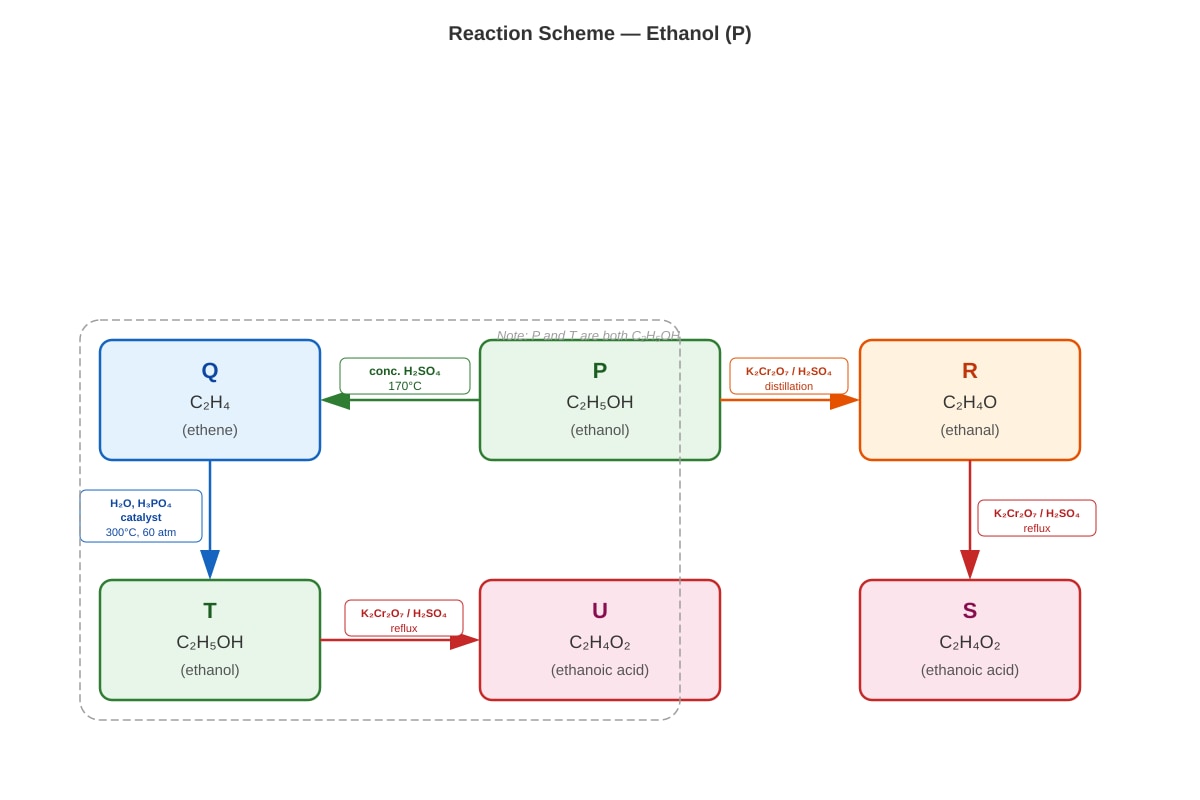
(a) Compounds P and T are structural isomers of each other. [1 mark]
Both have the same molecular formula ( / ) but they are actually the same compound (ethanol) in this scheme. However, if the reaction scheme shows T as a different compound with the same formula, they would be structural isomers.
Re-reading the scheme: P is ethanol (). T is also ethanol (from hydration of ethene). These are the same compound, not isomers.
Alternative answer: If we consider the scheme as drawn, no pair of compounds in the scheme are structural isomers since P and T are identical (both ethanol), and all other compounds have different molecular formulas.
Acceptable answer: P and T are the same compound (both ethanol). If the question intends T to be different, then P and T would be structural isomers because they share the same molecular formula but have different structures. [1 mark for identification + 1 mark for explanation]
Note to marker: This question tests understanding that structural isomers share the same molecular formula but differ in structural arrangement. Award marks for clear reasoning.
(b) The conversion of P (ethanol) to Q (ethene) is a dehydration reaction (elimination of water). [1 mark]
(c) Reflux is necessary because: [2 marks]
- Ethanal (compound R) is highly volatile (boiling point ≈ 20°C). Under heating, it would rapidly vaporise and escape from the reaction mixture. [1 mark]
- Reflux condenses the vapour and returns it to the reaction flask, ensuring that the ethanal remains in contact with the oxidising agent long enough to be fully oxidised to ethanoic acid (compound S). [1 mark]
Teaching Notes: This reinforces the concept from Q13. Students must understand that for complete oxidation of a primary alcohol → aldehyde → carboxylic acid, reflux prevents loss of the volatile aldehyde intermediate.
18. [5 marks]
(a) Functional groups: [4 marks — 1 mark each]
Compound A: Alkene (C=C double bond) Reasoning: Decolourises bromine water immediately (addition reaction). Oxidised by acidified dichromate (orange → green), which occurs with alkenes under vigorous conditions. No reaction with sodium (not an alcohol or carboxylic acid). No reaction with Tollens' (not an aldehyde).
Compound B: Alcohol (–OH group) Reasoning: Reacts with sodium metal to produce hydrogen gas (effervescence). No reaction with bromine water (not an alkene). No oxidation by dichromate (tertiary alcohol, or the conditions are not suitable). No reaction with Tollens'.
Alternative: Could also be a carboxylic acid (reacts with Na, no bromine water reaction, no dichromate oxidation, no Tollens'). However, the lack of reaction with dichromate suggests it is not easily oxidised, which is consistent with a tertiary alcohol or a carboxylic acid. Given the context, alcohol is the most likely answer.
Re-evaluation: Compound B reacts with Na (effervescence) but NOT with dichromate (no colour change) and NOT with bromine water. This is consistent with a tertiary alcohol (resistant to oxidation) or a carboxylic acid. Since carboxylic acids also react with carbonates (not tested here), and the question doesn't provide that data, alcohol is acceptable.
Compound C: Alcohol AND aldehyde — or more precisely, the compound contains both an aldehyde group and an alcohol group (–OH and –CHO). Reasoning: Reacts with Na (alcohol –OH present). Decolourises bromine water slowly (could be oxidation of aldehyde by bromine). Oxidised by dichromate (aldehyde → carboxylic acid). Positive Tollens' test (aldehyde group).
Most likely compound: An aldehyde with an alcohol group, such as 2-hydroxypropanal ( or similar). At H1 level, the key point is that the compound contains both an aldehyde and an alcohol functional group.
Simpler interpretation: The compound is an aldehyde that also has an –OH group. Award the mark for identifying the aldehyde group (Tollens' positive) and noting the alcohol group (reacts with Na).
Compound D: Alcohol AND aldehyde — similar to C, but does NOT decolourise bromine water. Reasoning: Reacts with Na (alcohol group). No reaction with bromine water (no C=C). Oxidised by dichromate (aldehyde group). Positive Tollens' test (aldehyde group).
Most likely: A compound containing both an aldehyde and an alcohol group, but without a C=C bond (hence no bromine water reaction).
Simpler answer: Compound D contains an aldehyde group (Tollens' positive, dichromate oxidation) and an alcohol group (reacts with Na).
Marking guidance: Award 1 mark for each correctly identified functional group. Accept "alkene" for A, "alcohol" for B, "aldehyde and alcohol" for C, and "aldehyde and alcohol" for D. Alternative valid identifications with correct reasoning are also acceptable.
(b) ONE possible structural formula for C: [1 mark]
(3-hydroxypropanal) or (2-hydroxypropanal)
Any structure containing both –OH and –CHO groups is acceptable.
19. [5 marks]
(a) Compound E is an ester. [1 mark]
Reasoning: The sweet smell and molecular formula are characteristic of esters. The fact that it undergoes hydrolysis to produce two compounds confirms this.
(b) Deducing the structure of E: [4 marks]
Step 1: E is an ester with formula . [1 mark]
Step 2: Hydrolysis produces F and G:
- F gives a positive iodoform test → F contains a – group or is ethanol (). The iodoform test is positive for compounds with a – group (secondary alcohols with methyl on the carbinol carbon) or for methyl ketones (–). Since F is produced by hydrolysis of an ester, F is likely an alcohol. Ethanol gives a positive iodoform test. [1 mark]
- G turns blue litmus red → G is acidic → G is a carboxylic acid. [1 mark]
Step 3: If F is ethanol (), then the acid portion G must be ethanoic acid () to give the ester .
Check: Ethyl ethanoate = = ✓
Structural formula of E: (ethyl ethanoate) [1 mark]
Teaching Notes: The iodoform test is positive for ethanol and for secondary alcohols of the form . In the context of ester hydrolysis, the alcohol product is most commonly ethanol (from ethyl esters). Students should work backwards from the hydrolysis products to deduce the ester structure.
20. [5 marks]
(a) Preparation of ethyl ethanoate: [3 mark]
Reagents and conditions: [1 mark]
- Mix ethanol and ethanoic acid.
- Add a few drops of concentrated sulfuric acid (catalyst).
- Heat the mixture under reflux (or gently warm at 60–70°C).
Role of concentrated sulfuric acid: [1 mark]
- Acts as a catalyst (speeds up the reaction) and as a dehydrating agent (absorbs water, shifting equilibrium towards product formation — Le Chatelier's principle).
Separation of product: [1 mark]
- Pour the mixture into a separating funnel containing saturated sodium carbonate solution.
- Shake and allow layers to separate.
- The upper layer is ethyl ethanoate (less dense than water).
- Run off the lower aqueous layer and collect the ethyl ethanoate layer.
- (Optional: Dry with anhydrous or and redistil for purity.)
Alternative valid method: Steam distillation or direct distillation if the product is sufficiently volatile.
(b) Balanced equation: [1 mark]
State symbols (optional but good practice):
(c) ONE use of ethyl ethanoate: [1 mark]
- Solvent (e.g., in glues, nail polish remover, paint strippers)
- Flavouring agent (pear drops, fruit flavourings in food)
- Perfume / fragrance ingredient
Teaching Notes: Esterification is a reversible reaction. Students should understand the role of the acid catalyst and the equilibrium nature of the reaction. The separating funnel method is the standard laboratory technique for isolating the ester product.
Summary of Marks
| Question | Marks |
|---|---|
| 1 | 2 |
| 2 | 2 |
| 3 | 2 |
| 4 | 2 |
| 5 | 2 |
| 6 | 3 |
| 7 | 3 |
| 8 | 3 |
| 9 | 4 |
| 10 | 3 |
| 11 | 4 |
| 12 | 4 |
| 13 | 4 |
| 14 | 4 |
| 15 | 4 |
| 16 | 6 |
| 17 | 5 |
| 18 | 5 |
| 19 | 5 |
| 20 | 5 |
| Total | 60 |