AI Generated Quiz
A Level H1 Chemistry Organic Chemistry Quiz
Free A Level H1 Chemistry Organic Chemistry quiz, HY3 AI version, with questions, answers, and A Level-style practice for Singapore students.
These static practice materials are generated from the site's syllabus and paper-generation workflow, with source and model context shown so students and parents can evaluate the material before use.
Questions
Free quiz and exam paper access
Enter your details to view this paper
Your access is remembered on this device.
Answers
A-Level Chemistry H1 Quiz - Organic Chemistry (Answer Key)
Total Marks: 40
Topic: Organic Chemistry (Extension Topic, Syllabus 8873)
Note: Content generated from LLM-inferred patterns (Stage 4/5). Not derived from 2026 exam papers; used for syllabus practice.
Section A: Fundamentals
Q1 [2 marks]
A homologous series is a family of organic compounds with the same general formula, similar chemical properties, and each successive member differs by a –CH₂– unit. (1 mark)
Example: alkanes (general formula CₙH₂ₙ₊₂) or alkenes (CₙH₂ₙ). (1 mark)
Teaching: This concept helps predict properties; the –CH₂– increment changes physical properties gradually.
Q2 [1 mark]
CₙH₂ₙ₊₂
Teaching: Alkanes are saturated; no double bonds.
Q3 [2 marks]
CH₃–CH=CH–CH₃ (structural formula showing double bond between C2 and C3). (2 marks for correct skeleton and position)
Common mistake: drawing but-1-ene (CH₂=CH–CH₂–CH₃) loses both marks.
Q4 [2 marks]
C₂H₅OH(l) + 3O₂(g) → 2CO₂(g) + 3H₂O(l) (1 mark balanced eq, 1 mark state symbols)
Teaching: Combustion of alcohols yields CO₂ and H₂O; balance C then H then O.
Q5 [2 marks]
Reagent: steam / H₂O(g) (1 mark); Condition: phosphoric acid catalyst, high temperature/pressure (1 mark).
Equation: C₂H₄(g) + H₂O(g) → C₂H₅OH(g) (not required but context).
Q6 [1 mark]
Positional isomerism (or structural isomerism).
Teaching: Different position of double bond gives different compounds.
Q7 [2 marks]
Propan-1-ol has an –OH group allowing hydrogen bonding between molecules (1 mark); propane only has van der Waals (induced dipole) forces which are weaker (1 mark). Stronger IMF needs more energy to overcome → higher b.p.
Q8 [2 marks]
CH₄(g) + Cl₂(g) → CH₃Cl(g) + HCl(g) (1 mark eq, 1 mark state symbols)
UV light shown as condition above arrow (not marked but expected).
Teaching: Free-radical substitution; one H replaced by Cl.
Section B: Data and Interpretation
Q9 [3 marks]
Molar mass from M⁺ = 72 → CₙH₂ₙ₊₂: 14n+2=72 → n=5 → C₅H₁₂ (1 mark).
Peak at m/z 43 = C₃H₇⁺ fragment (propyl cation) (1 mark for m/z assignment, 1 mark identity).
Teaching: Alkane fragments lose alkyl groups; C₃H₇⁺ common.
Q10 [2 marks]
CH₃CH₂OH has hydrogen bonding due to –OH (1 mark); CH₃CH₂CH₃ and CH₃OCH₃ lack O–H bond (dimethyl ether has dipole but no H-bond donor) (1 mark). Hence higher b.p.
Q11 [3 marks]
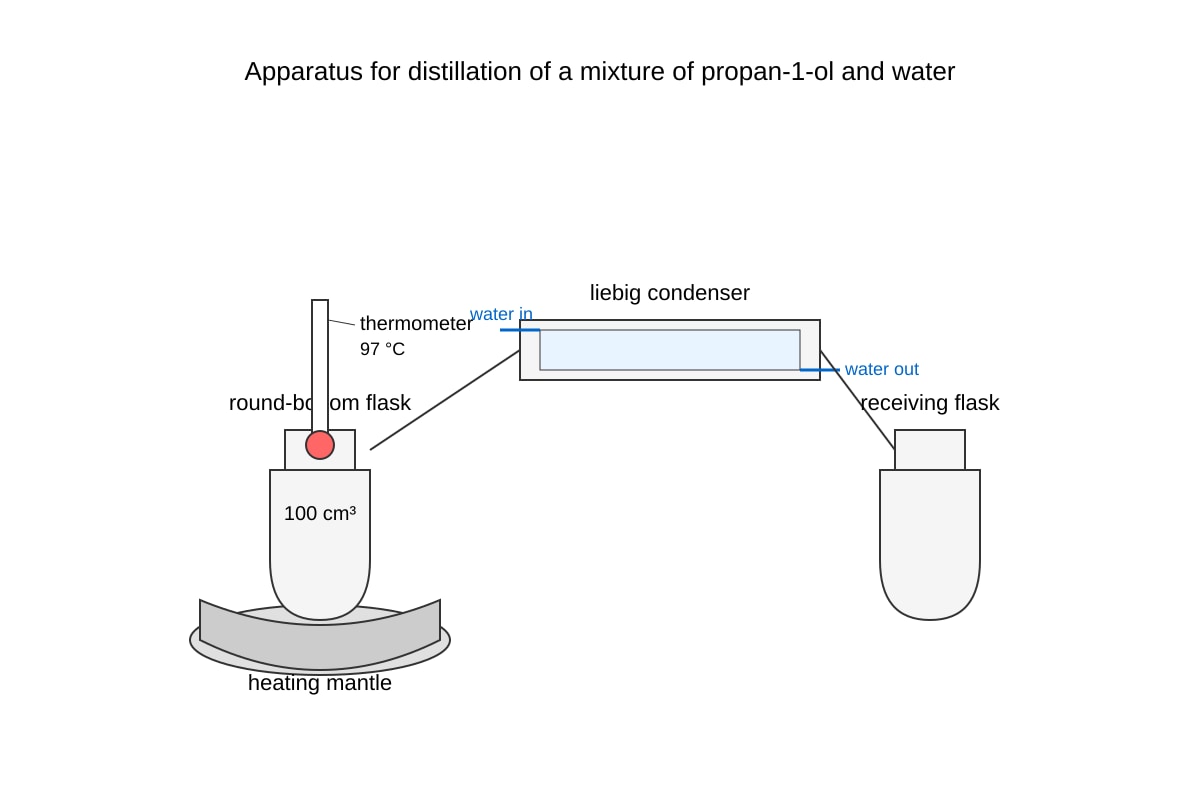
The collected fraction at 97 °C is a constant-boiling azeotrope of propan-1-ol and water, not pure alcohol (1 mark). Distillation separates by volatility; azeotrope boils at min/max (1 mark). Use: purification of liquids / separating mixtures (1 mark).
Visual: condenser water in at lower, out at upper; thermometer at neck; receiver collects 97 °C fraction.
Q12 [2 marks]
Contains aldehyde group –CHO (1 mark); Tollens' positive indicates aldehyde not ketone (1 mark).
Teaching: C₄H₈O₂ with –CHO → e.g. methyl propanoate is ester (no Tollens); so must be aldehyde-ester? Actually aldehyde + formula suggests hydroxy? But for H1, state aldehyde functional group.
Q13 [3 marks]
Carbonyl group C=O present (1 mark). Ketone (1 mark) because no O–H stretch near 3300 (would indicate carboxylic acid) and aldehyde usually shows C–H aldehydic peaks; but at 1715 with no broad OH → ketone (1 mark reason).
Q14 [2 marks]
Condensation polymerisation (1 mark); water eliminated (1 mark).
Teaching: Nylon from diacid + diamine loses H₂O at each link.
Section C: Extended Response
Q15 [3 marks]
Step 1: Ethene + Br₂ (or HOBr) → ethane-1,2-dibromide (or via epoxidation then hydrolysis). Simpler H1: ethene + Br₂ (dark) → BrCH₂CH₂Br (1 mark reagent/cond).
Step 2: hydrolysis with aqueous NaOH / heat → HOCH₂CH₂OH (1 mark).
Type: addition then nucleophilic substitution (1 mark).
Teaching: Two-step from alkene to diol.
Q16 [3 marks]
Bromoethane + NaOH(aq) → CH₃CH₂OH + Br⁻ (1 mark). Acidify removes OH⁻ interference (1 mark). Ag⁺ + Br⁻ → AgBr(s) pale yellow (1 mark).
Teaching: Halide test; AgBr pale yellow, AgCl white, AgI yellow.
Q17 [3 marks]
Thermoplastic: linear/branched chains, weak IMF, melt on heating (1 mark). Thermoset: cross-linked network, rigid (1 mark). Thermoplastics recyclable by remelting; thermosets cannot be remelted without degradation (1 mark).
Q18 [3 marks]
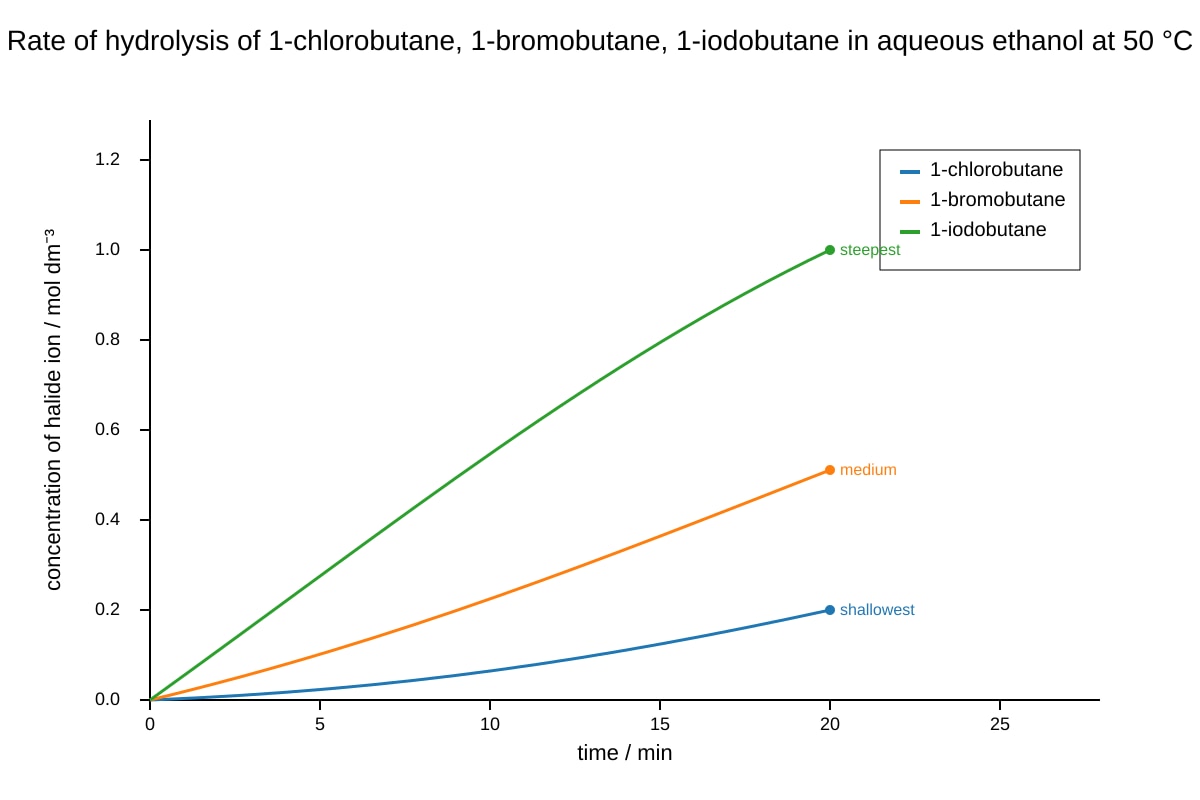
Rate: 1-iodobutane > 1-bromobutane > 1-chlorobutane (1 mark from graph). C–I bond weakest (enthalpy lowest) breaks easiest; C–Cl strongest (1 mark). Hence hydrolysis faster for I (1 mark).
Visual: curves labelled; iodide steepest.
Q19 [3 marks]
Step 1: Propene + HBr (or hydration to propan-1-ol then oxidise) → propan-1-ol (1 mark).
Step 2: Oxidise with acidified K₂Cr₂O₇ / heat → propanoic acid (1 mark).
Overall type: addition then oxidation (1 mark).
Q20 [3 marks]
Chiral centre at C2 bonded to –H, –CH₃, –C₂H₅, –OH (four different groups) (1 mark). Enantiomers are non-superimposable mirror images (1 mark). Representation: wedge/dash or stated mirror pair (1 mark).
Teaching: Chirality needs 4 distinct substituents.