AI Generated Quiz
A Level H1 Chemistry Kinetics Equilibrium Quiz
Free A Level H1 Chemistry Kinetics Equilibrium quiz, LongCat AI version, with questions, answers, and A Level-style practice for Singapore students.
These static practice materials are generated from the site's syllabus and paper-generation workflow, with source and model context shown so students and parents can evaluate the material before use.
Questions

Free quiz and exam paper access
Enter your details to view this paper
Your access is remembered on this device.
Answers
A-Level Chemistry H1 Quiz - Kinetics Equilibrium
Answer Key and Marking Scheme
Section A: Multiple Choice
1. C [1]
Explanation: The rate of reaction is defined as the change in concentration of a reactant or product per unit time. Option A is incorrect because the rate decreases as reactants are consumed. Option B is incorrect because the rate depends on reactant concentration, not product concentration. Option D is incorrect because rate increases with temperature due to more frequent and energetic collisions.
2. C [1]
Explanation: From the stoichiometry, 2 moles of decompose for every 1 mole of formed. Therefore:
The rate of disappearance is related to the rate of formation by the ratio of stoichiometric coefficients.
3. C [1]
Explanation: The rate constant depends on temperature (Arrhenius equation), activation energy, and the presence of a catalyst. However, it is independent of the concentration of reactants. Concentration affects the rate, not the rate constant. This is a common misconception — students often confuse rate (which depends on concentration) with rate constant (which depends only on temperature and catalyst).
4. A [1]
Explanation: Overall order = 1 + 2 = 3. For a third-order reaction: Units of
General rule: for an th-order reaction, units of are .
5. C [1]
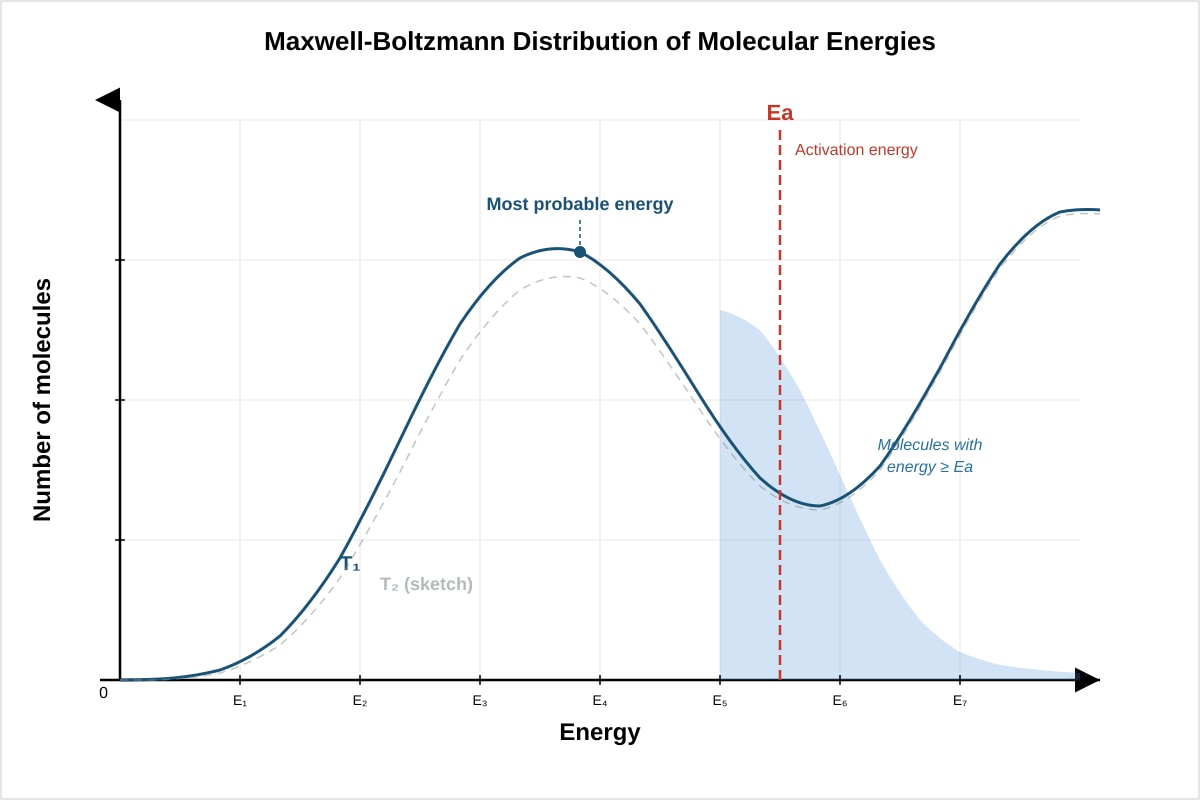
Explanation: A catalyst provides an alternative reaction pathway with a lower activation energy. This increases the proportion of molecules with energy ≥ , increasing the rate. It does NOT change the activation energy of the original pathway (A is wrong), does NOT change (B is wrong), and does NOT shift the equilibrium position (D is wrong). A catalyst speeds up both forward and reverse reactions equally.
6. C [1]
Explanation: At dynamic equilibrium, the forward and reverse reactions are still occurring, but at equal rates. The concentrations of reactants and products remain constant but are NOT necessarily equal (B is wrong). The reactions have not stopped (A is wrong) — that would be static equilibrium. Reactants are still present (D is wrong).
7. C [1]
Explanation: The reaction is exothermic ( kJ mol⁻¹). Decreasing the temperature favours the exothermic (forward) direction, producing more and increasing . is only affected by temperature — not by pressure changes (A), catalysts (B), or concentration changes (D). These other changes shift the position of equilibrium but do not change the value of .
8. A [1]
Explanation: For the general equilibrium :
Products go in the numerator, reactants in the denominator, each raised to the power of their stoichiometric coefficient. So:
9. C [1]
Explanation: , which is much less than 1. This means the denominator (reactant concentrations) is much larger than the numerator (product concentrations) at equilibrium. The equilibrium lies to the left, favouring reactants. A large (>> 1) would indicate products are favoured.
10. B [1]
Explanation: On the left side there are 2 moles of gas; on the right side there is 1 mole of gas. Increasing pressure shifts the equilibrium to the side with fewer moles of gas (to the right) to reduce the pressure. This is consistent with Le Chatelier's principle. Pressure does affect gaseous equilibria when there is a difference in the number of moles of gas on each side.
Section B: Structured Questions
11.
(a) The has been completely decomposed / used up, so no more is produced. [1]
Marking note: Accept "the reaction has gone to completion" or "all the reactant has been consumed." Do NOT accept "the reaction has reached equilibrium" — this is a decomposition, not a reversible equilibrium.
(b) Mean rate = [1] [1]
Marking note: Award 1 mark for correct method (division), 1 mark for correct answer. Accept 0.53 cm³ s⁻¹ if rounded. Unit must be stated.
(c) The graph should show: [2]
- A curve starting at the origin (0, 0)
- Steep initial gradient that gradually decreases (curve flattens)
- Passing through or near the data points (20, 12), (40, 21), (60, 28), (80, 33), (100, 36)
- Becoming horizontal at 36 cm³ after 100 s
Marking note: Award 1 mark for correct shape (curve with decreasing gradient), 1 mark for correct plateau at 36 cm³. Axes must be correctly labelled.
(d) As the reaction proceeds, the concentration of decreases. [1] This means there are fewer particles per unit volume, so the frequency of successful collisions between reactant particles decreases, resulting in a lower rate. [1]
Marking note: Must mention collision frequency or number of collisions. Must link decreasing concentration to fewer collisions. "Particles move slower" is incorrect — temperature is constant.
12.
(a) Order = 1 (first order) with respect to . [1]
Comparing experiments 1 and 2: is constant, doubles from 0.010 to 0.020, and the rate doubles from to . Since doubling the concentration doubles the rate, the order is 1. [1]
(b) Order = 1 (first order) with respect to . [1]
Comparing experiments 2 and 3: is constant, doubles from 0.020 to 0.040, and the rate doubles from to . Since doubling the concentration doubles the rate, the order is 1. [1]
(c) Rate = [1]
(d) Substituting data from experiment 1: [1]
Units: [1]
Marking note: Award 1 mark for correct calculation, 1 mark for correct units. Accept any experiment's data for substitution.
(e) Rate = [1] [1]
Marking note: Award 1 mark for correct substitution, 1 mark for correct answer. Follow through from their value if different.
13.
(a) Dynamic equilibrium is a state in a reversible reaction where the forward and reverse reactions are occurring at the same rate, [1] so the concentrations of reactants and products remain constant (but not necessarily equal). [1]
Marking note: Must mention both: (1) forward and reverse reactions still happening, (2) rates are equal / concentrations constant. "Reactions have stopped" = 0 marks.
(b)(i) The equilibrium shifts to the left (towards ). [1] Increasing temperature favours the endothermic direction. Since the forward reaction is exothermic ( kJ mol⁻¹), the reverse reaction is endothermic, so the equilibrium shifts left to absorb the added heat. [1]
Marking note: 1 mark for correct direction, 1 mark for correct explanation linking to endothermic direction and Le Chatelier's principle.
(b)(ii) The equilibrium shifts to the right (towards ). [1] There are 2 moles of gas on the left and 1 mole of gas on the right. Increasing pressure shifts the equilibrium to the side with fewer moles of gas to oppose the change. [1]
Marking note: 1 mark for correct direction, 1 mark for correct explanation mentioning fewer moles of gas on the right.
(c) The mixture becomes paler / less brown / colourless. [1] Placing the flask in an ice bath decreases the temperature. The forward reaction is exothermic, so decreasing temperature favours the forward reaction, converting brown to colourless . [1]
Marking note: 1 mark for correct observation (paler/less brown/colourless), 1 mark for correct explanation linking temperature decrease to exothermic forward direction.
14.
(a) [1]
Marking note: Products in numerator, reactants in denominator. All species are liquids but concentrations are still used for in this context.
(b)(i)
| Initial moles | 0.50 | 0.50 | 0 | 0 |
| Change in moles | −0.33 | −0.33 | +0.33 | +0.33 |
| Equilibrium moles | 0.17 | 0.17 | 0.33 | 0.33 |
[2]
Marking note: Award 1 mark for correct change in moles, 1 mark for correct equilibrium moles. All four values must be correct for full marks.
(ii) Since the volume is the same for all species, can be calculated using moles directly: [1]
has no units [1] because the number of moles of gaseous/liquid species is the same on both sides of the equation (2 moles on each side), so the units cancel out. [1]
Marking note: Award 1 mark for correct calculation, 1 mark for stating no units, 1 mark for correct justification. Accept answers in the range 3.7–3.8.
15.
(a)(i) The most probable energy is at the peak of the curve. [1]
(a)(ii) The activation energy is shown as a vertical dashed line to the right of the peak. [1]
(a)(iii) The area representing molecules with energy ≥ is the shaded area to the right of the line. [1]
Marking note: Students should label these directly on the graph. Award 1 mark for each correctly identified feature.
(b) The curve for should show: [2]
- A peak at a higher energy (shifted to the right)
- A lower peak height
- A broader distribution
- A larger area under the curve to the right of
Marking note: Award 1 mark for correct shape (broader, lower peak), 1 mark for correct position (shifted right, larger area beyond ).
(c) At a higher temperature, the curve shifts to the right and flattens. [1] This means a significantly larger proportion of molecules have energy ≥ . [1] Since the rate of reaction depends on the number of molecules with sufficient energy to react, even a small temperature increase causes a large increase in the number of successful collisions, leading to a large increase in rate. [1]
Marking note: Must mention the shift in the curve and the increase in the proportion of molecules with energy ≥ . Must link this to the rate of reaction. The key point is that the area under the curve beyond increases disproportionately with temperature.
16.
(a) Order = 2 (second order) with respect to . [1]
Comparing experiments 1 and 2: is constant, doubles from 0.010 to 0.020, and the rate increases by a factor of 4 (from to ). Since doubling the concentration increases the rate by a factor of 4 (= 2²), the order is 2. [1]
(b) Order = 1 (first order) with respect to . [1]
Comparing experiments 2 and 3: is constant, doubles from 0.010 to 0.020, and the rate doubles (from to ). Since doubling the concentration doubles the rate, the order is 1. [1]
(c) Rate = [1]
(d) Substituting data from experiment 1: [1]
Units: [1]
Marking note: Award 1 mark for correct calculation, 1 mark for correct units. Accept any experiment's data for substitution.
17.
(a) [1]
(b)(i)
| Initial moles | 1.0 | 1.0 | 0 |
| Change in moles | −0.8 | −0.8 | +1.6 |
| Equilibrium moles | 0.2 | 0.2 | 1.6 |
[2]
Marking note: Award 1 mark for correct change in moles, 1 mark for correct equilibrium moles. Since 1.6 mol of is formed, 0.8 mol of and 0.8 mol of are consumed (1:1:2 stoichiometry).
(ii) Since volume = 1.0 dm³, concentrations = moles. [2]
Marking note: Award 1 mark for correct substitution, 1 mark for correct answer. has no units since there are equal moles on both sides.
(c) decreases. [1] The forward reaction is exothermic ( kJ mol⁻¹). Increasing temperature favours the endothermic (reverse) direction, reducing the concentration of and increasing the concentrations of and , thus decreasing . [1]
Marking note: 1 mark for correct direction of change, 1 mark for correct explanation.
(d) The position of equilibrium does not change. [1] A catalyst speeds up both the forward and reverse reactions equally, so it does not affect the position of equilibrium or the value of . It only allows equilibrium to be reached faster. [1]
Marking note: 1 mark for no change, 1 mark for correct explanation. Common misconception: students think catalysts shift equilibrium.
18.
(a) Temperature: approximately 450 °C [1]; Pressure: approximately 200 atm [1]; Catalyst: iron (with possible promoters such as and ). [1]
Marking note: Award 1 mark for temperature, 1 mark for pressure. Catalyst is not required for the 2 marks but is good practice.
(b) A lower temperature would favour the forward reaction (exothermic) and give a higher equilibrium yield of . [1] However, at lower temperatures, the rate of reaction is too slow to be economically viable. [1] A compromise temperature of 450 °C gives a reasonable yield in a reasonable time. [1]
Marking note: Must mention both the equilibrium yield argument (favoured at low T) and the rate argument (too slow at low T). The concept of "compromise" is key.
(c) There are 4 moles of gas on the left (1 + 3 ) and 2 moles of gas on the right (2 ). [1] Increasing pressure shifts the equilibrium to the side with fewer moles of gas (to the right), increasing the yield of . [1]
Marking note: Must mention the difference in moles of gas and the direction of shift.
(d) The iron catalyst speeds up the rate of the reaction, allowing equilibrium to be reached more quickly. [1] It does not change the position of equilibrium or the value of .
Marking note: Must state that the catalyst increases the rate. Do NOT accept "increases yield" or "shifts equilibrium."
Section C: Free Response
19.
(a) Overall order = 2 (second order). [1]
Marking note: The rate equation shows first order with respect to and first order with respect to , so overall order = 1 + 1 = 2.
(b) The concentration of does not appear in the rate equation, which means the reaction is zero order with respect to . [1] This indicates that the step involving is not the rate-determining step — it occurs after the slow step and does not affect the overall rate. [1]
Marking note: Must state that the reaction is zero order with respect to and explain that the step is not rate-determining.
(c)(i) Rate = [1]
Units: [1]
[1]
Marking note: Award 1 mark for correct calculation, 1 mark for correct units, 1 mark for correct final answer with units.
(c)(i) Rate = [1] [1]
Marking note: Award 1 mark for correct substitution, 1 mark for correct answer. Note that is not used in the rate equation. Follow through from their value if different.
(d) The mechanism is consistent with the rate equation. [1] The rate-determining step (Step 2) involves the intermediate , which is formed from and in Step 1. [1] Since Step 1 is a fast equilibrium, the concentration of the intermediate depends on and , giving a rate equation of the form Rate = . [1] Step 3 involves but is fast, so does not appear in the rate equation, consistent with the experimental observation.
Marking note: Award 1 mark for stating consistency, 1 mark for identifying the rate-determining step, 1 mark for explaining how the rate equation arises from the mechanism. The key is linking the slow step to the rate equation.
20.
(a) [1]
(b) is a very large value (>> 1). [1] This indicates that at equilibrium, the concentration of products () is much greater than the concentration of reactants ( and ). The equilibrium lies far to the right, and the reaction proceeds almost to completion. [1]
Marking note: Must state that the large value indicates products are favoured / equilibrium lies to the right.
(c)(i)
| Initial moles | 2.0 | 1.0 | 0 |
| Change in moles | −1.8 | −0.9 | +1.8 |
| Equilibrium moles | 0.2 | 0.1 | 1.8 |
[2]
Marking note: From stoichiometry, 1.8 mol formed requires 1.8 mol and 0.9 mol consumed (2:1:2 ratio).
(ii) Since volume = 1.0 dm³, concentrations = moles. [1]
The calculated (810) is much smaller than the literature value (). [1] This suggests that the reaction had not yet reached equilibrium, or there may be experimental errors in the measurements. [1]
Marking note: Award 1 mark for correct calculation, 1 mark for noting the discrepancy, 1 mark for a valid explanation (not at equilibrium / experimental error).
(d)(i) The equilibrium shifts to the left (towards and ). [1] The forward reaction is exothermic ( kJ mol⁻¹). Increasing temperature favours the endothermic (reverse) direction to absorb the added heat. [1]
Marking note: 1 mark for correct direction, 1 mark for correct explanation.
(d)(ii) The position of equilibrium does not change. [1] A catalyst speeds up both the forward and reverse reactions equally, so it does not affect the position of equilibrium. It only allows equilibrium to be reached faster. [1]
Marking note: 1 mark for no change, 1 mark for correct explanation.
(e) A pressure of 2 atm is a compromise. [1] Higher pressure would favour the forward reaction (fewer moles of gas on the right: 2 vs 3), increasing the yield of . However, the equilibrium already lies far to the right at 700 K (very large ), so the yield is already high even at moderate pressure. Using very high pressure would be expensive and dangerous, with only a marginal increase in yield. [1]
Marking note: Must mention the cost/safety argument and the fact that the yield is already high due to the large . The concept of "compromise" between yield and cost is key.
END OF ANSWER KEY