AI Generated Quiz
A Level H1 Chemistry Kinetics Equilibrium Quiz
Free A Level H1 Chemistry Kinetics Equilibrium quiz, HY3 AI version, with questions, answers, and A Level-style practice for Singapore students.
These static practice materials are generated from the site's syllabus and paper-generation workflow, with source and model context shown so students and parents can evaluate the material before use.
Questions
Free quiz and exam paper access
Enter your details to view this paper
Your access is remembered on this device.
Answers
A-Level Chemistry H1 Quiz - Kinetics Equilibrium (Answer Key)
Total Marks: 40
Topic: Kinetics & Equilibrium (syllabus-first; complements Stage 3 patterns, not past-year derived)
Section A
1. [1 mark]
Rate of reaction is the change in concentration of a reactant or product per unit time.
Teaching note: Usually expressed as mol dm⁻³ s⁻¹. It measures how fast reactants are used up or products formed.
2. [1 mark]
rate = k[NO]¹[O₂]² or rate = k[NO][O₂]²
Teaching note: Order with respect to NO is 1, O₂ is 2; overall order = 3.
3. [2 marks]
Dynamic equilibrium is the state in a reversible reaction where:
- the forward and reverse reactions occur at equal rates, and
- the concentrations of reactants and products remain constant.
Marking: 1 mark for equal rates, 1 mark for constant concentrations.
4. [1 mark]
K_c = [NH₃]² / ([N₂][H₂]³)
Teaching note: Products over reactants, each raised to its stoichiometric coefficient.
5. [1 mark]
12.0 minutes.
Reasoning: One-eighth = (1/2)³, so 3 half-lives. 3 × 4.0 = 12.0 min.
6. [1 mark]
Le Chatelier’s Principle: If a system at equilibrium is subjected to a change in concentration, pressure, or temperature, the equilibrium shifts to oppose the change.
7. [2 marks]
- Increasing temperature gives particles more kinetic energy.
- A greater fraction of collisions exceed the activation energy (
E_a), so more successful collisions per unit time.
Marking: 1 mark each point.
8. [2 marks]
- Activation energy is lowered (1 mark).
- Position of equilibrium is unchanged (1 mark); catalyst speeds up both forward and reverse equally.
9. [1 mark]
Equilibrium yield of B decreases.
Reasoning: Exothermic forward; heat is product, so increasing T shifts left.
10. [1 mark]
First order.
Teaching note: Unit s⁻¹ indicates order 1 (zero order: mol dm⁻³ s⁻¹; second: dm³ mol⁻¹ s⁻¹).
Section B
11. [2 marks]
- Order w.r.t X: compare Exp 1→2: [X] doubles, rate doubles → first order (1 mark).
- Order w.r.t Y: Exp 1→3: [Y] doubles, rate quadruples → second order (1 mark).
12. [3 marks]
Rate equation: rate = k[X][Y]²
Using Exp 1: 0.020 = k(0.10)(0.10)² = k(0.001)
k = 0.020 / 0.001 = 20.0 dm⁶ mol⁻² s⁻¹
Marking: 1 for equation, 1 for substitution, 1 for answer + unit.
13. [2 marks]
K_c = [HI]² / ([H₂][I₂]) = (0.80)² / (0.20 × 0.20) = 0.64 / 0.04 = 16.0
Marking: 1 for correct expression use, 1 for final value (no unit as Δn=0).
14. [1 mark]
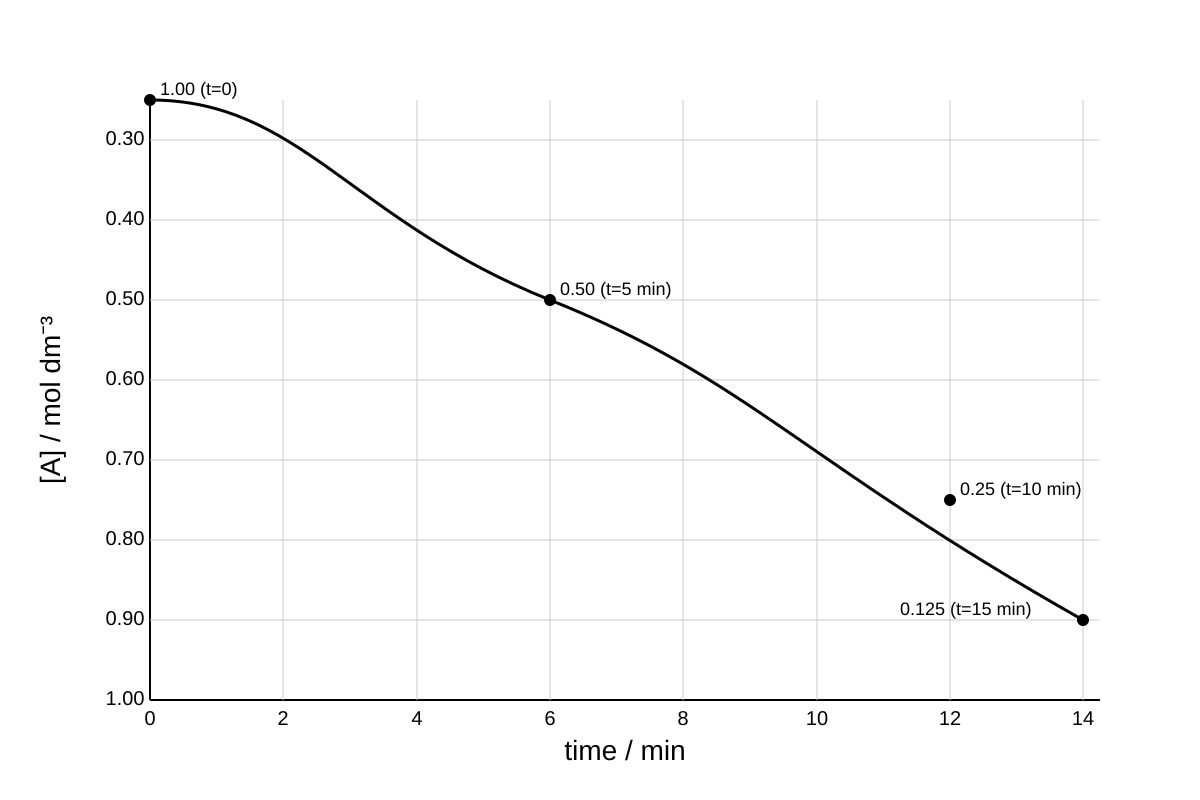
Half-life = 5.0 min (from 1.00→0.50).
Visual check: Graph shows decay to half at t=5.
15. [2 marks]
- Lower
E_ameans more molecules have energy ≥E_a(1 mark). - Larger fraction of successful collisions on Boltzmann curve (1 mark).
Section C
16. [3 marks total]
(a) [1] Equilibrium shifts to the right (towards SO₃).
(b) [2] There are fewer moles of gas on the right (3 mol → 2 mol). Increased pressure favours side with fewer gas moles to reduce pressure.
17. [3 marks]
- Enzymes are proteins with specific 3D shape (1).
- High T denatures enzyme, breaking H-bonds/ionic bonds (1).
- Active site lost, substrate cannot bind, rate falls (1).
18. [3 marks total]
(a) [1] K_c increases.
(b) [2] Endothermic forward; increasing T adds heat, shifts right to absorb heat, more products, K_c larger.
19. [3 marks]
Statement is false (1). Catalyst lowers E_a equally for fwd/rev (1). It speeds attainment of equilibrium but does not change equilibrium composition/yield (1).
20. [3 marks total]
(a) [1] Higher T increases kinetic energy of molecules.
(b) [2] More molecules exceed E_a per Boltzmann distribution; frequency of successful collisions rises, so k increases.